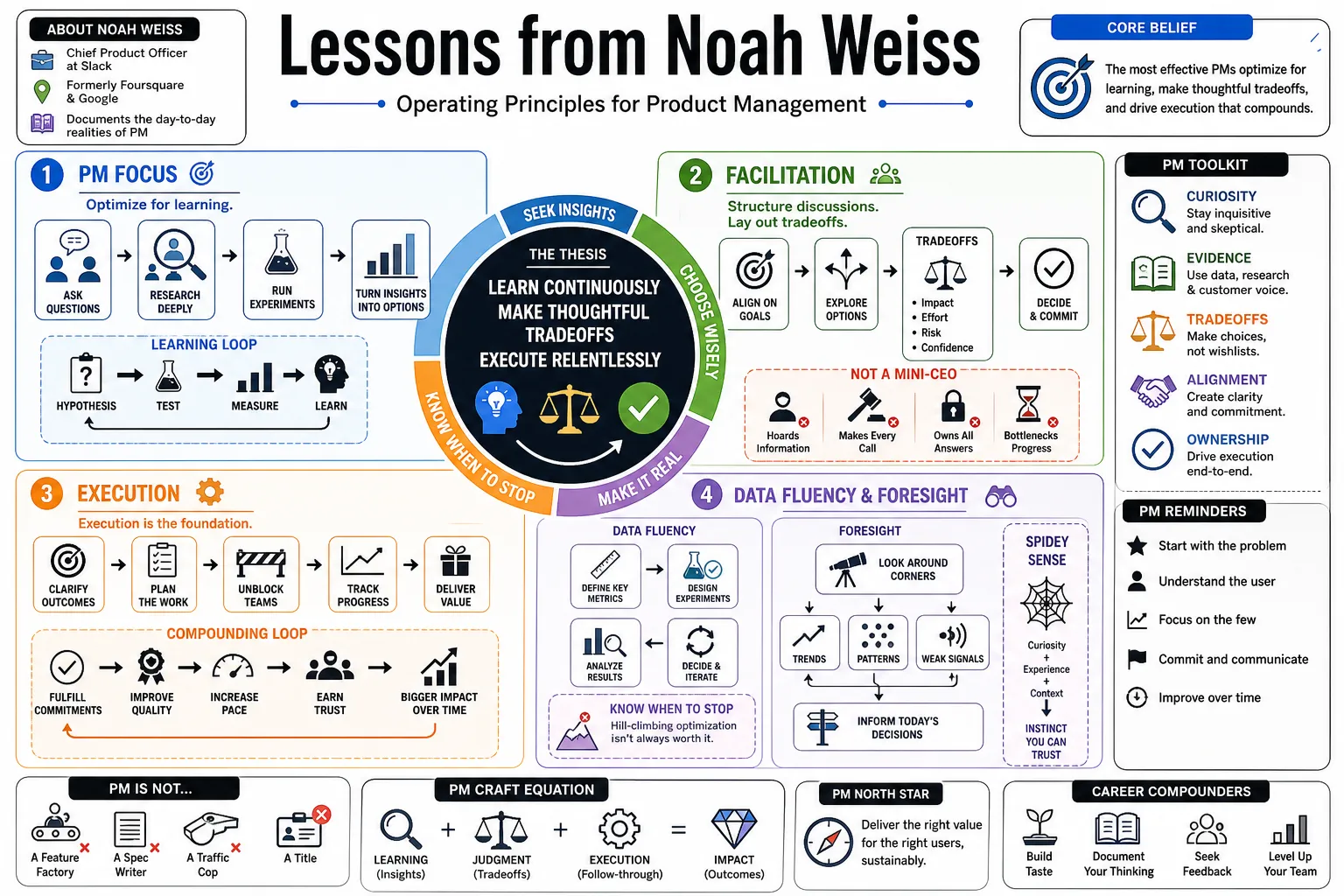
Noah Weiss currently serves as the Chief Product Officer at Slack, having previously led product teams at Foursquare and Google. He is known for documenting the day-to-day realities of product management, specifically regarding resource allocation, balancing intuition with data, and dismantling the myth of the PM as a mini-CEO. This profile compiles his operating principles and frameworks to provide a practical reference for those building software.
Part 1: The Product Management Craft
- On PM Focus: "The most effective PMs optimize for learning, vigorously seeking insights through research and experiments." — Source: [10 Traits of Great PMs]
- On Facilitation: "Great PMs structure discussions and lay out well-researched tradeoffs rather than acting as mini-CEOs who make every call themselves." — Source: [Five Dangerous Myths about Product Management]
- On Execution: "Execution is the foundation; PMs must ensure follow-through on commitments so that quality and pace improve over time." — Source: [10 Traits of Great PMs]
- On Data Fluency: "A strong PM knows how to define key metrics and analyze experiments, but also recognizes when hill-climbing optimization is no longer worth the effort." — Source: [10 Traits of Great PMs]
- On Foresight: "The best product managers develop a spidey sense to look around corners and prepare for potential downstream issues before they happen." — Source: [10 Traits of Great PMs]
- On Apprenticeship: "Product management is not an academic subject but a discipline learned primarily through apprenticeship and hands-on reps." — Source: [Five Dangerous Myths about Product Management]
- On High Standards: "It is necessary to maintain a consistently high bar for all output, setting a standard that elevates the rest of the cross-functional team." — Source: [10 Traits of Great PMs]
- On Saving Capital: "PMs should generally avoid just making the call unless absolutely required, as doing so consumes hard-earned organizational capital." — Source: [10 Traits of Great PMs]
- On Asking Better Questions: "A common unofficial role of senior product leaders is serving as the Chief Question Officer, asking better questions rather than just providing answers." — Source: [First Round Review]
- On Shared Context: "Great PMs build trust by establishing a clear, shared context that empowers others to do their best work." — Source: [Five Dangerous Myths about Product Management]
Part 2: Debunking PM Myths
- On The CEO Fallacy: "The idea that PMs are mini CEOs is a pernicious trap because PMs lack direct management authority and formal decision-making power." — Source: [Five Dangerous Myths about Product Management]
- On Idea Generation: "PMs do not have to be the sole idea generators; churning out concepts can distract from execution and stifle the creativity of the rest of the team." — Source: [Five Dangerous Myths about Product Management]
- On Dictatorship: "Acting like a dictator rather than a servant leader can rapidly lead to team organ rejection of the product manager." — Source: [Five Dangerous Myths about Product Management]
- On Making Decisions: "While PMs are responsible for the pace and quality of decisions, they should act as ultimate facilitators pulling the best ideas from cross-functional partners." — Source: [Five Dangerous Myths about Product Management]
- On Politics: "Great PMs serve as an antidote to startup politics by maintaining shared alignment and vision among disparate groups." — Source: [Five Dangerous Myths about Product Management]
- On Authority: "You cannot rely on founder-level credibility to push things through; you must earn influence through consistency and empathy." — Source: [Five Dangerous Myths about Product Management]
- On Credit: "A strong PM absorbs the blame when things go wrong and gives away the credit when things go right." — Source: [Five Dangerous Myths about Product Management]
- On Solitary Genius: "The myth of the lone product visionary is damaging; real product breakthroughs come from highly collaborative, cross-functional iteration." — Source: [Lenny's Podcast]
- On The PM Pedestal: "Putting the product manager on a pedestal minimizes the necessary contributions of engineering, design, and user research." — Source: [Five Dangerous Myths about Product Management]
Part 3: Decision-Making and Risk
- On The Role of Data: "Data is excellent for solving easy, incremental problems, but it often falls short on hard or novel problems where you cannot simply experiment your way to a solution." — Source: [First Round Review]
- On Two-Way Doors: "For reversible decisions, teams should move quickly to maintain momentum rather than deliberating endlessly." — Source: [First Round Review]
- On One-Way Doors: "Irreversible, high-stakes decisions require significant deliberation and upfront alignment before committing." — Source: [First Round Review]
- On Pace vs. Quality: "A leader's primary job is to facilitate the pace and quality of decision-making rather than bottlenecking the process by making every decision themselves." — Source: [First Round Review]
- On Post-Mortems: "Blameless post-mortems shift the focus from individual failure to organizational learning, creating a safer environment for bolder risks." — Source: [First Round Review]
- On Bold Bets: "If a planning process leaves a team wondering if they put too many resources behind a bet, that is often the sign of a project with real potential to succeed." — Source: [First Round Review]
- On Decision Frameworks: "Having explicit frameworks for how decisions are made prevents relitigating the same arguments over and over." — Source: [Lenny's Podcast]
- On The Trap of A/B Testing: "Relying purely on A/B testing can lead to a local maximum; sometimes you have to rely on intuition to take a leap to a new curve." — Source: [20VC Podcast]
- On Transparent Trade-offs: "Every product decision has a cost; making those trade-offs transparent to the whole team builds enduring trust." — Source: [10 Traits of Great PMs]
- On Fear of Failure: "A culture that punishes thoughtful failure will inevitably stop taking the big swings required for long-term survival." — Source: [First Round Review]
Part 4: Cultivating Product Taste
- On Intuition: "Taste and judgment are learnable skills; companies should look for ways to scale intuition across the product organization rather than relying solely on metrics." — Source: [First Round Review]
- On Applying Taste: "Product taste is the ability to balance high quality with scope and time constraints to deliver something that feels cohesive." — Source: [10 Traits of Great PMs]
- On Over-reliance on Data: "Intuition is often required for bold, innovative leaps where historical data is simply unavailable." — Source: [Lenny's Podcast]
- On Design Critiques: "Product managers must have a firm perspective and be able to defend their opinions constructively in design critiques." — Source: [Bring the Donuts]
- On Craft: "Even when scaling to enterprise, a product must never lose the craft and frictionless experience that made users love it initially." — Source: [20VC Podcast]
- On The Feel of a Product: "Software should feel responsive and alive; small micro-interactions build a sense of quality that numbers struggle to capture." — Source: [Lenny's Podcast]
- On Developing Taste: "You develop product taste by exposing yourself to excellent products outside your own industry and deconstructing why they work." — Source: [Lenny's Podcast]
- On User Empathy: "Empathy is about translating the underlying friction into elegant solutions rather than blindly acting on complaints." — Source: [First Round Review]
- On Simplicity: "Maintaining simplicity as a product scales is one of the hardest acts of product management, requiring rigorous taste to say no." — Source: [First Round Review]
Part 5: Resource Allocation and Time Management
- On The 70/20/10 Rule: "Manage your time like Google invests its resources: 70% on core tasks, 20% on near-term opportunities, and 10% on future moonshots." — Source: [Manage Your Time Like Google Invests its Resources]
- On The Core 70%: "The majority of your time must go toward the immediate execution of your current responsibilities; if the present fails, the future does not matter." — Source: [Manage Your Time Like Google Invests its Resources]
- On Living in the Future: "You need to spend at least 30% of your time living in the future to ensure ongoing growth and innovation." — Source: [Manage Your Time Like Google Invests its Resources]
- On Consistent Innovation: "Consistency in allocation avoids lumpy progress, where a team oscillates wildly between maintenance mode and panicked innovation." — Source: [Practica HQ Analysis]
- On The 10% Moonshot: "Reserving 10% for experimental ideas gives you permission to explore wild concepts without derailing the main roadmap." — Source: [Manage Your Time Like Google Invests its Resources]
- On Discovering the Next 20%: "By observing the friction points in your short-term work, you can often uncover clues for what your near-term 20% projects should be." — Source: [Manage Your Time Like Google Invests its Resources]
- On Roadmaps: "Organizing work into simple time-based buckets like Now, Next, Later prevents the roadmap from feeling like an uninspiring list of drudgery." — Source: [Practica HQ Analysis]
- On Saying No: "Proper resource allocation inherently means saying no to good ideas so you have the capacity to execute on the great ones." — Source: [First Round Review]
- On Audit Traps: "Periodically audit your calendar; if you find you are spending 100% of your time on current problems, you are neglecting your product's future." — Source: [Manage Your Time Like Google Invests its Resources]
Part 6: Building and Scaling Product Teams
- On Hiring Generalists: "When building early product teams, prioritize PM generalists who can adapt to rapidly changing business needs." — Source: [Bring the Donuts]
- On Team Vibe: "A team's vibe and cultural alignment is a massive driver of effective decision-making and product velocity." — Source: [Lenny's Podcast]
- On Interviewing: "When interviewing, dig for self-awareness; the best PMs know exactly where they are weak and how they compensate for it." — Source: [Lenny's Newsletter]
- On Psychological Safety: "To get a team to take big swings, you must establish psychological safety where people are comfortable proposing ideas that fail." — Source: [First Round Review]
- On Complaint Storms: "Harnessing internal complaint storms can foster deep empathy and urgency, keeping the team grounded in the actual user experience." — Source: [Lenny's Podcast]
- On Managing PMs: "Managing product managers requires coaching them on judgment and influence, instead of just reviewing their feature specs." — Source: [First Round Review]
- On Working with Founders: "When working with opinionated founders, a PM must learn to translate founder intuition into testable product hypotheses." — Source: [Lenny's Podcast]
- On Scaling Empathy: "As an organization scales, maintaining proximity to the customer becomes a deliberate structural choice rather than an organic byproduct." — Source: [First Round Review]
- On Cross-Functional Trust: "The speed of a product team is directly proportional to the trust between product, engineering, and design." — Source: [10 Traits of Great PMs]
- On Performance Reviews: "Evaluate PMs on the quality of the process and the collateral impact on team morale, rather than just looking at what shipped." — Source: [First Round Review]
Part 7: Product-Led Growth and Strategy
- On Product Speed: "Product speed is a compounding advantage; moving faster allows you to iterate and discover the right path before competitors do." — Source: [20VC Podcast]
- On SMB to Enterprise: "When scaling from self-serve SMBs to large enterprises, you have to build administrative control without degrading the end-user delight." — Source: [20VC Podcast]
- On Product Principles: "Product principles must be specific enough to be disagreed with; generic platitudes do nothing to resolve real trade-offs." — Source: [Refound Analysis]
- On Frictionless Experience: "A product-led growth motion relies entirely on a frictionless initial experience that gets the user to value almost immediately." — Source: [20VC Podcast]
- On Push Notifications: "Savvy push notifications should be treated as an extension of the product experience, avoiding the urge to use them as a marketing channel to blast users." — Source: [First Round Review]
- On Strategic Roadmaps: "A good strategy forces painful choices; if your roadmap includes every stakeholder's pet project, you do not have a strategy." — Source: [First Round Review]
- On Customer Obsession: "You want to be deeply customer-aware and informed, but pure customer-obsession can sometimes blind you to paradigm-shifting innovations." — Source: [Lenny's Podcast]
- On PLG Fundamentals: "Product-led growth is an organizational commitment to making the product its own best salesperson." — Source: [20VC Podcast]
- On Enterprise Debt: "Avoid taking on enterprise debt by building custom, one-off features for a single large customer that clutter the core experience for everyone else." — Source: [20VC Podcast]
Part 8: AI, The Future, and The "Chief Question Officer"
- On AI Implementation: "With AI, the UI promise must match the underlying quality of the models; overpromising an experience the AI cannot deliver destroys trust." — Source: [Lenny's Podcast]
- On AI Utility: "The best AI features feel like a seamless enhancement of a workflow the user was already trying to accomplish." — Source: [Lenny's Podcast]
- On The Chief Question Officer: "Rather than just providing answers, the most senior product leaders act as Chief Question Officers, probing and guiding teams to uncover better solutions." — Source: [First Round Review]
- On Asking Why: "When a team presents a roadmap, a leader's most powerful tool is simply asking why repeatedly until the foundational assumptions are exposed." — Source: [First Round Review]
- On Machine Learning in Products: "Machine learning should be used to reduce cognitive load for the user, surfacing what matters most before they have to search for it." — Source: [First Round Review]
- On Adapting to AI: "Product managers must become fluent in the capabilities and limitations of AI, treating it as a new core material for building software." — Source: [Lenny's Podcast]
- On Product Leadership: "Your title does not make you a leader; your ability to clarify ambiguity and bring order to chaos is what makes people want to follow you." — Source: [Five Dangerous Myths about Product Management]
- On Context over Control: "Lead with context, not control. If the team understands the overarching strategy, they will make the right micro-decisions on their own." — Source: [First Round Review]
- On The Long Game: "True product leadership is about building a system and a culture that can repeatedly produce great products long after you are gone." — Source: [First Round Review]