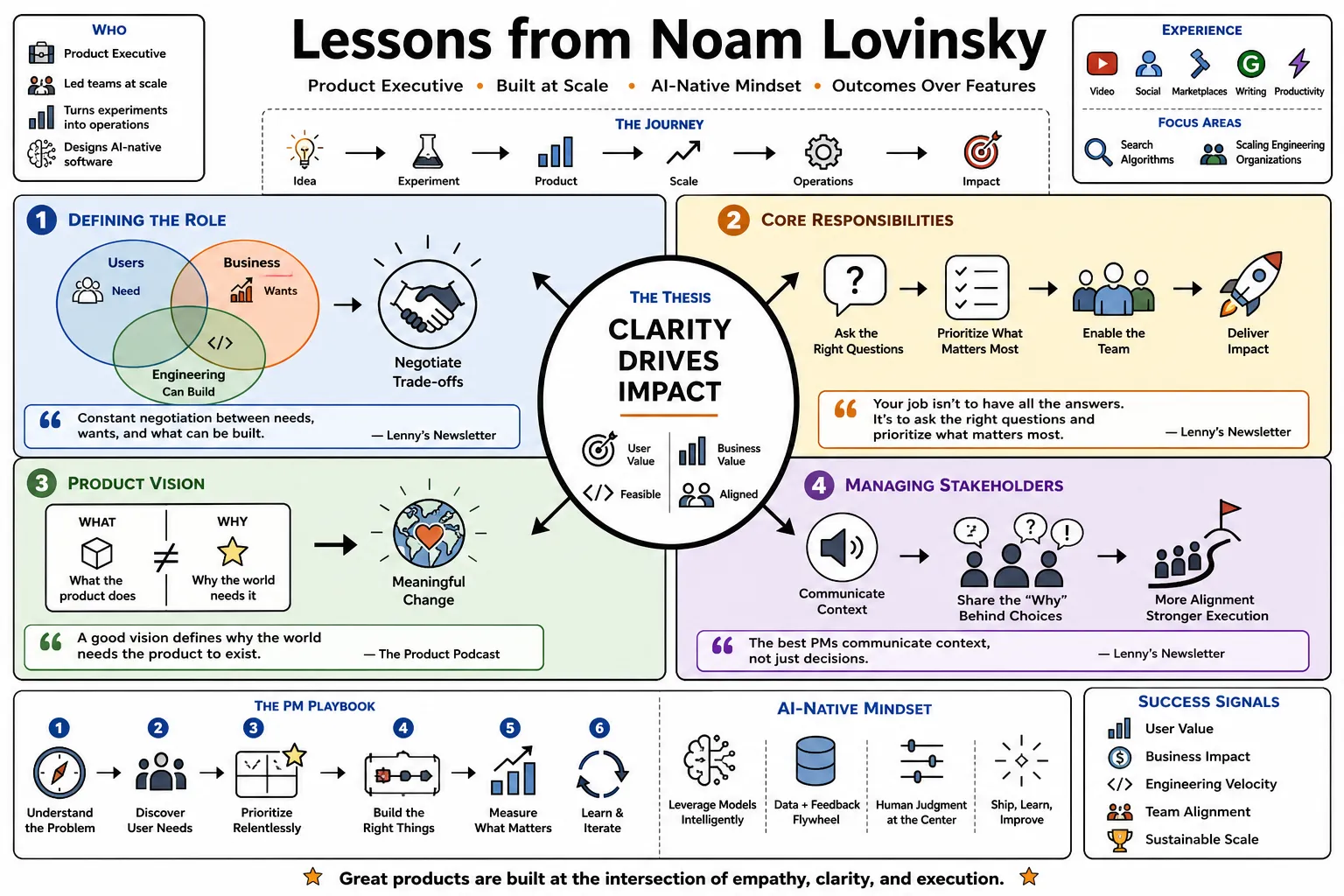
Lessons from Noam Lovinsky
Noam Lovinsky is a product executive who has led teams at YouTube, Facebook, Thumbtack, Grammarly, and Superhuman. He is known for turning early experiments into large-scale operations and designing AI-native software. This collection gathers his notes on building search algorithms and scaling engineering organizations, all grounded in the daily realities of product management.
Part 1: The Craft of Product Management
- On Defining the Role: "Product management often feels like a constant negotiation between what users need, what the business wants, and what engineering can actually build in a given timeframe." — Source: Lenny's Newsletter
- On Core Responsibilities: "Your job isn't to have all the answers. Your job is to make sure the team is asking the right questions and prioritizing the ones that matter most." — Source: Lenny's Newsletter
- On Product Vision: "A good product vision doesn't just describe what the product will do; it clearly defines why the world needs it to exist." — Source: The Product Podcast
- On Managing Stakeholders: "The best PMs communicate context, not just decisions. If people understand the 'why' behind a roadmap choice, they are much more likely to support it even if they disagree with the outcome." — Source: Lenny's Newsletter
- On Saying No: "You have to get comfortable with disappointing people. Prioritization inherently means telling smart people that their good ideas are not going to get funded right now." — Source: The Product Podcast
- On Execution: "Strategy is necessary, but execution is what ships. If you spend too much time agonizing over the perfect plan, you lose the opportunity to learn from real user feedback." — Source: Lenny's Newsletter
- On Metrics: "Metrics are proxies for user value, not the value itself. If you optimize blindly for a metric without understanding the underlying user behavior, you will build a worse product." — Source: Product Management AI
- On PM Superpowers: "Empathy is the most underrated skill in product management. If you can deeply understand both your users and your engineers, you can solve almost any misalignment." — Source: Lenny's Newsletter
- On Scope Creep: "Every feature you add increases the cognitive load on the user. We have to ruthlessly protect the simplicity of the core experience." — Source: The Product Podcast
- On Daily Work: "A lot of product management is just unblocking people and making sure the trains run on time. It's not always glamorous, but it is entirely necessary." — Source: Lenny's Newsletter
Part 2: Artificial Intelligence & AI-Native Products
- On the AI Transition: "Moving from a traditional product to an AI-native one requires fundamentally rethinking how you deliver value, not just bolting a chatbot onto an existing interface." — Source: The Twenty Minute VC
- On AI Utility: "The best AI features disappear into the workflow. Users shouldn't feel like they are 'using AI'; they should just feel like they are working faster and better." — Source: Grammarly Engineering
- On Trust in AI: "If an AI model hallucinates or makes a mistake, you lose user trust instantly. Building in mechanisms for users to verify AI outputs is as important as the outputs themselves." — Source: The Twenty Minute VC
- On Vibe Coding: "The shift toward AI-assisted development means product managers need to become highly proficient at prompt engineering and understanding the boundaries of what current models can do." — Source: Metacast
- On AI Prototyping: "You can now prototype ideas in days that used to take months. The bottleneck is no longer engineering capacity, but rather the quality of our ideas and our speed of validation." — Source: The Twenty Minute VC
- On Managing AI Expectations: "It is easy to get caught up in the hype. Product leaders have to ground their teams in what the technology can actually deliver today, not just what the research papers promise for tomorrow." — Source: Forbes
- On User Control: "Even in highly automated AI workflows, users need a sense of agency. Giving them the ability to steer or correct the AI is critical for long-term retention." — Source: Grammarly Engineering
- On AI Data Flywheels: "The moat for an AI startup isn't the model itself; it's the proprietary data you gather from user interactions to fine-tune that model for a specific use case." — Source: The Twenty Minute VC
- On Evaluating AI Use Cases: "We always ask: does this AI feature actually solve a high-frequency pain point, or is it just a novel parlor trick that people will try once and abandon?" — Source: Forbes
- On Future AI Interfaces: "We are moving away from point-and-click interfaces towards intent-based computing, where the user declares what they want and the system figures out how to execute it." — Source: The Twenty Minute VC
Part 3: Zero-to-One Product Development
- On Experimentation: "In a zero-to-one environment, your primary goal is learning, not revenue. Every experiment should be designed to validate or invalidate a specific assumption about human behavior." — Source: Lenny's Newsletter
- On New Product Teams: "The team that builds a zero-to-one product usually has a very different DNA than the team that scales it. You need generalists who are comfortable with high ambiguity." — Source: Lenny's Newsletter
- On Finding Signal: "When you are searching for product-market fit, you are looking for an emotional reaction from the user. If they aren't complaining when you take the prototype away, you haven't found it yet." — Source: The Product Podcast
- On Failing Fast: "Most new product ideas will fail. The structural advantage of an experimentation team is the ability to kill bad ideas quickly without damaging the morale of the broader company." — Source: Lenny's Newsletter
- On Internal Incubators: "Corporate incubators often fail because they are held to the same metrics as mature products. You have to evaluate new bets based on the rate of learning, not immediate ROI." — Source: Product Management AI
- On Building MVPs: "An MVP should be embarrassingly bare-bones. If you aren't slightly ashamed of the first version you put in front of users, you spent too long building it." — Source: The Product Podcast
- On User Interviews in 0-to-1: "Don't ask users what they want. Ask them to walk you through how they currently solve the problem. The friction in their current workflow is where your product opportunity lies." — Source: Lenny's Newsletter
- On Pivot vs. Persevere: "Deciding when to pivot is the hardest call in zero-to-one. You have to look objectively at whether the friction is in the distribution, the product execution, or the core premise itself." — Source: The Product Podcast
- On Protecting New Ideas: "Early-stage ideas are fragile. If you expose them to the broader organization's antibodies too soon, they will get crushed by the demand for immediate scale." — Source: Lenny's Newsletter
- On the Role of Luck: "You can do everything right in zero-to-one and still fail because of market timing. Acknowledging the role of luck helps teams process failure and move on to the next bet." — Source: Product Management AI
Part 4: Growth, Scaling, and Expansion
- On Scaling Challenges: "The processes that helped you find product-market fit will actively break your company when you try to scale. You have to intentionally rewrite your operating system as you grow." — Source: The Product Podcast
- On Growth through Acquisition: "When acquiring a product, you are mostly acquiring the team and their specific knowledge of a problem space. If you crush their autonomy, you destroy the value of the acquisition." — Source: The Product Podcast
- On Organic Growth: "Sustainable growth comes from building a core product loop that naturally encourages users to invite others, not from spending endlessly on paid acquisition." — Source: Forbes
- On Feature Expansion: "As you expand, there is immense pressure to add features for enterprise clients. You have to balance those requests against the need to keep the core product accessible for new users." — Source: Superhuman Blog
- On Organizational Design: "Conway's Law is real. Your product will inevitably reflect the communication structures of your org chart. If you want a seamless product, you need a highly aligned organization." — Source: The Product Podcast
- On Managing Debt: "Scaling inevitably creates technical and product debt. You have to dedicate a fixed percentage of your engineering capacity to paying that debt down, or the whole system grinds to a halt." — Source: Lenny's Newsletter
- On Performance as a Feature: "Speed is a feature. When you are scaling, maintaining a sub-100 millisecond interaction time often drives more retention than launching a new capability." — Source: Superhuman Blog
- On International Expansion: "Localization is not just translation. It requires adapting the product logic to fit the cultural context and payment habits of entirely different markets." — Source: The Product Podcast
- On Retaining Talent During Growth: "As the company scales, early employees often feel disconnected. You have to actively create new, ambiguous challenges to keep your zero-to-one builders engaged." — Source: Lenny's Newsletter
Part 5: User Experience and Empathy
- On Understanding the User: "We often mistake knowing demographic data for having user empathy. Empathy means understanding the anxiety a user feels right before they click a submit button." — Source: Lenny's Newsletter
- On Friction in Design: "Not all friction is bad. Sometimes you want to introduce deliberate friction to force the user to double-check a destructive action or pay attention to a key choice." — Source: Superhuman Blog
- On the Cost of Complexity: "Every setting you add to a preferences menu is a failure to make a strong product decision on behalf of the user." — Source: The Product Podcast
- On Onboarding: "The onboarding experience is your one chance to prove to the user that your product is worth their time. If they don't experience a magic moment in the first five minutes, they will churn." — Source: Superhuman Blog
- On Listening to Feedback: "Users are incredibly good at identifying problems, but they are often terrible at proposing the right solutions. Listen to their pain, but design your own fixes." — Source: Lenny's Newsletter
- On Keyboard Shortcuts: "For power users, moving their hand from the keyboard to the mouse is a context switch. Designing deep, keyboard-driven workflows is essential for professional tools." — Source: Superhuman Blog
- On Delight: "Micro-interactions matter. The subtle animation when a task is completed doesn't change the functionality, but it drastically changes how the user feels about the software." — Source: Superhuman Blog
- On Accessibility: "Building for accessibility forces you to clarify your product's core hierarchy. When you design for screen readers, you inevitably create a more logical interface for everyone." — Source: The Product Podcast
- On Continuous Research: "Product empathy decays over time. If you aren't talking to actual users every single week, your mental model of the customer is slowly becoming obsolete." — Source: Lenny's Newsletter
Part 6: Building and Leading Teams
- On Hiring PMs: "I look for people who have a high tolerance for ambiguity and a low ego. The worst PMs are the ones who think their job is to dictate orders to engineering." — Source: Lenny's Newsletter
- On Cross-Functional Trust: "Trust between product and engineering is the leading indicator of a team's velocity. When trust breaks down, every decision requires a meeting, and velocity drops to zero." — Source: The Product Podcast
- On Giving Feedback: "The kindest thing you can do for a product manager is to tell them exactly where their reasoning is flawed. Unclear feedback is just a recipe for future failure." — Source: Lenny's Newsletter
- On Team Autonomy: "If you want teams to move fast, you have to push decision-making power down to the edges of the organization. Leadership should provide the context, not the commands." — Source: The Twenty Minute VC
- On Managing Burnout: "Product managers are highly susceptible to burnout because the work is never truly done. As a leader, you have to force your teams to disconnect and celebrate milestones." — Source: Lenny's Newsletter
- On Diversity of Thought: "If everyone on your product team comes from the same three computer science programs, you are going to have massive blind spots in how you view the market." — Source: The Product Podcast
- On the Role of the CPO: "The Chief Product Officer shouldn't be making every product decision. The CPO's job is to build the machine that makes excellent product decisions consistently." — Source: Metacast
- On Remote Work: "Building culture in a remote product team requires explicit, documented rituals. You can't rely on hallway conversations to ensure everyone is aligned on the strategy." — Source: Superhuman Blog
- On Celebrating Failure: "If you only celebrate successful launches, your team will stop taking risks. You have to publicly reward the teams that run rigorous experiments, even when the hypothesis is disproven." — Source: Lenny's Newsletter
Part 7: Search, Discovery, and Personalization
- On Search and Discovery: At YouTube, Lovinsky led product teams for search, discovery, personalization, recommendations, and viewer-facing features, putting search intent and discovery at the center of his product remit. — Reference: Forbes Technology Council profile of Noam Lovinsky
- On Recommendation Scope: His YouTube remit included personalization and recommendations across viewer-facing surfaces, making recommendations a central product responsibility rather than a hidden back-end detail. — Reference: Forbes Technology Council profile of Noam Lovinsky
- On the Cold Start Problem: "Personalization requires data, but new users have no history. You have to design clever onboarding flows that explicitly ask for preferences to bridge that initial gap." — Source: Product Management AI
- On Team-First Decisions: Lenny’s episode notes frame Lovinsky’s YouTube story around advocating for what was best for himself and the team, including reallocating resources away from a draining project toward more useful work. — Reference: Lenny's Podcast episode with Noam Lovinsky
- On Business Priorities: Lenny’s episode outline calls out prioritizing what is best for the business and knowing when to kill a project as explicit lessons from Lovinsky’s product career. — Reference: Lenny's Podcast episode with Noam Lovinsky
- On the Home Feed: "The home screen is the most valuable real estate in your product. Every pixel must justify its existence through strict data analysis of how it impacts daily active usage." — Source: Lenny's Newsletter
- On User Mental Models of Search: "When search fails, users assume it is their fault and try different keywords. We have to design systems that parse natural language so users don't have to learn query syntax." — Source: Product Management AI
- On Viewer-Facing Responsibility: Forbes describes Lovinsky as leading all viewer-facing features at YouTube, which made discovery, personalization, and recommendation choices part of a broad user-facing product responsibility. — Reference: Forbes Technology Council profile of Noam Lovinsky
- On Implicit vs. Explicit Signals: "What users say they want in surveys rarely matches their actual engagement data. Always weight implicit behavioral signals heavier than explicit stated preferences." — Source: The Product Podcast
Part 8: The Happiness and Pain of the PM Role
- On the Emotional Toll: "Being a PM means absorbing the stress of the business and shielding your engineering team from it. It is an emotionally taxing job that requires deep resilience." — Source: Lenny's Newsletter
- On Imposter Syndrome: "Almost every great product leader I know suffers from imposter syndrome. It never goes away; you just get better at operating effectively in spite of it." — Source: Lenny's Newsletter
- On the Joy of Shipping: "There are few feelings better than seeing someone in the real world use a product that your team built. That moment of impact is what makes all the difficult meetings worthwhile." — Source: The Product Podcast
- On Career Progression: "Moving from an individual contributor product manager to a product leader means giving up control over the details. Your output is no longer a spec document; it is the performance of your team." — Source: Metacast
- On Dealing with Ambiguity: "The pain of product management is that there is rarely one right answer. You have to make decisions based on incomplete data and be willing to own the consequences." — Source: Lenny's Newsletter
- On the Importance of Mentorship: "No one learns how to be a PM in a classroom. It is an apprenticeship model, and having a manager who actually takes the time to coach you is the biggest career accelerant." — Source: Lenny's Newsletter
- On Conflict Resolution: "A large part of the job is simply managing conflict between reasonable people who have different incentives. If you avoid conflict, you will fail as a PM." — Source: The Product Podcast
- On Staying Grounded: "When the product succeeds, the team gets the credit. When it fails, the PM takes the blame. Internalizing that dynamic is essential for your mental health in this role." — Source: Lenny's Newsletter
- On Continuous Learning: "The moment you think you have product management completely figured out is the moment your skills start to atrophy. The technology changes, the users change, and you have to change with them." — Source: Metacast