Oji Udezue is a product leader who has directed growth and strategy at companies like Calendly, Typeform, and Twitter. He is known for frameworks like the "Shipyard" squad model and for identifying the "three-speed problem" in modern software development. The following insights detail his approach to finding acute customer pain points and restructuring teams for the AI era.
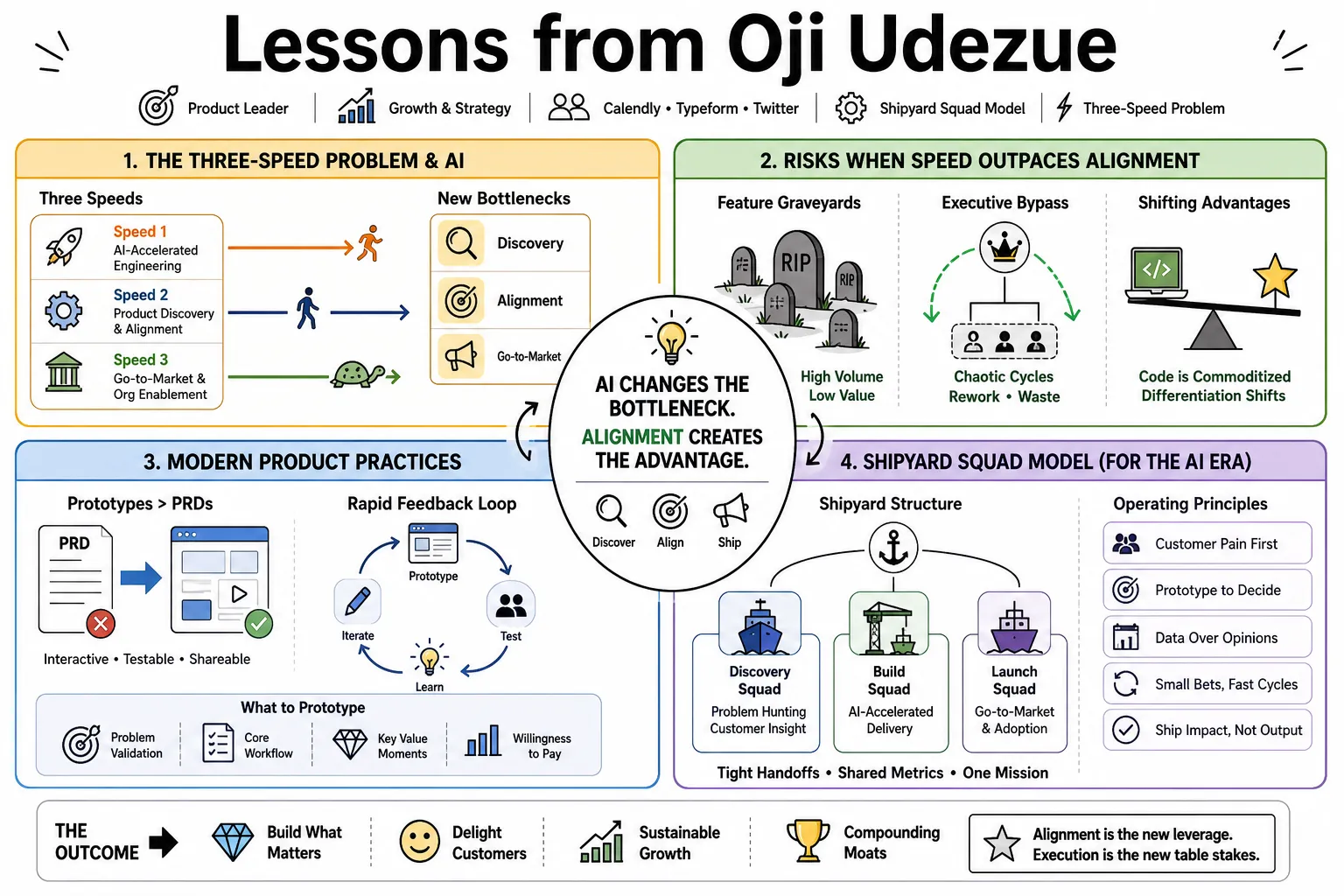
Part 1: The Three-Speed Problem and AI
- On the primary AI bottleneck: "AI has drastically accelerated engineering velocity, turning product discovery and go-to-market into the new organizational bottlenecks." — Source: Hg Capital
- On the risk of feature graveyards: "When engineering speed outpaces product alignment, teams risk building massive volumes of software that no one actually needs." — Source: Mind the Product
- On executive bypass: "Because prototyping is now so fast, founders and CEOs might bypass traditional product processes, leading to chaotic development cycles." — Source: Mind the Product
- On modern PRDs: "In an era of rapid AI generation, interactive prototypes should replace static Product Requirement Documents." — Source: Simplecast
- On shifting advantages: "With code generation becoming commoditized, the ultimate advantage for companies has shifted entirely to understanding market needs." — Source: Hg Capital
- On extreme experimentation: "Product teams must increase their experimentation velocity to match the speed at which engineers can now build." — Source: Simplecast
- On fusing roles: "To survive the three-speed problem, organizations need to tightly integrate their product and go-to-market functions so distribution keeps pace." — Source: Mind the Product
- On the nature of software construction: Udezue frames AI-assisted coding as a pace change rather than a magic wand: engineering velocity may move 5x to 10x faster, but the organization still has to decide what to build and how to sell it. — Reference: Hg Orbit episode on Oji Udezue and the three-speed problem
- On product divination: In the three-speed framework, Udezue says the real leverage shifts toward accelerating product divination and go-to-market as engineering capacity approaches its practical limits. — Reference: Hg Orbit episode on product divination and go-to-market speed
- On continuous listening: "Because engineering is no longer scarce, teams must centralize and scale their customer listening systems to feed the development engine." — Source: Hg Capital
Part 2: The Shipyard Squad Model
- On the outdated EPD triad: "The traditional triad of Engineering, Product, and Design is no longer sufficient to move at the speed required by modern development." — Source: ProductState
- On squad autonomy: "Product teams must be fully self-contained and not rely on external departments for daily functions like research or data analysis." — Source: ProductState
- On the six-function squad: "A modern squad should integrate Engineering, Product, Design, Customer Research, Data Analysis, and Product Marketing into a single unit." — Source: Mind the Product
- On eliminating handoffs: "By embedding marketing and research directly into the squad, teams avoid the communication delays that slow down traditional handoffs." — Source: ProductState
- On fractional integration: "You do not need a full-time marketer or researcher on every squad; integrating these roles at one-third capacity can fundamentally change a team's speed." — Source: ProductState
- On squad ownership: "The squad, not the department head, must have absolute ownership over the complete customer experience." — Source: ProductState
- On prioritizing squad goals: "For the Shipyard model to succeed, team members must prioritize squad objectives over their functional departmental requirements." — Source: ProductState
- On matching AI velocity: "The Shipyard model was specifically designed to help cross-functional disciplines keep pace with AI-accelerated engineering." — Source: LogRocket
- On decision context: "Embedding data analysis within the squad ensures that decisions are made based on immediate, localized context rather than delayed reports." — Source: ProductState
- On shipping speed: "Teams operating under a fully integrated Shipyard model often ship products twice as fast as those using traditional structures." — Source: ProductState
Part 3: Identifying Sharp Problems
- On defining sharp problems: "A sharp problem is a specific, acute pain point that actively drains a customer's time, energy, or money." — Source: Coda
- On willingness to pay: "A problem is only truly sharp if it is painful enough that a customer is actively willing to pay for a solution." — Source: Reddit
- On avoiding trend-chasing: "Product teams must focus on perennial human needs rather than blindly sprinkling trendy AI features over existing workflows." — Source: Lenny's Newsletter
- On continuous discovery: "Finding sharp problems requires operationalizing continuous customer discovery to identify pains before users explicitly voice them." — Source: Lenny's Newsletter
- On feature requests: "A product manager's job is rarely to build every feature a user asks for, but to dig deeper to find the underlying sharp problem." — Source: ProductState
- On business viability: "While new technology is exciting, it is useless if it does not solve a deep, commercially viable business need." — Source: GTMnow
- On prioritizing pain: "Teams must rigorously stack-rank customer pain points, deliberately choosing to ignore dull problems to focus entirely on sharp ones." — Source: Coda
- On workflow interruption: "The best opportunities for new products lie in the moments where a user's workflow is broken or inefficient." — Source: Coda
- On the Shipyard connection: "Maintaining close, cross-functional connections with customer insights is the most reliable way to keep focus on sharp problems." — Source: ProductState
- On human-centric building: "Before writing a line of code, teams must validate that the human at the other end actually cares about the problem being solved." — Source: Hustle & Flowchart
Part 4: Product-Led Growth (PLG) Mechanics
- On defining PLG: "True product-led growth means executing on a high-quality product that inherently pulls itself forward in the market." — Source: Produx Labs
- On full alignment: "PLG requires sales, marketing, and success teams to completely align their motions around the product's value." — Source: Wing VC
- On the K-Factor: "Sustainable growth relies heavily on a high K-Factor, where existing users naturally acquire new users through standard product usage." — Source: Vero
- On viral utility: "Products like Calendly grow organically because their core utility requires sharing the product with non-users to function." — Source: Vero
- On reducing friction: "To master PLG, organizations must systematically remove friction from the way customer feedback is collected, triaged, and actioned." — Source: Wing VC
- On the PLG culture shift: "Transitioning to a product-led model is fundamentally a cultural shift, requiring behavior changes beyond business metrics." — Source: Produx Labs
- On flat innovation: "PLG companies must create flat spaces within their organizational hierarchy to encourage rapid innovation and experimentation." — Source: Medium
- On enduring value: Udezue argues that product leaders have two linked jobs: delight customers and make the business model work, which is why he brings marketing into discovery and solution work from the start. — Reference: GTMnow interview on product leadership, marketing, and customer value
- On self-serve adoption: "The product experience must be intuitive enough that a user can discover, understand, and purchase it without ever talking to a human." — Source: How to PLG
- On synergy in tech: "Platforms like Typeform and Calendly succeed in PLG because they seamlessly integrate into broader workflows, qualifying leads and scheduling in one motion." — Source: Calendly
Part 5: Navigating Go-to-Market and Strategy
- On the VMSO framework: "Teams should use the Vision, Mission, Strategy, Objectives framework to create clarity, even when formal strategy is absent." — Source: Medium
- On draft strategies: "A draft strategy is highly valuable as a lightning rod to provoke discussion, alignment, and iteration among leadership." — Source: Produx Labs
- On the Zone of Benefit: "Companies unlock true revenue potential when they clearly define and operate within their specific zone of benefit for the customer." — Source: LogRocket
- On AI in GTM: "Artificial intelligence is actively rewriting traditional go-to-market playbooks, forcing teams to move faster and target more precisely." — Source: GTMnow
- On bridging product and marketing: "Product marketing cannot be an afterthought; it must be a concurrent process that shapes the product as it is being built." — Source: ProductState
- On strategic voids: "In the absence of a clear strategy, product teams will naturally drift toward building disjointed features rather than cohesive solutions." — Source: Produx Labs
- On where to fish: "Finding a unicorn business requires understanding exactly where to fish, identifying markets with high willingness to pay and acute pain." — Source: Lenny's Newsletter
- On competitive moats: "A strong go-to-market strategy combined with a viral product loop creates a competitive moat that is incredibly difficult for rivals to breach." — Source: OpenView
- On aligning objectives: "Every cross-functional team member's personal objectives must tie directly back to the core strategic goals of the product." — Source: Medium
Part 6: Rethinking the Product Role
- On the evolution of PMs: On Lenny's podcast, Oji and Ezinne Udezue describe PMs as a new bottleneck in AI-era product work, with the strongest PMs combining curiosity, humility, agency, and hands-on fluency with AI tools. — Reference: Lenny's Podcast episode on how AI is reshaping the product role
- On human judgment: "As AI takes over technical execution, a product manager's unique value becomes their human judgment and taste." — Source: Mind the Product
- On curiosity: Udezue treats curiosity as a practical AI-era operating skill: product leaders need to keep learning from new tools, younger builders, customers, and market signals instead of relying on old mental models. — Reference: Lenny's Podcast episode on curiosity, humility, and agency in AI-era product work
- On the decline of PRDs: "Writing exhaustive product requirement documents is becoming obsolete; the focus should be on shipping and testing." — Source: Lenny's Newsletter
- On vibe coding: "Product managers must learn how to prototype and experiment directly using AI tools, a practice sometimes referred to as vibe coding." — Source: LogRocket
- On managing chaos: "Product leaders must learn to embrace controlled chaos as a feature of rapid, multi-disciplinary team collaboration." — Source: LogRocket
- On technical backgrounds: "While a technical background is helpful, the ability to synthesize customer pain into a strategic direction is far more important." — Source: Lenny's Newsletter
- On avoiding the hype cycle: "Great product managers remain grounded in solving real problems rather than getting swept up in the latest technology hype cycle." — Source: Hustle & Flowchart
- On systems thinking: "The best product operators think in terms of product systems, creating repeatable processes that consistently generate innovation." — Source: Medium
Part 7: Customer Centricity and Research
- On continuous integration: "Customer research cannot be a one-time event at the start of a project; it must be continuously integrated into the daily workflow." — Source: ProductState
- On localized context: "When researchers sit directly with engineers, insights translate into product adjustments immediately rather than getting lost in reports." — Source: Mind the Product
- On observing behavior: "What customers say they want is often different from what they actually need; rigorous research focuses on observing their actual behavior." — Source: Lenny's Newsletter
- On the value of listening: "In a world where anyone can build software quickly, the company that listens to its customers best will ultimately win." — Source: Hg Capital
- On validating assumptions: "Every feature built without recent customer validation is a gamble that wastes valuable engineering cycles." — Source: ProductState
- On removing friction: "Research should identify the microscopic points of friction in a user's day, as these are often the seeds of massive product opportunities." — Source: Coda
- On the customer's time: "A product's primary job is often to give the customer their time back, which requires understanding exactly how they currently waste it." — Source: Coda
- On triaging feedback: "Successful organizations build fast systems to categorize, prioritize, and immediately act upon inbound customer feedback." — Source: Wing VC
- On market proximity: "The closer the entire product team is to the raw market data, the faster they can iterate toward true product-market fit." — Source: ProductState
Part 8: Building Enduring Organizations
- On building rocketships: "Creating a high-growth company requires blending extreme customer obsession with strict operational playbooks." — Source: Damn Gravity
- On repeatable innovation: "Companies must move away from relying on occasional hits and instead build systems that guarantee consistent innovation." — Source: Medium
- On the value of playbooks: "Scaling an organization requires battle-tested templates and tools that allow new teams to operate effectively from day one." — Source: Coda
- On scaling culture: "The hardest part of hyper-growth is ensuring that the customer-centric culture that sparked the initial success scales with the headcount." — Source: Produx Labs
- On pragmatic leadership: "Executive leadership in product requires a pragmatic, hands-on approach rather than managing strictly from spreadsheets and dashboards." — Source: Lenny's Newsletter
- On avoiding silos: "As companies grow, they naturally form functional silos; leaders must actively design squad structures that break these silos down." — Source: ProductState
- On surviving AI: Udezue's AI-era advice is organizational, not cosmetic: leaders should shed old mental models, make customer feedback turnkey, treat prototypes as the new PRD, and redesign discovery and go-to-market to keep pace with engineering. — Reference: Hg Orbit episode on CPO leadership in the age of unlimited engineering
- On the ultimate goal: "The ultimate measure of an organization's success is its ability to consistently deliver products that solve deep, perennial human problems." — Source: Hustle & Flowchart