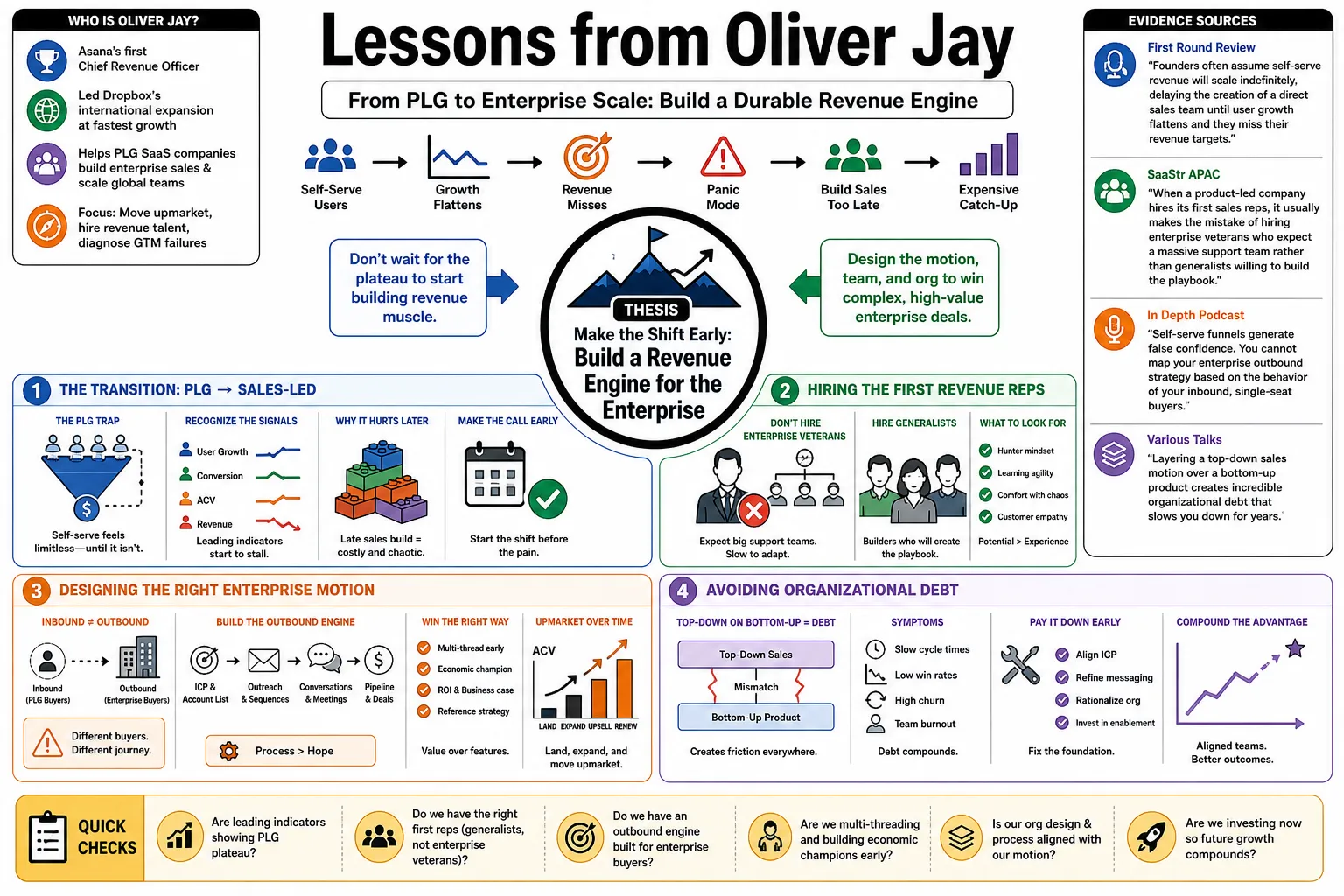
Lessons from Oliver Jay
Oliver Jay was Asana's first Chief Revenue Officer and led Dropbox's international expansion during its fastest growth. He helps product-led SaaS companies build their enterprise sales and scale global teams from scratch. This collection breaks down his frameworks for moving upmarket, hiring revenue talent, and diagnosing go-to-market failures.
Part 1: The Transition from Product-Led to Sales-Led Growth
- On the PLG trap: "Founders often assume self-serve revenue will scale indefinitely, delaying the creation of a direct sales team until user growth flattens and they miss their revenue targets." — Source: First Round Review
- On hiring the first reps: "When a product-led company hires its first sales reps, it usually makes the mistake of hiring enterprise veterans who expect a massive support team rather than generalists willing to build the playbook." — Source: SaaStr APAC
- On inbound leads: "Self-serve funnels generate false confidence. You cannot map your enterprise outbound strategy based on the behavior of your inbound, single-seat buyers." — Source: In Depth Podcast
- On organizational debt: "Layering a top-down sales motion over a bottom-up product creates immense friction if the engineering team refuses to build admin controls, security features, and billing infrastructure." — Source: The Twenty Minute VC
- On identifying enterprise readiness: "You are ready for enterprise sales when you start seeing multiple unconnected pockets of users within the same target company swiping their own credit cards." — Source: Stage 2 Capital
- On sales enablement: "Early sales enablement in a PLG company should focus entirely on teaching reps how to navigate the existing product data to find expansion opportunities." — Source: First Round Review
- On setting quotas: "Your first sales quotas in a product-led environment are complete guesswork; optimize for learning how customers buy rather than enforcing strict revenue penalties in year one." — Source: The Twenty Minute VC
- On product constraints: "Sales reps will uncover product gaps faster than any user survey. The challenge is convincing the product team to act on that feedback before the reps churn." — Source: In Depth Podcast
- On self-serve cannibalization: "Sales leaders often worry about cannibalizing the self-serve business. If you ignore the friction between the two motions, the buyer will simply walk away from both." — Source: SaaStr APAC
- On expansion velocity: "A healthy PLG motion gives you the initial user base, but the sales team dictates the velocity at which those single users consolidate into a massive corporate contract." — Source: Stage 2 Capital
Part 2: Defining the Modern CRO Role
- On the CRO mandate: "The Chief Revenue Officer is responsible for the entire customer lifecycle, meaning they must care equally about the first marketing touchpoint and the year-three renewal." — Source: The Twenty Minute VC
- On diagnosing pipelines: "A CRO must look past the aggregate pipeline number and drill into the conversion rates of individual cohorts to find the hidden leaks." — Source: First Round Review
- On board reporting: "Never surprise the board. The CRO's job is to forecast accurately and explain the exact mechanical reasons behind a miss before the numbers are finalized." — Source: In Depth Podcast
- On operational rhythm: "Revenue teams run on a heartbeat of weekly forecasts, monthly territory reviews, and quarterly business reviews. If you miss a beat, the machine slows down." — Source: Stage 2 Capital
- On cross-functional trust: "The fastest way for a CRO to fail is to declare war on the marketing team over lead quality instead of sitting down to rewrite the lead scoring model together." — Source: SaaStr APAC
- On scaling gracefully: "What works at ten million in revenue will break at fifty million. The CRO must rebuild the entire GTM engine while the car is driving down the highway." — Source: The Twenty Minute VC
- On managing managers: "Transitioning from managing reps to managing managers requires a completely different vocabulary. You can no longer jump on a call to save a deal; you have to train the manager to save it." — Source: First Round Review
- On forecasting accuracy: "Forecasting is a muscle. You build it by forcing reps to commit to exact dates and dissecting the psychological reasons why they are overly optimistic." — Source: In Depth Podcast
- On territory design: "Poor territory design creates toxic internal competition. A CRO must carve up accounts mathematically to ensure every rep has a fair shot at hitting quota." — Source: Stage 2 Capital
Part 3: Hiring and Architecting the Sales Team
- On the ideal early hire: "Your first sales hires must possess high ambiguity tolerance. They need to write the script, test it, fail, and rewrite it without waiting for permission." — Source: First Round Review
- On interview questions: "I always ask candidates to explain the hardest deal they ever lost. If they blame the product, the pricing, or the competitor, I pass. I want them to blame their own process." — Source: The Twenty Minute VC
- On ramping reps: "A slow ramp time destroys your unit economics. You must measure exactly how many days it takes for a new rep to generate pipeline and mercilessly optimize that window." — Source: SaaStr APAC
- On promoting from within: "The best SDRs rarely make the best Account Executives immediately. The skills required to book a meeting are fundamentally different from the skills required to negotiate a six-figure contract." — Source: In Depth Podcast
- On evaluating talent: "Past W-2 earnings are a trailing indicator. I look for reps who understand the mechanics of their past success and can replicate it in a completely different environment." — Source: Stage 2 Capital
- On onboarding programs: "Do not outsource onboarding to a slide deck. The leadership team must personally teach the first twenty reps how to pitch the product." — Source: First Round Review
- On firing fast: "If a rep cannot articulate the value proposition clearly after 30 days of intensive training, they will never close a deal. Let them go." — Source: The Twenty Minute VC
- On diversity in sales: "A homogeneous sales floor creates massive blind spots in how you approach different buyer personas. Diversity of background directly translates to a wider capture of market share." — Source: SaaStr APAC
- On compensation plans: "Keep the compensation plan simple. If a rep needs a spreadsheet to calculate their commission on a standard deal, the plan is broken." — Source: In Depth Podcast
- On maintaining culture: "Sales culture is defined by what you celebrate. If you only ring the bell for massive deals and ignore the reps doing the daily outbound grind, the top of your funnel will collapse." — Source: Stage 2 Capital
Part 4: Executing Global and International Expansion
- On entering new markets: "Companies usually expand internationally a year too late, leaving the door open for regional copycats to capture the early adopters." — Source: EDB Singapore
- On the first international hub: "When picking your first international office, index heavily on local talent availability and time zone overlap with headquarters, rather than just tax incentives." — Source: SaaStr APAC
- On localized messaging: "Translating your English website into Japanese does not constitute an APAC strategy. You have to adapt the core messaging to fit the local cultural buying habits." — Source: First Round Review
- On regional autonomy: "If the European lead has to ask San Francisco for permission to discount a deal by ten percent, you have defeated the purpose of opening a local office." — Source: The Twenty Minute VC
- On the expat dilemma: "Sending a senior leader from headquarters ensures culture transfer, but hiring a local veteran ensures immediate market access. You typically need a pairing of both to succeed." — Source: EDB Singapore
- On market prioritization: "Rank international markets strictly by product-market fit indicators, such as organic signups and current usage, rather than generic GDP metrics." — Source: In Depth Podcast
- On operating cadences: "Time zones will fracture your company culture if you are not careful. Force the executive team to rotate their meeting hours so the international offices are not always dialing in at midnight." — Source: Stage 2 Capital
- On localizing product features: "European buyers will demand data residency, and Asian buyers might demand entirely different integrations. Your engineering roadmap must reflect your geographic ambitions." — Source: SaaStr APAC
- On scaling APAC: "The Asia-Pacific region is highly fragmented. You cannot treat Singapore, Australia, and Japan as a single territory; each requires a distinct go-to-market motion." — Source: EDB Singapore
Part 5: Tactics for Enterprise Selling
- On the enterprise buyer: "Enterprise software is rarely bought by the person who will actually use it. Your pitch must address the economic buyer's fear of risk, not the end user's desire for a better interface." — Source: First Round Review
- On multi-threading: "If your deal relies entirely on one champion, you have no deal. The moment that champion leaves the company or loses political capital, the deal dies." — Source: The Twenty Minute VC
- On the proof of concept (POC): "A POC should never be free, and it should never be open-ended. Define the exact success metrics on day one, and secure an agreement that they will buy if you hit them." — Source: In Depth Podcast
- On discounting: "Discounting is a lazy way to create urgency. If you have to drop the price by forty percent to get the signature, you failed to communicate the true value of the software." — Source: Stage 2 Capital
- On legal negotiations: "Get the legal and procurement teams involved as early as possible. Deals do not die in the pitch; they die in the redlines of the master services agreement." — Source: SaaStr APAC
- On managing the funnel: "Reps spend too much time working deals that will never close. Teach your managers to ruthlessly disqualify bad pipeline so the team can focus on winnable accounts." — Source: First Round Review
- On executive sponsors: "Your CEO is a tool in your sales process. Bring them into the deal only at the final stage to align directly with the buyer's C-suite and force the close." — Source: The Twenty Minute VC
- On objection handling: "Amateur reps argue with objections; veteran reps isolate them. You have to find out if the budget complaint is real or just a smokescreen for a lack of trust." — Source: In Depth Podcast
- On mapping the organization: "Enterprise sales requires you to draw out the exact political structure of the target company and map your features to the individual KPIs of each department head." — Source: Stage 2 Capital
Part 6: Navigating Board Dynamics and Targets
- On setting expectations: "If you promise the board a doubling of revenue based on assumptions of perfect execution, you will miss. Always model your forecasts with a built-in margin for hiring delays and lost deals." — Source: First Round Review
- On reporting bad news: "Bad news must travel faster than good news. If a massive deal slips to the next quarter, tell the board immediately rather than waiting for the quarterly meeting." — Source: The Twenty Minute VC
- On metric alignment: "Boards love churn metrics, but they often misunderstand them. The CRO must define exactly how gross retention and net retention are calculated to prevent panic." — Source: In Depth Podcast
- On the growth versus efficiency debate: "In a bull market, boards demand top-line growth at any cost. In a bear market, they demand profitability. The CRO must build a machine capable of toggling between the two." — Source: Stage 2 Capital
- On handling board pressure: "When a board member suggests a radical change to the sales strategy based on an article they read, you must thank them, present your data, and respectfully stay the course." — Source: SaaStr APAC
- On understanding investors: "Venture capitalists view your sales team purely through the lens of customer acquisition cost and payback periods. Learn to speak their language." — Source: First Round Review
- On the predictability engine: "The board is not just buying revenue; they are buying predictability. They want to know that if they pour one dollar into the machine, two dollars will come out twelve months later." — Source: The Twenty Minute VC
- On quota attainment: "If ninety percent of your reps hit quota, your quotas are too low. If ten percent hit quota, your quotas are impossible. The board will scrutinize this distribution closely." — Source: In Depth Podcast
- On presenting data: "Never show a slide to the board that contains a metric you cannot explain the math behind. They will find the flaw and spend the entire meeting dissecting it." — Source: Stage 2 Capital
Part 7: Aligning Product and Revenue Teams
- On the fundamental conflict: "Sales wants features built for the customer who is threatening to churn today. Product wants to build features for the thousand customers they hope to sign next year. Both are right." — Source: First Round Review
- On resolving roadmaps: "You solve the product-sales divide by tying engineering resources directly to revenue impact. Force the sales team to attach a dollar value to every feature request." — Source: The Twenty Minute VC
- On beta testing: "Never let the sales team sell a beta product as if it is generally available. It destroys trust with the customer and infuriates the engineering team." — Source: In Depth Podcast
- On shared metrics: "If sales is measured on bookings and product is measured on daily active users, they will run in opposite directions. You must find a shared metric, like activated revenue." — Source: Stage 2 Capital
- On competitive intelligence: "The sales team hears every reason a prospect chose the competitor. The product team must mine those lost-deal notes to adjust their sprint planning." — Source: SaaStr APAC
- On pricing strategy: "Pricing is not a math equation; it is a product feature. If the pricing model is too complex, the reps will avoid selling it and the buyers will refuse to adopt it." — Source: First Round Review
- On killing features: "The hardest thing for a product team to do is kill an unused feature, but doing so drastically simplifies the pitch for the sales team. Less surface area equals a faster sale." — Source: The Twenty Minute VC
- On feature parity: "Chasing feature parity with an incumbent is a losing game. You win by solving a narrow problem so well that the buyer ignores the missing legacy features." — Source: In Depth Podcast
- On gathering feedback: "Product managers should sit in on five sales calls a month, silently listening to how prospects react to the positioning. It changes how they write code." — Source: Stage 2 Capital
Part 8: Building a Culture of High Performance
- On psychological safety: "A high-performance sales floor requires the psychological safety to lose a deal loudly, dissect it in front of the team, and learn from it without fear of termination." — Source: First Round Review
- On the danger of burnout: "If you treat your reps like disposable batteries, your turnover will wipe out your pipeline. You have to enforce time off and monitor leading indicators of exhaustion." — Source: The Twenty Minute VC
- On internal promotions: "Promoting your best rep to manager without training them is how you lose your best closer and gain a terrible leader in the same day." — Source: In Depth Podcast
- On celebrating the right behaviors: "Do not just celebrate the signed contract. Celebrate the rep who finally secured the meeting with the impossible account after six months of follow-ups." — Source: Stage 2 Capital
- On managing underperformers: "Allowing a toxic underperformer to remain on the floor out of pity lowers the standard for everyone else. The team is watching how you handle failure." — Source: SaaStr APAC
- On continuous coaching: "A weekly one-on-one should not be a pipeline update; that information is in the dashboard. Use that time to practice pitches and listen to recorded calls." — Source: First Round Review
- On remote sales culture: "Remote sales teams miss the ambient learning of a busy office. You have to manufacture those moments by scheduling frequent, structured deal-teardown sessions over video." — Source: The Twenty Minute VC
- On defining values: "Your sales culture is defined strictly by who you hire, who you promote, and who you fire. The posters on the wall mean absolutely nothing." — Source: In Depth Podcast
- On dealing with rejection: "The job is ninety percent rejection. You have to build a culture that views a 'no' as a data point rather than a personal failure." — Source: Stage 2 Capital
- On legacy: "The mark of a great revenue leader is not just the valuation they helped achieve, but the number of reps who eventually leave to become CROs themselves." — Source: SaaStr APAC