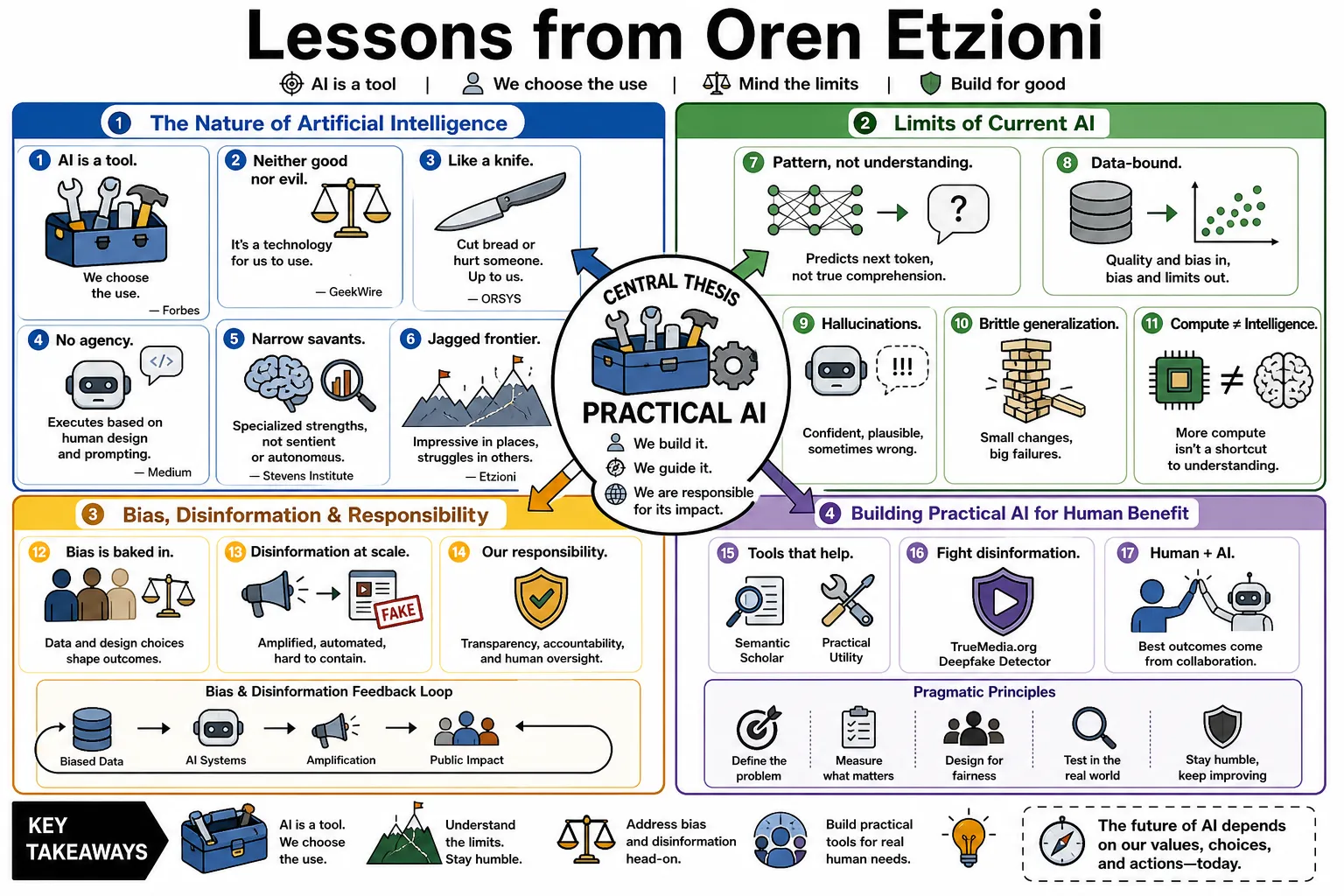
Lessons from Oren Etzioni
Computer scientist Oren Etzioni, founding CEO of the Allen Institute for AI, builds practical tools ranging from Semantic Scholar to the political deepfake detector TrueMedia.org. This collection outlines his pragmatic take on machine intelligence, detailing the actual limits of current models and the immediate problem of bias and disinformation.
Part 1: The Nature of Artificial Intelligence
- On the essence of AI: "AI is a tool. The choice about how it gets deployed is ours." — Source: Forbes
- On moral alignment: "AI is neither good nor evil. It's a tool. It's a technology for us to use." — Source: GeekWire
- On utility vs. autonomy: "AI is like having a knife. You can use it to cut bread or to hurt someone. It's up to us to decide how to use it." — Source: ORSYS
- On agency: AI systems do not have their own desires or independent will; they execute functions based on human design and prompting. — Source: Medium
- On savant-like behavior: Current AI systems are narrow, limited "savants" rather than autonomous, sentient entities. — Source: Stevens Institute of Technology
- On the jagged frontier: Modern AI exists on a "jagged frontier" where models demonstrate impressive capabilities in some areas but fail unexpectedly on nearly identical tasks. — Source: GeekWire
- On missing reliability: While progress in AI capabilities is rapid, we have not yet achieved true "artificial reliability." — Source: GeekWire
- On understanding output: "I think the only mistake is believing that you're getting facts" when querying generative AI models. — Source: American University
- On intelligence as a spectrum: Intelligence is a multidimensional spectrum where machines excel in some dimensions and trail humans in others. — Source: Allen Institute for AI
- On taking action: The field is shifting from AI that simply talks to AI that takes action, moving toward autonomous agents. — Source: GeekWire
Part 2: Navigating AI Hype and Doomsday Fears
- On existential dread: "I'm not a big fan of the doomsday scenarios about AI. I tell people we should not confuse science with science fiction." — Source: Medium
- On extinction fears: "AI is not going to exterminate us... It's going to empower us to help tackle real problems and to help humanity." — Source: TEDxSeattle
- On misplaced anxiety: Focusing on "robot apocalypse" scenarios distracts us from immediate, practical concerns like algorithmic bias. — Source: US House of Representatives
- On the Terminator trope: The persistent cultural image of the Terminator actively harms our ability to have rational policy discussions about AI. — Source: AI and You
- On real-world threats: The immediate dangers of AI are job displacement and data privacy violations, alongside organized disinformation. — Source: GeekWire
- On AGI timelines: Predictions of imminent Artificial General Intelligence often underestimate the massive leaps required in fundamental reasoning. — Source: World of DaaS
- On anthropomorphism: Humans naturally project human-like intent and consciousness onto text-generating algorithms, which leads to fundamental misunderstandings of the technology. — Source: Stevens Institute of Technology
- On managing fear: We must balance caution with optimism, recognizing that avoiding AI development out of fear carries heavy opportunity costs for society. — Source: Harvard Business School
- On the definition of AGI: A true AGI would go beyond mimicking text patterns; it would need the ability to formulate novel scientific hypotheses and test them. — Source: World of DaaS
- On common sense: One of the most stubborn hurdles preventing true AGI is equipping machines with the basic, unspoken common sense that a human toddler possesses. — Source: Allen Institute for AI
Part 3: The Allen Institute for AI (AI2) and AI for the Common Good
- On founding AI2: AI2 was built on Paul Allen's vision to conduct high-impact AI research and engineering explicitly for the common good. — Source: University of Washington
- On bridging the gap: AI2 is uniquely structured to bridge the separated worlds of foundational research, applied science, and user-facing products. — Source: Allen Institute for AI
- On independent research: There is an urgent need for non-profit, independent AI research institutes that operate outside the pressures of quarterly corporate earnings. — Source: GeekWire
- On environmental impact: AI should be directed toward humanity's greatest challenges, such as modeling climate change and discovering new materials for clean energy. — Source: Allen Institute for AI
- On the Aristo Project: The Aristo project demonstrated that AI could master standardized science tests, serving as a stepping stone toward systems capable of scientific reasoning. — Source: Allen Institute for AI
- On democratizing access: The tools and models developed for the common good must be accessible to researchers outside of heavily funded tech conglomerates. — Source: Substack
- On collaboration: AI for the common good requires unprecedented collaboration across universities, non-profits, and government agencies. — Source: University of Washington
- On open-source models: Releasing open models is essential for scientific reproducibility and for allowing the global community to scrutinize and improve AI systems. — Source: Allen Institute for AI
- On the cost of research: The soaring costs of computing power threaten to lock academic and non-profit researchers out of the most advanced AI developments. — Source: World of DaaS
Part 4: Combating Disinformation (TrueMedia)
- On political deepfakes: The proliferation of highly convincing audio and video deepfakes poses a severe and immediate threat to democratic elections globally. — Source: TrueMedia.org
- On non-partisan detection: TrueMedia.org was established specifically as a non-partisan, non-profit organization to combat political disinformation without bias. — Source: St. Louis Speakers Series
- On verification vs. perfection: Deepfake detection tools must prioritize transparency, clearly reporting uncertainty levels rather than falsely claiming absolute accuracy. — Source: TrueMedia.org
- On the arms race: Combating AI-generated disinformation is a continuous arms race between generation models and detection algorithms. — Source: Aleph Invested
- On empowering journalists: Journalists and election officials need free, accessible, and scientifically accurate tools to rapidly verify media authenticity during breaking news cycles. — Source: TrueMedia.org
- On multi-modal threats: Disinformation extends beyond text; synthetic audio is particularly dangerous because it is cheap to produce and easily distributed via social media or phone calls. — Source: Aleph Invested
- On human-in-the-loop: AI detection models should aggregate various signals, but human verification methods remain a necessary part of the media authentication process. — Source: TrueMedia.org
- On institutional handoffs: Transitioning TrueMedia.org to Georgetown University ensures the long-term, research-driven maintenance of open tools for navigating manipulated content. — Source: TrueMedia.org
- On the Liar's Dividend: The mere existence of deepfakes allows politicians to falsely claim that real, damaging evidence against them is simply AI-generated. — Source: Aleph Invested
Part 5: Startups and Entrepreneurship
- On AI-first design: Modern startups must be AI-first, meaning artificial intelligence serves as the core infrastructure of the product rather than an afterthought. — Source: GeekWire
- On the AI2 Incubator: The AI2 Incubator was created to apply expert academic knowledge and transform foundational research into real-world, problem-solving companies. — Source: Substack
- On early data aggregation: Before the modern AI boom, companies like Farecast demonstrated the immense predictive value of aggregating massive datasets to help consumers. — Source: Wikipedia
- On consumer empowerment: The best technology startups use data to level the playing field, shifting power and information back into the hands of the everyday consumer. — Source: Wikipedia
- On spin-offs: Academic and non-profit institutions should actively support commercial spin-offs as a mechanism to scale the impact of their research. — Source: Allen Institute for AI
- On practical application: An elegant algorithmic breakthrough only matters if it can be packaged into a user experience that solves a tangible human problem. — Source: GeekWire
- On navigating hype: AI founders must focus on delivering concrete return on investment and addressing specific pain points, rather than riding the general hype cycle of large language models. — Source: Allen Institute for AI
- On data moats: In the age of open-source models, a startup's true competitive advantage lies in proprietary data and deeply integrated workflows. — Source: Substack
- On venture capital in AI: Investors must develop the technical fluency to distinguish between startups building defensible AI technology and those simply providing wrappers around existing programming interfaces. — Source: AI2 Incubator
Part 6: Scientific Progress and Semantic Scholar
- On information overload: The sheer volume of scientific papers published daily makes it impossible for human researchers to stay current without AI assistance. — Source: Allen Institute for AI
- On Semantic Scholar's mission: Semantic Scholar was built to cut through scientific literature with AI, transforming how researchers discover and understand relevant work. — Source: Allen Institute for AI
- On extracting meaning: Search tools for science must go beyond simple keyword matching to genuinely understand the semantic meaning, methodology, and results of a paper. — Source: Allen Institute for AI
- On citing effectively: AI can analyze citation graphs beyond counting references, determining whether a citation is highly influential or merely background methodology. — Source: Allen Institute for AI
- On accelerating breakthroughs: By connecting disparate pieces of scientific knowledge across disciplines, AI can directly accelerate the pace of medical and technological breakthroughs. — Source: University of Washington
- On open science: Releasing scientific datasets openly is essential; progress in machine learning relies heavily on the community's ability to benchmark against shared data. — Source: Allen Institute for AI
- On summarizing research: Generative AI is exceptionally useful for synthesizing the core claims of complex scientific papers into accessible summaries. — Source: Allen Institute for AI
- On identifying gaps: AI tools can map the body of existing research to help scientists identify unaddressed questions in the literature. — Source: Allen Institute for AI
- On reproducibility: Making both code and datasets available alongside scientific papers is a fundamental requirement for maintaining the integrity of AI research. — Source: Allen Institute for AI
- On cross-domain insights: The next major scientific discoveries will likely occur at the intersection of fields, where AI can spot connections that specialized human experts miss. — Source: Allen Institute for AI
Part 7: Ethics, Bias, and Open Source
- On algorithmic bias: The most pressing ethical issue in AI today is mitigating the historical biases embedded within the training data that inform these models. — Source: US House of Representatives
- On the open versus closed debate: Stifling open-source AI development in the name of safety actually centralizes power and prevents independent researchers from auditing models for flaws. — Source: Allen Institute for AI
- On transparency: We cannot trust AI systems that operate as black boxes; there must be a push toward explainable AI where decision-making processes are visible. — Source: Stevens Institute of Technology
- On data privacy: As AI models consume vast amounts of internet data, protecting individual privacy and copyright must be balanced with the need for large training sets. — Source: GeekWire
- On moral obligations: Technologists have a moral obligation to anticipate the societal harms of their inventions and actively build guardrails before deployment. — Source: Aleph Invested
- On inclusive design: AI development teams must be diverse; homogeneous teams are more likely to overlook major cultural and demographic blind spots in their products. — Source: Allen Institute for AI
- On equitable access: The benefits of AI technology, from healthcare diagnostics to educational tutoring, must be distributed equitably, avoiding concentration in the wealthiest nations. — Source: Allen Institute for AI
- On deepfake accountability: Platforms that distribute manipulated media share the responsibility of providing context and labeling AI-generated content for their users. — Source: TrueMedia.org
- On auditing AI: We need standardized, independent auditing frameworks for AI models, similar to how we audit financial institutions or aircraft safety. — Source: Harvard Business School
Part 8: Regulation, Policy, and the Future
- On smart regulation: AI regulation should focus on transparency and specific applications, rather than stifling basic research. — Source: US House of Representatives
- On watermarking: Policymakers must push for strict, standardized watermarking on all AI-generated content to help citizens distinguish reality from synthetic media. — Source: TrueMedia.org
- On the pace of law: The traditional legislative process is currently too slow to keep up with the exponential curve of AI development; we need agile, adaptive regulations. — Source: Crosscut Talks
- On global cooperation: AI development and regulation cannot be siloed by country; establishing global norms is essential to prevent a race to the bottom in safety standards. — Source: Crosscut Talks
- On national security: While we must protect strategic AI advantages, treating all AI research as a national security secret will severely handicap domestic innovation. — Source: US House of Representatives
- On advising government: Technologists and AI researchers must actively brief lawmakers so that policy is based on technical reality, avoiding science fiction tropes. — Source: Ghosts in the Machine
- On anticipating workforce shifts: Governments must proactively invest in massive retraining and social safety nets to prepare for the inevitable economic disruptions caused by AI automation. — Source: GeekWire
- On liability: Legal frameworks must evolve to clarify who is liable when an AI system causes harm or disseminates defamatory information. — Source: US House of Representatives
- On the long-term vision: Ultimately, our goal should not be to build autonomous machines that replace us, but to build intelligent tools that profoundly augment human capability and creativity. — Source: Allen Institute for AI