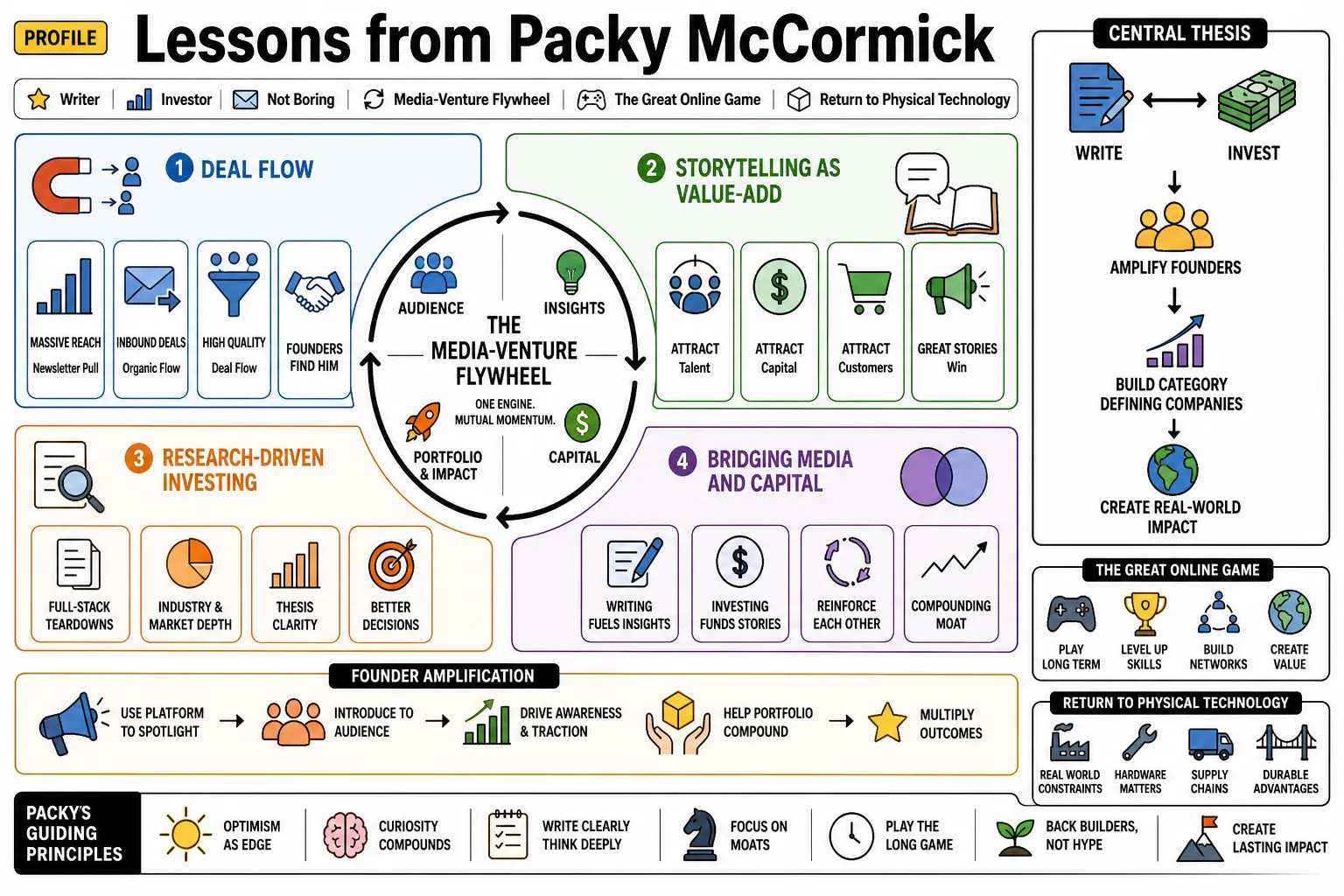
Lessons from Packy McCormick
Writer and investor Packy McCormick founded Not Boring, a newsletter and venture fund that popularized the media-venture flywheel. He treats the internet as "The Great Online Game" and argues for a return to physical technology through vertical integration. This profile collects his ideas on how technology, optimism, and online writing create concrete business opportunities.
Part 1: The Media-Venture Flywheel
- On Deal Flow: "The newsletter’s massive reach allows him to attract founders and high-quality deal flow organically, rather than relying on outbound sales." — Source: [We The Builders]
- On Storytelling as Value-Add: "A central pillar of the thesis is that great companies need to tell great stories to attract talent, capital, and customers." — Source: [F4 Fund]
- On Research-Driven Investing: "Each essay serves as a full-stack teardown, allowing him to deeply research a company or industry before, or while, deploying capital." — Source: [Not Boring]
- On Bridging Media and Capital: "He does not view his writing and investing as separate activities; they are a single engine that reinforce each other constantly." — Source: [Substack]
- On Founder Amplification: "Using his platform to help his portfolio companies articulate their vision helps them clarify their strategy while reaching a wider audience." — Source: [Not Boring]
- On Writing as Diligence: "Writing publicly about an investment thesis is a way to stress-test ideas and invite the market to provide feedback and corrections." — Source: [Rich Tactic]
- On Content as a Magnet: "By publishing high-quality analysis for free, you build trust at scale, which eventually converts into access to the best deals." — Source: [Startup Intros]
- On Transparent Investing: "Sharing the reasoning behind investments publicly helps demystify venture capital and builds a community of aligned operators." — Source: [Not Boring]
- On the Solo Operation: "Maintaining a tight, integrated operation between the media platform and capital deployment allows for rapid, high-conviction decision making." — Source: [F4 Fund]
- On Audience Moats: "An engaged audience provides portfolio companies with an immediate boost in distribution that traditional venture firms cannot easily replicate." — Source: [Substack]
Part 2: Techno-Optimism and Progress
- On Technological Progress: "Technological progress is good, actually. It is a powerful force for human prosperity that should be actively accelerated." — Source: [Not Boring]
- On Countering Doom: "I intentionally create content that serves as a counter-narrative to the doom and gloom frequently found in mainstream media." — Source: [Barrett Brooks]
- On Rational Optimism: "Optimism is more than a passive feeling; it is a rational conclusion drawn from spending time with people who are actively building things." — Source: [Packy McCormick interview]
- On Human Agency: "Technology is a tool that, when wielded by humans with clear goals, can help accomplish meaningful things and drive widespread prosperity." — Source: [Miika Huttunen]
- On Optimism During Downturns: "Optimism is an essential ingredient for entrepreneurship and societal growth, especially during market downturns." — Source: [Barrett Brooks]
- On the Builder's Mindset: "I think it's amazing that more people are writing about weird startups and hard startups and are optimistic about the future." — Source: [Barrett Brooks]
- On Overcoming FOMO: "Move beyond fear or FOMO regarding new technologies like AI. Instead, determine your personal goals and use technology as a tool to achieve them." — Source: [Miika Huttunen]
- On the Techno-Industrial Shift: "The name 'Techno-Industrial Revolution' was almost intentionally bombastic to force myself into a deeper analysis of the space." — Source: [Barrett Brooks]
- On Replacing Incumbents: "There is a necessity to replace sclerotic incumbents with companies built on modern technology from the ground up." — Source: [Reddit]
- On the Future: "If you spend enough time looking at the bleeding edge of deep tech startups, it becomes very hard to feel pessimistic about where we are heading." — Source: [Not Boring]
Part 3: Vertical Integrators and Hard Tech
- On Hardware and Software: "We did atoms development for all of human history, and then 50 years of software, and now we are trying to combine hardware and software to rebuild infrastructure." — Source: [Sourcery]
- On the Core Definition: "Vertical Integrators integrate cutting-edge-but-proven technologies into systems that can compete directly with slow-moving incumbents." — Source: [Not Boring]
- On Moats in Hard Tech: "If the Vertical Integrator can pull all of the hardware and software complexity off, all of those challenges become a moat, and advantages compound." — Source: [Not Boring]
- On the Benefit of Chaos: "Vertical Integrators are building physical systems to compete with incumbents who are most vulnerable to crises that rearchitect supply chains." — Source: [Not Boring]
- On Controlling the Value Chain: "Instead of outsourcing components, these companies control the entire value chain to ensure speed, quality, and structural advantages." — Source: [Substack]
- On Capital Intensity: "While vertical integration is difficult and highly capital-intensive upfront, it creates massive long-term competitive advantages." — Source: [Substack]
- On Displacing Paradigms: "It becomes very hard to displace a Techno-Economic Paradigm's first big winners until a new paradigm emerges decades into the future." — Source: [Not Boring]
- On Atoms Industries: "The biggest opportunities are now in atoms-based industries like energy, construction, and defense, rather than purely digital software." — Source: [Substack]
- On Solving Hard Problems: "We need companies willing to tackle long R&D cycles and deep technical innovation to solve significant real-world challenges." — Source: [Mac Venture Capital]
- On Structural Superiority: "The goal is to combine new technologies in just the right way to create a much better solution with structurally superior unit economics at scale." — Source: [Not Boring]
Part 4: The Great Online Game
- On Recognizing the Game: "The Great Online Game is free to play, and it starts simply: by realizing that you're playing a game. Every tweet is a free lottery ticket." — Source: [Read Something Great]
- On Fearless Play: "Play with the fearlessness of someone playing a game. These are internet strangers. At worst, they'll ignore you; at best, they'll open new doors." — Source: [Substack]
- On Absurd Outcomes: "Getting good at the Great Online Game makes seemingly absurd things happen, like your business icon sliding into your DMs." — Source: [Not Boring]
- On Infinite Mechanics: "There is no final winner in this game; the objective is simply to continue playing, learning, and building relationships over time." — Source: [Not Boring]
- On Identity and Work: "The internet has eroded the traditional boundaries between work, play, and personal identity. Playing online builds career capital." — Source: [Not Boring]
- On Asymmetric Upside: "The cost of a tweet that receives no engagement is near zero, while the potential upside of meeting a co-founder or investor is practically limitless." — Source: [Walletburst]
- On Career Fluidity: "When people ask my title, I don't have a good answer. Writer? Founder? Investor? Playing the Game is about opening doors you didn't know existed." — Source: [Packy McCormick interview]
- On Creating Luck: "By consistently publishing your thoughts and engaging with others online, you dramatically expand your surface area for serendipity." — Source: [Write of Passage]
- On Community Building: "The network you build by playing the game authentically becomes your most valuable professional asset over a long enough time horizon." — Source: [Bobby Voicu]
- On Opting In: "You don't need permission to start. The internet allows anyone with a connection to opt into the global talent market and start building equity." — Source: [Meda]
Part 5: Compounding and Accelerating Returns
- On the Pace of Change: "The rapid pace of technological change often makes the world feel crazy, but this acceleration is a feature of compounding, rather than a temporary bug." — Source: [Not Boring]
- On Exponential Progress: "Technological progress is exponential rather than linear. Each new invention becomes a building block for the next, speeding up the overall rate of innovation." — Source: [Substack]
- On Composability: "Composability—the ability to combine existing building blocks in new ways—is the primary driver of this accelerated human progress." — Source: [Not Boring]
- On Existential Optimism: "Despite the feeling of chaos and high market volatility, we maintain an existential optimism that we are in the early stages of a massive shift." — Source: [Not Boring]
- On Early Innings: "Everything is moving so fast out there. What if it's just getting started? We may be vastly underestimating the compounding effects of recent breakthroughs." — Source: [The PNR]
- On Adapting to Speed: "Organizations and individuals that understand the mathematics of compounding will outcompete those relying on linear models of growth." — Source: [Strategy of Security]
- On Cumulative Knowledge: "The internet allows human knowledge to compound globally and instantaneously, removing friction from the innovation cycle." — Source: [Not Boring]
- On Patience and Conviction: "Because the biggest returns in compounding come at the very end, investors and builders must develop the conviction to hold on through volatility." — Source: [Medium]
- On Building Blocks: "Once a technology becomes composable infrastructure, it allows the next generation of founders to build exponentially more complex products." — Source: [Superteam]
Part 6: Liquid Super Teams and Modern Work
- On Team Fluidity: "Liquid Super Teams are like bubbles in a lava lamp. People float in and out, join forces when it makes sense, and bounce away when it doesn't." — Source: [Not Boring]
- On The Avengers Model: "Think of it like The Avengers. Each has unique powers and can survive on their own, but when it's time to do something big, they join forces without formal contracts." — Source: [Not Boring]
- On Purpose-Built Coalitions: "Liquid Super Teams are purpose-built for a specific task and a finite period—a very different mindset than being part of a permanent functional team." — Source: [CMS Wire]
- On Retaining Optionality: "They offer a superior alternative to full-time employment for people who want flexibility and individualism while utilizing a specialized network." — Source: [Not Boring]
- On Social Norms Over Contracts: "Without employment contracts, social norms dictate participation. It is much easier for a Liquid Super Team to drop freeriders than it is to fire someone." — Source: [Not Boring]
- On Fractional Commitment: "It's a team of people with different strengths, most of whom wouldn't quit their job full-time, committing a few hours a week where everyone has upside." — Source: [Not Boring]
- On Squads in the Online Game: "If we're playing the Great Online Game, these Liquid Super Teams are our squads, teaming up to use combined skills for high-impact projects." — Source: [Not Boring]
- On the Cooperation Economy: "We are entering a cooperation economy where trust and reputation matter more than corporate hierarchies in organizing top talent." — Source: [Not Boring]
- On Talent Allocation: "By allowing the best people to work across multiple projects simultaneously, Liquid Super Teams solve the inefficient allocation of talent in traditional firms." — Source: [Not Boring]
Part 7: Writing and The Idea Maze
- On Anchoring the Weird: "Use familiar frameworks like Hamilton Helmer’s 7 Powers to explain complex, weird, or emerging technologies, making dense topics accessible without losing depth." — Source: [Not Boring]
- On Navigating the Maze: "Writing is a way to navigate an idea maze—deeply researching a trend to understand its history, technical details, economics, and future paths." — Source: [Sourcery]
- On Learning from Builders: "Prefer learning from people actively building in the field—founders, researchers, and creators—rather than relying solely on business books or academic theory." — Source: [Not Boring]
- On the Content Pyramid: "Writing is a way to create a content pyramid where work compounds over time, bridging the gap between being an analyst and an investor." — Source: [Substack]
- On Writer-Led Interest: "A key to consistency is writing about things you are genuinely interested in. If the writer is bored, the audience will likely be bored too." — Source: [Nathan Barry]
- On Format Evolution: "Over time, the process should adapt from frequent publishing to more intensive, long-form deep dives that synthesize years of accumulated research." — Source: [Growth in Reverse]
- On Leveraging AI for Writing: "AI tools can be used to help refine arguments and identify sections that drag or feel too defensive, acting as an always-available sparring partner." — Source: [Every]
- On Community Origins: "The foundation of a great newsletter often starts in small group chats and private writing communities where ideas can be safely tested and refined." — Source: [Every]
- On the Multi-Disciplinary Approach: "The best essays combine history lessons, strategy memos, and forward-looking analysis to explain why a specific trend will matter in a decade." — Source: [We The Builders]
Part 8: Business Strategy and Moats
- On the Necessity of Moats: "Companies that have the best products, most talented people, and fastest growth are precisely the ones for which moats are most important." — Source: [Glasp]
- On the Loss of Uncertainty: "As soon as success seems obvious, startups lose their training wheels moat—uncertainty—and should have the foundations of more permanent moats in place." — Source: [Glasp]
- On Worldbuilders: "Look for Worldbuilders—founders who are executing complex, ambitious strategies and have long-term, multi-decade visions for their industries." — Source: [Startup Intros]
- On Instinct vs. Intellectualizing: "While rigorous analysis is important, it is necessary to balance it with a reliance on gut instinct to avoid over-intellectualizing the investment process." — Source: [Sourcery]
- On Avoiding Dogma: "Investment strategies should be intentionally flexible. Avoiding rigid dogma allows you to adapt as the market changes and new paradigms emerge." — Source: [Not Boring]
- On Long-Term Horizon: "The biggest threats to incumbents don't look like obvious competitors today, but on a long enough time horizon, they will completely reshape the market." — Source: [Solana]
- On Scale and Complexity: "Startups that can manage extreme complexity at scale build natural defenses against competitors who attempt to enter the market later with simpler solutions." — Source: [Not Boring]
- On Compounding Strategy: "True competitive advantage originates from layering multiple strategic moats that reinforce one another over time, rather than a single brilliant move." — Source: [Not Boring]