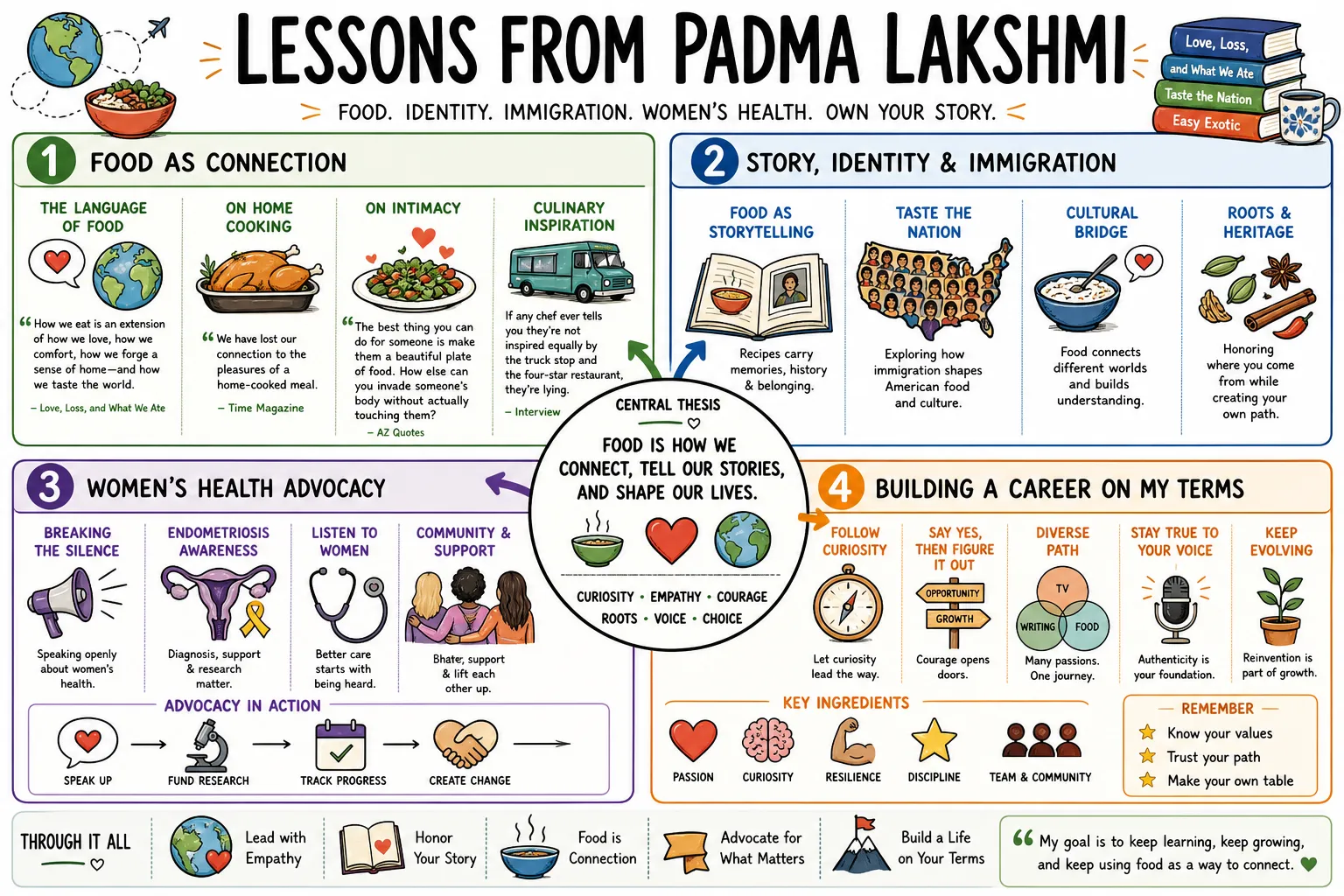
Lessons from Padma Lakshmi
Television host and author Padma Lakshmi spent over a decade on Top Chef and Taste the Nation using food to document American immigration, cultural identity, and personal history. This collection brings together her candid observations on the culinary industry, women's health advocacy, and how she built a career on her own terms.
Part 1: Food as Connection
- On the language of food: "Long before Padma Lakshmi ever stepped onto a television set, she learned that how we eat is an extension of how we love, how we comfort, how we forge a sense of home—and how we taste the world as we navigate our way through it." — Source: Love, Loss, and What We Ate
- On home cooking: "We would rather Instagram a dish we've had at a popular eatery than be proud of a simple roast chicken made at home. It feels like we have lost our connection to the pleasures of a home-cooked meal." — Source: Time Magazine
- On intimacy: "The best thing you can do for someone is make them a beautiful plate of food. How else can you invade someone's body without actually touching them?" — Source: AZ Quotes
- On culinary inspiration: "If any chef ever tells you they're not inspired equally by the truck-stop barbecue as they are by the four-star Michelin restaurant, they are lying." — Source: AZ Quotes
- On anticipation: "I'm the kind of girl who thinks about what she's gonna cook for dinner when she's finishing her lunch." — Source: AZ Quotes
- On shared meals: "Food acts as the most basic building block of a culture; sitting down to share a meal is the quickest way to understand another person's background." — Source: Taste the Nation
- On the kitchen's secrets: "The secrets of the kitchen were revealed to you in stages, on a need-to-know basis, just like the secrets of womanhood. You started wearing bras; you started handling the pressure cooker for lentils." — Source: Love, Loss, and What We Ate
- On preserving heritage: "Recipes are historical documents that record the survival and migration of families across generations." — Source: Taste the Nation
- On early food memories: "A child's earliest memories are frequently tied to the scents of a grandmother's kitchen, forming a sensory foundation that lasts permanently." — Source: Tomatoes for Neela
Part 2: The American Immigrant Experience
- On the core of American food: "Taste the Nation is a show about what connects us as Americans and as human beings. It's about the undeniable spirit, adaptability and resilience of the immigrants and indigenous communities who shaped this country and what we now know as 'American' food." — Source: PadmaLakshmi.com
- On the motivation for her show: "I’m an immigrant, and I’m not alone. I’ve spent my life writing about food and tasting the world. Now I wanna explore who we are through the food we eat." — Source: Taste the Nation
- On cultural microcosms: "The issue of immigration in this country is such an integral one—so many cultures have come here and contributed to American culture. America to me is a microcosm of the world." — Source: Life Time
- On braided communities: "I love the idea that we are a community braided together because people have been coming and going through El Paso for hundreds of years." — Source: Taste the Nation
- On food as a narrative vehicle: "In documenting immigrant communities, the culinary dishes are the entry point; the food acts as a bonus to the human stories of struggle." — Source: Anise to Za'atar
- On critics of Indian food: "When a critic called Indian food weak on social media, she replied, 'More for me then,' refusing to apologize for her cultural palate." — Source: Mashed
- On assimilation: "Immigrants often choose between blending in and preserving their heritage, with food usually serving as the last cultural artifact they relinquish." — Source: Taste the Nation
- On defining America: "What makes a dish American is not a European origin, but how it has been adopted, modified, and sustained by the people living here today." — Source: Taste the Nation
- On hyphenated identities: "Navigating a hyphenated identity means serving as an insider and an outsider simultaneously, constantly translating the world for both sides." — Source: Love, Loss, and What We Ate
- On indigenous foodways: "Discussions of American food are incomplete without acknowledging the indigenous ingredients and techniques that existed before settlers arrived." — Source: Taste the Nation
Part 3: Navigating the Culinary Industry
- On gender disparity in kitchens: "The professional food world is dominated by men. But most of the actual cooking of food in the world is done by women. And we women have always had to make do with whatever we can. We're a little bit like water—we find our way because we've had to." — Source: Citaty
- On critiquing food: "Judging a dish requires understanding the intention of the chef and evaluating whether they successfully translated that intention to the plate." — Source: Top Chef
- On industry gatekeeping: "The culinary establishment has historically placed higher value on European techniques over the complex methods of Asian, African, and Latin American cuisines." — Source: Taste the Nation
- On finding a niche: "Recognizing that your global travels and palate give you a unique, authoritative perspective is often the first step to carving out a space in food media." — Source: Masters of Scale
- On professional endurance: "Filming cooking competitions requires eating massive quantities of food, treating the body as an instrument that must be carefully managed off-camera." — Source: Love, Loss, and What We Ate
- On authentic leadership: "The secret to genuine leadership in the culinary world is to avoid mimicking aggressive chef personas and to lead with curiosity instead." — Source: Masters of Scale
- On the evolution of dining: "The restaurant industry is gradually moving away from formal dining rooms toward spaces reflecting the personal histories of their chefs." — Source: Top Chef
- On palate development: "A good palate is built through deliberate, repeated exposure and an open mind, rather than innate biological advantage." — Source: The Encyclopedia of Spices and Herbs
- On street food: "The most honest expressions of a city's culinary scene are rarely found in its expensive restaurants; they are cooked on the streets." — Source: Taste the Nation
- On respect for ingredients: "True culinary skill means treating a humble ingredient with enough respect to let it shine, rather than masking a poor ingredient with heavy technique." — Source: Top Chef
Part 4: Endometriosis and Women's Health
- On missing out on life: "This sickness, the 'endo-whatever,' had stained so much—my sense of self, my womanhood, my marriage, my ability to be present. I had effectively missed one week of each month every year of my life since I was thirteen." — Source: Patients Engage
- On the cost of undiagnosed illness: "I thought of all the many tests I missed in various classes throughout my education, the school dances, the jobs I knew I couldn't take as a model... How many family occasions was I absent from?" — Source: Patients Engage
- On turning anger into action: "When Padma Lakshmi finally received her endometriosis diagnosis at age 36, she felt relief—and then rage." — Source: Inner Balance
- On the danger of dismissal: "The medical community's habit of dismissing women's pain as just bad cramps is dangerous, far beyond being simply frustrating." — Source: Inner Balance
- On the motivation for advocacy: "I am a sufferer of endometriosis. I didn't want any young women to go through what I went through. I thought that people should know about it." — Source: All Author
- On systemic healthcare gaps: "The long delays in diagnosing reproductive health issues point to a broader systemic failure in how the medical establishment listens to women." — Source: Endometriosis Foundation of America
- On bodily autonomy: "Understanding and managing personal health is a fundamental aspect of taking control of one's own life." — Source: Endometriosis Foundation of America
- On the silence around menstruation: "Society's discomfort with discussing menstruation contributes directly to the suffering of millions of women who endure chronic pain in silence." — Source: Love, Loss, and What We Ate
- On education as a tool: "Teaching young girls what a normal period looks like serves as the first line of defense against years of unnecessary medical suffering." — Source: Endometriosis Foundation of America
Part 5: Womanhood and Beauty Standards
- On societal expectations: "Simply being born female in our society is to grow up being told your worth as a person is tied to how slim and attractive you are... the message is still driven home by the world at large." — Source: Goodreads
- On utility of looks: "Beauty is no accomplishment on its own. It's what you do with it." — Source: AZ Quotes
- On challenging stereotypes: "Where is it written that a smart woman can't also be stacked?" — Source: AZ Quotes
- On cultural differences in beauty: "To truly have a womanly figure, you had to eat, to be voluptuously full of food. This, of course, was in stark contrast to what was considered womanly or desirable in the West." — Source: Goodreads
- On women's voices: "Women's voices not being heard is the root of many of the problems of the world." — Source: AZ Quotes
- On physical scars: "Choosing not to hide a prominent physical scar allows it to serve as a map of your life and survival rather than a flaw to be concealed." — Source: Love, Loss, and What We Ate
- On aging in the public eye: "Growing older in television requires rejecting the industry's demand for youth and focusing instead on accumulated professional expertise." — Source: Cherry Bombe
- On the pressure to bounce back: "The expectation that women immediately return to pre-pregnancy bodies is a damaging standard that ignores the physical toll of creating a child." — Source: Love, Loss, and What We Ate
- On asserting capability: "A woman's value is constantly negotiated in public, making the assertion of her own intellect a daily requirement in professional settings." — Source: Goodreads
Part 6: Writing and Storytelling
- On the writing process: "Little did I know that writers are incredibly gifted at finding ways not to write." — Source: Substack
- On capturing memories: "Writing a memoir requires confronting the uncomfortable truths of the past rather than simply retelling polished public anecdotes." — Source: Love, Loss, and What We Ate
- On food writing: "Effective food writing goes beyond ingredients to examine the historical and emotional context in which a dish is prepared." — Source: The Encyclopedia of Spices and Herbs
- On vulnerability: "Sharing personal failures in print is terrifying but serves as the most effective way to establish a genuine connection with a reader." — Source: Love, Loss, and What We Ate
- On finding a voice: "It takes years of deliberate work to transition from being viewed as a subject in front of the camera to an author with a distinct, critical voice on the page." — Source: Masters of Scale
- On children's literature: "Writing for children provides an opportunity to pass down respect for the earth and seasonal eating without being overly didactic." — Source: Tomatoes for Neela
- On documenting spices: "Cataloging global spices acts as a method of mapping the history of trade, colonization, and cultural exchange across centuries." — Source: The Encyclopedia of Spices and Herbs
- On audio formats: "Audio formats like podcasts allow for a more intimate connection with an audience that television's strict editing often prevents." — Source: Substack
- On storytelling responsibility: "Holding a platform comes with a duty to amplify the voices of those historically excluded from mainstream narratives." — Source: Taste the Nation
- On rewriting the narrative: "Choosing to write a memoir is a deliberate act of taking control of a public narrative that had previously been shaped by tabloids." — Source: Love, Loss, and What We Ate
Part 7: Motherhood and Family
- On gratitude and priorities: "I have a great career, and I have my daughter. So what I don't have is not as important as what I do have." — Source: AZ Quotes
- On unconditional love: "Teddy taught me about kindness, about love that is unconditional; a sentiment not dependent on acceptance, approval, or the expectation of something in return." — Source: Goodreads
- On inherited wisdom: "The kitchen serves as the primary classroom where grandmothers pass down life lessons, history, and resilience to their granddaughters." — Source: Tomatoes for Neela
- On single motherhood: "Raising a child on your own terms requires building a chosen family and trusting your instincts over societal expectations." — Source: Love, Loss, and What We Ate
- On dietary traditions: "Feeding a child the foods of your culture is an act of preservation, ensuring your heritage survives for another generation." — Source: Love, Loss, and What We Ate
- On balancing career and family: "The idea of having it all is a myth; survival involves making difficult, conscious choices every day about where to allocate finite energy." — Source: Masters of Scale
- On protecting childhood: "In an era of intense public scrutiny, carving out a private space for a child to simply grow up is a primary parental responsibility." — Source: Love, Loss, and What We Ate
- On honoring the past: "Dedicating work to family members anchors the present to the lineage of strong women who made the current life possible." — Source: Tomatoes for Neela
- On setting an example: "The best way to teach a daughter about independence is by letting her watch you build and sustain a career you love." — Source: Cherry Bombe
Part 8: Resilience and Personal Growth
- On sensing change: "In the morning stillness, when the world is just waking up and your conscious mind hasn't fully taken over... It's like a quiet storm is coming." — Source: Goodreads
- On self-neglect: "I could worry about his health but somehow not about my own. We throw ourselves away a little each day." — Source: Goodreads
- On travel rituals: "I also like to make a little cocoon or sarcophagus for yourself with a shawl so you create your own microclimate. I know I look ridiculous doing it but it works." — Source: Town & Country
- On boundaries: "When asked if she had any allergies, she set a clear boundary on the type of energy she accepts by responding, 'None. Just to boring people.'" — Source: Interview Magazine
- On overcoming failure: "Professional setbacks are rarely the end of a career; they are the necessary friction required to figure out what you actually want to do." — Source: Masters of Scale
- On reinvention: "Pivoting careers requires a willingness to be a beginner again and to prove your intellect repeatedly to a skeptical audience." — Source: Love, Loss, and What We Ate
- On finding peace: "True stability comes from internal acceptance rather than external validation, a lesson usually learned only after years of chasing the latter." — Source: Love, Loss, and What We Ate
- On embracing the unknown: "A quiet storm on the horizon isn't always something to fear; it is often the deluge that washes away the old and forces you to rebuild something better." — Source: Goodreads
- On self-preservation: "Learning to prioritize your own well-being over the demands of your career is a necessary step for long-term survival in the public eye." — Source: Love, Loss, and What We Ate