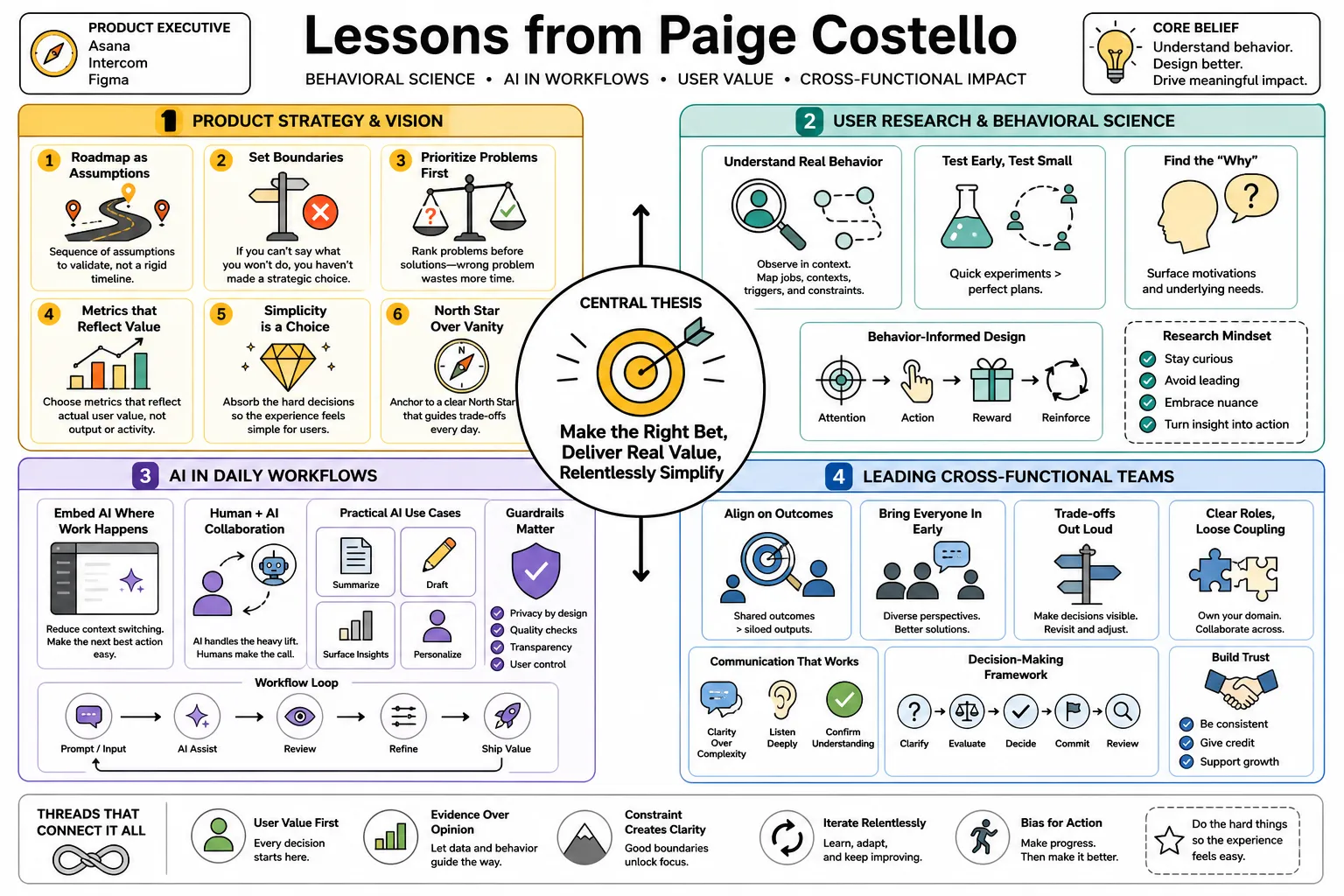
Lessons from Paige Costello
As a product executive at Asana, Intercom, and Figma, Paige Costello grounded interface design in behavioral science and built AI directly into daily workflows. This profile details her specific tactics for product strategy, user research, and managing cross-functional teams.
Part 1: Product Strategy and Vision
- On roadmap planning: "Treat your roadmap as a sequence of assumptions to validate rather than a rigid timeline of delivery dates." — Source: [Lenny's Podcast]
- On setting boundaries: "If you cannot clearly articulate what your product will not do, you have not actually made a strategic choice yet." — Source: [Product Excellence Summit]
- On prioritizing effectively: "Force rank your problems before you start force ranking your solutions, because prioritizing the wrong problem wastes more time than picking the wrong solution." — Source: [Lenny's Podcast]
- On defining success metrics: "Choose metrics that reflect actual user value delivered rather than the volume of features shipped or internal activity generated." — Source: [CRAFTED Podcast]
- On the value of simplicity: "Complexity usually creeps in when teams refuse to make a hard decision; simplicity is the result of absorbing that difficulty on behalf of the user." — Source: [Config 2025]
- On navigating ambiguity: "When the path forward is unclear, your job is to isolate the single biggest unknown and design a cheap way to learn about it." — Source: [Lenny's Podcast]
- On long-term vs. short-term: "You can ship quick wins to maintain momentum, but they must be structurally aligned with the three-year outcome you want to achieve." — Source: [Product Excellence Summit]
- On problem definition: "Spend twice as much time defining the problem as you think you need to. A well-framed problem often suggests its own solution." — Source: [Lenny's Podcast]
- On shifting market conditions: "When the market changes, do not adjust your feature list in isolation. Re-evaluate the underlying user needs that may have shifted in response." — Source: [WomenTech Network]
- On product-market fit: "Fit is not a static milestone you cross once. It is a continuous state you have to maintain as both your product and your audience evolve." — Source: [Lenny's Podcast]
Part 2: Artificial Intelligence and Software
- On AI-powered features: "Adding AI to a product only works if it directly reduces friction in a workflow the user is already trying to complete." — Source: [CRAFTED Podcast]
- On prompt-driven design: "Users should not have to learn prompt engineering to get value from your software. The interface should do the heavy lifting for them." — Source: [Config 2025]
- On human-in-the-loop AI: "Design systems where the AI proposes a draft and the human acts as the editor. This keeps the user in control while saving them time." — Source: [CRAFTED Podcast]
- On automation vs. augmentation: "Focus on augmenting human decision-making rather than trying to fully automate away tasks that require context and nuance." — Source: [Config 2025]
- On onboarding with AI: "When introducing AI features, show the user exactly what data is being used and how the output was generated to build early trust." — Source: [Irrational Labs]
- On hallucination risks: "Design your interface to gracefully handle errors. Make it easy for users to discard bad AI outputs without breaking their flow." — Source: [CRAFTED Podcast]
- On the pace of AI evolution: "Do not anchor your product strategy to a specific model's capabilities today. Build for the workflows that will still matter when models get ten times better." — Source: [Config 2025]
- On ethical AI deployment: "Consider the second-order effects of what you are automating. Ensure you are removing drudgery, not stripping away the meaningful parts of someone's job." — Source: [WomenTech Network]
- On user trust in AI: "Trust is built through predictable performance over time. If an AI feature is wildly inconsistent, users will simply revert to manual methods." — Source: [CRAFTED Podcast]
- On conversational interfaces: "Chat is not always the best UI. Often, extracting structured data from AI and presenting it in a standard table or form is much more useful." — Source: [Config 2025]
Part 3: Projecting Confidence and Leadership
- On executive presence: "Presence is less about having the loudest voice and more about the clarity and economy of your words." — Source: [Lenny's Podcast]
- On handling imposter syndrome: "Acknowledge what you do not know out loud. It immediately removes the pressure to pretend and builds credibility with your team." — Source: [WomenTech Network]
- On leading without authority: "Influence comes from consistently providing context that others lack and connecting their daily work to the broader company goals." — Source: [Lenny's Podcast]
- On admitting mistakes: "When a decision turns out wrong, dissect the process that led to it publicly. This normalizes course correction for everyone else." — Source: [Product Excellence Summit]
- On decisive action: "A good decision made today is usually better than a perfect decision made three weeks from now when the context has already shifted." — Source: [Lenny's Podcast]
- On public speaking: "Structure your presentations around the one specific takeaway you want the audience to remember, and cut anything that dilutes it." — Source: [WomenTech Network]
- On setting team culture: "Culture is defined entirely by the worst behavior you are willing to tolerate in a high performer." — Source: [Lenny's Podcast]
- On giving difficult feedback: "Deliver hard feedback directly and privately, focusing purely on observable behaviors and their impact rather than personal intent." — Source: [WomenTech Network]
- On protecting team time: "Your job as a leader is to act as a shield against organizational distraction so your team has unbroken blocks of deep work." — Source: [Product Excellence Summit]
Part 4: User Research and Behavioral Science
- On driving user accountability: "If you want users to complete a task, make the next step incredibly obvious and reduce the number of clicks to zero if possible." — Source: [Irrational Labs]
- On observing natural behavior: "Watch what users actually do in your product, because what they say they do in interviews is often an idealized version of reality." — Source: [CRAFTED Podcast]
- On cognitive load: "Every new button or option you add taxes the user's working memory. Keep the default interface focused strictly on the primary use case." — Source: [Irrational Labs]
- On default settings: "Users rarely change default settings. Design your defaults to represent the most successful and secure path through the product." — Source: [Irrational Labs]
- On user onboarding: "Onboarding should not be a tour of features. It should be the shortest path to experiencing the core value of the product for the first time." — Source: [Product Excellence Summit]
- On continuous feedback loops: "Set up systems to hear from users who just churned. Their reasons are often much more honest than those of your active, satisfied users." — Source: [Lenny's Podcast]
- On qualitative vs. quantitative data: "Use data to understand what is happening at scale, but you must talk to users to understand why it is happening." — Source: [CRAFTED Podcast]
- On identifying friction points: "Look for the places where users are creating their own workarounds or spreadsheets outside your product. That points directly to a missing feature." — Source: [Config 2025]
- On behavioral economics in UI: "Small changes in framing, like showing progress toward a goal rather than distance from the start, can drastically change completion rates." — Source: [Irrational Labs]
Part 5: Asking the Right Questions
- On interrogating the premise: "Before executing a request from leadership, pause to ask what underlying problem they are actually trying to solve." — Source: [Lenny's Podcast]
- On avoiding leading questions: "Never ask a user if they would use a feature. Ask them to describe how they currently solve the problem today." — Source: [CRAFTED Podcast]
- On unblocking engineering: "When engineers are stuck, do not ask for a status update. Ask what constraints you can remove to make the path easier." — Source: [Product Excellence Summit]
- On clarifying stakeholder intent: "When stakeholders disagree, trace the disagreement back to its root. It is usually a misalignment on the core customer persona." — Source: [Lenny's Podcast]
- On root cause analysis: "Use the 'five whys' framework not as a rigid rule, but as a habit to ensure you are treating the disease and not the symptom." — Source: [WomenTech Network]
- On cross-functional syncs: "Start meetings by asking what decision needs to be made by the end of the hour. If there is no decision, cancel the meeting." — Source: [Lenny's Podcast]
- On post-mortems: "Ask 'what broke in our process' rather than 'who made the error' to foster a culture where people surface issues early." — Source: [Product Excellence Summit]
- On framing choices: "Present options to stakeholders with clear trade-offs attached. Ask 'which set of problems would you rather have?'" — Source: [Lenny's Podcast]
- On customer interviews: "Ask for specific, recent examples of behavior. 'Tell me about the last time you did this' yields much better data than 'how do you usually do this.'" — Source: [Irrational Labs]
- On challenging assumptions: "Regularly ask your team what they would do if they had to achieve the same goal in half the time. It forces creative scoping." — Source: [Lenny's Podcast]
Part 6: Winning Over Skeptics
- On data-driven persuasion: "Skeptics rarely change their mind based on passion. Bring clear data from a small, contained experiment to prove your point safely." — Source: [Lenny's Podcast]
- On acknowledging trade-offs: "You build instant credibility with skeptics when you proactively point out the flaws and risks in your own proposal." — Source: [Product Excellence Summit]
- On finding internal champions: "Identify the most respected skeptic in the room and work with them one-on-one before the broader team meeting." — Source: [Lenny's Podcast]
- On handling vocal opposition: "Listen fully to objections without interrupting. Often, people just need to know their concerns are recorded and understood." — Source: [WomenTech Network]
- On the value of prototyping: "A functioning prototype ends most philosophical debates. Show the interaction instead of arguing about whether it will work." — Source: [Config 2025]
- On transparent communication: "Share the reasons behind a decision, especially the alternative paths you rejected. It shows the skeptics you considered their viewpoint." — Source: [Lenny's Podcast]
- On compromise in product: "Do not compromise by watering down a feature so it pleases everyone but helps no one. Choose a specific persona and serve them well." — Source: [Product Excellence Summit]
- On managing up: "When pitching executives, start with the conclusion and the business impact, then let them ask for the technical details if they want them." — Source: [Lenny's Podcast]
- On narrative framing: "Tie your new initiative directly to a company goal the skeptic already cares about. Make your success equal their success." — Source: [WomenTech Network]
Part 7: Execution and Shipping
- On reducing cycle times: "Break large projects into the smallest possible functional increments. Shipping smaller batches reduces risk and accelerates learning." — Source: [Product Excellence Summit]
- On defining minimum lovable products: "Your first release does not need every feature, but the core flow must be polished enough that users actually enjoy completing it." — Source: [Lenny's Podcast]
- On engineering partnerships: "Involve engineering in the discovery phase, rather than limiting them to delivery. They will often spot technical shortcuts to user value that a PM would miss." — Source: [Config 2025]
- On QA and polish: "Set a strict bar for quality before launch. Users will forgive missing features, but they will not forgive bugs that lose their data." — Source: [CRAFTED Podcast]
- On phased rollouts: "Always use feature flags and roll out in percentages. It allows you to catch edge cases in production without impacting the whole user base." — Source: [Product Excellence Summit]
- On technical debt: "Allocate a fixed percentage of every sprint to paying down technical debt, or you will eventually reach a point where you can no longer ship at all." — Source: [Config 2025]
- On celebrating launches: "Take time to recognize the team's effort after a release, but make sure the celebration focuses on the user impact over the code shipping." — Source: [WomenTech Network]
- On scope creep: "When new requirements emerge mid-cycle, require the team to drop something of equal size from the current sprint to accommodate it." — Source: [Lenny's Podcast]
- On operational cadence: "Establish a regular rhythm for reviews and planning. Predictability in the process gives the team freedom to be creative in the work." — Source: [Product Excellence Summit]
Part 8: Career Growth and Navigation
- On transitioning to leadership: "The shift to management means your output is no longer the product; your output is the team that builds the product." — Source: [Lenny's Podcast]
- On finding mentors: "Look for mentors who excel at the specific skill you are currently lacking, rather than just searching for someone with an impressive title." — Source: [WomenTech Network]
- On interviewing PMs: "When hiring, look for curiosity and the ability to synthesize complex information quickly instead of merely checking for domain experience." — Source: [Lenny's Podcast]
- On continuous learning: "The best product managers are generalists who can dive deep into a specific technical or design topic when the project requires it." — Source: [Product Excellence Summit]
- On managing burnout: "Protect your energy by aggressively declining meetings where you are not required to make a decision or provide unique context." — Source: [WomenTech Network]
- On domain expertise: "Do not rely entirely on your past experience. When you join a new company, approach the product with a beginner's mind to spot obvious flaws." — Source: [CRAFTED Podcast]
- On lateral career moves: "Taking a lateral role in a different functional area often accelerates your long-term growth more than a premature promotion." — Source: [WomenTech Network]
- On building a personal brand: "Your brand is just the promise of the experience people will have when they work with you. Build it by being consistently reliable." — Source: [Lenny's Podcast]
- On leaving a legacy: "The true measure of your work is whether the frameworks and culture you instituted remain effective long after you leave the team." — Source: [Product Excellence Summit]