Lessons from Parag Agrawal
Computer scientist Parag Agrawal served as Twitter's CTO and CEO, where he started Project Bluesky to decentralize social media. He now runs Parallel Web Systems, building programmatic internet infrastructure for autonomous AI agents. This collection covers his technical philosophy, his approach to scaling complex systems, and his take on how AI will shift web economics.
Part 1: The Agentic Web Transition
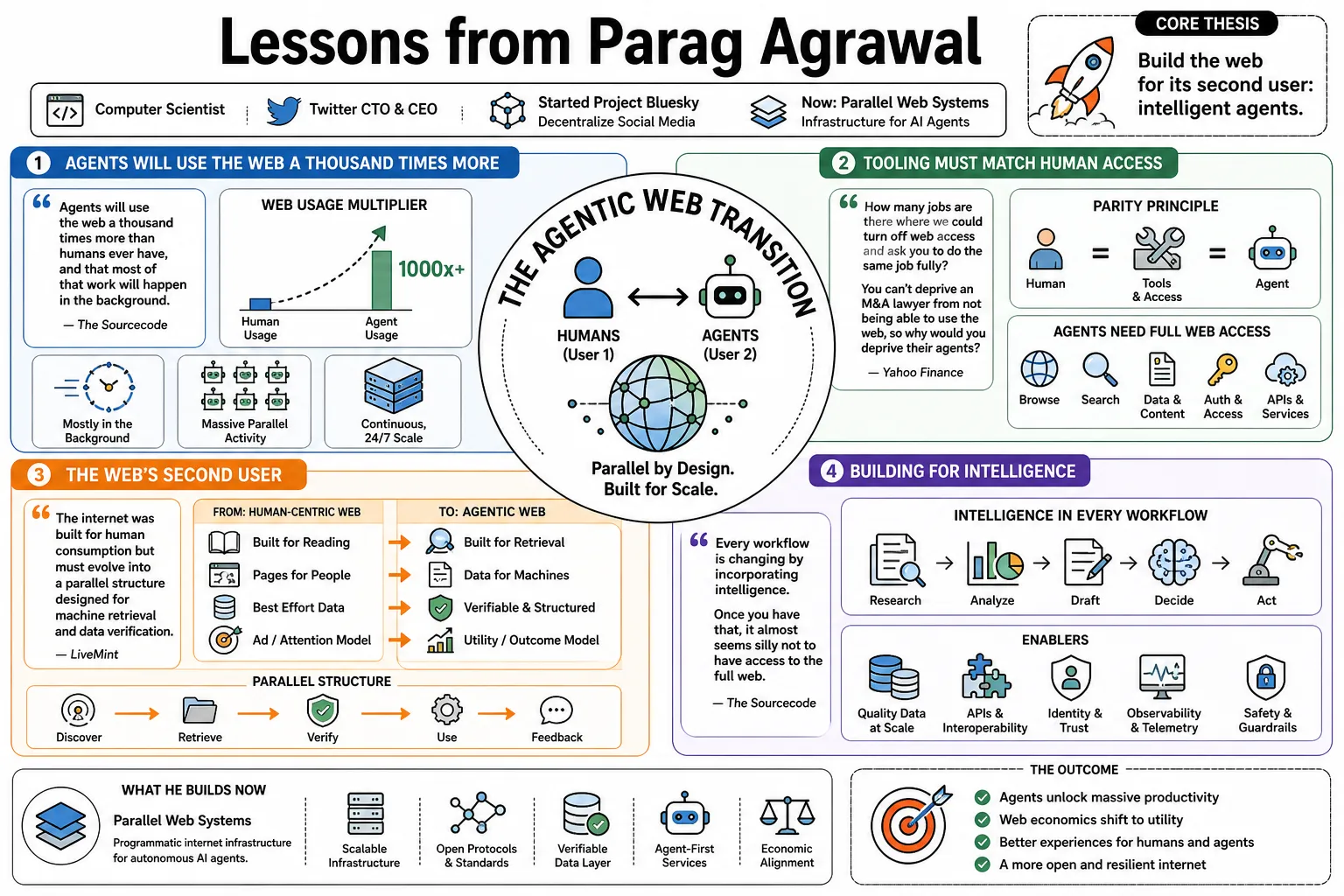
- On AI web usage: "Agents will use the web a thousand times more than humans ever have, and that most of that work will happen in the background." — Source: The Sourcecode
- On necessary tooling: "How many jobs are there where we could turn off web access and ask you to do the same job fully? You can't deprive an M&A lawyer from not being able to use the web, so why would you deprive their agents?" — Source: Yahoo Finance
- On the web's second user: The internet was built for human consumption but must evolve into a parallel structure designed for machine retrieval and data verification. — Source: LiveMint
- On building for intelligence: "Every workflow is changing by incorporating intelligence. Once you have that, it almost seems silly not to have access to the open web. That's what we're building, a parallel web for AI." — Source: InfoSecWriteups
- On infrastructure design: Programmatic web infrastructure allows AI agents to search, retrieve, and process information directly from the live web without human interfaces. — Source: SiliconANGLE
- On search paradigms: In the Founders in Arms conversation, Agrawal describes the web moving from pull-based search to push-based alerts that can call a human or agent when something important changes. — Reference: Founders in Arms transcript on pull-to-push web infrastructure
- On data access: Agrawal argues that blanket blocking of AI access is value-destructive because it can block good actors while failing to stop bad ones, so better market structures are needed for web content. — Reference: Founders in Arms transcript on blocking, bad actors, and new content business models
- On system architecture: In the First Round episode, Agrawal says AI-era products require teams to communicate and build around stochastic systems rather than only deterministic product assumptions. — Reference: First Round episode transcript on stochastic systems
- On workflow differences: AI agents operate fundamentally differently than humans clicking links in a browser, requiring a complete overhaul of internet routing. — Source: SiliconANGLE
- On real-time verification: The next era requires specialized internet pipelines where AI models can verify real-time data seamlessly. — Source: LiveMint
Part 2: Monetization and Web Economics
- On human friction: "For humans, ads was the most efficient business model due to the human cognitive overhead with payments." — Source: Digg
- On agent transactions: "With agents, direct payments will work much better. This is why I'm so optimistic about high quality content thriving on the web as agents take over." — Source: Digg
- On compensating creators: New business models must pay creators financially when their content is utilized by AI agents to complete autonomous tasks. — Source: Stratechery
- On content value: If artificial intelligence relies on human content to function accurately, the underlying infrastructure must ensure the creators of that content are rewarded. — Source: Parallel.ai
- On advertising limits: The traditional advertising model breaks down completely when the primary user of the web is an AI that ignores banner ads. — Source: Stratechery
- On aligning incentives: The open web will survive only if we build APIs that align the financial incentives of AI developers with those of publishers. — Source: StartupFortune
- On legacy strategies: The First Round episode frames Parallel as infrastructure for the web's second user, AIs, which pushes builders beyond attention-based experiences designed only for humans. — Reference: First Round episode overview on AI as the primary web customer
- On microtransactions: AI agents can handle the high volume of direct microtransactions that human users typically find too cumbersome to manage. — Source: Digg
- On sustaining journalism: We can ensure journalism and creative work survive the AI transition by structuring direct compensation for algorithmic data usage. — Source: Stratechery
Part 3: Protocol and Decentralization
- On the Bluesky vision: The initiative sought to create a decentralized protocol that would allow platforms to transition away from centralized corporate control. — Source: Business Chief
- On user empowerment: A decentralized standard gives users direct control over their own communities and content moderation tools. — Source: TubeFilter
- On technical priorities: Decentralization remained a critical long-term technical priority for Twitter's underlying infrastructure even during leadership transitions. — Source: TubeFilter
- On Web3 limitations: Web3 focused heavily on decentralized financial ownership but ultimately struggled to scale effectively for mass consumer applications. — Source: LiveMint
- On protocol versus platform: Building a shared protocol instead of a siloed platform reduces the moderation and operational burden on any single corporate entity. — Source: Gizmodo
- On open standards: The core objective of Bluesky was to develop an open social media standard that any independent developer could build upon safely. — Source: Wikipedia
- On structural independence: True decentralization requires setting up initiatives as independent entities that are free from a parent company's immediate commercial pressures. — Source: Gizmodo
- On the AT Protocol: The eventual launch of the AT Protocol demonstrated that social media networks can function securely at scale without a central arbiter. — Source: Wikipedia
- On data portability: Decentralized networks solve the lock-in problem by allowing users to move their social graphs seamlessly between competing applications. — Source: Business Chief
- On infrastructural separation: His work at Parallel focuses purely on AI web access protocols rather than the decentralized ownership models popularized by crypto. — Source: LiveMint
Part 4: Content Moderation and Platform Health
- On speech constraints: "Our role is not to be bound by the First Amendment, but our role is to serve a healthy public conversation." — Source: MIT Technology Review
- On platform responsibility: "...and our moves are reflective of things that we believe lead to a healthier public conversation." — Source: MIT Technology Review
- On adapting rules: "The kinds of things that we do about this is, focus less on thinking about free speech, but thinking about how the times have changed." — Source: MIT Technology Review
- On extreme attention: The public scrutiny he faced as CEO felt like a zero-sum game, but he now views attention as a positive-sum resource for evangelizing technology. — Source: ELC Community
- On global complexity: Managing a platform globally requires prioritizing community safety over strict adherence to localized and conflicting legal frameworks. — Source: Forbes
- On past quotes: A controversial 2010 tweet about double standards was actually him quoting a comedian to highlight hypocritical media narratives. — Source: The Quint
- On looking backward: "Yes, we could have done things differently and better. I could have done things differently. I think about that a lot." — Source: Inshorts
- On the moderation burden: Centralized social platforms bear a nearly impossible operational burden regarding content moderation that decentralized protocols could alleviate. — Source: Business Chief
- On navigating polarization: Technical leaders must make decisions that serve platform health even when faced with intense partisan criticism from the public. — Source: Fox Business
Part 5: Engineering Culture and Execution
- On daily execution: "Every few weeks, we solve one bottleneck and hit another somewhere. We're building some things I'm really excited about. I wouldn't work here if I wasn't." — Source: Financial Express
- On mission ambition: "Our mission is to keep the web open, transparent and competitive. We build the best infrastructure for AI agent applications... Our team is lean. Our ambitions are big." — Source: AI Magazine
- On development speed: Accelerating engineering velocity and deploying machine learning features across the platform were his primary technical mandates as CTO. — Source: Fox Business
- On technical scaling: Engineering leaders must scale technology systems while making data-driven architectural decisions under conditions of extreme uncertainty. — Source: ELC Community
- On working environments: Agrawal contrasts Twitter's remote-friendly scale with Parallel's small, in-person, five-day office rhythm, making team design contingent on stage and problem shape. — Reference: First Round transcript on Parallel's in-person operating model
- On the startup binary: His First Round conversation treats the move from Twitter to Parallel as a zero-to-one reset, where old leadership habits had to be unlearned for a small company still proving itself. — Reference: First Round transcript on unlearning from Twitter to startup mode
- On capital efficiency: The First Round episode covers Agrawal's fundraising framework in the context of Parallel's early build, supporting a lesson about raising capital around specific survival and execution needs. — Reference: First Round episode agenda on fundraising framework
- On flexible roadmaps: Agrawal says AI product work requires looking a step ahead because capabilities change quickly, so roadmaps need to follow what can work next rather than only today's model limits. — Reference: First Round transcript on building ahead of AI capability changes
- On technical leadership: A chief technology officer must oversee architecture while actively unblocking the human and organizational bottlenecks that slow down deployment. — Source: Plymouth University
Part 6: Machine Learning and Architecture
- On reducing hallucination: Specialized APIs that allow AI systems to search the live web are critical for reducing hallucinations and improving model reliability. — Source: Yahoo Finance
- On technical debt: Integrating advanced machine learning into legacy platforms requires engineers to carefully navigate years of accumulated technical debt and legacy code. — Source: Grokipedia
- On real-time constraints: Large language models remain fundamentally limited if they cannot verify their generated outputs against live internet data. — Source: SiliconANGLE
- On specialized agents: Tool-wielding AI agents can frequently outperform monolithic large language models when executing complex or multi-step research tasks. — Source: Entrepreneur
- On missing layers: The AI software ecosystem requires a dedicated infrastructure layer that sits directly between the neural network models and the raw internet. — Source: AI Magazine
- On compute shifts: The Founders in Arms transcript frames agents as limited less by human attention than by available compute, which changes how web-scale infrastructure has to be imagined. — Reference: Founders in Arms transcript on agents, GPUs, and orders-of-magnitude web use
- On algorithmic clarity: Machine learning systems operating at consumer scale must be built with mechanisms that allow engineers to reliably debug their outputs. — Source: ELC Community
- On pipeline velocity: The speed at which an engineering organization can train new models is entirely dependent on the quality of its underlying data pipelines. — Source: Fox Business
- On predictive feeds: His early architectural work focused on transitioning chronological content feeds into highly predictive, machine-learning-driven timelines. — Source: Wikipedia
Part 7: Navigating Leadership Transitions
- On crisis management: Leading a public company through a hostile acquisition requires compartmentalizing external noise to maintain focus on daily operational duties. — Source: Quora
- On team morale: During periods of corporate turbulence, a technical leader's primary job is to maintain team focus and protect the underlying engineering culture. — Source: Business Chief
- On quiet execution: Effective leadership often involves managing unglamorous infrastructural upgrades behind the scenes rather than seeking public recognition. — Source: Industry Leaders Magazine
- On structural clarity: Stepping away from executive roles provides clarity on the systemic issues inherent in managing publicly traded social media conglomerates. — Source: Inshorts
- On personal resets: Transitioning from a highly scrutinized public CEO to a startup founder requires a fundamental reset in how one defines professional success. — Source: ELC Community
- On shielding engineers: A crucial aspect of his tenure was attempting to shield core engineering teams from erratic shifts in the external media narrative. — Source: Washington Post
- On executive limits: Even at the highest levels of corporate leadership, an executive's ability to enact change is constrained by board dynamics and shareholder priorities. — Source: Forbes
- On strategic patience: Long-term technical initiatives must be actively protected from short-term financial engineering and quarterly earnings pressures. — Source: TubeFilter
- On evolving skills: First Round's episode explicitly covers the evolving role of engineers in an AI-assisted world, while Agrawal describes product and infrastructure work changing as agents become production users. — Reference: First Round episode on engineers in an AI-assisted world
Part 8: The Vision for the Future
- On the inevitable transition: The shift toward an agent-first internet is a certainty that requires immediate infrastructural preparation from developers. — Source: SiliconANGLE
- On preserving the web: "Our mission is to keep the web open, transparent and competitive." — Source: AI Magazine
- On human roles: Agrawal's agent framing keeps humans in the loop as customers of outcomes, while software does more background work through APIs, workflows, and deep research systems. — Reference: First Round transcript on agents, workflows, and human-facing outcomes
- On computing eras: Agrawal traces the agentic web to a change in the primary consumer of the web, from people looking at devices to agents requesting dense context for downstream work. — Reference: Founders in Arms transcript on agents as the primary web consumer
- On the end of blue links: The future of search is an intelligent agent that synthesizes verified data from across the internet into actionable insights rather than lists of links. — Source: Yahoo Finance
- On data starvation: If we do not fix financial incentives for data creation, the AI ecosystem will eventually starve itself of new, high-quality human information. — Source: Stratechery
- On ultimate goals: The Founders in Arms discussion grounds Parallel's work in helping agents access the exact right web content so they can complete useful tasks instead of merely returning ranked links. — Reference: Founders in Arms transcript on agent-ready web content
- On static obsolescence: The rapid pace of AI advancement means that building static software solutions guarantees obsolescence; infrastructure must be inherently adaptable. — Source: InfoSecWriteups
- On specialized networks: The most effective AI systems of the future will rely on a network of specialized, tool-using agents rather than a single generalized oracle. — Source: Entrepreneur
- On architecting tomorrow: Reuters reported that Parallel raised new funding to build web-search infrastructure for AI agents, reinforcing that Agrawal's post-Twitter work is an infrastructure bet rather than a conventional consumer search product. — Reference: Reuters report on Parallel's AI-agent search infrastructure funding