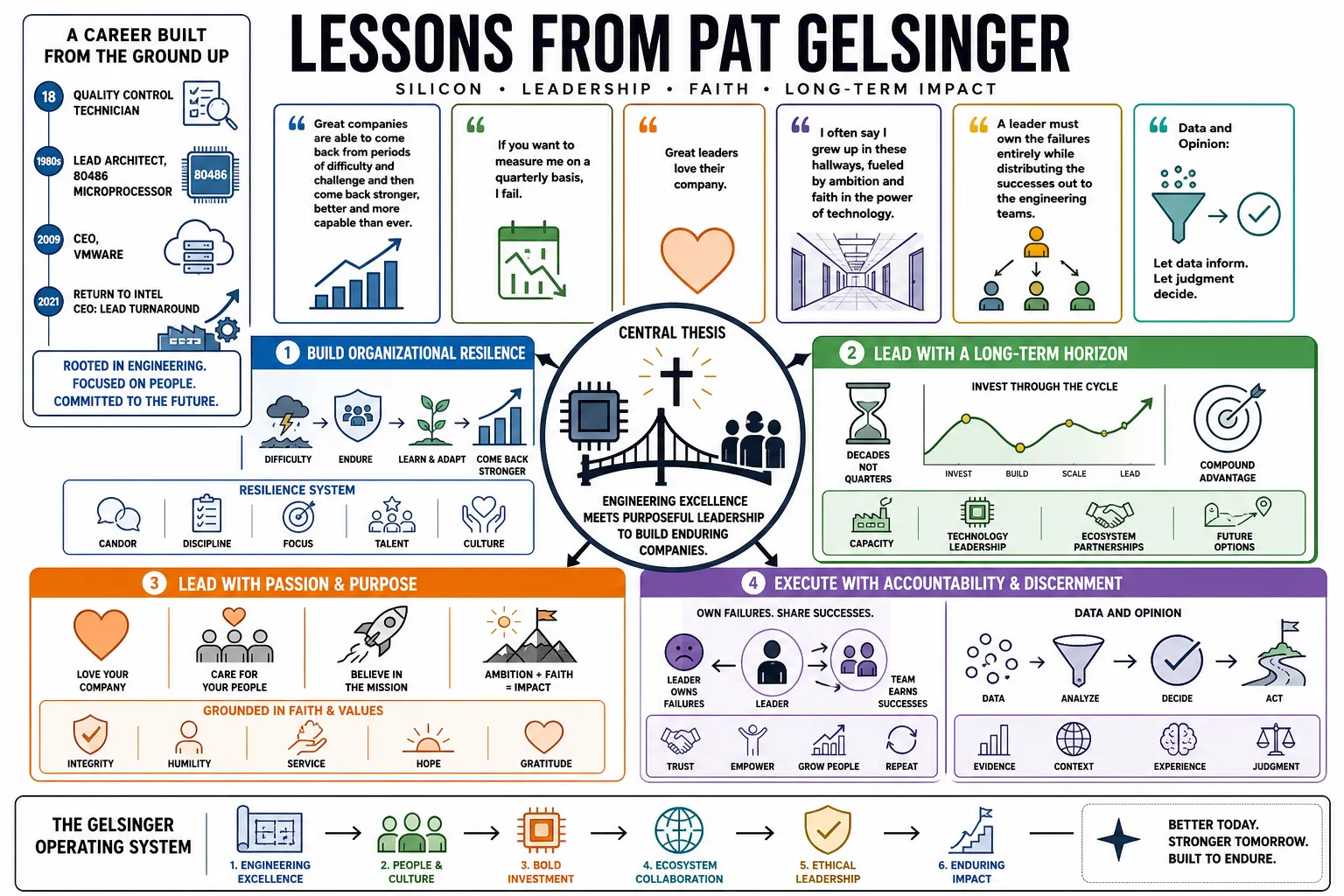
Pat Gelsinger spent the majority of his career at Intel, starting as an 18-year-old quality control technician and eventually becoming the lead architect of the 80486 microprocessor. After serving as CEO of VMware, he returned to Intel in 2021 to lead a complex, multi-year turnaround effort centered on revitalizing the company's manufacturing and engineering culture. This profile compiles his perspectives on silicon architecture, corporate leadership, and the intersection of executive ambition with personal faith.
Part 1: Leadership and Management
- On Organizational Resilience: "Great companies are able to come back from periods of difficulty and challenge and then come back stronger, better and more capable than ever." — Source: [Intel Newsroom]
- On Long-Term Horizon: "If you want to measure me on a quarterly basis, I fail." — Source: [The Wall Street Journal]
- On Authentic Passion: "Great leaders love their company." — Source: [Global Leadership Network]
- On Foundational Ambition: "I often say I grew up in these hallways, fueled by ambition and faith in the power of technology." — Source: [Intel Employee Memo]
- On Executive Accountability: A leader must own the failures entirely while distributing the successes out to the engineering teams. — Source: [VMware Retrospective]
- On Data and Opinion: You must bring both data and a well-defended opinion to the table; without both, you have no right to be in the meeting. — Source: [CNBC Interview]
- On Corporate Culture: Culture isn't written in a handbook; it is forged in how an executive team responds to a structural crisis. — Source: [Forbes Profile]
- On Innovation and Fear: If the fear of a product failure outweighs the desire to build something new, an engineering company is already dead. — Source: [TechCrunch Disrupt]
- On Trust: Trust is the currency of leadership; it is earned in drops over years and lost in buckets over days. — Source: [The Juggling Act]
- On Setting Goals: Set audacious goals that force an organization to stretch beyond its current physical and financial capabilities. — Source: [Intel Innovation Keynote]
Part 2: Moore's Law and the Future of Silicon
- On the Life of Moore's Law: "Moore's Law is alive and well... until the periodic table is exhausted, we ain't done." — Source: [Intel Innovation 2021]
- On Stewardship: "We as the stewards of Moore's Law will be relentless in our path to innovate in the magic of silicon." — Source: [Intel Unleashed Keynote]
- On Bending the Curve: "We expect to even bend the curve faster than a doubling every two years." — Source: [Intel Architecture Day]
- On the Golden Age: The initial "Golden Age" of Moore's Law may have evolved, but the underlying drive for density and efficiency dictates modern computing. — Source: [MIT Technology Review]
- On Silicon as the Foundation: Everything digital runs on silicon; it is the fundamental building block of the global supply chain. — Source: [World Economic Forum]
- On Geopolitics and Fabs: Semiconductor manufacturing is not just a commercial enterprise; it is a critical matter of national security and domestic resilience. — Source: [White House Semiconductor Summit]
- On Manufacturing Dominance: To lead in technology, you must lead in manufacturing; you cannot permanently separate chip design from the foundry. — Source: [Bloomberg Interview]
- On the Pace of Change: "Today, the pace of technology is the fastest of your life. It's also the slowest of the rest of your life." — Source: [Intel Vision 2022]
- On Advanced Packaging: The future of node shrinks isn't just about smaller transistors; it relies on 3D packaging and connecting chiplets. — Source: [IEEE Spectrum]
- On the Human Element: The advancement of silicon is brought to life by the dedication of material scientists who refuse to accept physical limits. — Source: [Intel Manufacturing Day]
Part 3: Work-Life Integration (The Juggling Act)
- On Family Time: "If you have kids, 6 to 9 p.m. is gold. Do not squander it." — Source: [Business Insider]
- On Late-Night Work: "You might get back on email at 9 p.m., or be doing Javascript at midnight, but make sure you carve those hours out and protect those." — Source: [Business Insider]
- On the Points System: Quantifying balance—like earning points for coming home by 5:00 p.m.—creates a tangible system of personal accountability. — Source: [The Juggling Act]
- On the Integrated Life: "We can't view our work as a compartment where the work personality shows up... we each need to strive to be an integrated person." — Source: [The Juggling Act]
- On Distraction: "Satan doesn't need to deceive us; he just needs to keep us busy." — Source: [The Juggling Act]
- On Intentionality over Perfection: You will make mistakes in balancing your schedule, but the key is to adjust and keep your priorities in perspective. — Source: [The Veritas Forum]
- On Setting Boundaries: Without firm boundaries, the demands of a high-level executive career will consume every available waking hour. — Source: [Harvard Business Review]
- On the "Big Top" Feeling: You may feel like you are living under the Big Top, but you don't need to be a circus professional to keep your life organized. — Source: [The Juggling Act]
- On Prioritization: After prioritizing a relationship with God, immediate family must always be the next unwavering commitment. — Source: [Purpose Nation Podcast]
- On Weekend Travel: If business travel consumes the weekend, there must be a structured way to reclaim that lost time for family during the week. — Source: [Business Insider]
Part 4: Faith, Values, and Stewardship
- On Life's Mission: "My life mission has been [to] work on a piece of technology that would improve the quality of life of every human on the planet." — Source: [Faith Driven Entrepreneur]
- On Excellence: "Don't apologize for success... Jesus rebuked the servant who buried his talent, not the one who multiplied it." — Source: [Theology of Work Project]
- On Value Creation: "Excellence and value creation are forms of stewardship." — Source: [Theology of Work Project]
- On Steadfastness: "Let your eyes look straight ahead; fix your gaze directly before you." — Source: [Intel Internal Memo]
- On Faith in the Workplace: Faith is not something to hide; it acts as the moral compass that guides ethical decision-making in corporate environments. — Source: [Purpose Nation Podcast]
- On Servant Leadership: The highest calling of a chief executive is to serve the employees, the customers, and the broader community they operate within. — Source: [Global Leadership Network]
- On Giving Back: Financial success should be viewed as a mechanism to fund philanthropic endeavors and support community institutions. — Source: [Faith Driven Entrepreneur]
- On Integrity: True integrity means your public decisions in the boardroom align perfectly with your private convictions at home. — Source: [The Juggling Act]
- On Purpose: Technology without an underlying moral purpose is just machinery; technology guided by strong values can uplift communities. — Source: [Intel Vision Event]
Part 5: Mentorship and the Grove Legacy
- On Mentoring with Andy Grove: "Mentoring with Andy Grove was like going to the dentist and not getting Novocain." — Source: [ChannelE2E]
- On the Importance of Data: "If you went into a meeting, you'd better have your data; you'd better have your opinion." — Source: [Substack Profile]
- On Grove's Passing: "Today the world has lost a great man in Andy Grove. A friend and mentor for many years." — Source: [X (formerly Twitter)]
- On Career Trajectory: Grove's persuasion to abandon a PhD path in favor of leading the 80486 team fundamentally altered the trajectory of a young engineer's life. — Source: [The Economic Times]
- On Discipline and Accountability: The culture Grove built at Intel—defined by intense discipline and rigorous execution—is the gold standard for the semiconductor industry. — Source: [Intel Corporate Archives]
- On Constructive Confrontation: Disagreement is not disrespect; fierce, data-driven debate is necessary to arrive at the correct engineering solutions. — Source: [Inc. Magazine]
- On the Power of Mentors: A highly effective mentor doesn't just offer advice; they force you into leadership roles before you feel completely ready. — Source: [Forbes Leadership]
- On Passing the Torch: The responsibility of being mentored by a silicon legend is that you are obligated to mentor the next generation of architects. — Source: [Stanford GSB Talk]
- On Paranoia: Only the paranoid survive, but that paranoia must be channeled into productive product development, not internal corporate politics. — Source: [The Wall Street Journal]
Part 6: Turnarounds, Resilience, and Crisis
- On Fixing Fundamentals: You cannot market your way out of a product deficit; you must physically engineer your way out. — Source: [CNBC Fast Money]
- On Rebuilding Trust: When a technology firm loses its edge, rebuilding trust with enterprise customers takes years of consistent, bug-free execution. — Source: [Bloomberg Technology]
- On Staying the Course: In a turnaround, the hardest part is maintaining the conviction to stick to a multi-year plan when Wall Street demands immediate quarterly results. — Source: [The Wall Street Journal]
- On Facing Reality: The first step in any corporate turnaround is a brutal, unvarnished internal assessment of exactly where the company has fallen behind. — Source: [Financial Times]
- On Morale During Crisis: An executive's job during a restructuring is to absorb the anxiety from the board and project focus down to the engineering teams. — Source: [Harvard Business Review]
- On Strategic Pivots: A corporate pivot is only successful if it leverages the historical DNA of the company rather than abandoning it entirely. — Source: [Fortune Magazine]
- On Patience: True technological turnarounds take time; silicon development cycles are measured in half-decades, not financial quarters. — Source: [TechCrunch]
- On Competitive Drive: A healthy dose of underdog mentality is the best fuel for a legacy company that grew too comfortable in its past monopoly. — Source: [Intel Innovation Keynote]
- On Hard Decisions: Preserving the core capabilities of a firm sometimes requires painfully divesting profitable businesses that distract from the main mission. — Source: [Reuters]
Part 7: Cloud, Software, and the Digital Edge
- On Technology's Importance: "Technology has never been more important for humanity than it is now." — Source: [Intel Innovation Event]
- On the Four Superpowers: "Everything is becoming digital, with four key superpowers – cloud, mobility fueled by 5G, artificial intelligence and the intelligent edge." — Source: [Intel Innovation Event]
- On the Software-Defined Future: Hardware sets the physical ceiling, but software defines the user experience; the future belongs to organizations that master both. — Source: [VMworld Keynote]
- On Cloud Transformation: The enterprise shift to the cloud is not just an infrastructure upgrade; it is a fundamental rewiring of how business operates. — Source: [Forbes Technology Council]
- On Open Ecosystems: No single company can dictate the future of computing; success requires an open, collaborative developer ecosystem. — Source: [Open Source Summit]
- On AI: Artificial Intelligence is not a standalone application; it is a foundational capability that will permeate every layer of the network stack. — Source: [Intel Vision Conference]
- On Virtualization: Abstracting the hardware away was the essential key to unlocking the true density and efficiency of modern data centers. — Source: [VMware Retrospective]
- On Security: In a highly distributed world, security must be baked directly into the silicon architecture, not bolted on as a software afterthought. — Source: [RSA Conference]
- On Digital Transcendence: The combination of ubiquitous connectivity and infinite compute is poised to transform every physical industry on earth. — Source: [Intel Keynote Address]
Part 8: Engineering, Architecture, and Building Things
- On the 80486 Processor: The 80486 was more than just a microprocessor; it was a career-defining project that served as a personal "Rembrandt." — Source: [The Washington Post]
- On Early AI Ambitions: Even in 1986, architecture teams were sketching out how to build early neural networks and machine learning capabilities into the silicon. — Source: [Computer History Museum]
- On the Engineering Mindset: A true engineer looks at a physical limitation not as a dead end, but as a complex puzzle waiting for a creative workaround. — Source: [IEEE Spectrum]
- On Systems Thinking: Great architecture isn't just about maximizing the clock speed of one core; it is about optimizing the entire system to eliminate data bottlenecks. — Source: [Stanford Engineering Talk]
- On Execution over Ideas: The semiconductor industry is full of brilliant whitepapers, but market dominance is achieved exclusively through flawless manufacturing yield. — Source: [CRN Interview]
- On Continuous Learning: To survive in technology, an architect must be willing to unlearn past design successes and aggressively embrace entirely new paradigms. — Source: [MIT Technology Review]
- On the Magic of Silicon: There is a profound, almost artistic beauty in turning raw sand into the most complex and precise machines ever created. — Source: [Intel Manufacturing Day]
- On Mentoring Young Engineers: The future of any tech company lies in trusting young, ambitious engineers with tape-outs that seem too large for them. — Source: [Intel Developer Forum]
- On the Ultimate Goal: The ultimate goal of hardware engineering isn't higher benchmark scores; it is creating tools that fundamentally alter what humans are capable of achieving. — Source: [Global Leadership Network]