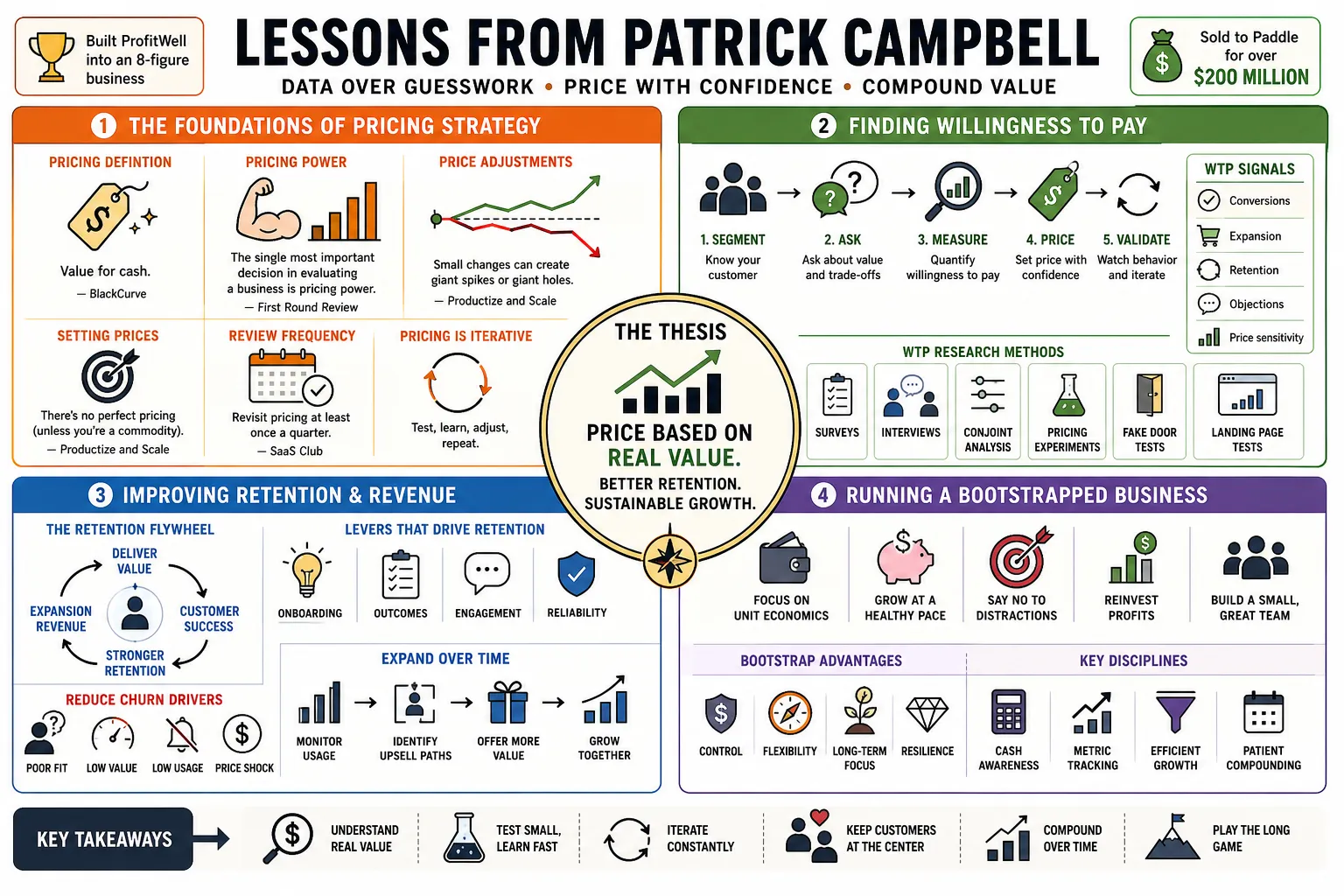
Lessons from Patrick Campbell
Patrick Campbell built ProfitWell into an eight-figure business before selling it to Paddle for over $200 million. He made his name by convincing software companies to stop guessing at their prices and start using actual data. This collection breaks down his frameworks for figuring out willingness to pay, improving retention, and running a bootstrapped company.
Part 1: The Foundations of Pricing Strategy
- On Pricing Definition: "Pricing is the exchange rate you put on all the tangible and intangible aspects of your business. Value for cash." — Source: BlackCurve
- On Pricing Power: Campbell opens his pricing framework with Warren Buffett's point that pricing power is one of the clearest tests of business quality. — Reference: First Round Review pricing strategy interview
- On Price Adjustments: "Small changes in your price can create giant holes in your revenue or giant spikes in your revenue." — Source: Productize and Scale
- On Setting Prices: "Unless you have a commodity business, the first thing to realize is that there's no perfect pricing." — Source: Productize and Scale
- On Review Frequency: Revisit pricing at least once a quarter; keeping prices stagnant for years often results in significant lost revenue. — Source: SaaS Club
- On Pricing Committees: Avoid pricing by committee; one leader should have final authority based on data. — Source: Long-Term Stock Exchange
- On Grandfathering: Do not grandfather existing customers into old pricing tiers indefinitely, as it is rarely a sound strategy. — Source: Business of Software
- On Price Increases: Focus communication on the added value the customer receives, rather than the company's internal need for revenue. — Source: Reddit
- On Growth Levers: Pricing is often a more powerful lever for growth than acquisition or retention. — Source: Leveling Up
- On Self-Churn: Misaligned pricing attracts the wrong customers who don't see value, leading directly to voluntary churn. — Source: Churn.fm
Part 2: Defining and Aligning the Value Metric
- On the Ideal Metric: A value metric dictates how a customer pays and should directly align with what the customer prioritizes. — Source: Long-Term Stock Exchange
- On Expansion Revenue: A well-chosen value metric creates a built-in mechanism for expansion as a customer's usage scales. — Source: Churn.fm
- On Per-Seat Pricing: Avoid per-user pricing unless it truly reflects the value delivered; it is often a lazy, outdated model. — Source: Long-Term Stock Exchange
- On Priority Outcomes: The perfect metric helps a customer increase revenue, save costs, or improve efficiency. — Source: Long-Term Stock Exchange
- On Strategic Forgiveness: If you get your value metric right, a business can succeed even if other areas are imperfect. — Source: Intercom
- On Tier Structures: Campbell recommends using quantified buyer personas so pricing pages and tiers reflect how different customer groups value the product. — Reference: First Round Review on buyer personas
- On Shifting Metrics: As products mature, the original value metric often needs to evolve alongside the market's perception. — Source: Long-Term Stock Exchange
- On Feature Tiers vs. Metrics: Don't confuse limiting features with a true value metric that scales directly with customer usage. — Source: Peak XV
- On Usage Ceilings: Avoid metrics that artificially limit usage in a way that creates friction before the customer realizes the value. — Source: ProdPad
- On Metric Selection: Campbell pushes teams to test what customers actually value, because usage alone does not always match willingness to pay. — Reference: First Round Review on feature preference and willingness-to-pay surveys
Part 3: Understanding Willingness to Pay (WTP)
- On Measurement Tools: Use research methodologies like the Van Westendorp survey to gather empirical data on willingness to pay. — Source: Reforge
- On Avoiding Gut Feeling: Rely on structured preference questioning rather than guessing what a customer might pay. — Source: SaaS Club
- On Segment Variation: WTP is not a static number; it varies drastically across different customer segments and use cases. — Source: Reforge
- On Geographic Differences: Adjust expectations based on region, as willingness to pay changes significantly across different geographies. — Source: Peak XV
- On Buyer Personas: Campbell says pricing work starts by defining a small set of target buyer groups and testing their preferences and willingness to pay. — Reference: First Round Review on quantified buyer personas
- On Feature Bloat: Avoid building tools that have a low willingness to pay across all of your primary segments. — Source: Reforge
- On Packaging Design: Campbell's packaging advice is to map feature preference and price-sensitivity data back to the distinct customer cohorts on the pricing page. — Reference: First Round Review on pricing-page design
- On Market Maturity: Re-evaluate WTP every six months because perceived value shifts as the market evolves. — Source: ProdPad
- On Asking Directly: Directly surveying customers about pricing ranges yields much better data than internal debates. — Source: SaaS Club
Part 4: Tactics for Customer Retention and Churn Reduction
- On Retention Types: Distinguish between tactical retention like dunning and strategic retention like product value alignment. — Source: Medium
- On the First 30 Days: Onboarding is the most critical period for long-term retention; users must reach their moment of delight early. — Source: Medium
- On Involuntary Churn: Failed payments cause involuntary churn, a mechanical issue that should be resolved without bothering the customer. — Source: ProfitWell
- On Voluntary Cancellations: Active churn requires a deeper strategic fix focused on user experience rather than quick tactics. — Source: Upvoty
- On Customer Success: Dedicated success teams often drive more expansion revenue than they reduce gross churn. — Source: ClientSuccess
- On Price Point Benchmarks: Do not compare churn rates blindly; high-end B2B products should expect much lower churn than low-cost B2C. — Source: Lenny's Newsletter
- On Defining Growth: "Growth is more revenue, not just more customers." — Source: Bold Commerce
- On Exit Interviews: Former subscribers are a goldmine of honest feedback regarding why they left and what would bring them back. — Source: Medium
- On Base Revenue: Ignoring your existing customer base means leaving your most profitable revenue opportunities completely unaddressed. — Source: Upvoty
Part 5: Bootstrapping and Financial Discipline
- On Constraints: Campbell's ProfitWell story is framed around building a large SaaS outcome without external funding, which forced disciplined choices. — Reference: MicroConf recap of bootstrapping ProfitWell
- On Capital: Campbell treats the funding question as situational, with bootstrapping and raising money both tied to the company's stage and goals. — Reference: Lenny's Podcast episode on bootstrapping ProfitWell
- On Avoiding VC: ProfitWell's path shows how a SaaS company can scale to a major exit without venture capital when revenue is the forcing function. — Reference: MicroConf recap of ProfitWell's bootstrapped exit
- On Hiring Standards: Campbell emphasizes hiring people who fit the company's values, making culture fit an explicit part of team-building. — Reference: Lenny's Podcast episode on team-building and culture
- On Co-Founder Equity: Do not tolerate part-time co-founders; settle equity and commitment issues directly and early. — Source: SaaS Club
- On Servant Leadership: Leaders should focus on asking the right questions instead of trying to provide all the answers. — Source: Reboot
- On Persistence: Campbell says founders do hit moments when everything feels terrible, and the job is to get back up and keep going. — Reference: Empire Flippers interview on ProfitWell's hard moments
- On Wasting Energy: Early struggles with commitment among founders drain emotional energy that should go toward the product. — Source: SaaS Club
- On Hardship: Campbell describes hardship as part of the entrepreneurial loop: each problem solved makes the next setback more survivable. — Reference: Empire Flippers interview on scaling ProfitWell
- On Value Creation: Without outside funding, you cannot afford to build features that do not directly translate to customer willingness to pay. — Source: Lenny's Newsletter
Part 6: Freemium Models and Product-Led Growth
- On Freemium Quality: If you use a freemium model, the free product must actually be better than the paid competition. — Source: SaaS Club
- On Free Value: The goal is to make users feel bad for not paying because the value they are receiving for free is so substantial. — Source: SaaS Club
- On Product-Market Fit: Only pursue freemium models after you have definitively proven product-market fit. — Source: Practical Founders
- On Free User Support: Modern freemium requires high-quality support and design, as customer expectations have increased drastically. — Source: Practical Founders
- On Freemium as a Moat: A powerful free tool acts as a competitive moat that makes it incredibly difficult for new entrants to gain a foothold. — Source: SaaS Club
- On Conversion Triggers: Free products must have natural friction points that seamlessly guide power users toward a paid tier. — Source: Practical Founders
- On Onboarding Free Users: The onboarding experience for a free user must be just as rigorous as for a paying customer. — Source: Practical Founders
- On Free Tier Limits: Campbell's episode treats retention and pricing as connected systems, with free or low-friction entry needing a path into paid value. — Reference: Lenny's Podcast episode on pricing and retention
- On User Acquisition: A strong freemium strategy significantly lowers customer acquisition costs by using the product as the primary marketing channel. — Source: SaaS Club
Part 7: Content Marketing as a Media Strategy
- On Media Mindset: Treat your content strategy like a media company rather than a traditional corporate blog. — Source: Intercom
- On Touchpoints: Aim for 5 to 8 touches per week to dominate a niche, rather than settling for the average of 1.6 touches. — Source: Intercom
- On Multimedia Strategy: Shift away from text-only output by launching dedicated podcasts and video shows to build brand recognition. — Source: SaaS Club
- On Breaking Through Noise: Incorporate high-quality video into blog posts to increase engagement and cut through crowded marketing channels. — Source: Productize and Scale
- On Proprietary Data: Leverage unique access to industry data to produce teardowns and research that competitors cannot replicate. — Source: ProfitWell
- On Content Quality: Produce content that offers direct, tactical value instead of relying on high-level fluff. — Source: Intercom
- On Serial Content: Build recurring shows or series that train your audience to expect and seek out your updates regularly. — Source: SaaS Club
- On Audience Building: Focus on building a dedicated audience before attempting to monetize every single interaction. — Source: Intercom
- On Teardowns: Publicly analyzing other companies' pricing pages provides highly engaging, educational content that proves your expertise. — Source: ProfitWell
Part 8: Founder Psychology and Leadership
- On the Freakout Cycle: Campbell's advice is to avoid letting temporary stress overwrite the long-term view of the business. — Reference: Empire Flippers interview on setbacks and long-term thinking
- On Building for the Long Term: Campbell credits long-term thinking, strategic pricing, and the bigger picture with helping ProfitWell differentiate. — Reference: Empire Flippers interview on ProfitWell's growth
- On Transparency: Maintain extreme transparency with your team regarding financial health to foster a culture of collective responsibility. — Source: Reddit
- On Exits: A successful exit requires meticulous documentation and a willingness to withstand grueling diligence processes. — Source: Built to Sell
- On Avoiding Distractions: Campbell's bootstrapping lessons focus on fundamentals such as pricing, retention, research, and competitive understanding rather than novelty tactics. — Reference: Lenny's Podcast episode on bootstrapping lessons
- On Ego: Put your ego aside when looking at pricing data; the numbers will often contradict your assumptions about your product. — Source: Reforge
- On Delegation: Campbell's company-building lessons start with team design and hiring, not the founder personally carrying every function. — Reference: Lenny's Podcast episode on building a team
- On Hunger: Campbell's bootstrapped ProfitWell story shows how limited capital can sharpen focus when growth has to come from customers. — Reference: MicroConf recap of ProfitWell's bootstrapped path
- On Resiliency: Campbell says getting through hard moments trains founders to keep moving rationally after bad news. — Reference: Empire Flippers interview on entrepreneurial resilience