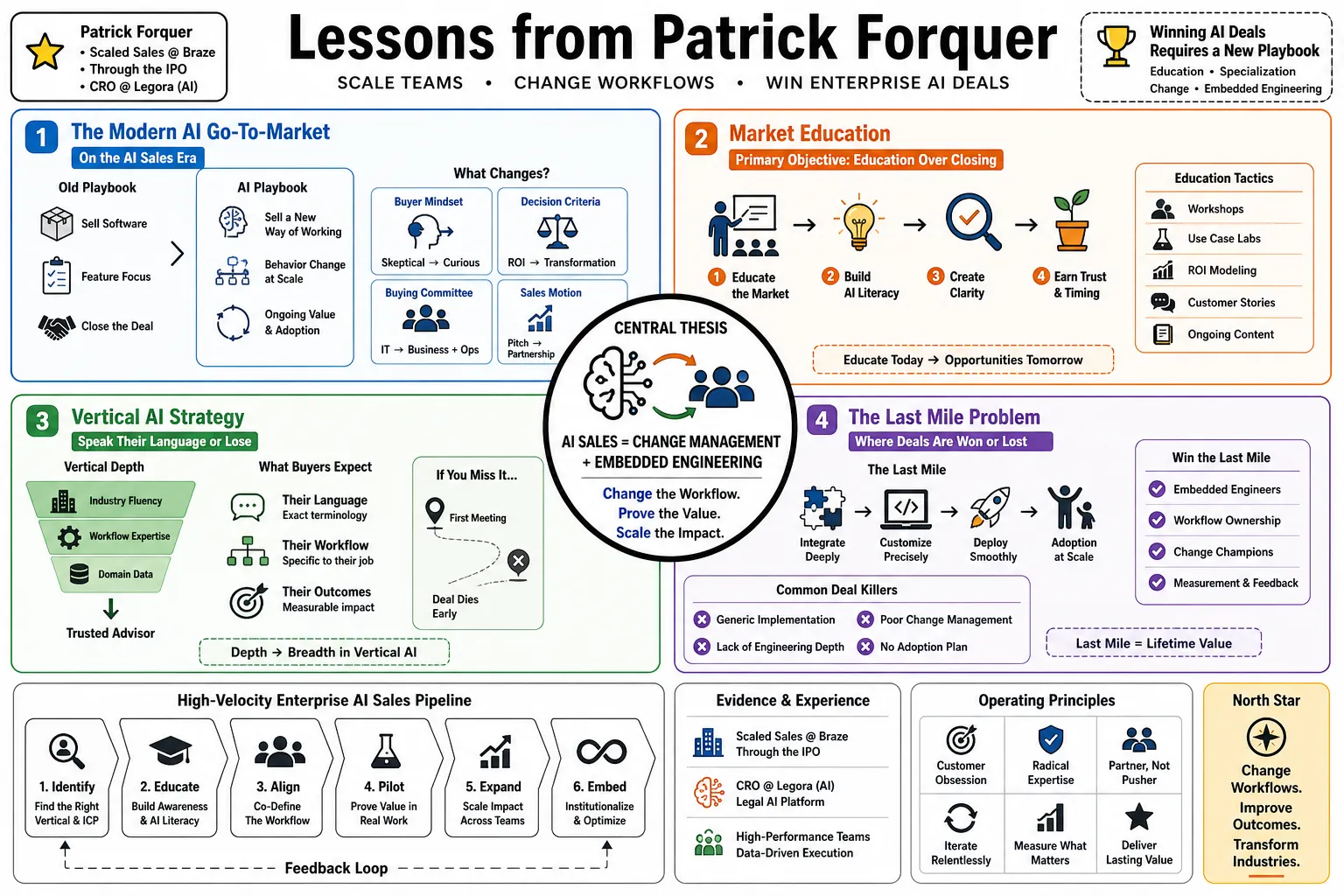
Lessons from Patrick Forquer
Patrick Forquer is a revenue executive who scaled sales teams at Braze through its IPO and served as Chief Revenue Officer at the legal AI firm Legora. He argues that traditional software playbooks fail when selling AI, advocating instead for a model built on change management and embedded engineering. This collection outlines his approach to pipeline generation and high-velocity enterprise sales.
Part 1: The Modern AI Go-To-Market
- On the AI sales era: Forquer treats enterprise AI sales as a change-management problem, not a normal software pitch: the product changes workflows, so the sale has to show how work itself will operate differently. — Reference: 20VC episode page and transcript on implementation winning in enterprise AI
- On Market Education: "Because AI literacy in the broader market remains relatively low, the primary objective of any modern revenue team is education rather than aggressive closing." — Source: Crypto Briefing
- On vertical AI strategy: In legal AI, Forquer emphasizes workflow fluency: Legora uses legal engineers because adoption depends on understanding how legal teams actually work, not just demoing generic AI capability. — Reference: 20VC transcript on forward-deployed legal engineers
- On the last-mile problem: Forquer sees the hard part as embedding the tool into customer workflows; pilots and implementation matter because a powerful agent is only valuable if the organization actually adopts it. — Reference: 20VC transcript on implementation and pilots
- On Geographic Focus: "New York is the legal services capital of the world. If you want to win this market, you have to win this city." — Source: Business Insider
- On defining value: He sells AI around expanded capability, using the product to show customers the future state rather than reducing the conversation to a narrow efficiency claim. — Reference: 20VC transcript on using product demos to show the future
- On category creation: Forquer treats category creation as execution-heavy: buyers need help seeing the workflow change, trusting the implementation path, and understanding why agentic software is different from old SaaS. — Reference: 20VC episode page on implementation, legal engineers, and AI enterprise sales
- On Sales Cycles: "The velocity of AI adoption demands that we condense enterprise sales cycles. What used to take nine months of deliberation now requires proof of value within nine days." — Source: Crypto Briefing
- On competing with incumbents: In head-to-head markets, Forquer comes back to preparation and execution: know the competitive process, anticipate objections, and run both offense and defense inside the deal. — Reference: 20VC transcript on competing with Harvey and the 8 Mile talk track
- On pricing AI: Forquer argues for pricing discipline in AI: Legora avoids giving the product away for free and tries to keep the commercial model clear even in competitive deals. — Reference: 20VC transcript on price integrity
Part 2: Rethinking the SaaS Playbook
- On the old playbook: Forquer does not discard every SaaS habit, but he says AI sales requires throwing out pieces of the old motion, especially the instinct to delay product exposure. — Reference: 20VC transcript on the old SaaS playbook
- On demos: With agentic products, Forquer wants the demo to arrive early enough to make the future concrete; discovery still matters, but the product has to carry the buyer into the new workflow. — Reference: 20VC transcript on demos and showing the future
- On pilots: Pilots are central to Forquer’s sales motion: Legora uses them to prove value in context, and he cites a 78% pilot-to-closed-won conversion rate. — Reference: 20VC transcript on pilot conversion
- On Rigid Frameworks: "Treating MEDDICC as an inflexible sales process will kill your momentum in AI. You need a framework that adapts to the rapid pace of AI evaluation." — Source: Crypto Briefing
- On selling capability: Forquer’s stronger pitch is not simple process efficiency; it is helping legal teams see new capacity once AI agents are embedded in real workflows. — Reference: 20VC transcript on agentic tools and workflow adoption
- On discovery calls: Discovery still matters in Forquer’s playbook, but it has to produce a point of view about the customer’s workflow before the product demonstrates the future state. — Reference: 20VC transcript on discovery plus early product demonstration
- On buyer committees: Forquer says AI changes buyer access: legal teams, executives, and practitioners all want to understand where the value will show up, so the sales motion has to speak to operational users as well as power. — Reference: 20VC transcript on access to power in AI legal deals
- On proof of concept: Forquer treats a POC as an adoption test, not just a feature test: the customer has to see how Legora fits real workflows and whether the organization can act on the new capability. — Reference: 20VC transcript on pilots, implementation, and workflow adoption
- On Sales Engineering: "The line between account executive and sales engineer is blurring. If the account executive cannot competently drive the AI interface, the trust is broken." — Source: Crypto Briefing
Part 3: Hypergrowth and Scaling Legora
- On hitting $100M ARR: Legora’s growth forced Forquer to build a go-to-market system that could absorb demand while keeping pilots, implementation, and hiring from falling behind the market. — Reference: 20VC episode page on Legora reaching $100M ARR in 18 months
- On onboarding at scale: Forquer puts heavy weight on structured onboarding because hypergrowth requires new hires to absorb the company’s sales motion fast, not wait for tribal knowledge to spread casually. — Reference: 20VC transcript on Legora onboarding and sales training
- On maintaining quality: Forquer’s implementation focus is a quality-control mechanism: as volume rises, the company still has to help each customer turn the product into real workflow change. — Reference: 20VC transcript on implementation change management
- On revenue forecasting: Forquer treats forecasting in AI markets as an operating discipline, because fast-moving pipeline only matters if the team can still read stages, commitments, and regional inputs clearly. — Reference: 20VC episode page on revenue forecasting in a world of AI
- On Scaling Operations: "Revenue operations is the nervous system of hypergrowth. If your data hygiene fails, your ability to make rapid decisions disappears." — Source: Crypto Briefing
- On early momentum: In Forquer’s view, hot markets reward speed: when a company has momentum and an advantage, it should press that advantage before the category settles. — Reference: 20VC transcript on pressing the advantage in a hot market
- On hiring profiles: Forquer evaluates sales hires through ramp evidence and adaptability, because Legora’s market moves too quickly for slow diagnosis or rigid enterprise habits. — Reference: 20VC transcript on sales-team red flags and fast ramp
- On market capture: Forquer frames the legal-AI window as time-sensitive: in a market being made in real time, execution speed can matter more than conserving capital. — Reference: 20VC transcript on market timing and pressing advantage
- On International Expansion: "Expanding a GTM motion across borders requires localizing the specific legal and cultural workflows of that region, rather than merely translating the language." — Source: Crypto Briefing
- On valuation and growth: Forquer’s job is to make Legora’s valuation credible in operating terms: pipeline, pilots, implementation capacity, and hiring have to catch up to the growth story. — Reference: 20VC episode page on Legora valuation and ARR trajectory
Part 4: Change Management as a Sales Strategy
- On organizational friction: Forquer’s Braze lesson carries into Legora: customers do not get value just by buying the tool; adoption depends on stakeholder management, technical workstreams, and behavior change. — Reference: 20VC transcript on implementation change management
- On AI literacy: Forquer sees part of the job as teaching customers how to work with agents: buyers need help moving from old software steps to goal-oriented workflow design. — Reference: 20VC transcript on the agent blank-page problem
- On workflow integration: Legora’s forward-deployed legal engineers exist because workflow integration is domain-specific; legal teams need the product mapped into the way their practice areas actually operate. — Reference: 20VC transcript on forward-deployed legal engineers
- On Adoption Metrics: "Selling the deal is only 10 percent of the battle. If daily active usage does not spike in the first 30 days, churn is inevitable." — Source: Crypto Briefing
- On champion building: Forquer keeps classic adoption work in the AI motion: champion building still matters, but the champion has to help drive real behavior change around the new workflow. — Reference: 20VC transcript on champion building and change management
- On overcoming fear: In AI deals, Forquer has to help customers separate the fear of automation from the practical question of where the tool creates value in legal work. — Reference: 20VC transcript on AI pressure and customer use-case questions
- On iterative deployment: Forquer’s implementation logic favors proving the product in specific workflows first, then letting successful usage expand the customer’s confidence and internal pull. — Reference: 20VC transcript on pilots and workflow adoption
- On Executive Alignment: "If the managing partners fail to explicitly mandate the use of the new AI tools, the associates will always default to their legacy habits." — Source: Crypto Briefing
- On continuous training: Forquer’s scaling model relies on distributed learning, with product, sales, legal engineering, regional teams, async video, and Notion keeping the organization current. — Reference: 20VC transcript on distributed training and knowledge sharing
Part 5: Brand Marketing and Pipeline Generation
- On creative campaigns: The Jude Law campaign worked only because Legora had already built the plumbing behind it: lead scoring, enrichment, routing, territory rules, and response SLAs. — Reference: 20VC transcript on the Jude Law campaign and pipeline infrastructure
- On Marketing Economics: "You have to break down the economics of high-profile marketing. If a massive celebrity spend directly correlates to high-intent enterprise meetings, the numbers make sense." — Source: Crypto Briefing
- On brand perception: Forquer treats brand as part of enterprise execution: in a noisy AI market, showing up with a credible team and clear presence helps customers take the company seriously. — Reference: 20VC transcript on brand, events, and enterprise market presence
- On capturing interest: Forquer’s pipeline lesson is operational: big awareness only matters if the sales system can route, score, enrich, and respond to demand quickly. — Reference: 20VC transcript on inbound plumbing and lead response infrastructure
- On breaking the mold: Legora’s campaign strategy shows Forquer is willing to use distinctive creative when the category is crowded and the company needs to make the market notice. — Reference: 20VC transcript on the Jude Law brand campaign
- On sales and marketing alignment: Forquer links marketing success to sales readiness: campaigns need routing rules, data enrichment, territory assignments, and SLAs before they can become real pipeline. — Reference: 20VC transcript on inbound lead infrastructure
- On Signal vs. Noise: "In a hyped market like AI, your brand must cut through the noise with extreme clarity about exactly what problem you solve." — Source: Crypto Briefing
- On experiential marketing: Forquer still values in-person moments, but the point is not old-school entertainment; it is creating chances for customers to meet the team and talk through AI adoption. — Reference: 20VC transcript on events, conferences, and showing the team
- On content strategy: Because Legora’s product and market move quickly, Forquer relies on distributed content and updates so teams can stay current without waiting on centralized training. — Reference: 20VC transcript on async video, Notion, and fast product updates
Part 6: Technical Sales and Forward-Deployed Engineering
- On sales team composition: Forquer’s AI sales team includes forward-deployed engineers and legal engineers because buyers need technical and domain translation during adoption, not only account coverage. — Reference: 20VC transcript on forward-deployed engineers and legal engineers
- On Domain Expertise: "We hire ex-big-law attorneys as deployed engineers. When the person building your workflow actually understands the nuances of a merger agreement, trust is established instantly." — Source: Crypto Briefing
- On custom workflows: Legora’s implementation work starts from the customer’s workflow and goals; legal engineers help translate practice-area needs into agentic usage rather than treating the product as one-size-fits-all. — Reference: 20VC transcript on workflow-specific legal engineering
- On bridging the gap: Forward-deployed legal engineers bridge the gap between the product promise and the buyer’s reality by understanding law-firm and corporate legal workflows. — Reference: 20VC transcript on forward-deployed legal engineers
- On rapid prototyping: Forquer values fast prototyping because field experts can make product ideas tangible quickly, as with the legal-engineer prototype that clarified a private-equity use case. — Reference: 20VC transcript on vibe-coded prototypes and product feedback
- On Technical Discovery: "Technical discovery must happen concurrently with business discovery to ensure the data architecture can actually support the AI." — Source: Crypto Briefing
- On post-sale handoffs: In Forquer’s model, sales cannot throw the customer over a wall; implementation continuity matters because workflow adoption is where enterprise AI succeeds or fails. — Reference: 20VC transcript on implementation and adoption continuity
- On engineering empathy: The forward-deployed role requires empathy for the user’s work: legal engineers have to understand practice context before they can help a firm use agents well. — Reference: 20VC transcript on legal engineers and practice-area context
- On security architecture: Forquer treats regulatory and data-sovereignty complexity as part of the go-to-market problem, especially when expanding across European legal markets. — Reference: 20VC transcript on data sovereignty and regulatory compliance
- On margin structure: Forquer is explicit that the human-heavy FDE/legal-engineer model costs money, so the company has to match that approach to contract value and enterprise-level economics. — Reference: 20VC transcript on FDE cost, margin reduction, and ACV thresholds
Part 7: Early Career Resilience and the Braze IPO
- On sales eras: Forquer started selling in the 2008-era world of steak lunches and relationship entertainment, but his current view is that enterprise selling has shifted toward activities, events, and showing the team’s real capability. — Reference: 20VC transcript on how sales relationship-building has evolved since 2008
- On the grind: Even in AI, Forquer keeps coming back to execution discipline: competitive deals are won through preparation, offense, defense, and follow-through rather than category excitement alone. — Reference: 20VC transcript on competitive execution
- On the Braze journey: The lesson Forquer carried from Braze to Legora is implementation change management: complex enterprise tools only succeed when stakeholder, technical, and workflow adoption are managed deliberately. — Reference: 20VC transcript on Braze implementation lessons
- On management systems: Forquer’s forecasting process depends on management layers doing real judgment work, with reps, directors, VPs, and regions rolling up commitments that can be compared with weighted forecasts. — Reference: 20VC transcript on regional forecast rollups
- On Long-Term Commitment: "Staying at one company through multiple stages of growth teaches you the consequences of the deals you closed years prior. It builds accountability." — Source: Crypto Briefing
- On surviving market pressure: In fast-moving AI markets, Forquer argues that the scarce resource is often time, not money; when the market is being made, the company has to press its advantage. — Reference: 20VC transcript on time, momentum, and pressing advantage
- On building pipeline: Forquer’s pipeline lesson is infrastructure-first: before a big campaign works, the team needs scoring, enrichment, routing, territory rules, and response SLAs in place. — Reference: 20VC transcript on pipeline plumbing
- On operating beyond milestones: Forquer translates big market expectations into operating discipline: growth targets, board guidance, and forecast quality have to be managed on shorter, evidence-based windows. — Reference: 20VC page and transcript on valuation, ARR, and forecasting
- On early-career learning: Forquer’s career lessons come less from slogans than from operating contexts: early sales environments, Braze’s implementation rigor, and Legora’s AI-market speed all shaped the playbook. — Reference: 20VC transcript on Braze lessons and sales evolution
Part 8: The Speed and Culture of AI Sales
- On Operational Pace: "We operate at an insane and unhinged pace. In the AI landscape, if you are not moving fast enough to feel slightly out of control, you are falling behind." — Source: Velocity Meter
- On decisiveness: Forquer’s urgency comes from market timing: when a category is being formed and the company has an advantage, slow execution can be more dangerous than imperfect execution. — Reference: 20VC transcript on pressing advantage in a hot market
- On sales culture: Legora’s sales culture is built around fast feedback: reps ramp quickly, managers watch early warning signs, and the team diagnoses performance far sooner than traditional enterprise cycles allow. — Reference: 20VC transcript on onboarding, ramp, and 45-day red flags
- On Feedback Loops: "The feedback loop from the sales floor to the product team needs to be measured in hours, rather than quarters. Product needs to hear the market's objections instantly." — Source: Crypto Briefing
- On managing expectations: At Legora’s speed, expectation management is an internal operating system: teams use async video, Notion, regional updates, and embedded product collaboration to keep pace with change. — Reference: 20VC transcript on distributed internal communication
- On learning at speed: Forquer’s operating challenge is not only growth, but learning fast enough to keep the sales, product, legal engineering, and engagement teams aligned as the product changes. — Reference: 20VC transcript on team-level and product-level learning loops
- On adaptation: Forquer keeps what still works from SaaS but throws out parts that do not fit AI, especially old habits around delayed demos and purely process-led selling. — Reference: 20VC transcript on adapting the old SaaS playbook
- On talent density: The people around the sale matter more in Forquer’s model: forward-deployed engineers and legal engineers carry enough context that average, generic coverage is not a substitute. — Reference: 20VC transcript on forward-deployed engineers and legal engineers
- On the future of work: Forquer sees agentic software changing how knowledge work is framed: users move from clicking through fixed steps to defining goals, systems, and workflows for agents. — Reference: 20VC transcript on the agent blank-page problem and workflow design