Lessons from Paul Adams
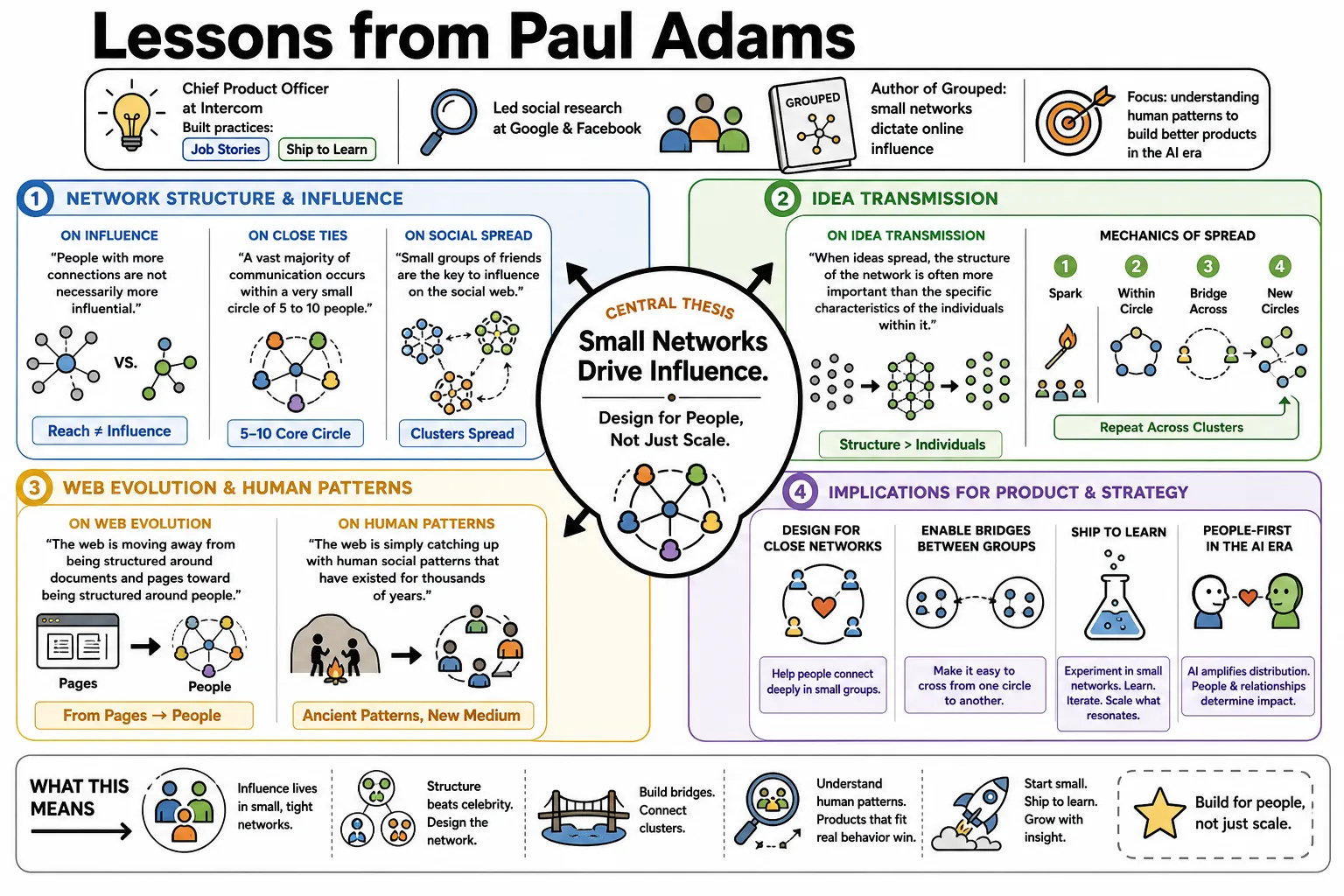
Paul Adams is the Chief Product Officer at Intercom, where he helped establish development practices like Job Stories and "Ship to Learn." He previously led social research at Google and Facebook, arguing in Grouped that small networks dictate online influence. This collection gathers his writing on product strategy, from understanding basic human behavior to building software for the AI era.
Part 1: Network Structure and Influence
- On Influence: "People with more connections are not necessarily more influential." — Source: [Grouped]
- On Social Spread: "Small groups of friends are the key to influence on the social web." — Source: [Greatest Hits Blog]
- On Idea Transmission: "When ideas spread, the structure of the network is often more important than the specific characteristics of the individuals within it." — Source: [Eoin Kennedy]
- On Web Evolution: "The web is moving away from being structured around documents and pages toward being structured around people." — Source: [Seedbed]
- On Human Patterns: "The web is simply catching up with human social patterns that have existed for thousands of years." — Source: [Noah Fang]
- On Close Ties: "A vast majority of communication occurs within a very small circle of 5 to 10 people." — Source: [Aaron Randall]
- On Decision Making: "The people closest to us have a disproportionate influence on the decisions we make." — Source: [UBC]
- On The Tipping Point Myth: "The idea that targeting a few super-connected influencers will guarantee success is largely a myth." — Source: [Noah Fang]
- On Social Platforms: "Social networks succeed not because they invent new ways to interact, but because they facilitate our existing psychology of communication." — Source: [Business Insider]
Part 2: Jobs-to-be-Done and Job Stories
- On Job Stories: "We frame every design problem in a Job, focusing on the triggering event or situation, the motivation and goal, and the intended outcome." — Source: [Intercom]
- On The Format: "The structure is simple: When [situation], I want to [motivation], so I can [expected outcome]." — Source: [Medium]
- On Personas vs Jobs: "Understanding the motivations behind actions is far more powerful than using demographics like age or gender to define a user." — Source: [Intercom]
- On Empathy: "Personas often provide empathy but lack fresh thinking or causal insight into why someone buys." — Source: [Intercom]
- On Navigating Feedback: "The Jobs framework helps teams remain focused on the 'why,' which is crucial when navigating customer feedback." — Source: [Game Thinking]
- On Pivoting Strategy: "When you know the job your product is hired to do, pivoting your strategy becomes a matter of solving the same problem better, not changing your identity." — Source: [Relayto]
- On Software Adaptation: "We had to adapt original Jobs-to-be-Done theory—often applied to milkshakes—to apply specifically to the complexities of developing software." — Source: [Intercom]
- On Situational Context: "Focus away from who the user is, and toward why and when they actually need a solution." — Source: [Medium]
- On Motivation: "The core of product design is answering: what is the triggering event that causes someone to look for a tool?" — Source: [24 Ways]
Part 3: Thinking Big, Starting Small
- On Ambition and Scope: "The first principle is that we think big but start small. This means thinking about a big vision and then ruthlessly cutting the scope so we can ship." — Source: [ProductPlan]
- On Documentation: "The longer the PRD doc, the less it gets read. The longer the doc, the less it gets remembered." — Source: [ProdMgmt World]
- On Constraint: "If you're forced to limit the brief to one page, you will get much better at describing the exact problem you're solving." — Source: [ProdMgmt World]
- On First Principles: "Design from first principles—start with a blank sheet of paper instead of copying a competitor or assuming the best solution exists in the world already." — Source: [ProductPlan]
- On Vision: "A big vision is necessary to ensure that the small steps you take are actually leading somewhere meaningful." — Source: [Intercom]
- On Execution: "You don't build a massive, complex system all at once; you build a simple system that works and evolve it." — Source: [Inside Intercom]
- On Simplicity: "Ruthless scope cutting isn't about doing less work; it's about finding the absolute core value of the idea." — Source: [ProductPlan]
- On Competitors: "If you start by looking at what competitors do, you anchor your thinking to their solutions rather than your customer's actual problem." — Source: [Inside Intercom]
- On Milestones: "Every small release should deliver some unit of value, not just a technical stepping stone." — Source: [Intercom]
Part 4: Shipping, Learning, and Speed
- On The Purpose of Shipping: "We ship to learn. We know that we will be wrong more often than we will be right." — Source: [Intercom]
- On Prioritizing Speed: "Because we care most about learning, we prioritise speed to execution over getting it perfectly right the first time." — Source: [Academia]
- On Shipping as a Beginning: "All too often, shipping product is seen as an end. A milestone reached... We believe the opposite is true, that shipping is a beginning." — Source: [Intercom]
- On Post-Launch Iteration: "We’ll ship and then we’ll figure out if it’s good or bad. Did it actually solve the problem we identified early on?" — Source: [Intercom]
- On Scheduling Time: "You must explicitly set time aside to iterate after you launch; otherwise, you just move to the next feature." — Source: [Intercom]
- On Ambiguity: "In eras of high ambiguity, the principle evolves to: Ship fast, ship early, ship often." — Source: [Refound AI]
- On The Shiny New Trap: "It takes discipline to retrospectively learn from what has been shipped rather than immediately moving on to the next shiny new project." — Source: [Medium]
- On Certainty: "You can spend months trying to be certain internally, or you can ship it and know for sure within days." — Source: [Intercom]
- On Feedback Loops: "The faster you ship, the tighter your feedback loop with reality becomes." — Source: [Liminary]
- On Perfecting Ideas: "An imperfect feature in the hands of users is infinitely more valuable for learning than a perfect idea on a whiteboard." — Source: [Class Central]
Part 5: Inputs, Outputs, and Outcomes
- On The Missing Metric: "Inputs are often the missing piece in the 'outcomes over outputs' debate." — Source: [Gary Blog]
- On Defining Inputs: "Focusing on the right inputs—deep problem discovery, customer research, and understanding core product premises—is what ultimately drives successful outcomes." — Source: [Intercom]
- On Outputs: "We must shift focus away from simply shipping features—outputs—toward the actual value or changes in behavior created for the user." — Source: [Intercom]
- On Control: "Inputs are the variable a business can actually control to influence long-term success." — Source: [Intercom]
- On Scoring: "If you don't have a goal, you can't score. It is an essential truth for product teams to maintain focus." — Source: [Product Coalition]
- On Measurement: "Don't just measure that people used the feature; measure whether using the feature actually solved the underlying job they hired it for." — Source: [Intercom]
- On Goal Setting: "Goals force clarity. They force you to decide what you are not going to do." — Source: [Inside Intercom]
- On Impact: "You deliver an outcome when you actually change the trajectory of the customer's success, not when the code is deployed." — Source: [Gary Blog]
- On The Inputs Process: "If your inputs are flawed—if you are listening to the wrong customers or misinterpreting their needs—no amount of excellent output will save the outcome." — Source: [Medium]
Part 6: Understanding the Customer Problem
- On Problem Definition: "Start with the customer problem. Before building, ensure the problem is real and that customers actually want it solved." — Source: [Creator Economy]
- On Solution Limits: "Your solution is only as good as your understanding of the problem." — Source: [Medium]
- On Going Back to Basics: "I'd start with the thing your product does. What's the core premise behind it? Why do people use it?" — Source: [Refound AI]
- On Feature Treadmills: "Avoid 'solution pollution' and the feature treadmill by ensuring the team is completely grounded in the reality of the problem." — Source: [Medium]
- On Product Taste: "Product Judgment, or product taste, is the ability to accurately predict what customers value and design the right solution." — Source: [Intercom]
- On Developing Judgment: "The only way to develop product judgment is by talking to lots of your customers, and asking them how they use your product." — Source: [Intercom]
- On AI and Interviews: "Using AI to summarize user interviews just isn't the same as sitting in on each interview. There are no shortcuts to direct customer interaction." — Source: [Creator Economy]
- On Empathy vs Evidence: "Don't confuse feeling bad for the customer with actually having evidence that they will use and pay for the solution." — Source: [Intercom]
- On Observation: "Watch what people do, not just what they say they want." — Source: [Inside Intercom]
- On Problem Severity: "Ensure the problem is painful enough that a customer is willing to change their current behavior to adopt your new solution." — Source: [Creator Economy]
Part 7: AI and the Future of Product Management
- On Transformation: "AI-first has to be built in; you can't bolt it on." — Source: [Appmixer]
- On Brutal Pivots: "If you're a SaaS company who thinks you're an AI company and you've not gone through brutal transformation, you're not there yet." — Source: [SaaStr]
- On The Blank Page: "Reimagine your business from a blank page. Rethink everything from product and pricing to branding and sales as an integrated system." — Source: [Appmixer]
- On Strategic Agility: "We ripped up our strategy five days after ChatGPT launched to focus entirely on the new opportunities AI presented." — Source: [Greg Kamradt]
- On PM Laziness: "AI could make some product managers lazier if they rely too heavily on tools to skip the hard work of actual customer discovery." — Source: [Creator Economy]
- On The Bad Type of PM: "There’s a world where AI accidentally turns a lot of otherwise brilliant product managers into the bad type, where you’re literally like, 'Click, magic wand, fill, send, next problem.'" — Source: [Intercom]
- On Wartime Urgency: "The transition to an AI-first model requires a 'wartime' pivot, reallocating the vast majority of engineering resources to the new paradigm." — Source: [Liminary]
- On Technological Shifts: "AI is a technological shift comparable to the arrival of the internet, requiring companies to move away from long-term, static roadmaps." — Source: [Intercom]
- On Continuous Experimentation: "The era of AI demands rapid, experimental cycles rather than assuming the best solution already exists." — Source: [Appmixer]
Part 8: Aligning Organizations and Teams
- On The God Complex: "Avoid the 'god complex,' where product managers confuse their specific product strategy with the overall company strategy." — Source: [Intercom]
- On Alignment: "You must urge closer alignment between the daily work of the product team and the overarching goals of the business." — Source: [Intercom]
- On Conviction: "Building conviction with skeptical coworkers requires transparently sharing the strategic inputs and the reality of the market." — Source: [Lenny's Podcast]
- On The Messy Middle: "Product leadership is often about navigating the 'messy middle' of strategy, bridging the gap between high-level vision and tactical execution." — Source: [Produx Labs]
- On Trust: "Building trust across disciplines—engineering, design, product—is the prerequisite for moving fast." — Source: [Produx Labs]
- On Company Culture: "A culture focused on the human psychology of communication will build fundamentally different products than an engineering-driven culture." — Source: [Business Insider]
- On Leadership Transparency: "Leaders must be clear about what is a hard constraint and what is open for debate, to avoid teams spinning their wheels." — Source: [Intercom]
- On Radical Transformation: "There are significant human and strategic costs to radical transformation; you must manage the people through the change just as much as the code." — Source: [Mind The Product]
- On Team Focus: "The product organization's job is not just to build things, but to continually clarify the 'why' for everyone involved." — Source: [Intercom]
- On Strategy vs Reality: "Strategy is just a theory until it hits the reality of customer usage; teams must be organized to react to that reality quickly." — Source: [Intercom]