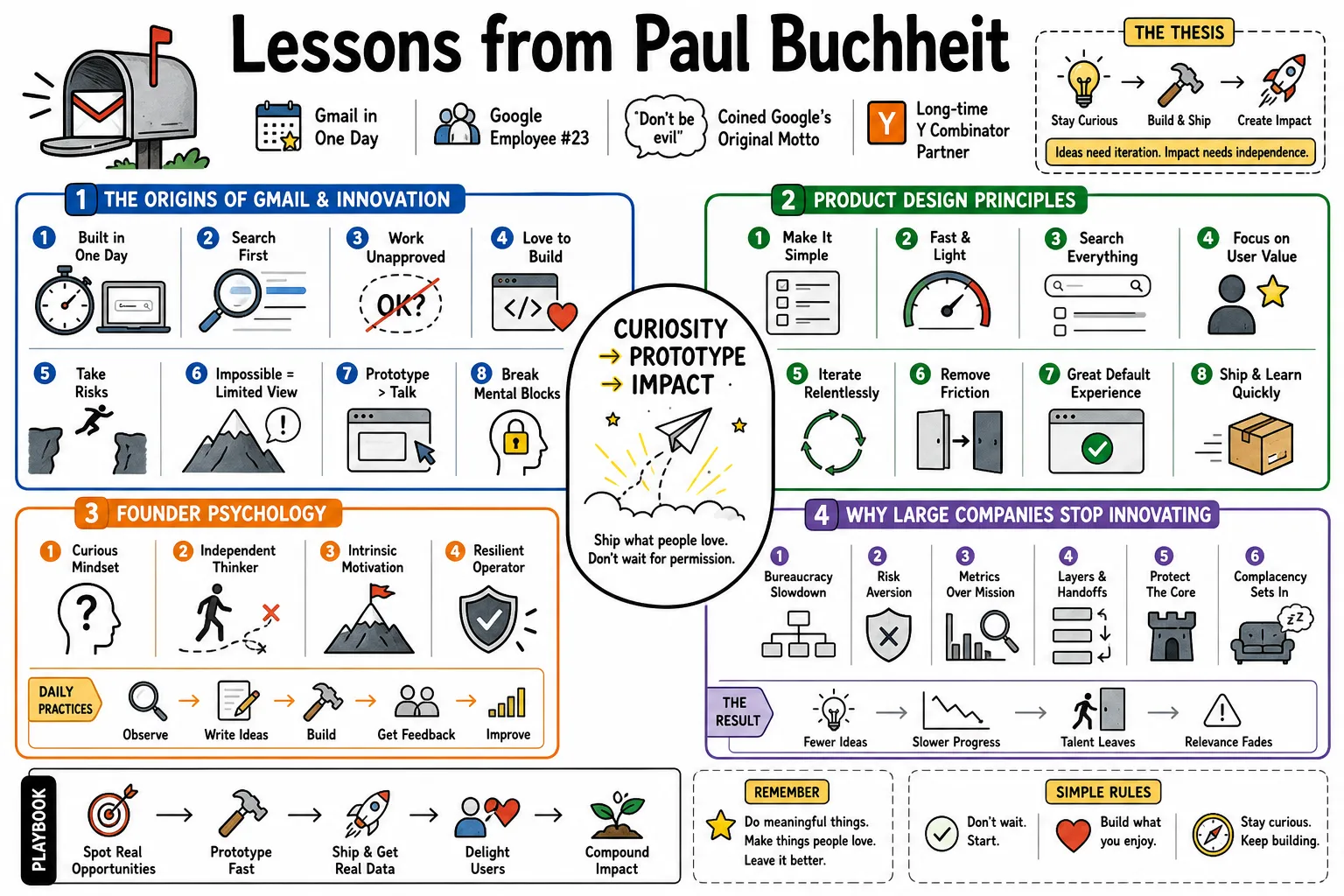
Lessons from Paul Buchheit
Paul Buchheit built the first version of Gmail in a single day, coined Google's original "Don't be evil" motto as employee #23, and later became a long-time Y Combinator partner. These insights trace his views on product design, founder psychology, and why large companies inevitably stop innovating.
Part 1: The Origins of Gmail and Innovation
- On taking risks: "If everything you do works, then you're not taking many risks and probably aren't innovating either." — Source: [QuoteFancy]
- On the impossible: "If someone says: 'That's impossible,' you should understand it as: 'According to my very limited experience and narrow understanding of the world, I haven't seen that happen.'" — Source: [Goodreads]
- On prototyping vs talking: "Consider spending less time talking, and more time prototyping, especially if you're not very good at talking." — Source: [QuoteFancy]
- On building what you enjoy: "I like writing code. I like building product. I like making things that people like." — Source: [QuoteFancy]
- On mental blocks: "Opportunity is all around us, but we have beliefs and habits that block it." — Source: [AZQuotes]
- On working unapproved: "I built the first version of Gmail in one day. It was just a search interface for my own email, but once I had it, I realized I could add routing." — Source: [Pirate Wires]
- On early skepticism: "When we first launched Gmail, many people thought it was an April Fools' joke because giving away a gigabyte of storage seemed financially impossible at the time." — Source: [Pirate Wires]
- On the reality of day jobs: "Many people with jobs have a fantasy about all the amazing things they would do if they didn't need to work. In reality, if they had the drive and commitment to do actually do those things, they wouldn't let a job get in the way." — Source: [QuoteFancy]
- On internal pushback: "The hardest part of building something new inside a large company is convincing the people around you that it isn't a terrible idea." — Source: [Founders at Work]
- On breaking the rules: "Sometimes you just have to ignore the stated requirements and build what the user actually needs." — Source: [Founders at Work]
Part 2: Product Design and The 90/10 Rule
- On the 90/10 solution: "Find ways to accomplish 90% of your desired outcome with only 10% of the effort." — Source: [YC Startup Library]
- On great vs good: "If your product is Great, it doesn't need to be Good." — Source: [Paul Buchheit's Blog]
- On feature creep: "Instead of building an endless list of features based on user feedback, focus on the 10% of features that provide 90% of the value." — Source: [YC Startup Library]
- On solving real problems: "Startups must come from personal experience. The best startups solve a genuine problem that the founder or someone they know has experienced." — Source: [YC Startup Library]
- On speed over polish: "Get started and deliver now. Do not disappear for years to work on a product in isolation." — Source: [YC Startup Library]
- On listening to users: "Pay attention to what users do, not just what they say they want. Often, they will ask for complex features when a simpler solution would serve them better." — Source: [YC Startup Library]
- On simplification: "The best products are those that hide their complexity behind a simple, intuitive interface." — Source: [Paul Buchheit's Blog]
- On iteration: "Ship early and iterate constantly based on real-world usage." — Source: [YC Startup Library]
- On product debt: "Over-engineering in the early days is the fastest way to kill a project." — Source: [Founders at Work]
Part 3: Make People Really Happy
- On the golden rule of startups: "It's better to make a few people really happy than to make a lot of people semi-happy." — Source: [Paul Graham Essays]
- On cultivating super fans: "It is much easier to grow a product that a small group of 'super fans' loves than it is to convince people who are merely indifferent to like it more." — Source: [YC Startup Library]
- On initial audiences: "Start out by making 100 users really happy, rather than a lot more users only a little happy." — Source: [QuoteFancy]
- On organic growth: "When people truly love a product, they will do the marketing for you." — Source: [YC Startup Library]
- On the danger of semi-happy: "If your users are only semi-happy, they will abandon you the moment a slightly better alternative comes along." — Source: [YC Startup Library]
- On product-market fit: "You know you have product-market fit when you can't keep up with the demand from your early adopters." — Source: [YC Startup Library]
- On user obsession: "The best founders are obsessed with their users, not their competitors." — Source: [YC Startup Library]
- On building for a few: "Don't be afraid to build something niche initially. A passionate niche is a better foundation than a lukewarm mass market." — Source: [YC Startup Library]
- On creating love: "You cannot mathematically optimize your way into making users love your product. It requires empathy." — Source: [YC Startup Library]
- On measuring success: "The ultimate metric is user joy. Everything else is secondary." — Source: [YC Startup Library]
Part 4: "Don't Be Evil" and Ethics
- On the origin of the motto: "I wanted a motto that would be difficult to remove once adopted. It was meant to be a critique of other technology companies at the time." — Source: [Wikipedia]
- On user trust: "The motto served as a shorthand for prioritizing user trust and integrity over short-term profits." — Source: [Cognition and Culture]
- On making decisions: "It was meant to guide decision-making by asking, 'Ignoring personal loss/gain, would the world be better if I stopped doing X?'" — Source: [The New Republic]
- On institutionalizing ethics: "We believe strongly that in the long term, we will be better served... by a company that does good things for the world even if we forgo some short term gains." — Source: [Wikipedia]
- On tech industry exploitation: "At the time, many companies were exploiting users through practices like invasive spyware or paid inclusion. 'Don't be evil' was a direct response to that." — Source: [Wikipedia]
- On keeping priorities straight: "It's easy to lose your moral compass when the financial incentives point the other way. The motto was a forced check on those incentives." — Source: [Founders at Work]
- On cultural pillars: "A company's culture is defined by what it is willing to sacrifice for its values." — Source: [Paul Buchheit's Blog]
- On avoiding rationalization: "People are very good at rationalizing bad behavior if it makes them money. You need a hard rule to prevent that." — Source: [Founders at Work]
- On the evolution of values: "As a company grows, maintaining its original ethical stance becomes exponentially harder, but also exponentially more important." — Source: [Pirate Wires]
Part 5: Startups, Focus, and Investing
- On the power of focus: "Focus is your most powerful weapon. Because startups have limited resources compared to large incumbents, they cannot afford to do many things at once." — Source: [YC Startup Library]
- On single point of impact: "Startups must direct all their energy into a single point of impact." — Source: [YC Startup Library]
- On made-up ideas: "Beware of ideas born from reading trends. Those are usually 'made-up' problems rather than genuine insights." — Source: [YC Startup Library]
- On blindness by numbers: "While growth is important, relying solely on metrics can lead to 'blindness by numbers.' If you can't explain why a product provides real value, good numbers are temporary." — Source: [Jotengine]
- On evaluating founders: "I look for founders who are deeply obsessed with the problem they are solving, almost to the point of unreasonableness." — Source: [YC Startup Library]
- On limited resources: "Scarcity of resources forces clarity of thought." — Source: [YC Startup Library]
- On doing things that don't scale: "In the beginning, you have to do things manually to learn what actually works. Scale comes later." — Source: [YC Startup Library]
- On building an epic company: "Focus, frugality, obsession, and love. These are the four pillars for building an epic company." — Source: [YC Startup Library]
- On the reality of investing: "Most startups fail. As an investor, you aren't looking for safe bets; you are looking for the rare magnitude of success that makes up for all the failures." — Source: [Jotengine]
- On speed of execution: "The speed at which a team can iterate is the single best predictor of their eventual success." — Source: [YC Startup Library]
Part 6: Escaping Dogma and Ego
- On the intrinsic path to success: "The intrinsic path to success is to focus on being the person that you are, and put all of your energy and drive into being the best possible version of yourself." — Source: [AZQuotes]
- On the danger of experience: "Experience can be a liability if it leads you to assume something won't work simply because it didn't work in the past." — Source: [Paul Buchheit's Substack]
- On ideological boxes: "Dogma and ideology force you to think within a narrow box, limiting your range of exploration." — Source: [Paul Buchheit's Substack]
- On the illusion of rationality: "The belief that one is always acting 'rationally' is a function of ego, and it prevents people from seeing non-obvious solutions." — Source: [Paul Buchheit's Substack]
- On clearing mental distractions: "Eliminate mental distractions and 'daemon processes'—unnecessary worries or ego—to stay focused on the actual work." — Source: [Paul Buchheit's Substack]
- On resilience: "Starting a company is a heavy moral weight. You have to 'bend at the knees' when lifting that weight and never give up, even when morale is low." — Source: [Paul Graham Essays]
- On embracing failure: "If you are terrified of looking foolish, you will never attempt the truly ambitious ideas." — Source: [Paul Buchheit's Substack]
- On the internal state of a founder: "The biggest battles a founder fights are entirely internal. Managing your own psychology is half the job." — Source: [Paul Buchheit's Substack]
- On breaking rules: "Established industry rules are usually just historical accidents masquerading as laws of physics." — Source: [Paul Buchheit's Substack]
Part 7: Insurgents vs. Gatekeepers
- On the lifecycle of companies: "Companies often shift from being 'insurgents' focused on innovation to 'gatekeepers' obsessed with preserving their status and avoiding risk." — Source: [Pirate Wires]
- On the insurgent mindset: "Insurgents have nothing to lose, which makes them incredibly dangerous and highly innovative." — Source: [Pirate Wires]
- On becoming a gatekeeper: "The moment a company starts prioritizing the protection of its existing revenue streams over exploring new ones, it becomes a gatekeeper." — Source: [Pirate Wires]
- On stifling creativity: "Gatekeeper cultures naturally stifle creativity because any new idea is viewed primarily as a threat to the established order." — Source: [Pirate Wires]
- On innovating from within: "It is extraordinarily difficult for modern tech giants to replicate the environment that allowed early breakthroughs like Gmail to be built." — Source: [Pirate Wires]
- On large company dynamics: "In a large company, the default answer to any new proposal is 'no,' because 'no' is safe." — Source: [Founders at Work]
- On fighting bureaucracy: "As an organization grows, the bureaucracy inevitably begins to optimize for its own survival rather than the company's original mission." — Source: [Pirate Wires]
- On the structural limits of giants: "You cannot fight the structural incentives of a monopoly. Once a company wins its market, the DNA of the organization changes." — Source: [Pirate Wires]
- On the vulnerability of gatekeepers: "Gatekeepers are eventually overthrown because they lose the ability to see the next paradigm shift until it's too late." — Source: [Pirate Wires]
Part 8: The Future, AI, and Big Tech
- On the evolution of search: "The traditional search engine paradigm is vulnerable to disruption by systems that can synthesize answers directly." — Source: [Founders in Arms]
- On the impact of AI: "Artificial intelligence is going to reset the landscape of what is possible for small teams to build." — Source: [Founders in Arms]
- On large language models: "LLMs are fundamentally changing how we interact with computers, moving from syntax-driven commands to narrative understanding." — Source: [Theo Jaffee Podcast]
- On open-source AI: "Open-source AI models are critical to ensuring that the next generation of technology isn't completely controlled by a few massive gatekeepers." — Source: [Lightcone Podcast]
- On narrative understanding: "The leap from traditional computing to AI is the leap from literal instruction execution to contextual narrative understanding." — Source: [Theo Jaffee Podcast]
- On the future of startups: "AI will allow startups to achieve the scale and complexity of a large corporation with a fraction of the headcount." — Source: [All-In Podcast]
- On tech cycles: "Every major tech cycle begins with a period of wild experimentation before consolidating into a few dominant platforms. AI is currently in its wild phase." — Source: [Founders in Arms]
- On interacting with Bill Gates in 1995: "Seeing how Microsoft viewed the internet in the mid-90s was a masterclass in how even brilliant leaders can initially misjudge a massive technological shift." — Source: [Pirate Wires]
- On the ultimate driver of change: "Technology changes rapidly, but human psychology remains constant. The products that win are the ones that understand human nature best." — Source: [YC Startup Library]