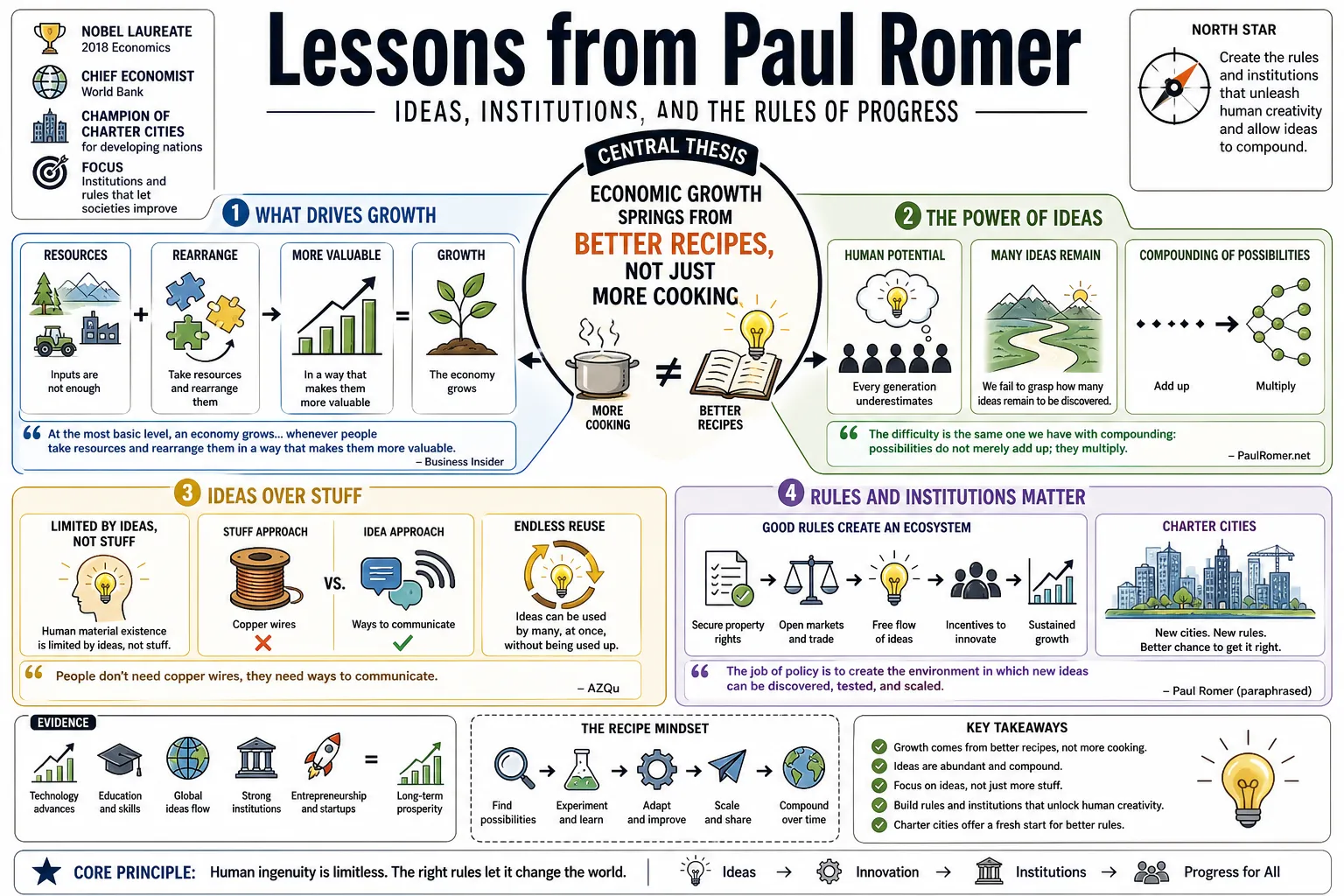
Lessons from Paul Romer
Economist and Nobel laureate Paul Romer showed how ideas and innovation drive long-term economic progress. He also served as Chief Economist of the World Bank and proposed charter cities to help developing nations. This profile covers his views on the rules and institutions that allow human societies to improve.
Part 1: Endogenous Growth and Recipes
- On economic growth: "Economic growth springs from better recipes, not just from more cooking." — Source: PaulRomer.net
- On the mechanics of growth: "At the most basic level, an economy grows... whenever people take resources and rearrange them in a way that makes them more valuable." — Source: Business Insider
- On human potential: "Every generation has underestimated the potential for finding new recipes and ideas. We consistently fail to grasp how many ideas remain to be discovered." — Source: PaulRomer.net
- On possibilities: "The difficulty is the same one we have with compounding: possibilities do not merely add up; they multiply." — Source: PaulRomer.net
- On the limits of stuff: "Human material existence is limited by ideas, not stuff; people don't need copper wires, they need ways to communicate." — Source: AZQuotes
- On changing value: "Oil was a contaminant, then it became a fuel." — Source: AZQuotes
- On the role of discovery: "We recognized that discovery is something where incentives matter, and if we create the right institutions people will do more of it." — Source: Econlib
- On the missing theory: "What was missing was a simple economic theory that could describe that process. And that was where endogenous growth theory... came in." — Source: Econlib
- On resource inputs: "True growth comes from discovering new, more efficient ways to combine resources." — Source: Economic Times
- On internal processes: "Growth is the result of internal processes and intentional discovery, rather than external forces." — Source: NobelPrize.org
Part 2: The Nonrival Nature of Ideas
- On technology as an input: "The distinguishing feature of... technology as an input is that it is neither a conventional good nor a public good; it is a nonrival, partially excludable good." — Source: Salon
- On scarcity: "A given idea is not scarce in the same way that land or capital or other objects are scarce." — Source: WordPress
- On simultaneous use: "[A]n idea can be used by any number of people simultaneously without congestion or depletion." — Source: WordPress
- On excludability: "Unlike public goods, which are nonexcludable, technological advances generate benefits that are at least partially excludable." — Source: NBER
- On private provision: "Hence, innovations in the technology are for the most part privately provided." — Source: NBER
- On objects vs. ideas: "While physical objects are rival (if you use it, I cannot), ideas are nonrival (if you use an idea, I can use it too)." — Source: Brandeis University
- On increasing returns: "Because ideas are nonrival and partially excludable, they create increasing returns to scale, allowing for sustained economic growth." — Source: Stanford University
- On the joy of abstraction: "The great thing about a nonrival abstraction is that the clarity and satisfaction, perhaps even joy, it can offer truly is something that we can all share." — Source: PaulRomer.net
- On the economic model: "Standard competitive models don't apply to ideas; growth is driven by profit-maximizing agents investing in the search for them." — Source: Stanford University
Part 3: Charter Cities and Urbanization
- On the essence of the idea: "In one sense, the essence of the idea is the notion of a Startup City. You have a chance to start a city anew." — Source: PaulRomer.net
- On choice and reform: "With a Startup City, you can propose something entirely new and let people choose whether they want to live under its rules, as embodied in its charter." — Source: PaulRomer.net
- On avoiding coercion: "People who want to try the reform can go there, and people who don’t, they don’t have to. With a startup, you can have reform without coercion." — Source: PaulRomer.net
- On constraints to progress: "The primary constraint on raising living standards is a limited capacity to discover and implement new rules." — Source: ETH Zurich
- On poverty reduction: "The central task of reducing global poverty is to find ways for developing countries to adopt new rules that are known to work better than the ones they have." — Source: ETH Zurich
- On the host-guarantor model: "A host country would provide land, while a third-party guarantor country would ensure the city’s charter and rules are respected and enforced." — Source: Charter Cities Institute
- On opportunity: "Millions of poor families could become residents, live, and work under better rules and lift themselves out of poverty." — Source: Center for Global Development
- On escaping bad systems: In his TED talk on charter cities, Romer argues that bad rules can keep countries stuck and that new city-scale jurisdictions can create opt-in places where better rules, infrastructure, firms, and residents can gather. — Reference: TED talk transcript on bad rules, charter cities, and opt-in places with new rules
- On precedent: "Hong Kong and Shenzhen serve as models for how specialized zones can facilitate the spread of effective rules and economic progress." — Source: PaulRomer.net
- On scale: "Urban density and population scale are necessary to foster human flourishing and economic dynamism." — Source: EconTalk
Part 4: Rules and Institutions
- On the rules of the game: "Growth is heavily dependent on the rules of the game that create incentives for individuals to engage in discovery." — Source: Wikiquote
- On necessary institutions: "Patent laws, research grants, and universities are critical because they shape the incentives for innovation." — Source: Econlib
- On institutional failure: "The inability to adopt better rules is often the bottleneck that keeps developing nations poor." — Source: ETH Zurich
- On crisis as an opportunity: "A crisis is a terrible thing to waste, especially when it comes to implementing necessary institutional reforms." — Source: PaulRomer.net
- On local laboratories: Romer points to China's special economic zones around Hong Kong as a way to let some people opt into market rules first, demonstrate success locally, and then build wider consensus for reform. — Reference: TED talk transcript on China's special economic zones, opt-in reform, and demonstrated local success
- On the spread of rules: "Effective rules can spread outward from successful zones as people observe and choose to adopt them." — Source: City Journal
- On government's role: "The state must balance the enforcement of property rights with the need to prevent monopolies that stifle the discovery of new ideas." — Source: Stanford University
- On urbanization as an institution: "The city itself is an institutional technology that allows humans to interact, exchange ideas, and compound growth." — Source: EconTalk
- On intentionality: "Better rules do not happen by accident; they require intentional design and political will." — Source: Center for Global Development
Part 5: Mathiness and the State of Economics
- On defining the term: "The style that I am calling mathiness lets academic politics masquerade as science." — Source: Economicsociology.org
- On slippage: "Like mathematical theory, mathiness uses a mixture of words and symbols, but instead of making tight links, it leaves ample room for slippage between statements in natural versus formal language." — Source: PaulRomer.net
- On permanent damage: "Mathiness could do permanent damage because it takes costly effort to distinguish mathiness from mathematical theory." — Source: Blogspot
- On the market for theory: "The market for mathematical theory will collapse. Only mathiness will be left. It will be worth little, but cheap to produce, so it might survive as entertainment." — Source: Blogspot
- On collective responsibility: "Economists have a collective stake in flushing mathiness out into the open." — Source: Blogspot
- On obfuscation: "Mathiness occurs when authors use complex models to look scientific, but the formal model does not actually support the conclusions they claim." — Source: Bruegel.org
- On ideological cover: "It serves as a tool for academic politics, allowing researchers to push preferred theories that lack logical or empirical soundness." — Source: Medium
- On economic modeling: "Presenting a model is like doing a card trick. Everybody knows that there will be some sleight of hand. There is no intent to deceive because no one takes it seriously." — Source: Wikiquote
- On intellectual honesty: "The profession must prioritize clear communication and tight logic over the mere appearance of rigor." — Source: American Economic Association
Part 6: The World Bank and Bureaucracy
- On clear communication: "A World Development Report, like a knife, has to be narrow to penetrate deeply." — Source: Marginal Revolution
- On waffly prose: "Because of this type of pressure to say that our message is 'this, and this, and this too, and that …' the word 'and' has become the most frequently used word in Bank prose." — Source: WordPress
- On the reader's experience: "Everyone in the Bank should work toward producing prose that is clear and concise. This will save time and effort for a reader." — Source: The Guardian
- On the bank's true mission: "I believe that it can do so much more; it can build more roads and vaccinate more children more effectively if it embraces its diplomatic mission." — Source: PaulRomer.net
- On the Doing Business controversy: "I want to make a personal apology to Chile, and to any other country where we conveyed the wrong impression. Based on the things we were measuring before, business conditions did not get worse in Chile." — Source: Quartz
- On challenging norms: On People I Mostly Admire, Romer says he spent more than a year trying to reform the World Bank research department, concluded he could not win the internal fight, and then gave a controversial interview because continuing felt like a waste of time. — Reference: Freakonomics People I Mostly Admire transcript on Romer's World Bank exit
- On bureaucratic inertia: "Large institutions often struggle to adopt new ideas because their internal incentive structures favor consensus and safety over clarity." — Source: Conversations with Tyler
- On serial quitting: "Leaving institutions when they refuse to reform is sometimes the only rational choice for someone committed to scientific honesty." — Source: Freakonomics Radio
- On institutional culture: "To be effective, development organizations must prioritize rigorous truth-seeking over political expediency." — Source: EconTalk
Part 7: Human Capital and Education
- On investing in people: "My number one recommendation is to invest in people. Humans that are well trained are the inputs into this discovery process." — Source: Bipartisan Policy Center
- On the transmission of knowledge: "And going the other way, from codified knowledge to human capital? This is what education is all about." — Source: PaulRomer.net
- On the cost of education: "Both of the steps in the chain from human capital to codified knowledge and back are complex and costly." — Source: PaulRomer.net
- On the correct measure of scale: "While physical capital matters, the correct measure of scale for an economy’s growth is often its human capital." — Source: Stanford University
- On defining human capital: "Human capital is the cumulative effect of activities such as formal education and on-the-job training." — Source: Stanford University
- On the role of universities: "If you look back in our history, we really benefited as a nation from subsidizing discovery and innovation and universities were a good way to do that." — Source: Bipartisan Policy Center
- On university reform: "Universities have developed, I think, some wasteful features and I would like to shake things up a little bit." — Source: Bipartisan Policy Center
- On literacy: "The power of reading and literacy is foundational to a society's ability to absorb and utilize nonrival ideas." — Source: Conversations with Tyler
- On human inputs: "We cannot rely solely on accumulated knowledge; we need active human minds capable of translating that knowledge into new discoveries." — Source: PaulRomer.net
- On using extra income: "Extra national income provides resources that can be spent on priorities like education to further improve standards of living." — Source: Econlib
Part 8: Pandemics, Policy, and Public Health
- On scale of testing: "During the COVID-19 pandemic, the U.S. needed to move beyond testing only the symptomatic and implement massive, population-wide testing." — Source: CEPOS
- On test quality: "Even tests with a high false-negative rate could be effective if they were inexpensive, quick, and conducted frequently enough." — Source: PaulRomer.net
- On the cost-benefit analysis: "The economic cost of lockdowns was in the trillions, making the investment in a massive, nationwide testing infrastructure highly cost-effective." — Source: CEPOS
- On identifying cases: "Frequent testing was necessary to identify and isolate infectious individuals before they could spread the virus." — Source: NIH
- On opening the economy: "A roadmap to reopen requires prioritizing frontline workers for testing before expanding to the general population." — Source: PaulRomer.net
- On simulations: "Simple toy models can effectively simulate the impact of testing policies and demonstrate the mathematical necessity of scale." — Source: PaulRomer.net
- On the failure of response: "The initial public health response failed because it prioritized perfect testing accuracy over speed and frequency." — Source: EconReporter
- On science and policy: "A culture of science is necessary to rapidly adapt public policy during a crisis." — Source: Conversations with Tyler
- On regulations: "Relaxing certain regulations in an emergency is critical to create a sustainable path toward normalcy." — Source: EconTalk