Pep Guardiola is the manager of Manchester City and a prominent tactician in modern football. His teams at Barcelona, Bayern Munich, and Manchester City rely on controlling space, aggressive pressing, and intentional possession. This profile catalogs his specific views on tactics, leadership, failure, and the daily mechanics of managing a squad.
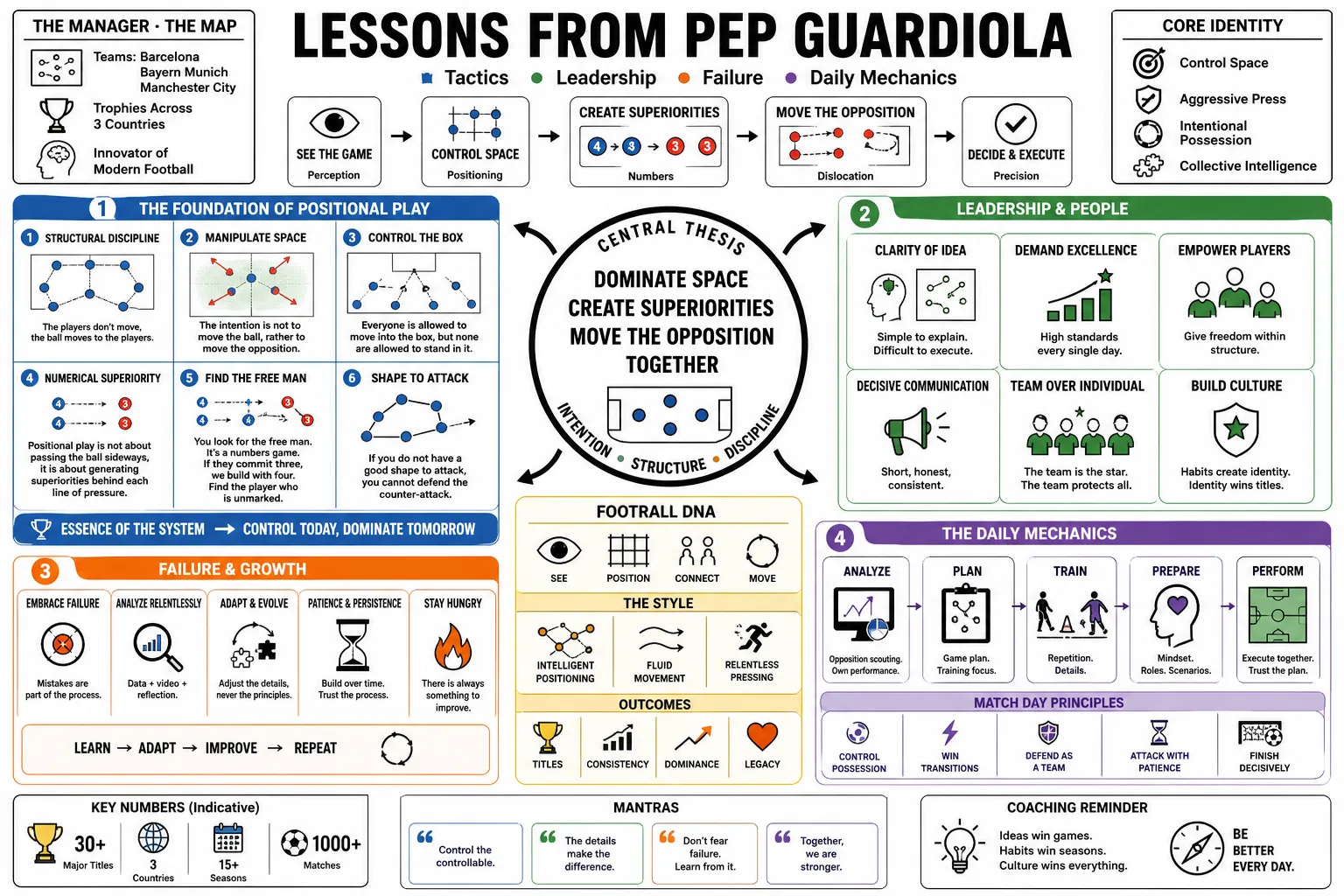
Part 1: The Foundation of Positional Play
- On structural discipline: "The players don't move, the ball moves to the players." — Source: [Training Ground Guru]
- On manipulating space: "The intention is not to move the ball, rather to move the opposition." — Source: [Pep Confidential]
- On controlling the penalty box: "Everyone is allowed to move into the box, but none are allowed to stand in it." — Source: [Tola Coaching]
- On numerical superiority: "Positional play is not about passing the ball sideways, it is about generating superiorities behind each line of pressure." — Source: [Spielverlagerung]
- On creating the free man: "You look for the free man. It’s a numbers game. If they commit three, we build with four. You must always find the player who is unmarked." — Source: [The Athletic]
- On attacking shape: "If you do not have a good shape to attack, you cannot defend the counter-attack." — Source: [Sky Sports]
- On the essence of his system: "What we want is so simple: when the opponent has the ball, take it back as quick as possible. When we have the ball, try to move as quick as possible." — Source: [Manchester City Official]
- On using the goalkeeper: "The goalkeeper is the first attacker, and the striker is the first defender." — Source: [The Guardian]
- On tactical boundaries: "I divide the pitch into zones. The players have rules about where they must be in relation to the ball. If they follow the rules, the team will function." — Source: [Coach Notes]
- On positional fluidity: "We don't play with strikers, we play with space. The space is the striker." — Source: [BBC Sport]
Part 2: Control and Intent
- On tiki-taka: "I loathe all that passing for the sake of it, all that tiki-taka. It's so much rubbish and has no purpose." — Source: [Pep Confidential]
- On the purpose of possession: "You have to pass the ball with a clear intention, with the aim of making it into the opposition's goal. It's not about passing for the sake of it." — Source: [Manchester City Official]
- On defensive principles: "When we defend deeper because they are better... But in the principles, I prefer to regain up the pitch, and make a lot of possession to de-structure the opponents." — Source: [Reddit Tactics]
- On risk management: "The team that gives the ball away the most is the team that will suffer the most counter-attacks. Possession is defensive as well as offensive." — Source: [The Independent]
- On the 15-pass rule: "If there is no sequence of 15 passes first, it is impossible to carry out the transition between defence and attack properly. Impossible." — Source: [Pep Confidential]
- On dictating the tempo: "We need the ball. If the opponent has it, we must press. If we have it, we decide the rhythm of the game." — Source: [The Athletic]
- On wide play: "You have to make the pitch as big as possible. The wingers must stay wide to open the spaces inside." — Source: [Coaches Voice]
- On attacking through the center: "If you want to win, you have to control the middle of the pitch. That is where the game is decided." — Source: [Sky Sports]
- On long balls: "I don't hate the long ball. But if you play a long ball, it must be to a player in a better position, not just to clear the danger." — Source: [The Guardian]
Part 3: Johan Cruyff and Mentorship
- On Cruyff's foundational impact: "Without him I wouldn't be here. I know for sure this is why I am, right now, the manager of Manchester City and before that Bayern Munich and Barcelona." — Source: [The Guardian]
- On discovering a new perspective: "I thought I knew about football but when I met him, and I started to work with him, I realised a new world in front of me." — Source: [The Score]
- On evaluating greatness: "All the people thinking about the best manager by talking about how many prizes or titles you've got, that is a huge mistake. It matters how they influence a new generation." — Source: [TNT Sports]
- On Cruyff as a creator: "You hear all these people saying: 'Oh Pep, what a good manager he is.' Forget about it. Cruyff was the best, by far. Creating something new is the difficult part." — Source: [The Guardian]
- On physical fitness: "I believe Johan Cruyff—my mentor, my idol, my everything. When he said to me 'when a player doesn't want to be injured, they will not be injured'." — Source: [Fox Sports]
- On decision-making: "He taught us—not only me, but a generation of players—to understand the game, to understand why you took that decision." — Source: [Manchester Evening News]
- On building Barcelona's identity: "Cruyff built the cathedral. We only maintained it." — Source: [Marca]
- On managing disruptive players: "If you have guys who don't listen... you might lose one or two games, but then you will start winning." — Source: [Goodreads]
- On Cruyff's enduring legacy: "I will never forget what he did for me. He gave me the chance to understand the game in a completely different way." — Source: [BBC Sport]
Part 4: The Demands of Training
- On the correlation between training and playing: "If you train badly, you play badly. If you work like a beast in training, you play the same way." — Source: [AZ Quotes]
- On effort versus execution: "I will forgive if the players cannot get it right, but not if they do not try hard." — Source: [AZ Quotes]
- On attention to detail: "The secret is in the details and in observing a lot. You have to pay a great deal of attention, constantly, to what happens every day." — Source: [Goodreads]
- On repetition: "We practice the same movements again and again. In the game, the player should not have to think. The reaction must be automatic." — Source: [The Athletic]
- On setting daily standards: "The result is an empty thing. The result is I'm happy for the next two days... what matters is the daily work." — Source: [Manchester City Official]
- On match preparation: "I spend hours watching the opponent, trying to find the one weakness we can exploit. Once I find it, I can sleep." — Source: [Pep Confidential]
- On the intensity of rondos: "The rondo is not just a warm-up. It is the foundation of our game. It teaches you to pass, to move, to think fast under pressure." — Source: [Coaches Voice]
- On feedback: "I am always correcting them. Sometimes they get tired of me. But the moment I stop correcting a player, it means I have given up on them." — Source: [Sky Sports]
- On maintaining focus: "The hardest thing in football is to keep winning. To wake up every day and maintain the same hunger. That requires relentless training." — Source: [The Guardian]
Part 5: Leadership and Player Accountability
- On rejecting excuses: "In football, the worst things are excuses. Excuses mean you cannot grow or move forward." — Source: [Manchester City Official]
- On leading by example: "I try to be positive. I speak to my players about how we have to play, respect the rules. What I have done is always be positive." — Source: [Gracious Quotes]
- On managing the person: "I am not dealing with footballers, I am dealing with people. They have fears and worry about failing." — Source: [QuoteFancy]
- On collective responsibility: "I have to make them see that without each other they are nothing." — Source: [QuoteFancy]
- On humility: "It doesn't mean my footballing ideas are special, different, better than the others... It's the way I believe. I'm not special." — Source: [Manchester City Official]
- On tactical compliance: "You must adapt to the players you have, but fundamentals stay the same." — Source: [Phase of Play]
- On confronting fear: "They worry about making fools of themselves in front of 80,000 people. My job is to give them the structure to feel secure." — Source: [QuoteFancy]
- On building culture: "Creating something new is the difficult part. To make it and build it and get everyone to follow? Amazing." — Source: [Manchester City Official]
- On trust: "I give the players the tools to reach the final third. Once they are there, it is about their talent and their decisions." — Source: [The Athletic]
- On squad rotation: "Everyone must feel they have a role. If a player feels he will never play, you lose him for the season." — Source: [BBC Sport]
Part 6: Handling Pressure and Failure
- On embracing failure: "I’m delighted to have failed. I love failures. In this society where everything has to be perfect, it is important to accept that you can fail." — Source: [Indian Express]
- On the burden of success: "I know if we don't win, I'll be a failure. And if we do it's 'how good is Pep?'" — Source: [The National]
- On the nature of pressure: "The pressure to win is always there. But the pressure you put on yourself to play the right way is heavier." — Source: [Sky Sports]
- On ignoring external noise: "I do not read the press after a game. If we win, they say I am a genius. If we lose, they say I made a mistake." — Source: [The Guardian]
- On processing defeat: "Losing is painful, but it is necessary. It forces you to ask questions you avoid when you are winning." — Source: [The Athletic]
- On title races: "You have to live with the knowledge that if you don't win, you will not be champions. You must find the personality to handle that." — Source: [Goal.com]
- On moving past mistakes: "A mistake is just a moment. What matters is the reaction. If you hide after a mistake, you cannot play for this team." — Source: [BBC Sport]
- On the illusion of perfection: "Perfection does not exist in football. The game is too chaotic. We only try to be less imperfect than the opponent." — Source: [The Times]
- On defining his own success: "I will not judge my career based on the trophies I won, but on how my teams played." — Source: [Sky Sports]
Part 7: Tactical Evolution and Constant Adaptation
- On adapting to leagues: "When I came to England, they told me I could not play this way. I had to prove it was possible, but I also had to adapt to the second balls." — Source: [The Telegraph]
- On positional fluidity: "Moving Philipp Lahm into midfield wasn't a sudden invention, it was a necessity to control the counter-attacks." — Source: [Medium]
- On inverting full-backs: "We bring the full-backs inside not just to pass, but to have players ready to press immediately if we lose the ball." — Source: [Soccer Tutor]
- On the false nine: "The false nine is about creating a dilemma for the center-backs. If they follow, there is space behind. If they stay, we have an extra man in midfield." — Source: [The Athletic]
- On evolving formations: "Formations are just phone numbers. It is about the spaces players occupy when the ball is moving." — Source: [Sky Sports]
- On the role of the striker: "Erling Haaland gives us a different dimension. We don't change our principles, but we adapt our build-up to utilize his specific qualities." — Source: [Manchester City Official]
- On continuous learning: "If I am doing the same things now that I did at Barcelona, I am going backwards. The game changes, and you must change with it." — Source: [The Guardian]
- On defensive transitions: "The first five seconds after losing the ball are the most important. If we win it back then, we attack an unorganized defense." — Source: [Coaches Voice]
- On breaking down low blocks: "When ten players defend in the box, patience is a tactic. You move the ball from side to side until a crack appears." — Source: [BBC Sport]
Part 8: Philosophy and the Human Element
- On his core motivation: "I don't manage to win titles. I manage to see my team play the way I envision in my head." — Source: [Sky Sports]
- On the beauty of the game: "Football is not just a business or a competition. It is an art form. We have an obligation to entertain the people who pay to watch us." — Source: [The Guardian]
- On player relationships: "You cannot treat every player the same. Some need an arm around the shoulder, others need a kick. You have to understand the human being." — Source: [The Athletic]
- On the passage of time: "Everything has a cycle. As a manager, you have to know when your time at a club is coming to an end. You cannot overstay your welcome." — Source: [BBC Sport]
- On passion: "If I lose the passion for the training session, for the details, that is the day I will retire." — Source: [Manchester City Official]
- On critics: "People criticize because they don't understand the process. They only see the result. I cannot control what they see." — Source: [The Times]
- On legacy: "I want people to remember my teams because they made them feel something. That is more important than any medal." — Source: [The Telegraph]
- On the unpredictability of football: "You can plan everything perfectly, and then in one second, a deflection changes the game. That is why we love it, and why it drives us crazy." — Source: [The Independent]
- On self-doubt: "Before every big game, I have doubts. I question my setup. If you don't have doubts, you are arrogant." — Source: [Pep Confidential]
- On the meaning of effort: "At the end of the day, when the game is over, the only question that matters is: did we give absolutely everything?" — Source: [Manchester City Official]