Lessons from Pete Kazanjy
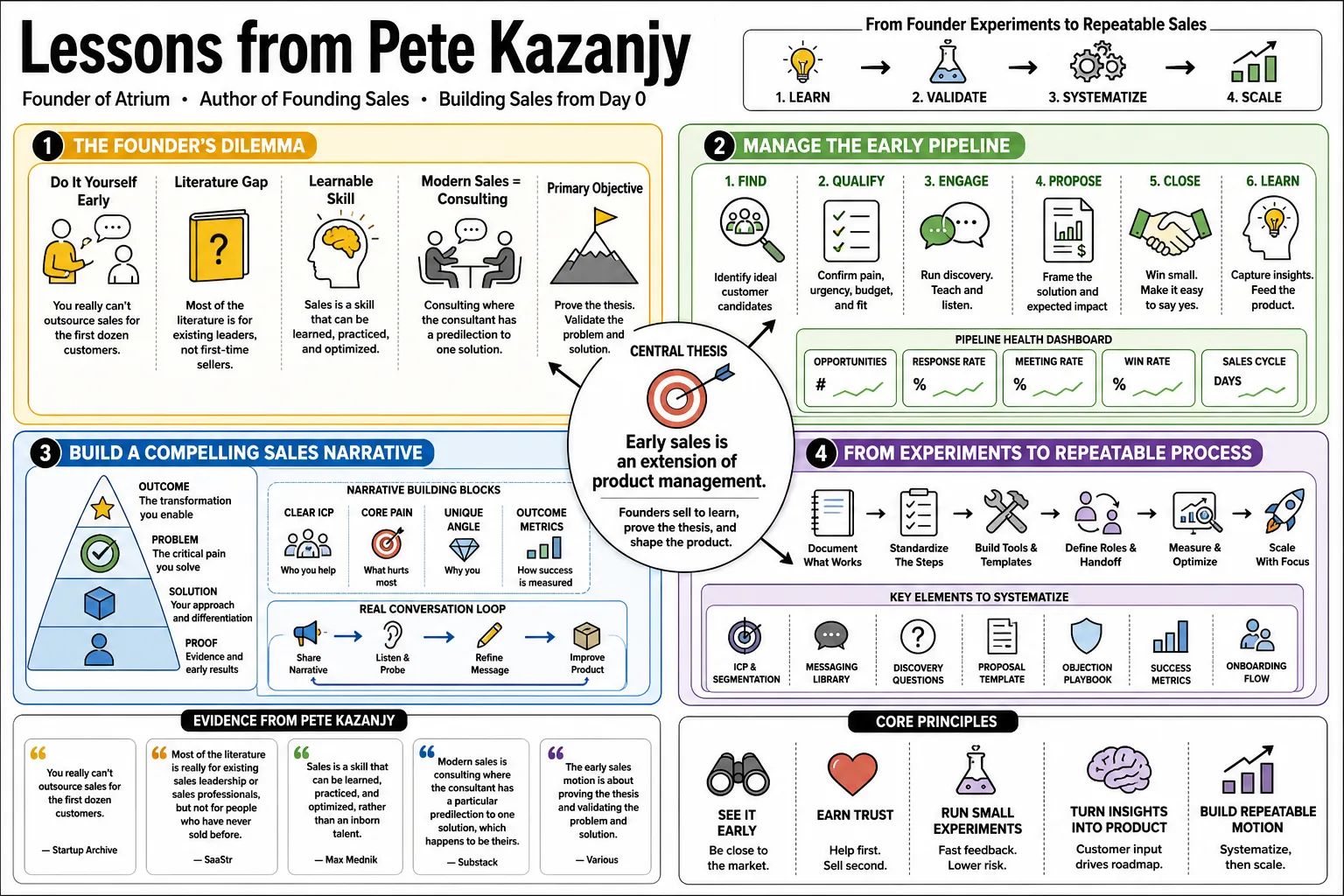
Pete Kazanjy wrote the handbook Founding Sales and founded the sales management tool Atrium. He argues that early startup sales are simply an extension of product management that founders must handle directly rather than outsourcing. This profile breaks down his practical advice on managing pipelines, building sales narratives, and scaling those early experiments into a repeatable sales process.
Part 1: The Founder's Dilemma
- On early execution: "You really can't outsource sales for the first dozen customers. You lose the feedback loop with the product." — Source: Startup Archive
- On existing literature: "Most of the literature is really for existing sales leadership or sales professionals, but not for people who have never sold before." — Source: SaaStr
- On sales as a competency: "Sales is a skill that can be learned, practiced, and optimized, rather than an inborn talent." — Source: Max Mednik
- On redefining the role: "Modern sales is consulting where the consultant has a particular predilection to one solution, which happens to be theirs." — Source: Substack
- On the primary objective: "The early sales motion is about proving the thesis and validating the product, rather than merely closing revenue." — Source: Founding Sales
- On sales tactics: Kazanjy describes sales as a misunderstood craft: on Scratchpad, he says non-sales colleagues often misunderstand prospecting, and that experience gave him empathy for how sales actually works rather than the movie-version caricature of pushy tactics. — Reference: Scratchpad Beyond Quota transcript on sales being misunderstood, prospecting, empathy, and the impetus for Founding Sales
- On readiness for scale: "Before scaling the machine and hiring reps, you must figure out the initial motion yourself." — Source: Lenny's Newsletter
- On mindset shifts: "Moving from a product or marketing mindset to a sales mindset requires being heavily grind-oriented." — Source: SaaS Club
- On tactical focus: "Founders should avoid vague, mystical sales gurus and focus on practical, repeatable frameworks." — Source: Y Combinator
- On keeping knowledge centralized: "You want to keep the learnings of whether your message fits the market in one brain to start." — Source: Startup Archive
Part 2: Activity and Discipline
- On assumed activity: "Sales organizations often operate at only 60 percent of the activity level that leadership believes is happening." — Source: SaaS Club
- On core strategy: "Three main rules: focus, focus, focus." — Source: Siskar
- On priorities: "Put activity above all else." — Source: Founding Sales
- On pipeline volume: "Embrace plenty, not scarcity in your pipeline." — Source: Founding Sales
- On time management: "Spend good time with good opportunities." — Source: Founding Sales
- On qualification: "Be ruthless with respect to truncating unproductive conversations with marginal opportunities." — Source: Founding Sales
- On input and output: "Activity in equals value out." — Source: Max Mednik
- On skill acquisition: "The transition from novice to competent requires ongoing practice and rigorous repetition." — Source: Modern Sales Pros
- On early effort: Kazanjy argues that founders have to do the early selling enough times to discover the sales motion: not once or three times, but a statistically meaningful number of conversations that reveal who must be engaged, what stages matter, and what needs to be documented. — Reference: SaaStr transcript on founder sellers discovering the sales motion through repeated early conversations and documentation
- On hitting targets: "Consistent numbers require methodical pipeline management over relying on luck." — Source: OpsStars
Part 3: Weaponized Product Management
- On founder-led selling: Kazanjy says the founder moves from customer development into what he calls a "weaponized product manager": engaging people with a validated pain, proposing a solution, and figuring out the sales motion before trying to hand that knowledge to someone else. — Reference: SaaStr transcript on the founder as a weaponized product manager during early sales discovery
- On the feedback loop: "The loop between articulation, presentation, listening, and building needs to be a tight one." — Source: Startup Archive
- On founder advantages: "Founders are uniquely equipped to sell early on because they deeply understand the customer's problem." — Source: Substack
- On prospect education: "Your goal is to genuinely help a prospect understand their problem and believe in its importance." — Source: Substack
- On fit assessment: "Evaluate if the solution is a fit rather than forcing a square peg into a round hole." — Source: Substack
- On market friction: "If the message doesn't fit the market, the founder needs to hear that friction firsthand." — Source: Startup Archive
- On discovery: "Treat the sales conversation as a direct discovery mechanism for engineering priorities." — Source: Lenny's Newsletter
- On product validation: In the SaaStr interview, Kazanjy lays out the early product-company sequence as identifying pain, validating that the pain exists, proving the solution relieves that pain, and then getting commercial exchange for it. — Reference: SaaStr transcript on identifying pain, validating it, proving the solution, and earning commercial exchange
- On the cost of outsourcing: "You lose the most valuable product learnings if you outsource the initial selling process." — Source: Startup Archive
- On integration: "Merging the roles of product management and sales accelerates finding true product-market fit." — Source: Founding Sales
Part 4: Data-Driven Sales Management
- On shifting paradigms: "Move sales from voodoo magic to a scientific, repeatable, and data-backed discipline." — Source: David Dulany
- On new skillsets: "As sales tech stacks become complex, there is a growing need for sales nerds to analyze CRM data." — Source: David Dulany
- On process visibility: "Instrument the sales process to truly understand what is working and what is not." — Source: David Dulany
- On metrics: "Break team performance down into granular, measurable metrics to monitor success." — Source: Modern Sales Pros
- On targets: "Effective goal setting is an iterative process that requires continuous adjustment." — Source: Modern Sales Pros
- On clarity: "Leaders must select metrics that matter and communicate them clearly to the team." — Source: Modern Sales Pros
- On consistency: "Getting metrically excellent is an ongoing operational process rather than a one-time project." — Source: Modern Sales Pros
- On predictable revenue: "Relying on a repeatable system is far more effective than depending on a few unicorn sellers." — Source: OpsStars
- On the management gap: "Bridge the gap between perceived and actual activity by using proactive, always-on data insights." — Source: SaaS Club
Part 5: Crafting the Narrative
- On differentiation: "A persuasive sales story must highlight why the product is different and distinctly better." — Source: SaaS Club
- On trade-offs: "Acknowledge potential trade-offs in your sales narrative to build credibility with buyers." — Source: SaaS Club
- On discovery calls: "Honesty and transparency are absolutely essential during early customer conversations." — Source: OpsStars
- On building trust: "Sharing weaknesses can often build more trust than trying to present a perfect solution." — Source: OpsStars
- On boundaries: "Be entirely clear about what your product does not do." — Source: OpsStars
- On narrative evolution: "The pitch must evolve continuously based on the raw feedback from founder-led sales calls." — Source: Lenny's Newsletter
- On hypothesis testing: "Apply rigorous, hypothesis-driven frameworks to the development of your sales narrative." — Source: Holloway
- On sales collateral: "Treat your slide decks and demo scripts as products that require testing and iteration." — Source: SaaS Club
- On enduring truths: "Back to basics is a big thing, as human psychology and sales fundamentals haven't radically changed." — Source: GTM Now
Part 6: Hiring and Scaling
- On handoffs: "Package your startup sales process before hiring a leader." — Source: SaaS Club
- On system deployment: "Compare handing off sales to deploying software, because it has to run on someone else's machine." — Source: SaaS Club
- On documentation: "When you are making assets for yourself, you are also making the assets for your future sales team." — Source: Dock.us
- On hiring timing: "You must prove product-market fit before bringing in professional salespeople to scale the machine." — Source: Lenny's Newsletter
- On first hires: "Early sales staff must be highly adaptable rather than rigid followers of existing enterprise playbooks." — Source: Lenny's Newsletter
- On transition metrics: Kazanjy recommends instrumenting the sales process instead of waiting for quarter-end results: track first meetings, new opportunities, stage advancement, rep activity, conversion, and other leading indicators so managers can catch transition problems early. — Reference: SaaStr transcript on instrumenting leading indicators, rep activity, opportunities, conversion, and sales-process telemetry
- On operational support: "Sales operations and enablement are required for transforming initial momentum into a scalable motion." — Source: OpsStars
- On enablement goals: "Enablement should be about creating long-term customer advocates rather than merely closing the first deal." — Source: OpsStars
- On momentum: "Start quickly and iterate rapidly when building out your initial sales team." — Source: Modern Sales Pros
Part 7: Process and Instrumentation
- On early frameworks: "The early sales process should be treated as a cultural descendant of The Lean Startup." — Source: Holloway
- On cross-team alignment: "Sales processes must be operationally excellent to support communication across all revenue departments." — Source: OpsStars
- On experimentation: "Treat early sales like a structured experiment with clearly defined inputs and measurable outputs." — Source: Lenny's Newsletter
- On process rigor: "Document your workflow and early collateral meticulously to ensure it can be replicated." — Source: Dock.us
- On tech implementation: "Implement technology purposely to create a scientific, highly structured sales motion." — Source: David Dulany
- On accountability: "Granular KPI tracking is the only way to ensure the team hits their numbers consistently." — Source: OpsStars
- On predictability: "Do not rely on luck; rely entirely on methodical, disciplined pipeline management." — Source: OpsStars
- On behavior modification: "Continuously monitor metrics to diagnose issues and improve the quality of team behavior." — Source: Modern Sales Pros
- On pragmatism: "Avoid hand-wavy advice and rely on practical, tactical frameworks that can be instrumented." — Source: Y Combinator
Part 8: The Broader Ecosystem
- On community learning: "A peer-learning environment is required for modern sales leaders to solve novel problems." — Source: David Dulany
- On revenue synergy: "Success requires deep collaboration between Marketing, Sales, Product, and Customer Success." — Source: OpsStars
- On interpreting data: "The challenge of interpreting complex performance data is often best solved within a community of peers." — Source: OpsStars
- On remote management: "Managing remote and hybrid sales teams necessitates entirely new data-driven management approaches." — Source: OpsStars
- On the future of RevOps: "Emerging technologies and AI are fundamentally changing how Revenue Operations processes data." — Source: OpsStars
- On modern leadership: "Today's sales leaders must be highly thoughtful, creative, and intelligent system-builders." — Source: David Dulany
- On industry evolution: "The sales profession has definitively shifted from an art form to a scientific discipline." — Source: Founding Sales
- On company culture: "Founders must build an internal culture that inherently values metrics, discipline, and accountability." — Source: Modern Sales Pros
- On continuous improvement: "Community is a powerful mechanism for sharing best practices, iterating on strategy, and avoiding common pitfalls." — Source: David Dulany