Brothers Peter and Dick Dreissigacker were the engineering and product-building force at the center of Concept2's founding team. They started developing carbon-fiber oars while training for the 1976 Olympic trials, then built the indoor rowers now used by athletes worldwide. Bari Dreissigacker co-founded the company with them in 1976, and Judy Geer joined as its fourth co-founder in 1983. Together, the team paired practical engineering with customer service, athlete insight, and a long-term commitment to manufacturing in Vermont. This profile focuses on Peter and Dick's approach to invention while recognizing the broader team that made the company endure.
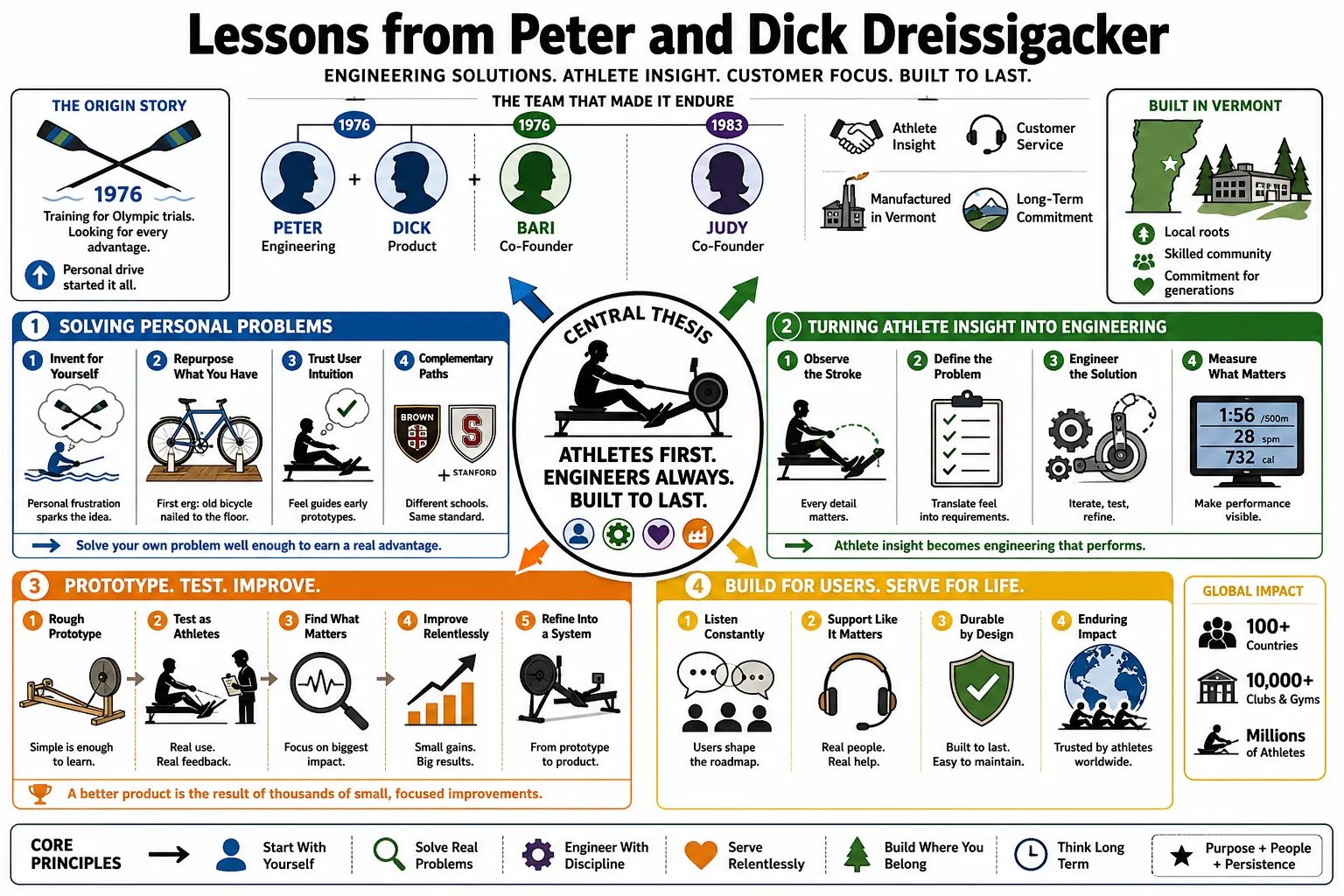
Part 1: Solving Personal Problems
- On inventing for yourself: The best product insights often come from personal frustration. The brothers initially developed carbon-fiber oars simply because they were looking for a mechanical advantage to improve their own performance at the Olympic trials. — Reference: Concept2 Timeline
- On repurposing materials: Early prototypes do not need to be elegant to be effective. The very first indoor rowing ergometer was built by nailing an old bicycle to the floor and using its chain to simulate the rowing stroke. — Reference: World Rowing Feature
- On trusting user intuition: When you are the primary user of your invention, your intuitive sense of what feels right can guide early prototypes before testing turns that feel into a repeatable design. — Reference: How I Built This: Concept2
- On complementary paths: Dick came to rowing through Brown and Stanford and introduced Peter to the sport. Their shared training gave two engineers a common problem to solve and a common standard for judging the result. — Reference: The Innovators Behind Concept2
Part 2: Turning Athlete Insight Into Engineering
- On mechanical reality: Performance improvements come from aligning with physics and mechanical efficiency rather than chasing industry trends or adopting new materials for the sake of marketing. — Reference: The Dreissigackers: For the Love of Rowing and the Passion to Innovate
- On ignoring fashion: A tool's value lies in its utility. The brothers consistently pushed back against athletic superstitions and aesthetic demands that did not demonstrably improve boat speed or training efficiency. — Reference: World Rowing Interview
- On adapting to feedback: Continuous improvement requires listening to how athletes actually use the equipment, which can differ from how engineers envision it in the workshop. — Reference: How I Built This: Concept2
- On prototyping early: Concept2's product-development loop moves quickly from theoretical analysis and engineering discussion into a physical prototype. Ideas become more useful once athletes and engineers can test them against reality. — Reference: Supporting Olympians in the Search for Speed
Part 3: Making Performance Legible
- On gradual refinement: Innovation does not always mean radical reinvention. The progression from the Model A through later ergometers came through patient improvements to a proven foundational design. — Reference: Concept2 Timeline
- On standardization: Establishing a reliable baseline allows users to trust their progress over time and across different machines, turning a training tool into an objective standard. — Reference: World Rowing Feature
- On consistent measurement: A stable performance monitor lets athletes compare efforts across sessions and machines, making the erg a training standard rather than a disposable appliance. — Reference: Concept2 Timeline
- On the power of an afterthought: Peter added a bicycle speedometer to the first erg so users could see distance and speed. That small measurement feature made the machine raceable and helped turn solitary winter training into a competitive sport. — Reference: The Erg to Compete
Part 4: Designing Products to Last
- On low-maintenance design: Products should be built to withstand heavy use without requiring constant attention. The longevity of Concept2 machines in boathouses and gyms is a direct result of engineering for minimal maintenance. — Reference: Why Concept2 Supports 40-Year-Old Ergs
- On functional utility: Every component should justify its presence. Unnecessary features introduce points of failure, so maintaining a stripped-down and purely functional design supports long-term reliability. — Reference: Concept2 Model A: Return to Glory 40 Years Later
- On enduring design: A product that correctly solves a fundamental physical problem will naturally resist becoming outdated, proving that good physics makes for timeless engineering. — Reference: World Rowing Feature
- On backwards support: Concept2 still supplies parts and guidance for machines built four decades ago. Supporting old products turns durability from a claim into an operating commitment. — Reference: Why Concept2 Supports 40-Year-Old Ergs
Part 5: Building the Service System Around the Product
- On enduring value: Creating a machine that lasts for decades builds deeper brand loyalty than planned obsolescence does. — Reference: The Innovators Behind Concept2
- On resisting feature bloat: While fitness equipment often adds screens, subscriptions, and complex electronics, Concept2 has kept its core machines mechanically legible and serviceable. — Reference: The Innovators Behind Concept2
- On repairable systems: A long-lived product needs replaceable components and documentation, not merely a strong frame. Design the service system alongside the machine. — Reference: Why Concept2 Supports 40-Year-Old Ergs
- On keeping production close: Concept2 grew into a global supplier while keeping manufacturing in and around Morrisville. Proximity between engineering, production, and customers made product knowledge easier to retain and improve. — Reference: Making It in Vermont: Concept2
Part 6: Expanding From a Strong Core
- On broadening access: A machine first sold mainly to rowing clubs and schools reached a much broader fitness market once CrossFit gyms began adopting it in the 2000s. — Reference: How I Built This: Concept2
- On mastering one thing: Concept2 spent decades developing oars and indoor rowers before expanding into SkiErgs and BikeErgs, demonstrating the value of depth before adjacency. — Reference: Concept2 Timeline
- On patient market expansion: Concept2 did not begin with a universal-fitness pitch. It won rowing clubs first, then reached gyms and home users as adjacent communities found the same machine useful. — Reference: How I Built This: Concept2
- On making a visible leap when physics supports it: Concept2 introduced an asymmetrical hatchet-shaped blade in 1991. By the 1992 Olympics, most crews were using it. Patient iteration can still produce a decisive change when a new shape moves water more effectively. — Reference: Concept2, More Than Equipment
Part 7: Treating Community as Infrastructure
- On organic growth: The popularity of indoor rowing grew partly through competitions such as the CRASH-B Sprints, which gave athletes a reason to train and a common standard to chase. — Reference: Concept2 Timeline
- On creating a shared language: By standardizing the measurement of effort, the brothers inadvertently created a global community where a rower in Vermont could directly compare their fitness with a rower in New Zealand. — Reference: World Rowing Interview
- On community as a design input: Concept2 credits customers, athletes, employees, suppliers, and neighbors in its mission. A durable physical-product company is sustained by the network around the machine as much as by the machine itself. — Reference: Fifty Years Strong, Powered by Community
- On designing a standard that welcomes more people: The community around Concept2 grew to include Olympians, adaptive athletes, and first-time users. A demanding performance tool can remain inclusive when access and comparability are treated as part of the system. — Reference: Women Who Move Us Forward
Part 8: Choosing Independence and Place
- On independence: Staying private and manufacturing in Vermont gave Concept2 room to optimize for product quality and durability instead of an outside investor's timetable. — Reference: Adhoc97 Thread
- On humble beginnings: A corporate headquarters is not a prerequisite for serious engineering. The brothers began manufacturing composite oars in a Vermont barn. — Reference: About Concept2
- On staying grounded: Keeping the company in Morrisville tied manufacturing to the local workforce and kept the operation close to the places where the brothers rowed and tested products. — Reference: About Concept2
- On resourcefulness: Their first indoor rower used bicycle parts and was aimed at a limited market of rowing clubs and schools, showing that a narrow early market can still support meaningful product development. — Reference: How I Built This: Concept2
Part 9: Building a Complete Founding Team
- On telling the full founding story: Concept2 began with more than two brothers in a barn. Bari Dreissigacker co-founded the company with Peter and Dick in 1976, and Judy Geer joined as the fourth co-founder in 1983. Accurate company history should recognize the operators who turned invention into an institution. — Reference: Women Who Move Us Forward
- On giving the business an operating foundation: Bari built the early systems around customer service, sales, accounting, human resources, and shipping. Engineering creates the product; disciplined operations make it possible to serve customers repeatedly. — Reference: Women Who Move Us Forward
- On combining athlete experience with technical depth: Judy joined with experience as an Olympic rower, coach, and engineer. That combination helped Concept2 connect product decisions to the real demands of training and racing. — Reference: Women Who Move Us Forward
- On knowing the people you serve: The founding team belonged to the rowing community before it sold to it. Shared identity with customers made feedback specific, personal, and difficult to ignore. — Reference: Women Who Move Us Forward
Part 10: Designing Stewardship
- On long-term independence: Protecting a company's mission can require an ownership structure that prevents a conventional sale. On January 1, 2025, the founders transferred all of Concept2 to a Perpetual Purpose Trust. — Reference: Concept2 Perpetual Purpose Trust
- On employee stewardship: The trust places long-term stewardship in the hands of a committee that includes founders and employees, preserving continuity without making the company dependent on a new outside owner. — Reference: Concept2 Perpetual Purpose Trust
- On where profits go: Under the trust, profits are reinvested in the business and used to fulfill its purpose rather than flowing to individual shareholders or beneficiaries. — Reference: Concept2 Perpetual Purpose Trust
- On preserving purpose: The founders treated succession as a product-design problem: define what must endure, then choose a structure that makes those constraints explicit. — Reference: Concept2 Perpetual Purpose Trust