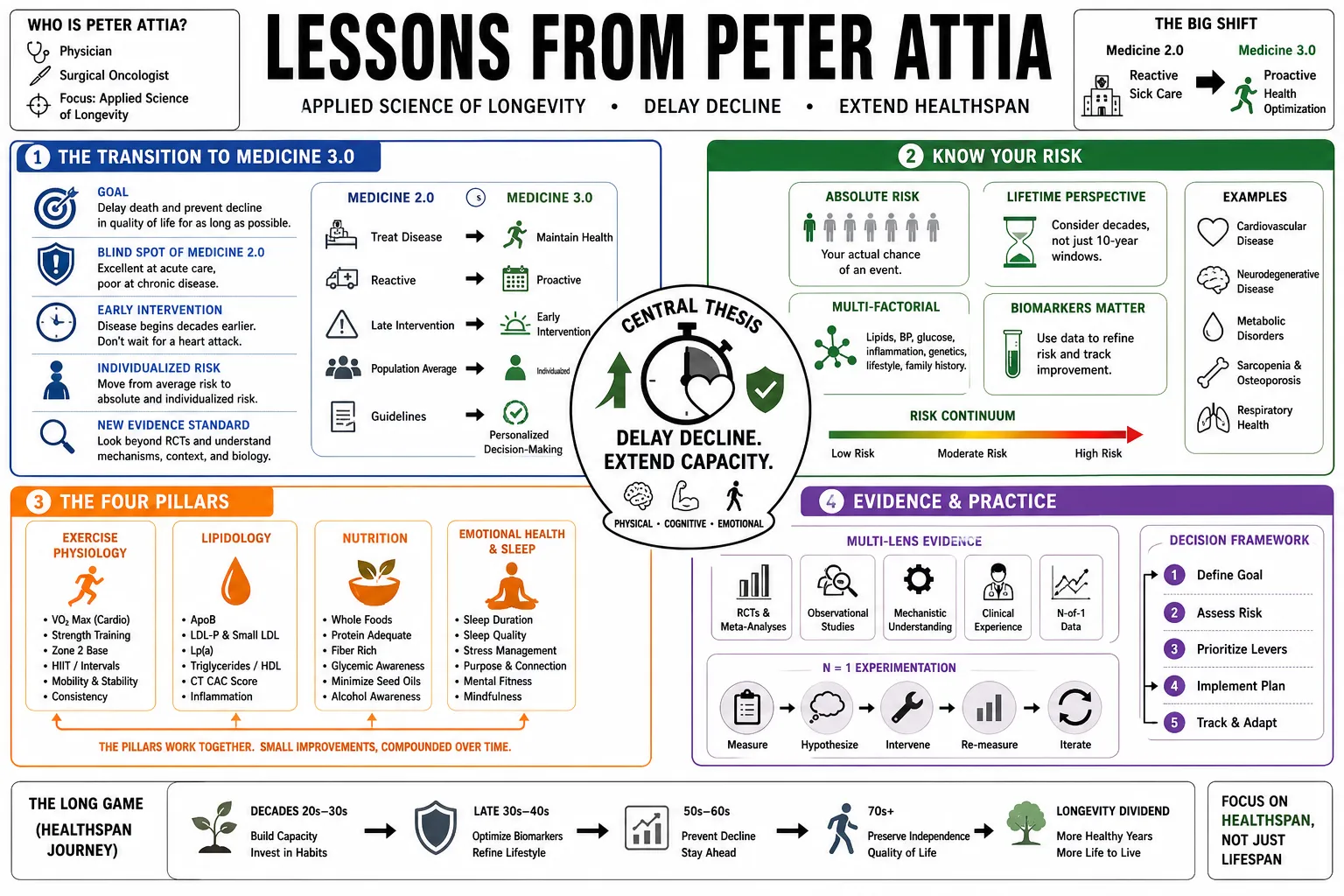
Lessons from Peter Attia
Peter Attia is a physician who left surgical oncology to focus on the applied science of longevity. He advocates for "Medicine 3.0," a framework that prioritizes early intervention over late-stage disease management to extend both physical and cognitive capacity. This profile documents his specific methods for delaying decline through exercise physiology, lipidology, nutrition, and emotional health.
Part 1: The Transition to Medicine 3.0
- On modern medicine's blind spot: "Medicine 2.0 has been wildly successful at treating acute disease and injuries, but it has largely failed at treating chronic diseases." — Source: [Outlive: The Science and Art of Longevity]
- On the goal of Medicine 3.0: "The objective is to delay death and to prevent the decline in quality of life for as long as possible." — Source: [The Drive, Episode 200]
- On early intervention: "You cannot wait until you have a heart attack to start treating cardiovascular disease. The disease process began decades earlier." — Source: [Huberman Lab Podcast]
- On risk assessment: "We need to shift from a mindset of average risk to an understanding of absolute and individualized risk." — Source: [Outlive: The Science and Art of Longevity]
- On evidence-based practice: "Medicine 3.0 demands that we look beyond randomized controlled trials and understand the nuances of Mendelian randomization and epidemiology." — Source: [The Drive, Episode 150]
- On the definition of healthspan: "Healthspan extends beyond physical capability; it encompasses cognitive function and emotional well-being." — Source: [Tim Ferriss Show #352]
- On continuous tracking: "If you don't measure it, you can't manage it. Continuous glucose monitors offer a window into metabolic health that a single fasting glucose test misses." — Source: [The Drive, Episode 10]
- On patient agency: "The patient must become the CEO of their own health, rather than a passive passenger relying entirely on a physician." — Source: [Outlive: The Science and Art of Longevity]
- On ignoring average guidelines: "Guidelines are designed for populations. Individuals must be treated based on their unique biology and goals." — Source: [The Drive, Episode 240]
Part 2: Exercise as the Most Potent Drug
- On the primary lever for longevity: "Exercise is by far the most potent intervention we have for both lifespan and healthspan." — Source: [Outlive: The Science and Art of Longevity]
- On Zone 2 training: "Zone 2 is the metabolic engine of your body. It increases mitochondrial efficiency and is the foundation for all other physical work." — Source: [The Drive, Episode 85]
- On VO2 max: "Your VO2 max is the single strongest predictor of future mortality. A high VO2 max reduces all-cause mortality risk more than any other metric." — Source: [Huberman Lab Podcast]
- On the necessity of strength: "Muscle mass and strength decline linearly after age forty, and accelerating after sixty. Preserving it requires lifting heavy things." — Source: [The Drive, Episode 223]
- On grip strength: "Grip strength is a simple, highly correlated proxy for overall strength and reliably predicts a longer lifespan." — Source: [Outlive: The Science and Art of Longevity]
- On bone density: "Osteoporosis is a pediatric disease with geriatric consequences. Heavy load-bearing exercise is mandatory to maintain bone mineral density." — Source: [The Drive, Episode 194]
- On rucking: "Carrying a heavy pack walks the line between cardio and strength. It builds the chassis of the body while taxing the heart." — Source: [The Drive, Episode 250]
- On the volume of exercise: "Aiming for three hours of Zone 2 and two sessions of strength training per week is the minimum effective dose for a long, capable life." — Source: [Tim Ferriss Show #352]
- On stability: "Stability is the transmission of force. Without it, you cannot safely translate muscle power into movement without injury." — Source: [Outlive: The Science and Art of Longevity]
- On consistency: "A mediocre exercise routine done consistently for decades will vastly outperform a perfect routine done intermittently." — Source: [The Drive, Episode 112]
Part 3: Nutritional Biochemistry and Diet
- On dietary tribalism: "Nutrition is religion disguised as science. We must abandon dogmatic diets and focus on biochemistry." — Source: [TEDMED 2013]
- On protein intake requirements: "Most people, especially as they age, under-consume protein. The RDA of 0.8 grams per kilogram is enough to prevent malnutrition, not to build or maintain muscle." — Source: [The Drive, Episode 224]
- On nutritional priorities: "When evaluating diet, look at total calories, protein intake, and the quality of fats. Everything else is secondary." — Source: [Outlive: The Science and Art of Longevity]
- On intermittent fasting: "Time-restricted eating is a tool to restrict calories and improve metabolic flexibility, but it often leads to under-eating protein and losing muscle." — Source: [The Drive, Episode 140]
- On alcohol consumption: "Alcohol is a neurotoxin. There is no biological free lunch with drinking, regardless of what observational epidemiology suggests." — Source: [Huberman Lab Podcast]
- On fructose metabolism: "Excessive liquid fructose bypasses normal satiety signals and drives hepatic fat accumulation and insulin resistance." — Source: [The Drive, Episode 87]
- On continuous glucose monitoring: "A CGM provides immediate feedback on how your specific body responds to different foods, sleep deprivation, and stress." — Source: [Tim Ferriss Show #352]
- On plant vs animal protein: "Animal sources are denser in essential amino acids, particularly leucine, which is the trigger for muscle protein synthesis." — Source: [The Drive, Episode 109]
- On standard diets: "The standard American diet is perfectly engineered to maximize caloric intake and drive metabolic dysfunction." — Source: [Outlive: The Science and Art of Longevity]
Part 4: Sleep and Brain Health
- On sleep as foundational: "If your sleep is broken, everything else is compromised. Your insulin resistance rises, your hormone profile worsens, and your cognition degrades." — Source: [The Drive, Episode 47]
- On Alzheimer’s prevention: "The goal in preventing neurodegeneration is to build cognitive reserve and maintain vascular health to delay the onset of symptoms." — Source: [Outlive: The Science and Art of Longevity]
- On deep sleep and recovery: "Slow-wave sleep is the only time the brain physically clears out the metabolic waste products that accumulate during waking hours." — Source: [The Drive, Episode 48]
- On sleep duration: "The evidence suggests that chronically sleeping less than seven hours a night shortens your life and accelerates disease onset." — Source: [The Drive, Episode 49]
- On temperature and sleep: "A cool environment is mandatory for initiating and maintaining deep sleep. The core body temperature must drop." — Source: [Huberman Lab Podcast]
- On sleep architecture: "Sleep architecture matters as much as duration; sufficient REM is required for emotional regulation and deep sleep for physical repair." — Source: [The Drive, Episode 55]
- On sleep pharmacology: "Most sleeping pills are sedative hypnotics that knock you unconscious but fail to produce the restorative brainwaves of natural sleep." — Source: [Outlive: The Science and Art of Longevity]
- On ApoE4 and risk: "Having the ApoE4 variant increases Alzheimer’s risk, but lifestyle interventions like exercise and sleep can significantly mitigate that genetic predisposition." — Source: [The Drive, Episode 92]
- On cognitive training: "The brain needs novel, complex tasks. Learning a new language or how to play an instrument builds more reserve than repetitive brain games." — Source: [Outlive: The Science and Art of Longevity]
Part 5: Cardiovascular Health and Lipidology
- On the true cause of atherosclerosis: "Atherosclerosis is driven by the retention of ApoB-containing lipoproteins in the artery wall. It is a concentration-dependent process." — Source: [The Drive, Episode 39]
- On LDL cholesterol vs ApoB: "Measuring LDL cholesterol is measuring the weight of the passengers. Measuring ApoB tells you the exact number of cars on the road, which is the actual risk factor." — Source: [The Drive, Episode 101]
- On early statin intervention: "Treating elevated ApoB should begin in your thirties or forties, not when a calcium score shows the disease is already advanced." — Source: [Outlive: The Science and Art of Longevity]
- On Lp(a): "Lipoprotein(a) is a highly atherogenic particle that is genetically determined. Everyone should have it checked at least once in their life." — Source: [The Drive, Episode 26]
- On target lipid levels: "For primary prevention in high-risk individuals, the goal is to drive ApoB to the physiological levels of an infant, around 20 to 30 mg/dL." — Source: [The Drive, Episode 152]
- On endothelial health: "The endothelium is the single cell layer protecting the artery. High blood pressure, smoking, and insulin resistance damage this barrier, allowing ApoB particles to enter." — Source: [Outlive: The Science and Art of Longevity]
- On calcium scores: "A zero calcium score tells you what hasn't calcified yet, but it does not rule out the presence of dangerous soft plaque." — Source: [The Drive, Episode 202]
- On the failure of HDL therapies: "Raising HDL cholesterol pharmacologically has repeatedly failed to reduce cardiovascular events. HDL function matters more than HDL concentration." — Source: [The Drive, Episode 41]
- On dietary fat and lipids: "Saturated fat downregulates LDL receptors in the liver for some people, leading to higher circulating ApoB. This response is highly individualized." — Source: [The Drive, Episode 175]
- On prioritizing cardiac risk: "Cardiovascular disease is the most preventable of the major causes of death, yet it remains the number one killer. We have the tools to nearly eliminate it." — Source: [Outlive: The Science and Art of Longevity]
Part 6: Metabolic Health and Insulin Resistance
- On the spectrum of metabolic disease: "Type 2 diabetes is the end stage of a process that begins decades earlier with insulin resistance and hyperinsulinemia." — Source: [The Drive, Episode 11]
- On insulin as a growth factor: "Chronic high insulin levels drive cellular proliferation and reduce apoptosis, which creates a favorable environment for cancer." — Source: [Outlive: The Science and Art of Longevity]
- On ectopic fat storage: "When subcutaneous fat cells reach their limit, the body stores fat in organs like the liver and muscles, causing severe metabolic dysfunction." — Source: [The Drive, Episode 14]
- On the role of muscle in metabolism: "Muscle is the largest sink for glucose in the body. More muscle mass means better insulin sensitivity and glucose disposal." — Source: [Huberman Lab Podcast]
- On uric acid: "Elevated uric acid is a strong independent marker of metabolic dysfunction and insulin resistance." — Source: [The Drive, Episode 199]
- On visceral fat: "Visceral fat acts as highly active endocrine tissue that pumps inflammatory cytokines directly into the bloodstream." — Source: [Outlive: The Science and Art of Longevity]
- On fructose and the liver: "The liver metabolizes liquid fructose differently than glucose, rapidly converting it to fat and driving non-alcoholic fatty liver disease." — Source: [The Drive, Episode 71]
- On testing for insulin resistance: "Fasting glucose is a late lagging indicator. To spot metabolic trouble early, you must look at fasting insulin or an oral glucose tolerance test." — Source: [The Drive, Episode 210]
- On energy toxicity: "The fundamental driver of modern metabolic disease is energy toxicity, meaning consuming more calories than our cellular machinery can handle." — Source: [Outlive: The Science and Art of Longevity]
Part 7: Emotional Health and Lifespan
- On the necessity of emotional health: "I realized that extending lifespan without resolving the misery in my life was a curse. You have to want to live." — Source: [Outlive: The Science and Art of Longevity]
- On trauma and behavior: "Many of the traits that make people professionally successful, like obsession or perfectionism, are adaptations to early childhood trauma." — Source: [The Drive, Episode 211]
- On dialectical behavior therapy: "DBT tools allow you to insert a wedge of time between a stimulus and your emotional response, giving you the power of choice." — Source: [The Drive, Episode 111]
- On the toll of chronic stress: "Living in a state of chronic sympathetic nervous system activation breaks down the body and accelerates aging." — Source: [Tim Ferriss Show #352]
- On therapy as training: "We treat mental health reactively. We should train for emotional resilience exactly the way we train for physical strength." — Source: [The Drive, Episode 188]
- On the narrative in our heads: "The way you talk to yourself often determines your emotional reality. Most of us speak to ourselves in a way we would never speak to a friend." — Source: [Outlive: The Science and Art of Longevity]
- On psychedelics in psychiatry: "Compounds like MDMA and psilocybin, when used in a clinical setting, can quiet the default mode network and allow patients to process intractable trauma." — Source: [The Drive, Episode 63]
- On perfectionism: "Perfectionism is a defense mechanism. It is the belief that if you do everything perfectly, you can avoid criticism and pain." — Source: [The Drive, Episode 218]
- On human connection: "Loneliness has a physical toll equivalent to smoking a pack of cigarettes a day. Meaningful relationships are biologically required for a long life." — Source: [Outlive: The Science and Art of Longevity]
Part 8: Centenarian Decathlon and Tactics
- On the Centenarian Decathlon: "To train effectively, you must define exactly what physical tasks you want to be able to do in your last decade of life, and backcast the training required today." — Source: [Outlive: The Science and Art of Longevity]
- On predicting physical decline: "If you want to pick up a thirty-pound grandchild when you are eighty, you must have the capacity to lift much more than that today, accounting for age-related decline." — Source: [Huberman Lab Podcast]
- On balance and falls: "The morbidity and mortality associated with a femur fracture in old age is staggering. Training balance and proprioception is mandatory." — Source: [The Drive, Episode 223]
- On tactical supplementation: "Supplements cannot fix a broken diet or poor sleep. They are useful only for specific, measurable deficiencies, such as magnesium or vitamin D." — Source: [The Drive, Episode 161]
- On rapamycin and mTOR: "Rapamycin is the most promising molecule we currently have for extending lifespan, as it mimics the cellular effects of nutrient scarcity by inhibiting mTOR." — Source: [The Drive, Episode 118]
- On VO2 max training protocols: "Four-by-four intervals, meaning four minutes of maximum sustainable effort followed by four minutes of recovery repeated four times, is the gold standard for raising VO2 max." — Source: [The Drive, Episode 17]
- On cold exposure: "Deliberate cold exposure builds brown fat and increases resilience, but it should not be done immediately after resistance training, as it blunts the hypertrophy signal." — Source: [Huberman Lab Podcast]
- On fasting protocols: "Periodic prolonged fasting induces autophagy and clears senescent cells, but the optimal frequency depends entirely on one's body composition and goals." — Source: [The Drive, Episode 67]
- On dynamic neuromuscular stabilization: "Proper breathing mechanics and intra-abdominal pressure are the foundation of safe movement under heavy loads." — Source: [The Drive, Episode 82]
- On the ultimate metric: "The goal of all these tactics is marginal decades, adding ten highly functional, capable years to your life rather than simply extending the end-stage of decline." — Source: [Outlive: The Science and Art of Longevity]