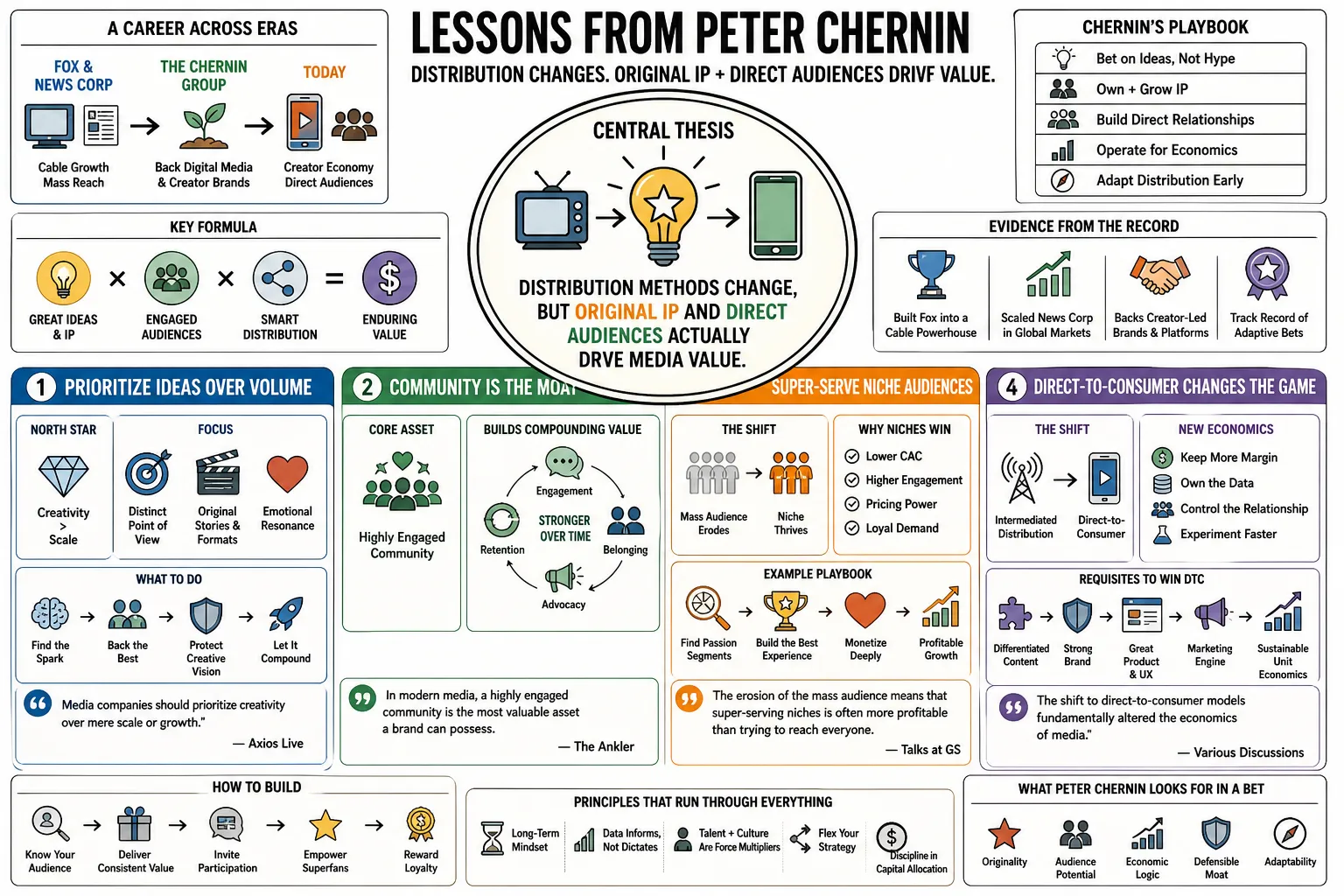
Lessons from Peter Chernin
Peter Chernin ran Fox and News Corp at the height of cable television before launching The Chernin Group to back digital media and creator-led brands. He built his track record on the premise that distribution methods change, but original IP and direct audiences actually drive media value. This profile covers his approach to creative risk, corporate strategy, and the mechanics of modern entertainment.
Part 1: The Media Landscape and Content Strategy
- On creativity over scale: Chernin argues that media challengers cannot beat incumbents simply by matching their scale; they need a more creative angle. — Reference: Axios Live coverage of Peter Chernin on creativity in Hollywood
- On the content recession: Chernin treats the pullback in Hollywood spending as an industry reset to analyze, not a reason to assume the end of demand for strong entertainment businesses. — Reference: The Town episode with Peter Chernin on Hollywood spending and smart money
- On creator-led communities: The Chernin Group's creator-business thesis depends less on generic reach than on focused audiences that care enough to support multiple products around the same brand. — Reference: The Ankler on The Chernin Group's creator-led media investments
- On audience fragmentation: Chernin says consumers are not short of content; they are short of time and good curation, which makes recommendation and audience focus central media problems. — Reference: Goldman Sachs Talks at GS interview with Peter Chernin
- On direct-to-consumer incentives: Chernin frames content as part of a larger business system, where companies use programming to strengthen direct consumer relationships and adjacent revenue engines. — Reference: Variety coverage of Peter Chernin on Hulu, Netflix, and media investment
- On content monetization: Chernin's media-investing logic treats valuable IP as more than one revenue line; strong content can support consumer products, experiences, subscriptions, and distribution leverage. — Reference: Variety coverage of Peter Chernin on media investment models
- On adapting to distribution changes: "The mobile market is exploding and it makes perfect sense for a media company like ours to create a real content destination for the billions of cell phone users around the world." — Source: The Guardian coverage of News Corp's mobile-content push quoting Peter Chernin
- On identifying market shifts: Chernin's digital-entertainment framing starts with changing consumer behavior, then asks how media companies must adapt around discovery, brand, and customer acquisition. — Reference: Goldman Sachs Talks at GS interview with Peter Chernin
- On tech-platform incentives: Chernin treats Hollywood's tech-platform shift as an incentive change as much as a distribution change: platforms value content when it strengthens devices, subscriptions, customer relationships, or ecosystems. — Reference: The Town episode with Peter Chernin on Hollywood money and strategy
- On content abundance: Chernin's media analysis starts from a simple constraint: audiences have more entertainment options than time, so discovery, curation, and brand trust matter more as supply expands. — Reference: Goldman Sachs Talks at GS interview with Peter Chernin
Part 2: Creative Risk and Filmmaking
- On creative judgment: Chernin's investing and producing work points to a judgment-heavy media model: data can inform a decision, but creative conviction and audience understanding still matter when evaluating entertainment bets. — Reference: Variety coverage of Peter Chernin on media investment models
- On the limits of prediction: Chernin frames media strategy around changing consumer behavior and hard-to-predict demand, which makes curation, brand, and repeated audience contact more useful than treating past viewing data as destiny. — Reference: Goldman Sachs Talks at GS interview with Peter Chernin
- On managing creative businesses: Chernin's creator and media-investment thesis depends on giving strong creative assets enough business support, distribution, and audience focus to become durable companies rather than one-off projects. — Reference: Axios Live coverage of Peter Chernin on creativity in Hollywood
- On event value: Chernin's media logic treats distribution choices as business-model choices: some releases are valuable because they create focus, urgency, and cultural attention around a piece of content. — Reference: Variety coverage of Peter Chernin on Hulu, Netflix, and media investment
- On creative quality: Chernin's public comments about Hollywood competition put the emphasis on distinctive creative work, not simply more spending or more output. — Reference: Axios Live coverage of Peter Chernin on creativity in Hollywood
- On original ideas: Chernin argues that smaller or newer media players need creative differentiation rather than a pure scale contest with the largest incumbents. — Reference: Axios Live coverage of Peter Chernin on creativity in Hollywood
- On creative collaboration: Chernin's producing work points to a practical creative lesson: ambitious entertainment projects need both artistic conviction and business discipline, not one at the expense of the other. — Reference: The Town episode with Peter Chernin on Hollywood strategy
- On evaluating pitches: Chernin's media-investing frame keeps returning to audience clarity: a project is stronger when the buyer, fan, or community it serves is concrete rather than abstract. — Reference: The Town episode with Peter Chernin on Hollywood money and strategy
- On production economics: Chernin treats media spending as a strategy question: budget, audience size, distribution, and expected return have to fit the same business logic. — Reference: Variety coverage of Peter Chernin on Hulu, Netflix, and media investment
- On the producer role: Chernin's career sits at the intersection of creative judgment and operating discipline, which makes the producer's job partly translation between story, audience, capital, and distribution. — Reference: Axios Live coverage of Peter Chernin on creativity in Hollywood
Part 3: Digital Disruption and Technology
- On technology and storytelling: Chernin's technology comments are safest read as a media-business point: new tools can change production economics and distribution, but entertainment still depends on creative work people want to watch. — Reference: Goldman Sachs Talks at GS interview with Peter Chernin
- On new media canvases: Chernin's broader digital-media thesis leaves room for new formats, but the durable test is whether a technology creates real audience behavior rather than novelty alone. — Reference: Goldman Sachs Talks at GS interview with Peter Chernin
- On internet responsibility: During News Corp's internet expansion, Chernin publicly emphasized that media companies needed to take online child-safety and parental-control concerns seriously. — Reference: The Guardian coverage of News Corp's internet and mobile-content strategy
- On mobile distribution: Chernin's digital-entertainment view treats mobile as a change in consumer access and attention, forcing media companies to think harder about discovery, format, and direct relationships. — Reference: Goldman Sachs Talks at GS interview with Peter Chernin
- On the value of platform ownership: "Relying entirely on third-party platforms for distribution puts media companies at the mercy of algorithm changes." — Source: The Ankler
- On audience data: Chernin treats consumer behavior data as useful input for media strategy, but not a substitute for judgment about attention, curation, and creative demand. — Reference: Goldman Sachs Talks at GS interview with Peter Chernin
- On technological change: Chernin's digital-entertainment framing starts with changing consumer behavior, then asks how media companies should experiment around discovery, distribution, and brand before the old model fully settles. — Reference: Goldman Sachs Talks at GS interview with Peter Chernin
- On adapting podcast IP: "Audio provides a low-cost testing ground for intellectual property before scaling it into expensive film and television productions." — Source: Screen Daily
- On digital advertising: "The shift from broadcast to digital advertising requires media properties to prove direct attribution rather than just aggregate reach." — Source: The Town Podcast
- On the durability of text and audio: "Despite the rise of video, text-based and audio communities often boast the highest engagement and retention rates." — Source: The Ankler
Part 4: The Creator Economy
- On investing in creators: "We focus on creator-led empires because individual personalities can now drive more loyalty than traditional media brands." — Source: The Ankler
- On focused audiences: The Chernin Group's creator-business thesis values engaged audiences that can support durable products and relationships, not just broad advertising reach. — Reference: The Ankler on The Chernin Group's creator-led media investments
- On the shift in talent power: "Distribution is now a commodity; the leverage has entirely shifted to the people who can reliably capture attention." — Source: The Town Podcast
- On direct audience relationships: Chernin's media-investment logic favors businesses with durable customer relationships, because direct demand gives a media company more options than relying only on someone else's distribution priorities. — Reference: Variety coverage of Peter Chernin on media investment models
- On the evolution of specific brands: "Brands built on distinct, unfiltered voices can generate massive enterprise value by expanding into commerce and betting." — Source: Wikipedia
- On niche media networks: "A collection of highly targeted, passionate communities is worth more than a single, diluted mainstream network." — Source: The Ankler
- On sustainable creator businesses: Chernin's creator thesis is not just more content output; the stronger bet is building real business systems around a creator's audience, brand, and product surface. — Reference: The Ankler on The Chernin Group's creator-led media investments
- On creator commerce: The Chernin Group's creator-led media bet treats commerce, products, and owned audience relationships as part of the business model rather than a sidecar to advertising. — Reference: The Ankler on The Chernin Group's creator-led media investments
- On authenticity in media: "Consumers have developed a highly tuned radar for corporate polish and increasingly prefer raw, authentic creator content." — Source: The Town Podcast
Part 5: Leadership and Corporate Strategy
- On navigating corporate mergers: "The formation of the News America Publishing Group will lead to greater editorial excitement, new business opportunities and greater efficiencies and coordination." — Source: QuoteFancy
- On managing downturns: "It's a tough marketplace right now... It is very compressed... A turnaround is likely to happen quicker than before." — Source: QuotesGram
- On executive focus: Chernin's public media analysis keeps returning to a few leadership choices: understand consumer attention, back distinctive creative work, and build business models that can survive distribution shifts. — Reference: Goldman Sachs Talks at GS interview with Peter Chernin
- On scale and differentiation: Chernin's argument is not that every media company can win a pure scale contest; smaller players need creative differentiation, sharper audiences, or business models the largest incumbents are unlikely to copy well. — Reference: Axios Live coverage of Peter Chernin on creativity in Hollywood
- On investment discipline: Chernin's media-investment lens separates cultural buzz from the harder question of whether a property has a durable distribution model, customer relationship, and business path. — Reference: Variety coverage of Peter Chernin on Hulu, Netflix, and media investment
- On creative risk: Chernin argues that studios need room for risk, especially lower-budget original work, because a culture built only around safe franchise bets eventually weakens creativity. — Reference: CNBC interview with Peter Chernin on how Hollywood needs to change
- On strategic patience: "Building a new media brand requires a longer time horizon than public markets are typically willing to tolerate." — Source: The Town Podcast
- On capital allocation: Chernin's public media analysis treats capital allocation as a choice between copying the industry's biggest bets and backing differentiated creative work with a business model that can actually travel. — Reference: Axios Live coverage of Peter Chernin on creativity in Hollywood
- On adapting to change: "The companies that fail are the ones that try to protect their legacy business models at the expense of necessary innovation." — Source: Axios Live
Part 6: Franchises vs. Original Intellectual Property
- On sequel fatigue: "The industry's over-reliance on sequels risks alienating audiences who are desperate for fresh narratives." — Source: Axios Live
- On the value of original IP: "While franchises provide a financial floor, original hits provide the ceiling and the opportunity to build the franchises of tomorrow." — Source: The Town Podcast
- On franchise fatigue: Chernin sees franchise and sequel fatigue as a signal that studios cannot keep repeating old formulas forever; younger audiences can create room for fresher creative bets. — Reference: CNBC interview with Peter Chernin on franchise fatigue and fresh ideas
- On established IP: Existing intellectual property can reduce launch risk, but Chernin's recent Hollywood critique is that overreliance on sequels and franchises can crowd out the fresh ideas audiences eventually need. — Reference: CNBC interview with Peter Chernin on Hollywood risk-taking
- On independent content platforms: Chernin's North Road strategy points toward a well-funded independent supplier that can build and own content across formats while buyers compete for distinctive programming. — Reference: The Hollywood Reporter on Peter Chernin launching North Road
- On the limits of nostalgia: Chernin's franchise-fatigue point is that nostalgia may create attention, but durable entertainment businesses still need new ideas and new audience reasons to care. — Reference: CNBC interview with Peter Chernin on franchise fatigue
- On the horror genre: "Genres like horror remain highly profitable because they rely on execution and concept rather than expensive movie stars." — Source: The Town Podcast
- On lower-budget risk: Chernin's critique of Hollywood is that studios need more appetite for lower-budget original films, not only expensive tentpoles and franchise extensions. — Reference: CNBC interview with Peter Chernin on lower-budget fare
- On standing out: "In an era of infinite choice, the only way to break through the noise is by offering something aggressively unique." — Source: Axios Live
Part 7: Investment and Deal-Making
- On identifying smart money: "Strategic capital brings more than just a check; it brings operational expertise and a deep understanding of the specific media vertical." — Source: The Town Podcast
- On IP ownership: Chernin's investment lens emphasizes that durable media value is tied to who owns the content, controls the relationship with buyers, and can keep participating as distribution models change. — Reference: Variety coverage of Peter Chernin on media investment and streaming economics
- On evaluating media startups: "When looking at digital media companies, the focus should be on the cost of customer acquisition and the lifetime value of the subscriber." — Source: The Ankler
- On first-look deals: "Partnerships for audio adaptation allow a studio to lock up emerging IP before it becomes widely recognized." — Source: Screen Daily
- On media scale: Chernin's North Road strategy reflects the capital intensity of premium content: independent suppliers need enough scale and funding to compete while still staying creatively differentiated. — Reference: The Hollywood Reporter on Peter Chernin launching North Road
- On international content: Chernin's North Road buildout treats global production capacity as part of the strategy, giving the company ways to supply distinctive programming beyond a single Hollywood pipeline. — Reference: The Hollywood Reporter on North Road's international content strategy
- On independent studios: "The rise of well-funded independent studios proves there is a viable alternative to the legacy conglomerate model." — Source: The Town Podcast
- On institutional capital: Chernin's media-investment commentary shows why outside capital is drawn to entertainment assets, but his filter is whether the content business has a repeatable model rather than just a famous title. — Reference: Variety coverage of Peter Chernin on media investment models
- On financial discipline: Chernin's critique of Hollywood is that capital has to be paired with creative and operating discipline; funding alone does not solve an industry that keeps retreating to the same expensive formulas. — Reference: CNBC interview with Peter Chernin on Hollywood risk-taking
Part 8: The Future of Entertainment
- On theatrical pressure: Chernin's recent Hollywood critique is less about declaring one channel dead than about warning that studios cannot rely only on spectacle, sequels, and franchises to sustain audience attention. — Reference: CNBC interview with Peter Chernin on franchise fatigue
- On the evolution of streaming: "Streaming platforms will inevitably bundle together and introduce advertising to offset the unsustainable costs of original production." — Source: The Town Podcast
- On changing audience behavior: Chernin's broader point is that entertainment companies have to follow how audiences spend attention, then back creative formats that feel current instead of assuming the old model will carry every future habit. — Reference: Axios Live coverage of Peter Chernin on creativity in Hollywood
- On storytelling: Chernin's case for more creative risk rests on a simple belief: the industry still needs fresh stories that earn audience attention, not only familiar franchises optimized for safety. — Reference: CNBC interview with Peter Chernin on fresh ideas in Hollywood
- On cultural cycles: Chernin's current Hollywood critique starts from changed audience behavior: studios have to move with what viewers actually respond to instead of assuming old release formulas will keep working. — Reference: Axios Live coverage of Peter Chernin on creativity in Hollywood
- On the return to curation: "As content libraries become overwhelming, platforms will have to shift away from algorithms and back toward human curation." — Source: The Ankler
- On audience focus: Chernin frames the next entertainment challenge as earning focused audience attention with fresher creative work, not simply depending on bigger spectacles or legacy formulas. — Reference: CNBC interview with Peter Chernin on Hollywood risk-taking
- On global talent: Chernin's North Road buildout points to a global content market where creative supply, production partnerships, and audience demand cannot be treated as Los Angeles-only questions. — Reference: The Hollywood Reporter on North Road's global studio strategy
- On optimism in media: "The entertainment industry has survived the advent of radio, television, and the internet; it will adapt and thrive in the era of artificial intelligence." — Source: Axios Live