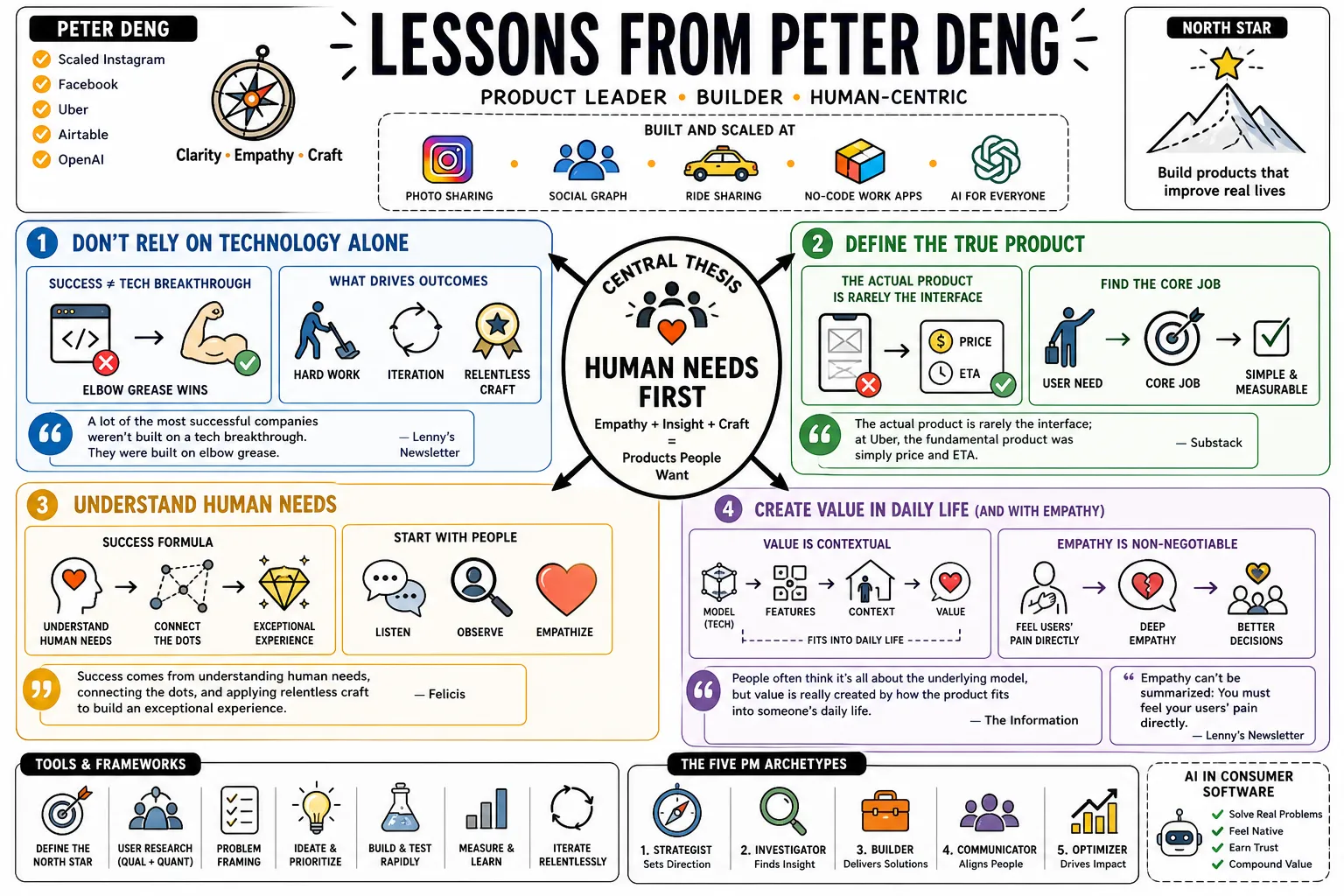
Lessons from Peter Deng
Peter Deng is a product leader who helped scale Instagram, Facebook, Uber, Airtable, and OpenAI. He is best known for defining the five product manager archetypes and arguing that human-centric design beats raw technical capabilities. This profile collects his frameworks for building teams, managing products, and bringing AI into consumer software.
Part 1: Building Products People Want
- On Technological Over-Reliance: "A lot of the most successful companies weren't built on a tech breakthrough. They were built on elbow grease." — Source: Lenny's Newsletter
- On the True Product: "The actual product is rarely the interface; at Uber, the fundamental product was simply price and ETA." — Source: Substack
- On Human Needs: "Success comes from understanding human needs, connecting the dots, and applying relentless craft to build an exceptional experience." — Source: Felicis
- On Value Creation: "People often think it's all about the underlying model, but value is really created by how the product fits into someone's daily life." — Source: The Information
- On Empathy: "Empathy can't be summarized: You must feel your users' pain directly." — Source: Lenny's Newsletter
- On AI Summaries: "No ChatGPT summary of user research can replace the physical experience of being in the room and hearing a customer's frustration firsthand." — Source: Lenny's Newsletter
- On User Delight: "Consumer products must be designed with an obsession for delight and intuition, not just functional utility." — Source: Lenny's Vault
- On Going Slow: "You have to plan your chess moves in advance. Sometimes, you need to go slow to go fast." — Source: Substack
- On Defining the Core: "AI has to be core to the product experience; if it is just bolted on, the product is fundamentally uninteresting." — Source: Simplecast
- On Enduring Value: "The greatest consumer applications endure because they solve a core human motivation that remains unchanged across technology cycles." — Source: Felicis
Part 2: The Art of Hiring
- On Accountability: "In six months, if I'm telling you what to do, I've hired the wrong person." — Source: Business Insider
- On Autonomy: "The ultimate goal of management is to reach a calibration point where your new hire is the one proactively identifying and leading the necessary work." — Source: Lenny's Newsletter
- On Agency: "Hiring should always prioritize high-agency individuals who take ownership over the outcome rather than waiting for instructions." — Source: FedeCarg
- On Complementary Traits: "Do not hire for uniformity; identify specific spikes in candidates and hire to build a team with complementary strengths." — Source: Lenny's Newsletter
- On the Trap of Consensus: "Hiring decisions should not be made by consensus, as consensus often filters out candidates with extreme, specialized strengths in favor of well-rounded but average performers." — Source: Lenny's Newsletter
- On Setting Standards: "The six-month rule is less about firing people and more about setting a relentlessly high standard for ownership from day one." — Source: Business Insider
- On Evaluating Talent: "Look for evidence of relentless iteration and a history of sweating the small details when evaluating builders." — Source: Lenny's Vault
- On Interviewing for Empathy: "Ask candidates how they connect with users; those who rely purely on dashboards instead of direct conversations often lack the necessary empathy for consumer products." — Source: Felicis
- On Hiring for the Stage: "Ensure the archetype you are hiring matches the specific lifecycle stage and immediate needs of your product." — Source: Lenny's Vault
Part 3: Structuring Product Teams
- On the Avengers Framework: "Build product teams like a team of Avengers, where members have diverse, complementary superpowers rather than being interchangeable parts." — Source: Business Insider
- On the Consumer PM: "The Consumer PM archetype is design-obsessed and focused intensely on creating user delight." — Source: Lenny's Vault
- On the Growth PM: "The Growth PM archetype acts as the data-driven skeptic, focusing on rigorous testing, measurement, and experimentation." — Source: Lenny's Vault
- On the Business PM: "The Business/GM PM archetype is margin-focused and thinks fundamentally in terms of business models and incentives." — Source: Lenny's Vault
- On the Platform PM: "The Platform PM archetype specializes in building scalable tools and complex systems that empower other developers." — Source: Substack
- On the Research PM: "The Research/AI PM archetype focuses on deep technical capabilities and translating emerging research into viable features." — Source: Lenny's Newsletter
- On Healthy Tension: "The best products emerge from creating healthy tension by deliberately pairing people with opposing strengths, such as a Growth PM with a Consumer PM." — Source: Lenny's Newsletter
- On the Role of Leadership: "In a team of complementary superpowers, the leader's primary job is to act as the adjudicator who balances differing perspectives to achieve the best outcome." — Source: Business Insider
- On Avoiding Echo Chambers: "Teams composed of the same PM archetypes suffer from blind spots; diversity of thought is a structural requirement for scale." — Source: Lenny's Vault
- On the Necessity of Conflict: "Debates between data-driven skeptics and intuition-driven designers consistently lead to better products than peaceful, consensus-driven environments." — Source: Lenny's Newsletter
Part 4: Managing Up and Communicating
- On the Formula for Trust: "The fundamental formula for managing up is: Say you're gonna do the thing, say you're doing the thing, and show the results." — Source: Lenny's Newsletter
- On Repetition: "Repeating goals and vision is essential. Do not assume a message has landed after one mention." — Source: Lenny's Vault
- On Clarity: "Repetition is a highly effective tool for driving clarity, ensuring alignment, and helping the organization internalize its top priorities." — Source: Lenny's Vault
- On Setting Expectations: "Always pre-communicate your strategy; surprises in product execution usually erode trust with senior leadership." — Source: Felicis
- On Managing Stakeholders: "Good communication requires translating the complex reality of product development into the specific language and metrics your stakeholders care about." — Source: Lenny's Newsletter
- On Transparency: "When a project is failing, communicate the failure early and focus the narrative entirely on the lessons learned." — Source: Lenny's Vault
- On Aligning Incentives: "When communicating with Business PMs and general managers, frame product decisions in terms of margin, incentives, and unit economics." — Source: Lenny's Vault
- On Simplification: "The ability to distill a sprawling, multi-month roadmap into a single, comprehensible narrative is a required skill for senior product leaders." — Source: Lenny's Newsletter
- On Feedback: "Structure communication channels so that negative feedback flows upward quickly without being filtered by middle management." — Source: Felicis
Part 5: Navigating the AI Era
- On AGI and Effort: "When AGI arrives, it will still require builders to channel that intelligence into products humans want. The hustle and craft will matter more, not less." — Source: Lenny's Newsletter
- On AI Native Products: Deng frames AI product advantage around workflow integration, proprietary usage data, and craft: in Lenny's episode summary, the AI-startup path is not a superficial wrapper, but a product that learns from real use and fits deeply into how work happens. — Reference: Lenny transcript page and show notes on AI products, proprietary data, workflow integration, and product craft
- On the Value of Taste: The Podwise episode summary highlights Deng's emphasis on taste and craft alongside measurement rigor: AI lowers some production costs, but product leaders still need judgment about what matters, what users feel, and where craft should overcome distribution advantages. — Reference: Podwise summary on taste, craft, measurement, empathy, and product advantage in AI-era products
- On Connecting the Dots: "The hardest part of building AI products is not training the model, but connecting the model's capabilities to an actual, acute human problem." — Source: The Information
- On Empathy in AI: "You cannot farm out user empathy to language models; if you do not sit with the user, you will build the wrong product." — Source: Lenny's Newsletter
- On AI as a Feature: "Adding a chatbot interface to a traditional software product does not automatically make it an AI-native company." — Source: Simplecast
- On Human-Centric AI: "The best AI tools fade into the background and allow the user to focus entirely on their own goals rather than the technology itself." — Source: Felicis
- On Technical Literacy: "This new archetype of product manager must possess deep technical literacy to understand what the model is truly capable of tomorrow, not just today." — Source: Lenny's Newsletter
- On Building for the Future: "When designing AI interfaces, you have to plan your chess moves based on where the foundational models will be in six months, not where they are currently." — Source: Substack
- On the Illusion of Intelligence: "Do not confuse a model's ability to speak fluently with its ability to solve a complex, multi-step workflow for an enterprise user." — Source: Felicis
Part 6: Execution and Craft
- On Relentless Iteration: "Monumental business successes like Facebook and Instagram were forged through relentless iteration and craft, not singular technological leaps." — Source: Lenny's Vault
- On Sweating Details: "Craft means applying elbow grease to the smallest interactions until the product feels completely intuitive to a first-time user." — Source: Lenny's Vault
- On the Lego Block Strategy: "When building platforms, design every piece of functionality like a Lego block so customers can assemble them to solve diverse problems over a decade." — Source: Taskade
- On Platform Vision: "A true platform allows users to build things the original creators never anticipated." — Source: Taskade
- On Speed vs. Quality: "Rushing foundational architecture will invariably slow down feature development later." — Source: Substack
- On Finding the Core: "Strip away everything until you find the exact metric the user actually cares about, such as price and ETA in ride-sharing." — Source: Substack
- On Execution Culture: "A culture of high execution relies on individuals who do not need to be told what to do after their first six months." — Source: Business Insider
- On Removing Friction: "The primary job of a consumer product manager is to identify and systematically destroy every point of friction in the user journey." — Source: Lenny's Newsletter
- On Simplicity: "The hardest engineering challenges often result in the simplest user interfaces, masking massive backend complexity." — Source: Felicis
Part 7: Career Growth and Management
- On Thriving: "If you move a tree, it dies. If you move a person, he thrives." — Source: Lenny's Newsletter
- On Career Risks: "Optimize your career for learning and novel experiences rather than seeking out safe, highly predictable paths." — Source: Lenny's Newsletter
- On the Cost of Leadership: "As you move into management, you must accept that you will lose touch with hands-on technical work; it is an unavoidable trade-off." — Source: Quora
- On the Meta-Goal: "The true goal of a manager is to build a team that operates at such a high caliber that they render the manager's daily oversight obsolete." — Source: Lenny's Newsletter
- On Adapting: "Your management style must adapt to the specific PM archetypes on your team; you cannot manage a Growth PM the same way you manage a Consumer PM." — Source: Lenny's Vault
- On Growth Trajectories: "True career growth comes from voluntarily placing yourself in environments with healthy tension and differing viewpoints." — Source: Lenny's Newsletter
- On Letting Go: "To scale as a leader, you have to let go of the specific execution details and focus entirely on calibrating the judgment of your team." — Source: Business Insider
- On Mentorship: "The best mentors do not tell you what to do; they provide the frameworks necessary for you to evaluate your own decisions." — Source: Felicis
- On Burnout: "Moving people to entirely new problem spaces is often the most effective cure for organizational staleness and burnout." — Source: Lenny's Newsletter
Part 8: Metrics, Retention, and Lessons
- On the North Star: "User acquisition means absolutely nothing if the product cannot demonstrate long-term retention." — Source: Lenny's Vault
- On Product Failures: "It ain't a loss, it's a lesson. Failed product attempts are valuable as long as the team rigorously extracts insights from the retention data." — Source: Lenny's Vault
- On Measuring What Matters: "Do not optimize for vanity metrics; focus entirely on the core behaviors that indicate a user has integrated the product into their life." — Source: Substack
- On Growth Skepticism: "A healthy product organization requires growth managers who look at every positive metric with intense skepticism and demand rigorous proof." — Source: Lenny's Vault
- On Evaluating Trade-offs: "When metrics conflict, the tie-breaker should always be what drives the highest long-term trust with the consumer." — Source: Lenny's Newsletter
- On the Limits of Data: "Data can tell you what is happening and where users are dropping off, but only direct empathy and qualitative research can tell you why." — Source: Lenny's Newsletter
- On Institutional Memory: "Documenting lessons from failed launches is just as critical as celebrating the metrics of successful ones." — Source: Lenny's Vault
- On Marketplaces: "In two-sided marketplaces like Uber, metrics must be perfectly balanced; over-optimizing one side usually destroys the liquidity of the other." — Source: Software Engineering Daily
- On Long-Term Thinking: "The ultimate measure of a product's success is not its launch day traffic, but its daily utility to the user five years later." — Source: Felicis