Peter Reinhardt co-founded Segment, an analytics API company that Twilio acquired for $3.2 billion, before shifting to heavy industry to co-found Charm Industrial. He is known for detailing the exact mechanics of finding product-market fit after spending 18 months building things nobody wanted. This profile collects his specific operational advice on navigating early-stage sales and the physics of scaling carbon removal.
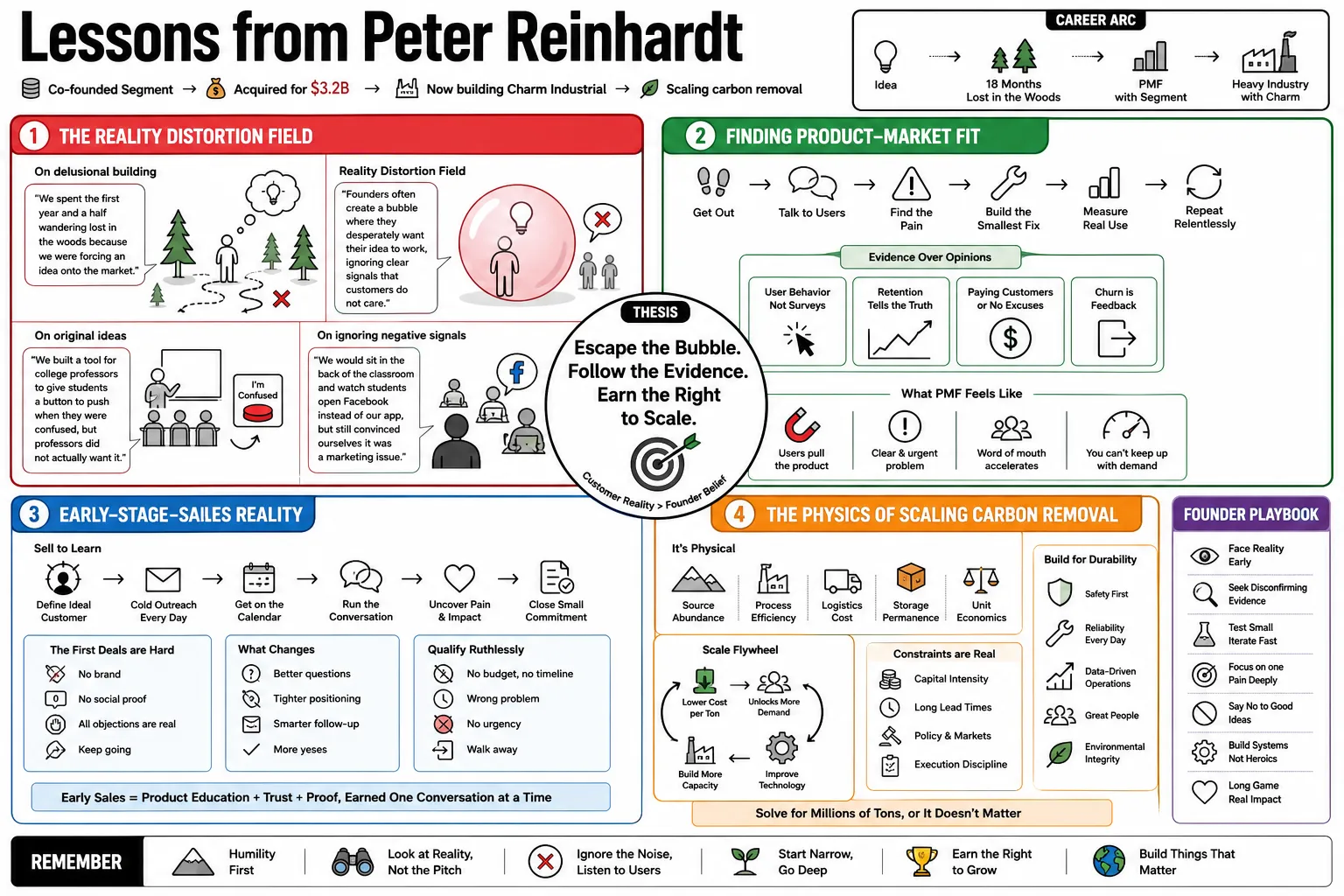
Part 1: The Reality Distortion Field
- On delusional building: "We spent the first year and a half wandering lost in the woods because we were forcing an idea onto the market." — Source: [rein.pk]
- On the reality distortion field: "Founders often create a bubble where they desperately want their idea to work, ignoring clear signals that customers do not care." — Source: [SaaStr Podcast]
- On original ideas: "We built a tool for college professors to give students a button to push when they were confused, but professors did not actually want it." — Source: [Y Combinator]
- On ignoring negative signals: "We would sit in the back of the classroom and watch students open Facebook instead of our app, but still convinced ourselves it was a marketing issue." — Source: [Invest Like the Best]
- On the Airbnb trap: "Hearing the Airbnb story makes founders assume they just need to keep hammering away at an unvalidated idea for years." — Source: [Startup Archive]
- On building versus testing: "Engineers often feel like writing code is the real work, when they should actually be validating if the code needs to be written at all." — Source: [rein.pk]
- On realizing failure: "The sinking feeling of running out of money while holding onto an idea that clearly has no traction is physically painful." — Source: [Indie Hackers]
- On forcing a solution: "Trying to solve a problem that the market simply is not experiencing is the most common early-stage failure mode." — Source: [14 Minutes of SaaS]
- On over-engineering: "We spent months building complex backend systems for a product that had zero engaged users." — Source: [This Week in Startups]
Part 2: The Path to Product-Market Fit
- On accidental product-market fit: "The idea for Segment was originally just an internal tool we built to manage our own data, not the main business." — Source: [Y Combinator]
- On trying to kill an idea: "We put the open-source library on Hacker News hoping it would fail so we could move on, but it exploded in popularity instead." — Source: [Medium]
- On the feeling of product-market fit: "True product-market fit feels like a landmine going off. The market drags the product out of you." — Source: [SaaStr Podcast]
- On solving real pain: "We finally found product-market fit when we shifted to solving a tedious coordination problem for developers routing data to multiple tools." — Source: [Y Combinator]
- On open source as a wedge: "Open sourcing the original analytics library was the catalyst that showed us the massive latent demand for a unified API." — Source: [Segment Blog]
- On the pivot: "Pivoting from an education app to an enterprise data routing tool required abandoning all our prior ego and code." — Source: [20 VC]
- On market pull: "When you have product-market fit, your servers are melting and customers are demanding to pay you. It is a visceral change from pushing a boulder uphill." — Source: [Invest Like the Best]
- On validation: "The moment the GitHub stars started ticking up rapidly was the first time we felt actual validation from strangers." — Source: [Medium]
- On focusing on developers: "We realized our core user was a developer who hated integrating third-party tags, rather than an average consumer." — Source: [Y Combinator]
- On defining a startup: "A startup is just an organization designed to search for product-market fit." — Source: [rein.pk]
Part 3: Customer Discovery and the Art of the Interview
- On shifting mindsets: "The turning point for Segment was stopping the coding and starting deep, hour-long customer interviews." — Source: [rein.pk]
- On the 20-hour rule: "Twenty hours of high-quality customer interviews could have saved us eighteen months of building useless features." — Source: [rein.pk]
- On asking the right questions: "You have to ask about actual past behavior, not hypothetical future behavior, to get honest answers." — Source: [14 Minutes of SaaS]
- On listening for frustration: "The best product ideas come from listening to what makes a customer actively angry or frustrated in their daily workflow." — Source: [Invest Like the Best]
- On the danger of surveys: "Surveys give you shallow data. Only open-ended conversations reveal the underlying motivation." — Source: [SaaStr Podcast]
- On ignoring feature requests: "You should not blindly build what customers ask for. You must dig into why they are asking for it to understand the root problem." — Source: [Y Combinator]
- On early beta testers: "The best early customers are the ones who are willing to deal with a buggy product because the core problem you solve is so painful for them." — Source: [This Week in Startups]
- On founder-led sales: "In the early days, the founders themselves must be the ones talking to customers to internalize the market feedback directly." — Source: [20 VC]
- On discarding bad feedback: "Learning to filter out polite feedback from people who will never actually buy your product is a necessary skill." — Source: [Indie Hackers]
Part 4: Sales, Pricing, and Capturing Value
- On learning to sell: "Coming from an engineering background, learning enterprise sales felt like learning an entirely new language based on human psychology rather than logic." — Source: [Invest Like the Best]
- On pricing boldness: "Founders frequently undersell themselves. Simply asking for more money in early deals is often the easiest way to increase company value." — Source: [Substack]
- On the value of time: "Enterprise companies do not pay you for code. They pay you for saving their engineers' time and reducing their operational risk." — Source: [SaaStr Podcast]
- On moving upmarket: "As Segment grew, we realized the enterprise market required entirely different features for compliance, security, and governance." — Source: [Y Combinator]
- On the first enterprise deal: "The realization that a large company was willing to pay tens of thousands of dollars for something we originally gave away for free changed everything." — Source: [Invest Like the Best]
- On value-based pricing: "Pricing should be tied directly to the metric of value the customer receives, rather than solely the cost of your servers." — Source: [Medium]
- On the sales learning curve: "The transition from founder-led sales to a repeatable sales motion is one of the most painful but necessary stages of growth." — Source: [20 VC]
- On objection handling: "Hearing 'no' in a sales meeting is often just the beginning of understanding the customer's true constraints." — Source: [14 Minutes of SaaS]
- On creating urgency: "You have to find the specific compelling event that makes the customer need to buy your product this quarter." — Source: [Invest Like the Best]
Part 5: Startup Finance and Survival
- On accounting basics: "Accurate record-keeping of the past through bank accounts, credit cards, and contracts is the unglamorous foundation of surviving." — Source: [rein.pk]
- On strategic finance: "Finance is about modeling the future and making capital allocation decisions to fuel growth, rather than solely doing accounting." — Source: [rein.pk]
- On part-time CFOs: "Hiring a fractional CFO early on can save founders from catastrophic financial modeling mistakes." — Source: [rein.pk]
- On annual prepayments: "Getting customers to pay annually upfront is one of the most powerful ways to fund your own growth without taking extreme dilution." — Source: [rein.pk]
- On the shadow budget: "Maintaining a secondary, conservative budget is essential to mitigate risk if revenue growth suddenly stalls." — Source: [rein.pk]
- On venture debt: "Venture debt is a useful tool for extending runway, but it becomes a deadly trap if you do not have a clear path to profitability or your next round." — Source: [rein.pk]
- On cash flow versus revenue: "Understanding the difference between recognized revenue and actual cash in the bank is a lesson many founders learn the hard way." — Source: [This Week in Startups]
- On fundraising negotiating power: "The best time to raise money is when you do not actually need it, because that is when you have the most negotiating power over terms." — Source: [20 VC]
- On financial transparency: "Sharing the financial realities of the company with the early team builds trust and aligns everyone on the survival metrics." — Source: [Indie Hackers]
- On managing burn rate: "The default state of a startup is dead. Controlling your burn rate is the only way to buy enough time to get lucky." — Source: [rein.pk]
Part 6: Building Segment: Engineering and Culture
- On the initial architecture: "The early version of Segment was held together by duct tape and sheer willpower, prioritizing speed over perfect architecture." — Source: [Medium]
- On technical debt: "You have to accept technical debt in the search for product-market fit, but you must aggressively pay it down once you find it, or the system will collapse." — Source: [Y Combinator]
- On unified APIs: "The core thesis of Segment was that a single, clean API could abstract away the chaos of hundreds of different marketing and analytics tools." — Source: [Segment Blog]
- On hiring engineers: "The best early engineers are pragmatic problem solvers who care more about user impact than technical purity." — Source: [20 VC]
- On company culture: "Culture is the behavior you reward and the bad behavior you tolerate, rather than what you write on the wall." — Source: [Invest Like the Best]
- On focusing the roadmap: "Once you find product-market fit, the hardest job is saying no to good ideas so you can execute flawlessly on the great ones." — Source: [Glasp]
- On data privacy: "As we became the central nervous system for customer data, security and privacy transitioned from being a feature to being the entire foundation of the company." — Source: [SaaStr Podcast]
- On scaling the team: "The transition from a ten-person room to a hundred-person company requires breaking and rebuilding your communication structures multiple times." — Source: [This Week in Startups]
- On the Twilio acquisition: "Selling the company to Twilio was driven by the realization that our combined platforms could create a massive, unified customer engagement layer." — Source: [Medium]
Part 7: The Shift to Climate Tech (Charm Industrial)
- On the origin of Charm: "The decision to start Charm Industrial came from a deep frustration with the low quality and questionable permanence of traditional carbon offsets." — Source: [Watershed]
- On hard tech versus software: "Transitioning from a software company to a hard tech climate company requires a different tolerance for physical world delays and capital expenditures." — Source: [MCJ]
- On the urgency of climate: "I realized that software alone could not solve the physics problem of gigatons of excess carbon in the atmosphere." — Source: [Climate Now]
- On bio-oil sequestration: "Our breakthrough was realizing that converting biomass into bio-oil and pumping it underground was a scalable, highly permanent carbon removal method." — Source: [A Climate Change]
- On the agricultural supply chain: "The logistics of carbon removal require building massive networks to collect agricultural waste before it burns or rots." — Source: [Hardware to Save a Planet]
- On the transition of capital: "We are seeing a generational shift where top-tier engineering talent and venture capital are moving from optimizing ad clicks to solving planetary-scale physics." — Source: [MCJ]
- On regulatory markets: "The ultimate success of carbon removal relies on transitioning from voluntary corporate purchases to compliance-driven regulatory markets." — Source: [MCJ]
- On decarbonizing steel: "Beyond sequestration, the bio-oil we produce has the potential to replace fossil fuels in hard-to-decarbonize industries like iron and steel making." — Source: [Climate Now]
- On founder energy: "Tackling climate change requires a level of stubborn, irrational optimism that is standard in software but rare in heavy industry." — Source: [Contrary Research]
Part 8: The Science and Economics of Carbon Removal
- On the permanence problem: "Planting trees is great, but it is not a permanent carbon sink because trees burn or rot, returning the carbon to the air." — Source: [The Carbon Curve]
- On fast pyrolysis: "Heating biomass without oxygen to create a stable bio-oil is a known chemical process applied to a new planetary problem." — Source: [Climate Now]
- On measurement and verification: "The carbon removal industry cannot survive without rigorous, transparent, and standardized verification to prove the carbon is actually gone." — Source: [The Carbon Curve]
- On the cost curve: "Like solar and wind before it, the cost of engineered carbon removal will only come down through massive scale and deployment." — Source: [Contrary Research]
- On the failure of avoidance offsets: "Paying someone to not cut down a tree does not remove carbon from the atmosphere. We need absolute, net-negative removals." — Source: [Watershed]
- On the scale of the challenge: "We need to build an industry the size of the current oil and gas industry, but running in reverse, within the next three decades." — Source: [Hardware to Save a Planet]
- On the demand premium: "Early buyers in the voluntary market pay the initial premium that funds the research required to lower costs for everyone else." — Source: [Contrary Research]
- On the injection process: "Utilizing existing, abandoned oil wells for bio-oil injection is a practical way to use legacy fossil fuel infrastructure for climate repair." — Source: [A Climate Change]
- On standardizing carbon: "We must treat a ton of removed carbon as a strict, verifiable commodity, free from the fuzzy accounting of legacy carbon credits." — Source: [The Carbon Curve]
- On the future of heavy industry: "The ultimate goal is to clean up the past while providing the physical raw materials required for a zero-carbon industrial future." — Source: [MCJ]