Lessons from Peter Zeihan
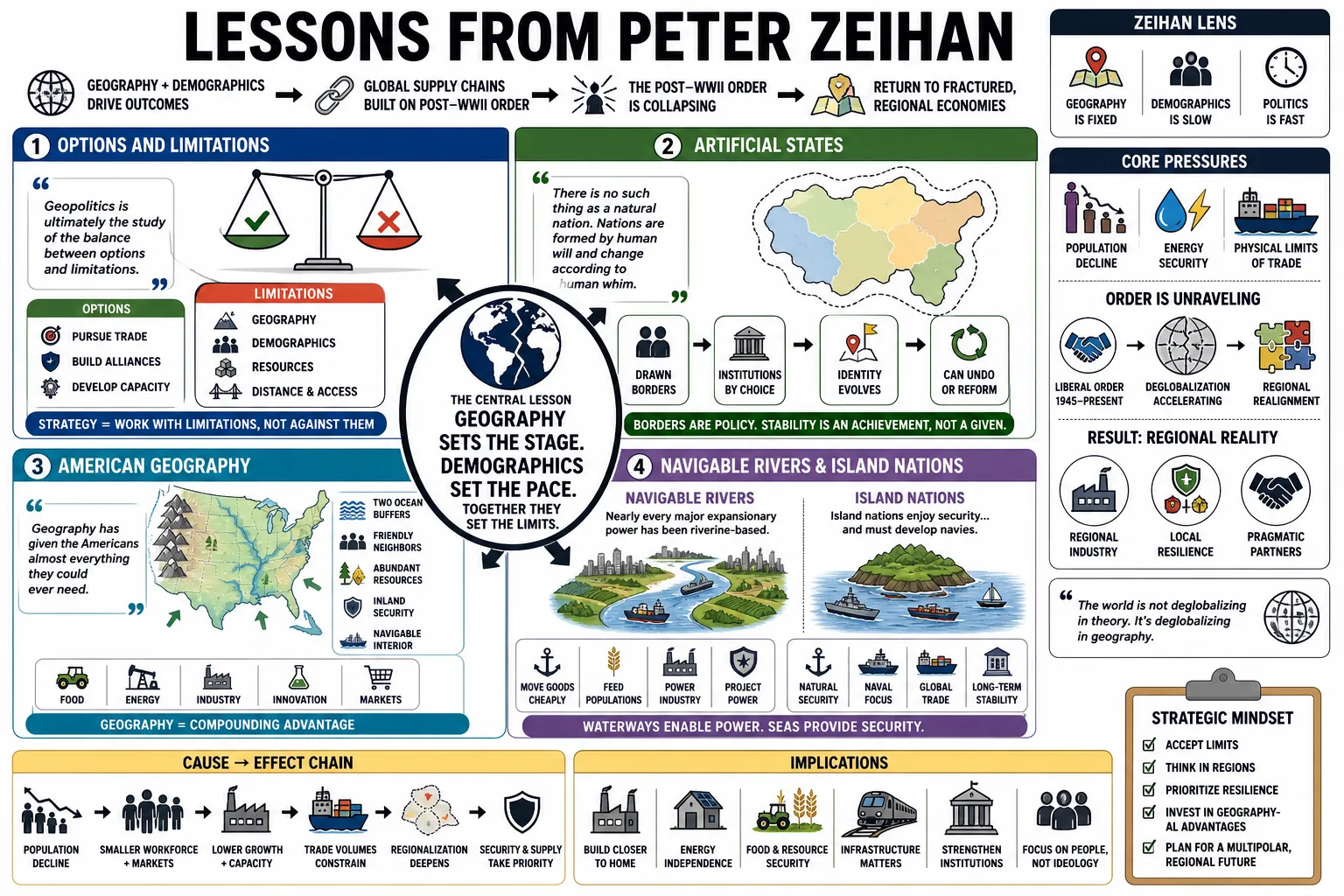
Geopolitical strategist Peter Zeihan studies how geography and demographics shape global supply chains. He argues that the post-WWII American global order is collapsing, which will force a return to fractured, regional economies. This profile covers his main claims regarding population decline, energy security, and the physical limits of international trade.
Part 1: Geography and National Destiny
- On Options and Limitations: "Geopolitics is ultimately the study of the balance between options and limitations." — Source: [The Absent Superpower]
- On Artificial States: "There is no such thing as a natural nation. Nations are formed by human will and change according to human whim." — Source: [Disunited Nations]
- On American Geography: "Geography has given the Americans almost everything they could ever need." — Source: [The Accidental Superpower]
- On Navigable Rivers: "There are good solid reasons as to why nearly every major expansionary power of the past has been based in a temperate climate zone, and why all those that have lasted have been riverine-based." — Source: [The Accidental Superpower]
- On Island Nations: "Island nations enjoy security... in part because of the physical separation from rivals, but also because they have no choice but to develop navies that help them keep others away from their shores." — Source: [The Absent Superpower]
- On Geographic Insulation: "Americans survived and thrived before because their geography is insulated from, while their demographic profile is starkly younger than, the bulk of the world." — Source: [The End of the World is Just the Beginning]
- On Overreach: "Such ease of internal transport [in certain nations] not only makes these countries socially unified, wealthy, and cosmopolitan, but also more than a touch self-important. They show a distressing habit of becoming overimpressed with themselves—and so tend to overreach." — Source: [The Absent Superpower]
- On Natural Moats: "A country's geography determines in large part what vulnerabilities it faces and what tools it has to address them." — Source: [The Absent Superpower]
- On European Topography: "Europe's fractured geography, characterized by multiple peninsulas and intersecting mountain ranges, guarantees the continent will remain a collection of competing ethno-national states." — Source: [Zeihan on Geopolitics]
Part 2: The Collapse of Demographics
- On the Point of No Return: "The world's demographic structure passed the point of no return twenty to forty years ago. The 2020s are the decade when it all breaks apart." — Source: [The End of the World is Just the Beginning]
- On Consumption-Driven Growth: "The era of consumption-driven growth that has been the economic norm for seventy years is coming to an unceremonious end." — Source: [The End of the World is Just the Beginning]
- On Aging Populations: "Decades of demographic degradation are now manifesting as chronic shortages of labor and capital." — Source: [Zeihan Newsletter]
- On the End of Cheap Labor: "Instead of cheap and better and faster, we're rapidly transitioning into a world that's pricier and worse and slower." — Source: [The End of the World is Just the Beginning]
- On Capital Scarcity: "As large population cohorts move into retirement, they liquidate growth-oriented investments, permanently removing capital from the global system." — Source: [Zeihan on Geopolitics]
- On Urbanization: "The process of industrialization forced people into cities where children transitioned from being free agricultural labor to expensive urban liabilities, leading to a global crash in birth rates." — Source: [Disunited Nations]
- On Russian Demographics: "Russia is facing a demographic collapse so severe that its current actions in Ukraine are viewed by Moscow as the final opportunity to secure its borders before it runs out of young men to fight." — Source: [Zeihan Video Update]
- On the Millennial Generation: "The United States is unique among developed nations because it has a large Millennial generation that can drive consumption and fill out the workforce." — Source: [The Accidental Superpower]
- On Terminal Decline: "Most developed countries simply do not have the young populations required to sustain their current economic models, and there is no policy that can instantly produce thirty-year-old workers." — Source: [Zeihan on Geopolitics]
- On Inflation: "Shrinking labor pools inevitably lead to structural inflation as companies are forced to pay a premium for a dwindling supply of capable workers." — Source: [The End of the World is Just the Beginning]
Part 3: The End of Globalization
- On the State of Globalization: "The globalization game is not simply ending. It is already over. Most countries will never return to the degree of stability or growth they experienced in 2019." — Source: [The End of the World is Just the Beginning]
- On Global Fragility: "Bottom line: the world we know is eminently fragile. And that's when it is working to design." — Source: [The Absent Superpower]
- On the Speed of Disintegration: "Globalization isn't simply past its peak, it is disintegrating with accelerating speed." — Source: [Zeihan Newsletter]
- On American Overwatch: "Today's economic landscape isn't so much dependent upon as it is eminently addicted to American strategic and tactical overwatch." — Source: [The End of the World is Just the Beginning]
- On Bretton Woods: "The post-WWII global order was an artificial system maintained by U.S. military power as a bribe to contain the Soviet Union, not a natural evolution of global trade." — Source: [The Accidental Superpower]
- On De-globalization: "The world isn't falling apart—it's being pushed apart." — Source: [Disunited Nations]
- On the End of an Era: "The world of the past few decades has been the best it will ever be in our lifetime." — Source: [The End of the World is Just the Beginning]
- On Every-Country-for-Itself: "As international institutions lose their teeth, nations will increasingly abandon multilateralism and prioritize their own naked survival." — Source: [Disunited Nations]
- On Regionalism: "The future is a world where countries or regional blocs will have no choice but to make their own goods, grow their own food, and secure their own energy." — Source: [The End of the World is Just the Beginning]
- On the Loss of the Oceans: "Remove the Americans, and long-haul shipping degrades from being the norm to being the exception." — Source: [The End of the World is Just the Beginning]
Part 4: The Future of American Hegemony
- On Persian Gulf Security: "The Americans do not protect the Persian Gulf kingdoms and emirates so that the Americans can use Middle Eastern oil, but so that their Bretton Woods partners... can." — Source: [The Accidental Superpower]
- On Strategic Disengagement: "The Americans are no longer gaining a strategic benefit from that network, even as the economic cost continues." — Source: [The Accidental Superpower]
- On Institutional Resilience: "Only the United States could engage in a war as dubious as Iraq or roll out a social policy as byzantine as Obamacare and walk away largely unscathed." — Source: [The Accidental Superpower]
- On Military Drawdowns: "At the time of this writing, the Americans now have fewer troops stationed abroad than at any time since the Great Depression." — Source: [Disunited Nations]
- On the Shale Advantage: "The shale revolution allows Americans to sidestep an increasingly dangerous energy market." — Source: [The Accidental Superpower]
- On Domestic Politics: "The U.S. is systematically retreating from the global security role it held since 1945, a rare point of bipartisan agreement spanning multiple administrations." — Source: [Disunited Nations]
- On North American Integration: "The US-Mexico relationship is the most economically complementary demographic pairing in the world, ensuring North America remains globally competitive." — Source: [Zeihan on Geopolitics]
- On Border Policies: "Never forget that anti-migrant, build-the-wall Donald Trump carried nearly every county on the southern border when running for reelection in 2020." — Source: [The End of the World is Just the Beginning]
- On Future Alliances: "The U.S. will no longer offer blanket security guarantees, but will instead engage in transactional, bilateral deals with countries that offer direct strategic benefits." — Source: [Zeihan Briefing]
Part 5: The Decline of China
- On Geographic Vulnerability: "In absolute terms the biggest loser by far will be China. China sits at the end of the world's longest supply routes for nearly everything it imports." — Source: [The Accidental Superpower]
- On Naval Limitations: "China's navy lacks the range necessary to secure, via trade or conquest, agricultural products – or even the inputs to grow and raise its own." — Source: [The Accidental Superpower]
- On Internal Risks: "Chinese fascism has worked to this point, but between a collapse of domestic consumption... and an inability to protect the imports of energy... China's embracing of narcissistic nationalism risks spawning internal unrest." — Source: [The End of the World is Just the Beginning]
- On Demographic Collapse: "China's demographic collapse is the fastest in human history, fundamentally breaking the economic model that relied on an endless supply of cheap young labor." — Source: [Zeihan Newsletter]
- On German Machinery: "The bulk of the expansion of China's industrial base since 2005 has been possible only because the Germans built the core machinery that made it happen." — Source: [The End of the World is Just the Beginning]
- On Single-Party Systems: "One of the downsides of single-party rule is, when recession hits, there's no one else to scream at." — Source: [Disunited Nations]
- On Cultural Transfer: "Unfortunately for the world, culture cannot be transferred. No matter how much cash is splurged on it. Just ask the Chinese." — Source: [The End of the World is Just the Beginning]
- On the Export Crisis: "China's economy is entirely dependent on exporting manufactured goods to markets that are both aging and turning increasingly protectionist." — Source: [Zeihan on Geopolitics]
- On Energy Import Dependency: "Without the U.S. Navy guaranteeing safe passage through the Persian Gulf and the Strait of Malacca, China cannot secure the oil required to keep its lights on." — Source: [The Accidental Superpower]
- On North Korea: "The assumption that Beijing holds absolute control over Pyongyang is outdated; their relationship is far more fractured than Western policymakers admit." — Source: [Zeihan Video Update]
Part 6: Energy Security and the Shale Revolution
- On the Value of Shale: "The commercialization of shale oil and gas completely decoupled the United States from the geopolitical chaos of Middle Eastern energy markets." — Source: [The Absent Superpower]
- On Global Energy Shortages: "The world is in the midst of a supply disruption of historical magnitude, and physical inventories are dangerously depleted." — Source: [Zeihan Newsletter]
- On Post-War Energy Systems: "The U.S. Navy acting as the sole guarantor of global shipping lanes is the only reason Middle Eastern oil has reliably reached Asian markets for decades." — Source: [The Accidental Superpower]
- On Russian Oil Export Vulnerabilities: "The primary threat to Russian energy exports isn't sanctions, but the degradation of critical infrastructure in permafrost regions without Western technical assistance." — Source: [Zeihan on Geopolitics]
- On Petro-States: "Nations whose sole geopolitical leverage is oil export will face existential crises once they have to secure their own transit routes to market." — Source: [Disunited Nations]
- On Refining Capacity: "It is not enough to extract crude oil; the United States possesses a massive, insulated refining complex that protects it from external supply shocks." — Source: [The Absent Superpower]
- On the Danger of Price Spikes: "The countries that will suffer most from energy market volatility are the heavily industrialized, resource-poor nations of East Asia and Europe." — Source: [The End of the World is Just the Beginning]
- On Localized Power Grids: "The breakdown of global energy trade will force nations to rely strictly on the energy sources they can produce and protect within their own borders." — Source: [The End of the World is Just the Beginning]
- On the Middle East: "The ongoing conflicts in the Middle East are accelerating the withdrawal of foreign investment, which will permanently impair the region's total output capacity." — Source: [Zeihan Video Update]
Part 7: The Vulnerability of Global Supply Chains
- On Manufacturing Complexity: "Modern manufacturing requires materials sourced from dozens of countries, meaning a breakdown in a single critical node can halt production globally." — Source: [The End of the World is Just the Beginning]
- On the Death of Just-In-Time: "The era of optimized, just-in-time supply chains is over; companies must now build bloated, localized redundancies just to guarantee basic operations." — Source: [Zeihan Briefing]
- On Semiconductor Fragility: "The concentration of high-end semiconductor manufacturing in Taiwan represents the single most vulnerable supply chain chokepoint on the planet." — Source: [Zeihan on Geopolitics]
- On Re-shoring: "The United States is actively pulling manufacturing back to North America, not out of economic altruism, but because the global system is no longer reliable." — Source: [Zeihan Newsletter]
- On Capital Goods: "The machinery required to build modern industrial bases is overwhelmingly produced by a handful of aging nations, creating an unbridgeable gap for emerging economies." — Source: [The End of the World is Just the Beginning]
- On Transportation Costs: "Without the U.S. Navy subsidizing global maritime security, insurance and transit costs will skyrocket, rendering many current trade routes economically unviable." — Source: [The Accidental Superpower]
- On Protectionism: "As scarcity increases, governments will inevitably turn to resource nationalism, hoarding critical inputs and further fracturing integrated supply chains." — Source: [Disunited Nations]
- On Industrial Erosion: "The shift away from integrated global trade is exposing deep vulnerabilities in industrial bases that relied on imported components." — Source: [Zeihan Video Update]
- On the Cost of Redundancy: "Rebuilding localized supply chains will require trillions of dollars in capital at the exact moment global demographic aging is making capital scarce." — Source: [The End of the World is Just the Beginning]
Part 8: Agriculture and Green Tech Realities
- On Devolving Conditions: "We are completely capable as a species of devolving into a fractured, dark, poor, hungry world while still increasing greenhouse gas emissions." — Source: [The End of the World is Just the Beginning]
- On Green Tech Limitations: "Not only does greentech fail to generate sufficient electricity in most locations to contribute meaningfully to addressing our climate concerns but also it's laughable to think that most locations could manufacture the necessary components." — Source: [The End of the World is Just the Beginning]
- On Agricultural Inputs: "Modern farming relies entirely on globalized inputs—potash from Belarus, phosphates from Morocco, and nitrogen derived from natural gas—none of which are geographically co-located." — Source: [The End of the World is Just the Beginning]
- On Fertilizer Shortages: "When the supply chains for fertilizer break down, crop yields do not merely decrease; they collapse to pre-industrial levels, leading directly to mass famine." — Source: [Zeihan Newsletter]
- On the Metals Constraint: "A global transition to green energy requires a massive increase in the mining and refining of copper, lithium, and rare earths, supply chains that are currently highly vulnerable." — Source: [Zeihan on Geopolitics]
- On Geographic Disparities in Renewables: "Solar and wind power are deeply geography-dependent, meaning they cannot serve as a reliable baseline energy source for regions lacking optimal weather conditions." — Source: [The End of the World is Just the Beginning]
- On Food Security: "Countries that cannot grow their own food or secure the sea lanes to import it are facing a catastrophic collapse in carrying capacity." — Source: [Disunited Nations]
- On Brazilian Agriculture: "Brazil's agricultural miracle is entirely dependent on imported fertilizers; without them, the cerrado soil is too acidic to sustain large-scale food production." — Source: [The End of the World is Just the Beginning]
- On the Illusion of Autarky: "No country, not even the United States, possesses everything necessary for modern life within its own borders, but North America is the only region capable of surviving the transition intact." — Source: [The End of the World is Just the Beginning]