Lessons from Phaedra Ellis-Lamkins
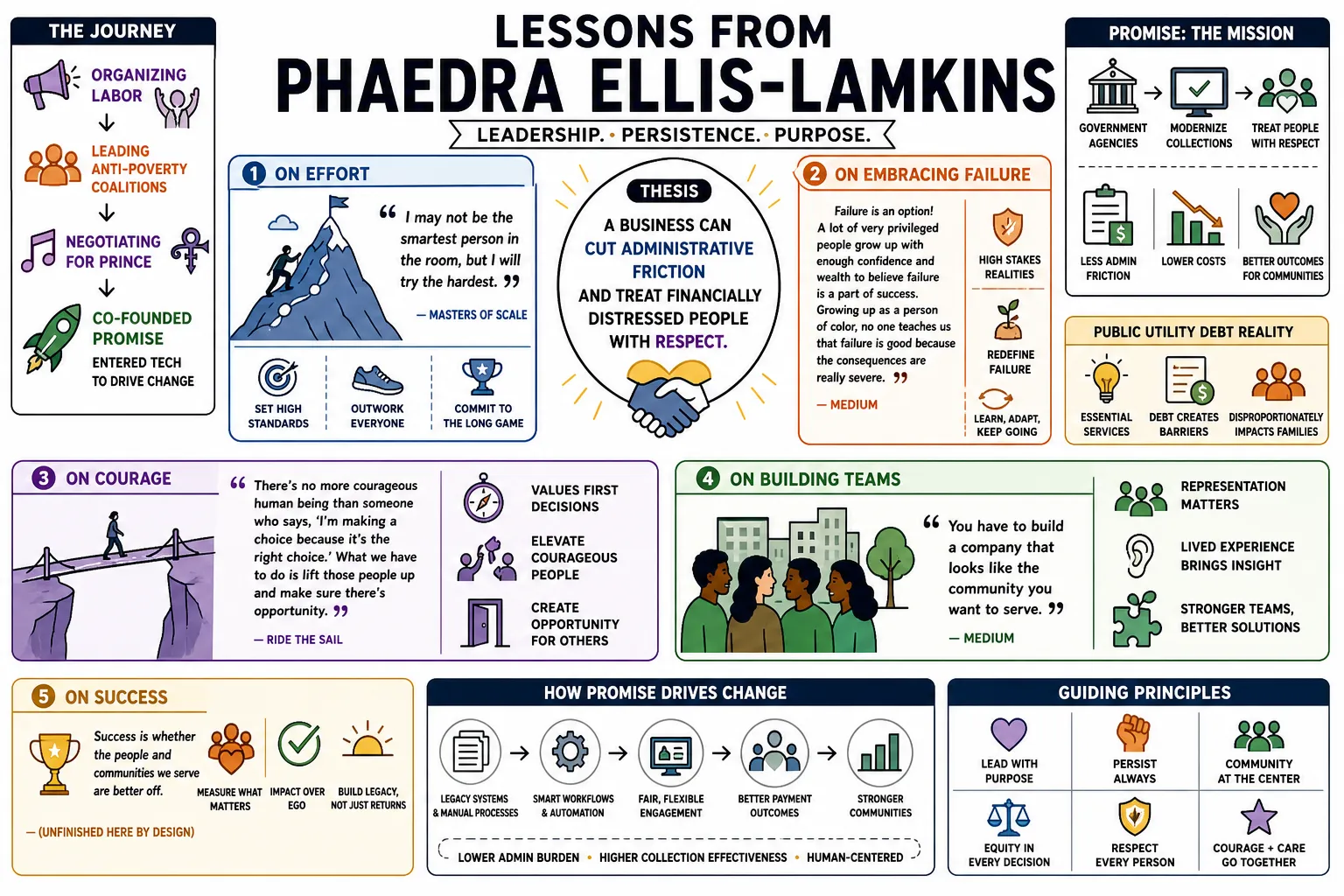
After a career organizing labor, leading anti-poverty coalitions, and negotiating for Prince, Phaedra Ellis-Lamkins entered the tech sector to co-found Promise. The company updates how government agencies collect public utility debt, proving a business can cut administrative friction while treating financially distressed people with respect.
Part 1: Leadership and Persistence
- On Effort: "I may not be the smartest person in the room, but I will try the hardest." — Source: Masters of Scale
- On Embracing Failure: "Failure is an option! A lot of very privileged people grow up with enough confidence and wealth to believe failure is a part of success. Growing up as a person of color, no one teaches us that failure is good because the consequences are really severe." — Source: Medium
- On Courage: "There’s no more courageous human being than someone who says, 'I’m making a choice because it’s the right choice.' What we have to do is lift those people up and make sure there’s opportunity." — Source: Ride the Sail
- On Building Teams: "You have to build a company that looks like the community you want to serve." — Source: Medium
- On Success: Ellis-Lamkins told Bitbean she founded Promise to make technology work for working people, not just to build another scalable company detached from community outcomes. — Reference: Bitbean interview with Phaedra Ellis-Lamkins
- On Focus: "Block out the noise and center your energy on the actual work of building something that matters." — Source: Forbes
- On Personal Drive: "True drive comes from a deep-seated desire to see systemic change rather than personal enrichment." — Source: Urban Magazine
- On Resilience: "When the consequences of failure are high, the resilience you build becomes your most significant asset as a leader." — Source: Authority Magazine
- On Taking Space: "You have to be willing to walk into rooms that weren't built for you and demand that they accommodate your vision." — Source: Bioneers
- On Groundedness: In Bitbean, Ellis-Lamkins connects Promise to growing up around struggling working people, labor organizing, Green for All, music, and tech, keeping the company anchored in lived experience. — Reference: Bitbean interview with Phaedra Ellis-Lamkins
Part 2: Technology and Social Equity
- On Tech Representation: "If more black and brown people aren't creating and owning technology platforms, we won't be able to use technology to help our communities." — Source: Medium
- On Solving Real Problems: "I have seen so many tech companies built to make dog walking or valet parking more efficient. Sure, those are big problems for some people, but I am more concerned with helping families keep their water on." — Source: Medium
- On AI in Welfare: "Artificial intelligence must be used to close access gaps in social programs rather than to build new barriers." — Source: Possible Podcast
- On Tech as a Tool: "Technology itself is neutral; its moral weight is determined entirely by who is designing it and for what purpose." — Source: Masters of Scale
- On Data and Dignity: "We must use data to proactively deliver assistance rather than forcing citizens to repeatedly prove their poverty." — Source: Forbes
- On Fintech for Good: "Fintech should focus on providing zero-interest, flexible payment plans instead of predatory lending models." — Source: Forbes
- On Avoiding Tech Saviors: Ellis-Lamkins told Bitbean that teams building technology for real social problems need to look like and understand the communities they serve, not merely optimize convenience for already-comfortable users. — Reference: Bitbean interview with Phaedra Ellis-Lamkins
- On Preventing Incarceration: Bitbean describes Promise's pivot from bail reform to government payments after the team saw that unpaid debt could mean losing a license, losing water service, or ending up in jail. — Reference: Bitbean interview with Phaedra Ellis-Lamkins
- On Systemic Change: "A product is only disruptive if it is actively dismantling systems of inequality." — Source: Urban Magazine
- On Access: "Access to basic utilities in a modern society is a technological problem that we already have the tools to solve." — Source: Possible Podcast
Part 3: Lessons from Prince and the Music Industry
- On Ambition: "Do you want to play in Madison Square Garden or do you want to play in your backyard?" — Source: Medium
- On Ownership: "Negotiating for the rights to your own creations is the most fundamental form of professional self-respect." — Source: Masters of Scale
- On Independence: "Prince taught that you don't have to accept the industry standard if the industry standard is exploitative." — Source: Forbes
- On Value: Ellis-Lamkins's work with Prince on reclaiming his masters, described in Bitbean, reinforces her broader view that technology and institutions should not devalue people's labor or ownership. — Reference: Bitbean interview with Phaedra Ellis-Lamkins
- On Impact over Fame: "The goal shouldn't only be to be famous; it should be to use whatever platform you have to make a tangible difference." — Source: Masters of Scale
- On Negotiation: In First Round's interview, Ellis-Lamkins explains that selling into government means understanding fear, procurement risk, subcontractors, cooperative agreements, and the buyer's need for stability. — Reference: First Round In-Depth interview with Phaedra Ellis-Lamkins
- On Protecting Artists: "Digital rights management is more than fighting piracy; it is about ensuring creators aren't cut out of the wealth they generate." — Source: Inc. Magazine
- On Defying Expectations: "Being uncompromising in your vision is often the only way to shift a stubborn paradigm." — Source: Masters of Scale
- On Artistic Integrity: "Business strategy must serve the art rather than the other way around." — Source: Forbes
- On Social Responsibility in Music: "A platform as large as a pop star's must be utilized for social justice." — Source: Bioneers
Part 4: Organizing and Movement Building
- On Unity: "We’re refusing to be divided by black and brown, gay and straight, men and women. Ours is the movement of liberation." — Source: 350.org
- On Holding Power Accountable: "To those who’ve put short term profits over long term health: It’s over. It’s done. Your time is up." — Source: 350.org
- On Shared Prosperity: "Prosperity in places like Silicon Valley must be actively distributed; it does not trickle down on its own." — Source: Bill Moyers
- On Labor Power: "The foundation of a healthy economy is a labor force that has the collective power to demand a living wage." — Source: Bioneers
- On Grassroots Tactics: "Real organizing happens block by block by having conversations with people about the material conditions of their lives." — Source: Urban Magazine
- On Coalition Building: "You cannot win systemic change without building coalitions across seemingly disparate interest groups." — Source: Bioneers
- On Economic Justice: In GovTech, Ellis-Lamkins frames Promise around making public institutions work better for people who rely on them, including interest-free payment plans and easier access to benefits. — Reference: GovTech interview with Phaedra Ellis-Lamkins
- On Challenging the Status Quo: "If your movement isn't making comfortable people uncomfortable, it isn't pushing hard enough." — Source: 350.org
- On Sustaining Movements: "Burnout is real; movements must be structured to care for their organizers as much as their constituents." — Source: Medium
Part 5: Modernizing Government and Public Welfare
- On GovTech's Purpose: Ellis-Lamkins told GovTech she wants technology to improve the lives of working people and modernize public services, not simply make already-convenient services more convenient. — Reference: GovTech interview with Phaedra Ellis-Lamkins
- On Punitive Bureaucracy: "We have to replace outdated, punitive systems with modern, user-friendly technology that assumes the best in people." — Source: Forbes
- On Government Debt: GovTech describes Promise offering utilities flexible, interest-free repayment options so people can keep service on and pay government or utility debt on workable terms. — Reference: GovTech interview with Phaedra Ellis-Lamkins
- On Service Delivery: "Citizens should experience the same seamless, high-quality digital interactions with their government as they do with consumer apps." — Source: Masters of Scale
- On Bail Reform: Bitbean reports that Promise began as a bail reform platform but pivoted when the team concluded that making parts of the criminal justice system more efficient could still harm the people it meant to serve. — Reference: Bitbean interview with Phaedra Ellis-Lamkins
- On Public Trust: "Rebuilding trust in government starts with ensuring that public services actually work for those who need them most." — Source: Possible Podcast
- On Selling to Government: First Round's episode centers on the extra-long sales cycles, subcontractors, risk-averse decision makers, and procurement structures Promise had to learn to sell into government. — Reference: First Round In-Depth interview with Phaedra Ellis-Lamkins
- On Empathy in Policy: "Policies must be designed with deep empathy for the user experience of a person navigating a crisis." — Source: Forbes
- On Proactive Assistance: "The government should use its data to tell citizens they qualify for help instead of waiting for them to jump through hoops to find out." — Source: Possible Podcast
Part 6: Environmental Justice and the Green Economy
- On Climate Inequality: "The burden of climate change disproportionately falls on poor, Black, and brown communities." — Source: 3BL Media
- On Green Jobs: "The transition to a clean energy economy must explicitly include job creation for those historically left out of economic booms." — Source: Wordpress
- On Intersectional Environmentalism: "Environmental justice cannot be separated from racial and economic justice." — Source: Bioneers
- On Policy Advocacy: "We must advocate for environmental policies that do not accidentally gentrify or displace vulnerable populations." — Source: 3BL Media
- On Broadening the Narrative: "The environmental movement must speak to the immediate economic needs of disenfranchised people to be truly effective." — Source: Bill Moyers
- On Corporate Accountability: "Corporations that pollute marginalized neighborhoods must be held financially and morally responsible." — Source: 350.org
- On Community Resilience: "Building green infrastructure is fundamentally about building community resilience against future shocks." — Source: 3BL Media
- On Sustainable Growth: "Economic growth that destroys the environment is ultimately a tax on the poorest citizens." — Source: Bioneers
- On The Future of Work: "The green economy is more than a niche sector; it is a viable blueprint for the future of work." — Source: Wordpress
Part 7: Navigating the Startup Ecosystem
- On Founder Resilience: "The startup world is unforgiving, but surviving it requires the same tactical endurance learned in labor organizing." — Source: Y Combinator
- On Venture Capital: Y Combinator describes Promise raising from Kapor Capital, Bronze, First Round, and YC while Ellis-Lamkins emphasized aligned incentives, mission, revenue, and the need for different founder patterns to succeed. — Reference: Y Combinator profile of Promise and Phaedra Ellis-Lamkins
- On Scaling Empathy: "The hardest challenge for a growing startup is maintaining the empathy of its original mission as its user base scales." — Source: Masters of Scale
- On Contrarian Thinking: "Building a massive business by focusing on people in poverty is a contrarian bet that challenges traditional Silicon Valley logic." — Source: Masters of Scale
- On Hiring: "Hire people who have lived the problems your product is trying to solve; lived experience is an invaluable credential." — Source: Medium
- On B2B vs B2G: Ellis-Lamkins told First Round that government buyers want innovation without risk, so Promise had to make contracts, integrations, and partnerships feel standard, stable, and easy to adopt. — Reference: First Round In-Depth interview with Phaedra Ellis-Lamkins
- On Pivot Strategy: "A successful pivot requires recognizing where you can achieve the highest structural impact." — Source: Forbes
- On For-Profit Models: In GovTech, Ellis-Lamkins says Promise is intentionally not a nonprofit or public-benefit corporation; she wants to prove a company can win commercially without harming people. — Reference: GovTech interview with Phaedra Ellis-Lamkins
- On Product Market Fit: First Round describes Promise pivoting from a bail-reform product toward government payments after the team recognized stronger product-market fit in reducing debt burdens and making agencies work better. — Reference: First Round In-Depth interview with Phaedra Ellis-Lamkins
Part 8: Delivering Human Dignity at Scale
- On Dignity as a Model: "Delivering human dignity to your customers is more than just good practice. It can be a powerful engine of scale." — Source: Masters of Scale
- On Operationalizing Respect: "You have to build systems that structurally operationalize respect for the end-user." — Source: Masters of Scale
- On Removing Shame: "Technology should be used to remove the shame often associated with being unable to pay a bill." — Source: Forbes
- On Systemic Forgiveness: "A modern society should have mechanisms for systemic forgiveness when people fall on hard times." — Source: Possible Podcast
- On Trusting Users: "The default assumption of any public service should be that the user is telling the truth." — Source: Possible Podcast
- On Human-Centered Design: "Every interface, every form, and every notification must be designed to reduce anxiety." — Source: Masters of Scale
- On Measuring Impact: "The ultimate metric of success is how many people were able to maintain their basic dignity because of your intervention." — Source: Urban Magazine
- On Redefining Value: "The real value of a company isn't in its valuation, but in how it treats its most vulnerable stakeholders." — Source: Forbes
- On The End Goal: Ellis-Lamkins told GovTech that Promise assumes people do not want their water or power shut off or to go to jail; if systems make repayment and aid easier, people can succeed. — Reference: GovTech interview with Phaedra Ellis-Lamkins