Lessons from Phil Knight
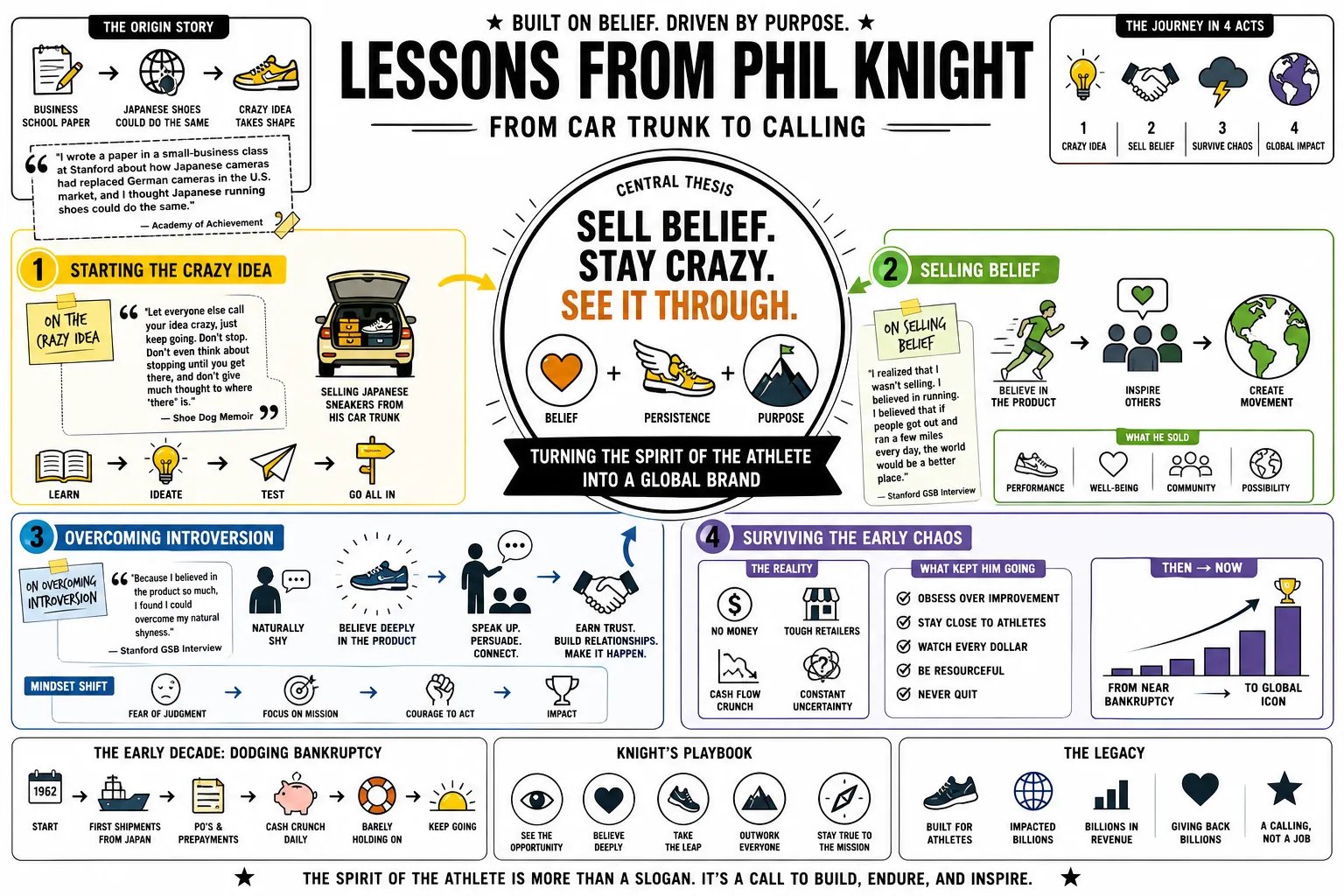
Phil Knight started Nike selling Japanese sneakers from his car trunk, an idea he first floated in a business school paper. He spent the company's first decade dodging bankruptcy while trying to turn the "spirit of the athlete" into a global brand. This profile breaks down how Knight survived that early chaos to build a business that felt more like a calling than a job.
Part 1: Starting the Crazy Idea
- On the "Crazy Idea": "Let everyone else call your idea crazy, just keep going. Don’t stop. Don’t even think about stopping until you get there, and don’t give much thought to where 'there' is." — Source: Shoe Dog Memoir
- On Selling Belief: "I realized that I wasn't selling. I believed in running. I believed that if people got out and ran a few miles every day, the world would be a better place." — Source: Stanford GSB Interview
- On the Thesis: "I wrote a paper in a small-business class at Stanford about how Japanese cameras had replaced German cameras in the U.S. market, and I thought Japanese running shoes could do the same." — Source: Academy of Achievement
- On Overcoming Introversion: "Because I believed in the product so much, I found I could overcome my natural shyness to go out and talk to track coaches and runners." — Source: View From The Top
- On Seeking a Calling: "I’d tell men and women in their mid-twenties not to settle for a job or a profession or even a career. Seek a calling." — Source: Nike News
- On Early Hardship: "The cowards never started and the weak died along the way. That leaves us, ladies and gentlemen. Us." — Source: Bookroo
- On Initial Strategy: "I didn't have a master plan to build a billion-dollar company. I just wanted to be able to pay my bills and keep importing shoes." — Source: Forbes Profile
- On Authenticity: "People, sensing my belief, wanted some of that belief for themselves." — Source: 25iq Analysis
Part 2: The Spirit of Competition
- On Forgetting Limits: "The art of competing is the art of forgetting. You must forget your limits. You must forget your doubts, your pain, your past." — Source: Medium Summary
- On the Finish Line: "There is no finish line. When you reach one goal, you find that there is another one just ahead." — Source: Nike Brand History
- On Bill Bowerman: "If there's no Bill Bowerman, there's no me. He taught me the spirit of the competitor." — Source: University of Oregon
- On Shared Struggle: "Running gives you a shared language with other people who are trying to push themselves." — Source: Harvard Business Review
- On Preparation: "The athlete is our reason for being. If we don't listen to the voice of the athlete, we don't have anything." — Source: Stanford GSB Insights
- On Discipline: "I would run until my lungs burned and my legs felt like lead, and that gave me the mental toughness to handle the banks." — Source: Shoe Dog Excerpts
- On Winning: "It’s not just about winning, it’s about the quest for excellence in everything you do." — Source: Academy of Achievement Interview
- On Suffering: "A runner can always go a little bit further than they think they can." — Source: Inc. Magazine
- On the Nature of Sport: "Sport is like life. It’s a lot of hard work and then you get to the starting line." — Source: Oprah Interview
Part 3: Navigating Risk and Resilience
- On Growth: "Life is growth. Business is growth. You grow or you die." — Source: Stanford GSB
- On Failing Forward: "My goal was to fail fast so I would have enough time to apply the lessons to my next attempt." — Source: Lightspeed HQ
- On the Banks: "For ten years, my banker was my greatest enemy. He told me that growing 100 percent a year was dangerous." — Source: Shoe Dog Narrative
- On the Brink: "We were always out of cash. We lived on the edge of bankruptcy for over a decade." — Source: Forbes Life
- On Survival: "We were a bunch of guys in a basement fighting for our lives against giant corporations." — Source: Academy of Achievement Transcript
- On Legal Battles: "The lawsuit with Onitsuka was a fight for our identity. It taught us that we had to own our own brand." — Source: Nike Heritage
- On Reinvestment: "I put every penny we made back into the company. I didn't care about a salary, I cared about more shoes." — Source: 25iq Business Lessons
- On Courage: "Fear of failure is a good thing if it drives you to work harder." — Source: Stanford View From The Top Transcript
Part 4: Brand and Marketing
- On Values: "Nike is a marketing-oriented company, and the product is our most important marketing tool." — Source: Harvard Business Review
- On the Consumer Pyramid: "We focus on the top of the pyramid, the elite athletes, because they give the brand its reason for being." — Source: HBR High-Performance Marketing
- On Emotional Ties: "Effective marketing communicates the company's soul. It creates an emotional connection with the consumer." — Source: Beehiiv Marketing Insights
- On the Swoosh: "I don't love it, but I think it will grow on me." — Source: Nike History of the Swoosh
- On Hating Advertising: "I used to think that if you had a good product, it would sell itself. I was wrong." — Source: Harvard Business Review Interview
- On Celebrity Influence: "When Michael Jordan wore our shoes, he wasn't just a spokesperson, he was the embodiment of the brand." — Source: CNBC Nike History
- On Brand Focus: "Once you say you want to be the world's best sports company, you have a focus. You don't end up making wing tips." — Source: NIH Business Archive
- On the Power of Story: "We aren't just selling sneakers, we are telling a story about the potential of the human spirit." — Source: Forbes Phil Knight Profile
- On Authenticity in Ads: "The consumer can tell if you're being honest or if you're just trying to sell them something." — Source: Stanford GSB Video
- On Honors: "We don't just use athletes to sell shoes, we honor them." — Source: HBR 1992 Interview
Part 5: Culture and Leadership
- On the "Buttfaces": "We called our management team the 'Buttfaces' because we spent all our time arguing and challenging each other." — Source: Shoe Dog Memoir
- On Misfit Culture: "I liked to hire people who were a little bit outside the mainstream, who had a chip on their shoulder." — Source: 25iq Nike Case Study
- On Collaborative Leadership: "In the modern world, the only sustainable leadership model is collaborative." — Source: Stanford GSB View From The Top
- On Trust: "I didn't micromanage because I trusted my team implicitly. We were like a family." — Source: Inc. Magazine Profile
- On Shared Obsession: "You need to surround yourself with people who are just as obsessed with the product as you are." — Source: Academy of Achievement
- On Managing Introverts: "You don't have to be the loudest person in the room to be a great leader." — Source: View From The Top Transcript
- On Company Loyalty: "Our early employees stayed because they felt like they were part of something bigger than a business." — Source: Nike Newsroom
- On Empowerment: "If you give people freedom, they will do things you never thought possible." — Source: Stanford GSB Interview Transcript
Part 6: Innovation and Product Craft
- On the Waffle Iron: "Bill Bowerman ruined his wife's waffle iron pouring rubber into it, but he created the most innovative shoe sole in history." — Source: Nike Waffle Trainer History
- On Marginal Gains: "Bowerman calculated that saving one ounce on a shoe would reduce the weight a runner lifted by 55 pounds over a mile." — Source: Runner's World
- On the "Shoe Dog": "A Shoe Dog is someone who is wholly obsessed with the design, history, and soul of footwear." — Source: Shoe Dog Definition
- On the Guinea Pig Strategy: "I was Bowerman's primary test subject because I was a mediocre runner and he didn't mind if his experiments failed on me." — Source: University of Oregon Speech
- On Innovation Context: "Innovation must have a reason that comes from the market, not just from the lab." — Source: HBR 1992 Interview
- On Product Integrity: "You cannot create an emotional tie to a bad product because it isn't honest." — Source: Harvard Business Review
- On the Craft: "Mastery requires a level of obsession that goes beyond professional interest into personal identity." — Source: Academy of Achievement
- On Technical Superiority: "When you're the underdog, the only way to win is to make a product that is objectively better." — Source: 25iq Phil Knight Analysis
- On Iteration: "We didn't just design a shoe once, we redesigned it every day for years." — Source: Nike Innovation Lab History
Part 7: Financials and Logistics
- On Cash Flow: "Growth off your balance sheet is dangerous. Our sales grew faster than our available cash for years." — Source: Beehiiv Marketing Lessons
- On Logistics: "Logistics are how ulcers are born. Supply and demand is the root problem in business." — Source: Shoe Dog Memoir Narrative
- On the IPO: "Going public was a painful decision because we lost some of our independence, but we needed the capital to survive." — Source: Nike Investor Relations Archive
- On Supply Chains: "Early on, we were at the mercy of the shipping schedules and the factories in Japan." — Source: 25iq Business Strategy
- On Debt Management: "I had to learn how to talk to bankers who only cared about equity, when all I had was inventory." — Source: Stanford GSB Interview
- On Operational Reality: "While marketing is flashy, logistics is what keeps the lights on." — Source: Inc. Magazine Interview
- On the Danger of Scale: "The faster you grow, the more debt you need, and the more likely you are to crash." — Source: Academy of Achievement Transcript
- On Accounting: "You must have a rigorous understanding of the boring side of business if you want to be successful." — Source: Beehiiv Business Insights
- On Resource Allocation: "We reinvested every dollar to keep the growth going because we knew the competition was right behind us." — Source: Harvard Business Review
Part 8: Legacy and Life Wisdom
- On Giving Back: "Nike directs 3 percent of net profits to charitable causes, focusing on things like the 'Girl Effect'." — Source: Stanford GSB Insights
- On the "Thinking Duck": "Use your education to be critical thinkers. We need more 'Thinking Ducks' in the world." — Source: Oregon Commencement Address
- On Luck: "Hard work is critical, a good team is essential, but luck can be the deciding factor." — Source: Ramaiah Evolute
- On Mentorship: "Seek out teachers who challenge you. Success is rarely a solo endeavor." — Source: University of Oregon 2003 Speech
- On Loyalty: "Loyalty matters. Stay connected to your roots and the people who helped you." — Source: Oregon Alumni Association
- On Life Wisdom: "The study of business isn't just about decision-making, it is a search for wisdom." — Source: Stanford GSB View From The Top Video
- On Passion as Leadership: "Passion is the most vital trait of leadership. It sustains the grind." — Source: Academy of Achievement Phil Knight Profile
- On Work as Play: "If you love what you do, the fatigue will be easier to bear and the highs will be like nothing you’ve felt." — Source: Beehiiv Business Wisdom