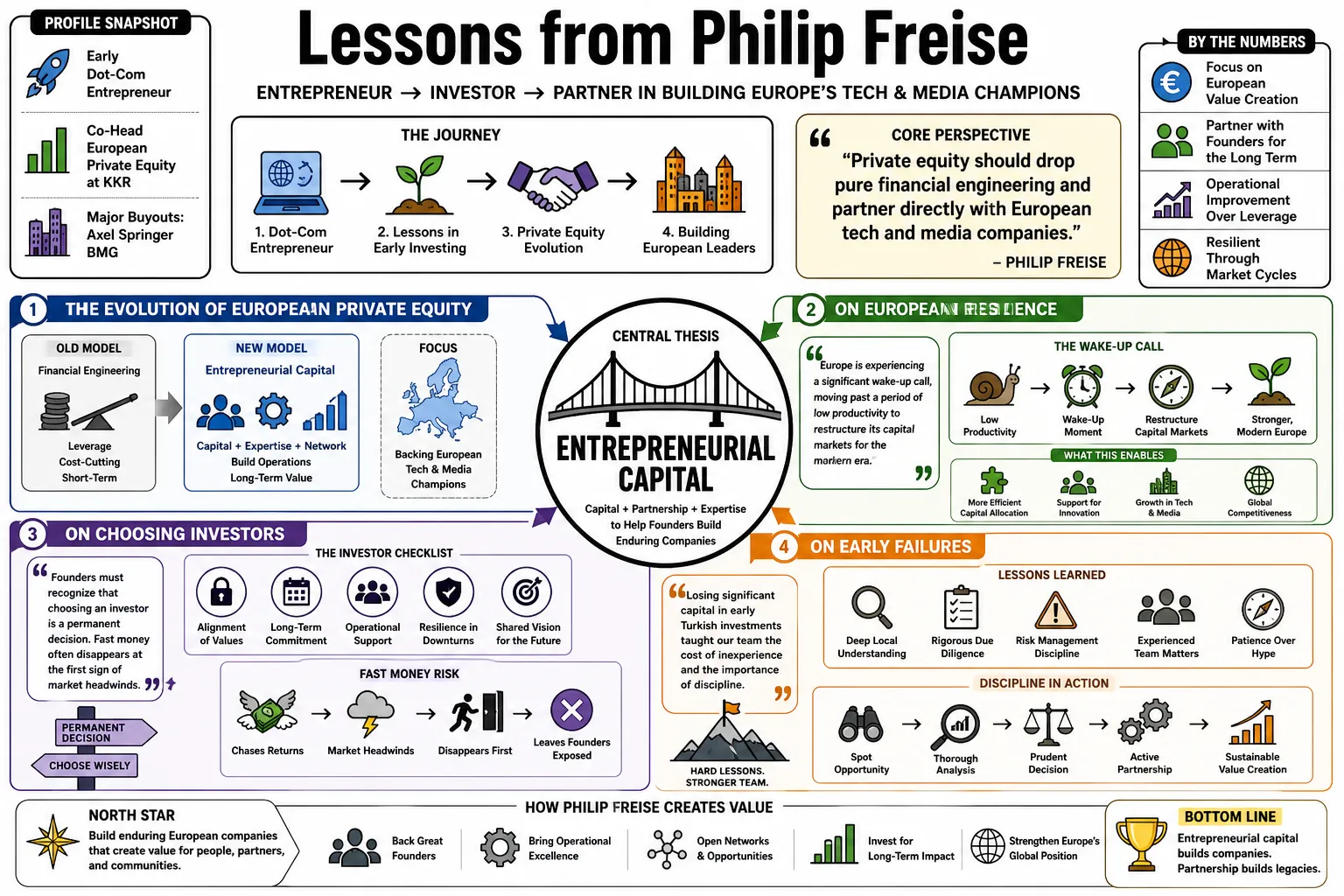
Lessons from Philip Freise
Philip Freise, Co-Head of European Private Equity at KKR, went from an early dot-com entrepreneur to managing major buyouts like Axel Springer and BMG. He advocates for "entrepreneurial capital," arguing that private equity should drop pure financial engineering and partner directly with European tech and media companies. This profile outlines his approach to scaling businesses, weathering market swings, and handling the human side of dealmaking.
Part 1: The Evolution of European Private Equity
- On European Resilience: "Europe is experiencing a significant wake-up call, moving past a period of low productivity to restructure its capital markets for the modern era." — Source: [McKinsey Interview]
- On the Role of Private Equity: "The industry has shifted entirely; it is no longer about financial leverage, but about supplying entrepreneurial capital that helps founders actually build their operations." — Source: [Money Maze Podcast]
- On Choosing Investors: "Founders must recognize that choosing an investor is a permanent decision. Fast money often disappears at the first sign of market headwinds." — Source: [20VC Podcast]
- On Early Failures: "Losing significant capital in early Turkish investments taught our team the hard mechanics of downside protection and the necessity of extreme diligence before scaling." — Source: [20VC Podcast]
- On the Dot-Com Era: "Running a venture incubator in the late 90s demonstrated how quickly theoretical valuations collapse when there are no fundamental unit economics to support the business." — Source: [Money Maze Podcast]
- On Capital Structuring: "The best European firms are currently starved for patient capital, which creates an opening for private markets to fund the gap left by traditional banking." — Source: [Financial Times]
- On the AI Transition: "Integrating artificial intelligence into Europe's industrial base is the single most capital-intensive requirement of this decade." — Source: [McKinsey Interview]
- On Geopolitical Shifts: "European private equity can no longer operate in a vacuum; understanding supply chain sovereignty and regulatory environments is a daily requirement." — Source: [Bloomberg Surveillance]
- On the Perception of Buyouts: "We have to continuously prove that our involvement leads to net job creation and technological modernization, rather than mere cost-cutting." — Source: [KKR Insights]
Part 2: Investing in Media and Technology
- On Media Transformation: "Print-to-digital transformations, like the one we executed with Axel Springer, require a complete rewiring of the company’s internal incentive structures." — Source: [Axel Springer Press]
- On Music Rights Valuation: "The creation of BMG showed that treating music publishing as predictable, recurring revenue fundamentally changes how media assets are valued by institutional investors." — Source: [Tech Europe]
- On Platform Economics: "A successful digital platform must go beyond aggregating demand; it must provide workflow tools that make suppliers dependent on the software." — Source: [Money Maze Podcast]
- On the Creator Economy: "Firms like Leonine are built on the premise that premium local content will hold its value against global streaming algorithms." — Source: [Financial Times]
- On Digital Classifieds: "The transition of classified businesses to pure-play digital marketplaces is characterized by winner-take-all dynamics that demand aggressive early capital." — Source: [KKR Insights]
- On Travel Tech: "Investing in platforms like GetYourGuide proved that digitizing fragmented, offline experiences is the next frontier of consumer technology." — Source: [Tech Europe]
- On Data Privacy: "Media companies must treat first-party data as their primary asset, especially as regulatory frameworks continuously restrict third-party tracking." — Source: [Bloomberg Surveillance]
- On Tech Valuations: "We separate technology investments into infrastructure and application layers, applying much stricter revenue multiples to the latter." — Source: [20VC Podcast]
- On Legacy Brands: "A recognized heritage brand provides a customer acquisition advantage that pure digital startups are forced to spend billions trying to replicate." — Source: [Business Class Podcast]
- On Convergence: "The line between e-commerce, media, and software has dissolved; every scaled media business must eventually build a transactional engine." — Source: [Money Maze Podcast]
Part 3: Value Creation and Partnership
- On Board Dynamics: "A private equity board seat is useless if the operator treats you merely as a compliance check; you must earn the right to be a sounding board." — Source: [20VC Podcast]
- On Aligning Interests: "We spend months before closing just ensuring the management team’s equity structure actually incentivizes the specific growth vectors we agreed upon." — Source: [KKR Insights]
- On Operational Heavy-Lifting: "Value creation today means putting specialized operators into the business to fix specific functions like pricing or digital marketing." — Source: [McKinsey Interview]
- On the First 100 Days: "The first 100 days post-acquisition should be focused entirely on establishing reporting hygiene and unblocking the one bottleneck restricting immediate growth." — Source: [Wall Street Oasis]
- On Corporate Carve-Outs: "Carve-outs are complex because you are building an entire back-office infrastructure from scratch while the business runs, rather than merely changing ownership." — Source: [Bloomberg Surveillance]
- On Founder Transitions: "When a founder steps back from the CEO role, the investor's job is to manage their emotional transition as much as the operational handover." — Source: [Business Class Podcast]
- On Capital Allocation: "Often, our most significant contribution is stopping a management team from spreading capital across ten initiatives, forcing them to double down on the top two." — Source: [Money Maze Podcast]
- On Synergies: "We underwrite deals on standalone metrics; any revenue synergy with other portfolio companies is treated strictly as an upside bonus." — Source: [Tech Europe]
- On Exit Timelines: "You cannot force a company into an exit window; you must build a resilient business that can simply wait out a closed IPO market." — Source: [Financial Times]
Part 4: Leadership and Talent Development
- On Preventing Burnout: "It is almost like conducting an orchestra where the whole thing has gone into 'Ride of the Valkyries'; we have to slow down a little bit to protect the human element from crashing." — Source: [Wall Street Oasis]
- On Assessing Talent: "Past success in a stable corporate environment rarely translates to success in a highly levered, fast-moving private equity context." — Source: [Business Class Podcast]
- On Firm Culture: "A sustainable investment firm requires a culture where junior associates feel comfortable directly contradicting a partner based on raw data." — Source: [20VC Podcast]
- On Trust: "Business fundamentally operates on trust. If you continuously renegotiate terms at the final hour, your reputation in the European market will evaporate." — Source: [Business Class Podcast]
- On Executive Hiring: "We look for executives who treat capital as a scarce resource, even when we have billions available in reserve." — Source: [Money Maze Podcast]
- On Managing Consultants: "Having been at McKinsey, I know that consultants provide excellent frameworks, but they cannot replace the raw, gut-level conviction required to take financial risk." — Source: [Money Maze Podcast]
- On Team Diversity: "Homogeneous investment committees naturally drift towards groupthink, which is fatal when assessing consumer markets you don't personally participate in." — Source: [KKR Insights]
- On Feedback Loops: "The most effective leaders we back have established mechanisms that force bad news to travel upward faster than good news." — Source: [McKinsey Interview]
- On Compensation: "True alignment means the management team must feel the financial pain of a missed target alongside the upside of a success." — Source: [Financial Times]
- On Mentorship: "My role as a leader is increasingly about absorbing the anxiety of the deal team so they can focus on objective underwriting." — Source: [20VC Podcast]
Part 5: Navigating Market Cycles
- On Inflation: "Inflation exposes businesses without true pricing power; if you cannot raise prices without losing volume, your brand equity is an illusion." — Source: [Bloomberg Surveillance]
- On Interest Rates: "A normalized interest rate environment is healthy for private equity because it eliminates tourists and forces returns to come from operational improvement." — Source: [Financial Times]
- On Market Corrections: "When valuations compress, we do not pause investing; we lean into the dislocation to acquire assets that were previously priced to perfection." — Source: [Money Maze Podcast]
- On Distressed Assets: "There is a distinct difference between a bad balance sheet and a bad business. We are solely interested in fixing the former." — Source: [KKR Insights]
- On Timing: "Attempting to time the macroeconomic bottom is a fool's errand; we deploy capital steadily across vintages to average out market volatility." — Source: [20VC Podcast]
- On Leverage: "Debt is a tool to optimize capital structure, not a mechanism to save a mediocre investment thesis." — Source: [Bloomberg Surveillance]
- On Dry Powder: "Having uncalled capital is a competitive advantage only if you have the internal discipline to let it sit idle during overheated markets." — Source: [Tech Europe]
- On Cycle Psychology: "Investment committees are naturally overly optimistic at market peaks and overly pessimistic at the troughs. The process must correct for human emotion." — Source: [McKinsey Interview]
- On Liquidity Management: "During a downturn, cash flow visibility is the only metric that matters for a portfolio company’s survival." — Source: [Wall Street Oasis]
Part 6: Building European Champions
- On Scaling Across Borders: "A European champion cannot be built in a single domestic market; you must underwrite the complexity of expanding across differing regulatory regimes." — Source: [Money Maze Podcast]
- On Competitiveness: "Europe possesses world-class engineering talent, but we often fail to provide the late-stage capital required to commercialize those innovations globally." — Source: [Financial Times]
- On Local Partnerships: "Navigating European labor relations requires treating unions and works councils as constructive partners rather than obstacles." — Source: [Axel Springer Press]
- On the Mittelstand: "The German mid-market holds hidden global leaders that require digital modernization to maintain their export dominance." — Source: [Business Class Podcast]
- On US Competition: "We cannot replicate Silicon Valley; Europe must build champions based on its specific strengths in deep tech, sustainability, and industrial software." — Source: [McKinsey Interview]
- On Regulatory Moats: "Understanding European data privacy laws early on allowed our portfolio companies to turn compliance into a structural advantage against foreign competitors." — Source: [Tech Europe]
- On Corporate Governance: "European family-owned businesses are incredibly resilient, but they often need outside governance frameworks to survive the transition to the third generation." — Source: [KKR Insights]
- On M&A as Strategy: "Buy-and-build strategies in Europe are highly effective because industries here remain structurally more fragmented than in the US." — Source: [Bloomberg Surveillance]
- On Talent Retention: "Keeping top talent in Europe requires offering equity structures that are competitive with what executives would receive in North America." — Source: [20VC Podcast]
Part 7: The Future of Content and Platforms
- On Content Spend: "The arms race in global streaming content spend is unsustainable; profitability will dictate a return to targeted, localized productions." — Source: [Financial Times]
- On Subscription Fatigue: "Consumers are reaching a limit on subscription services, meaning platforms must prove continuous, daily utility to avoid churn." — Source: [Money Maze Podcast]
- On Advertising Technology: "The deprecation of third-party cookies is a massive tailwind for publishers who have actively maintained a direct, authenticated relationship with their readers." — Source: [Axel Springer Press]
- On Audio Markets: "Music rights and podcasting remain undervalued relative to the daily hours of engagement they capture from the average consumer." — Source: [Tech Europe]
- On News Media: "Independent journalism is a highly investable asset if you transition the revenue model from print advertising to high-margin digital subscriptions." — Source: [Bloomberg Surveillance]
- On Niche Platforms: "Horizontal networks are losing ground to vertically integrated platforms that solve highly specific problems for niche communities." — Source: [20VC Podcast]
- On Intellectual Property: "Owning the underlying IP is drastically more profitable over a ten-year horizon than merely acting as a distribution conduit." — Source: [KKR Insights]
- On Generative AI in Media: "AI will commoditize basic content creation, making human-curated, highly opinionated editorial brands more valuable, not less." — Source: [McKinsey Interview]
- On Sports Rights: "Live sports remain the final structural pillar holding up traditional broadcast television, making those rights fiercely competitive." — Source: [Financial Times]
Part 8: Lessons in Dealmaking and Negotiation
- On Due Diligence: "You learn more about a business by speaking to three former customers who churned than by reading fifty pages of a consultant's market report." — Source: [Money Maze Podcast]
- On Walking Away: "The hardest discipline in our industry is letting a good company go to a competitor because the valuation math crossed into speculation." — Source: [20VC Podcast]
- On Complexity: "We actively seek out complex, messy carve-outs or successions because the friction of the deal scares away pure financial buyers." — Source: [KKR Insights]
- On Building Rapport: "Negotiation is rarely about fighting over the last dollar; it is about assuring a founder that their legacy will remain intact under your stewardship." — Source: [Business Class Podcast]
- On Information Asymmetry: "In modern dealmaking, information is ubiquitous. Your edge comes from how you interpret the data, not from simply possessing it." — Source: [McKinsey Interview]
- On Speed vs. Certainty: "Sellers will frequently accept a slightly lower enterprise value if you can offer absolute certainty of closing and immediate execution." — Source: [Tech Europe]
- On Deal Post-Mortems: "Reviewing a successful deal is dangerous. We only truly learn our biases by conducting brutal post-mortems on the investments that lost capital." — Source: [Wall Street Oasis]
- On Sourcing: "The best deals originate from relationships built over a decade with no immediate transaction in sight." — Source: [Financial Times]
- On Managing Stakeholders: "A successful buyout requires mapping out the secondary motivations of every board member, union representative, and debt holder involved." — Source: [Bloomberg Surveillance]
- On Conviction: "If an investment committee approves a deal unanimously with no debate, the diligence was probably not rigorous enough. Good deals require friction." — Source: [20VC Podcast]