Lessons from Pieter Abbeel
Pieter Abbeel is a UC Berkeley computer science professor and co-founder of Covariant. His research in apprenticeship and deep reinforcement learning focuses on how machines acquire physical skills through human demonstration and trial-and-error. This profile collects his talks, interviews, and writing to outline his approach to building physical intelligence.
Part 1: The Philosophy of Intelligence and Learning
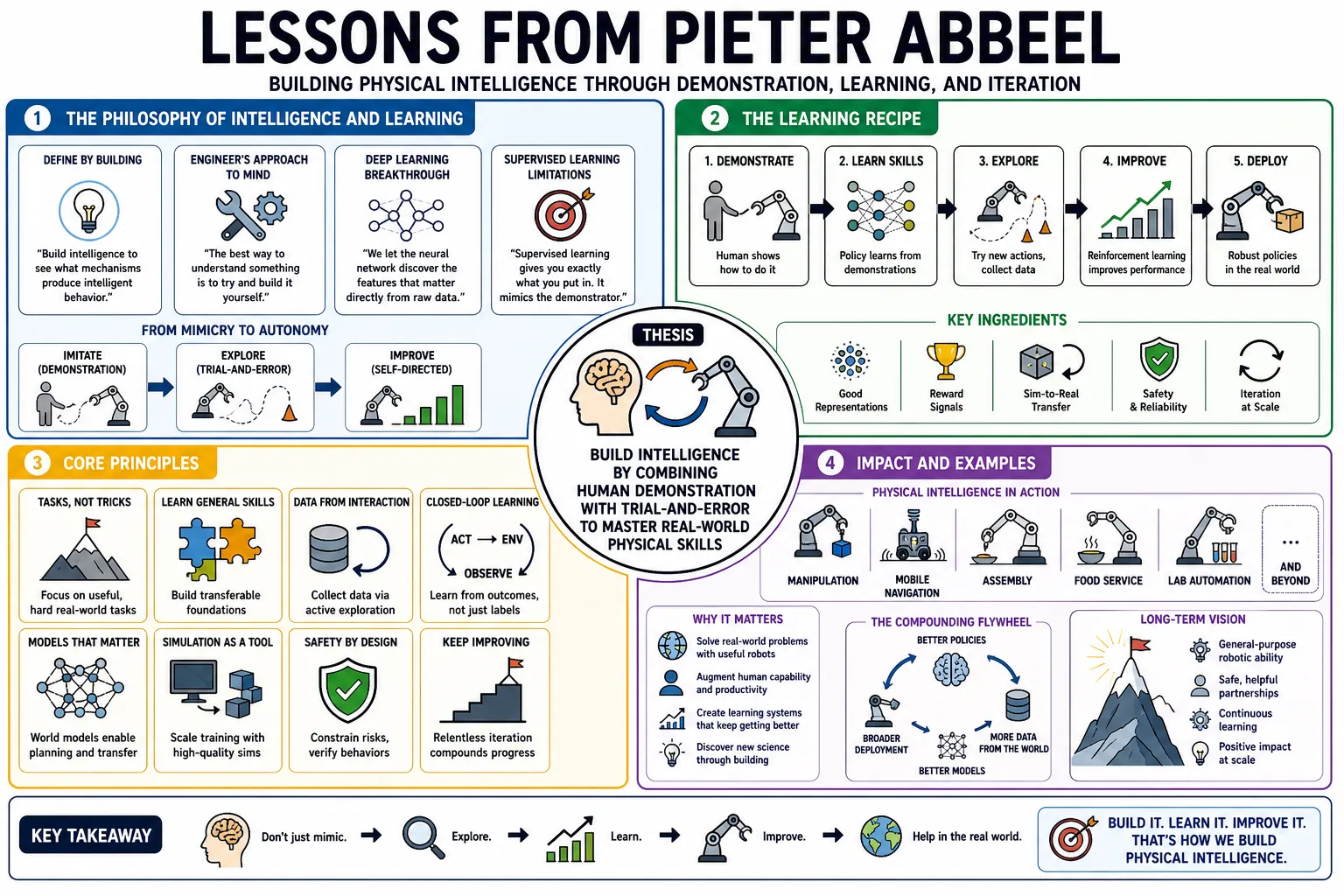
- On defining intelligence: "Instead of trying to understand the human brain, which is incredibly difficult to measure, we can build intelligence to see what mechanisms actually produce intelligent behavior." — Source: [Medium]
- On the engineering approach to mind: "I realized early on that I wanted to understand how the brain works, but as an engineer, the best way to understand something is to try and build it yourself." — Source: [The Robot Brains Podcast]
- On deep learning's breakthrough: "The fundamental shift was moving away from humans hand-coding features. We let the neural network discover the features that matter directly from the raw data." — Source: [DeepLearning.AI]
- On supervised learning limitations: "Supervised learning gives you exactly what you put in. It mimics the demonstrator. To get systems that surpass human intuition, you need reinforcement learning." — Source: [Lex Fridman Podcast]
- On the shift in AI research: "For a long time, the barrier in robotics was hardware. Now, the hardware is often capable enough, and the bottleneck is entirely the software and the learning algorithms." — Source: [TWIML AI Podcast]
- On data-driven robotics: "We are at an inflection point where AI can finally give robots the intelligence they need to be useful in unstructured environments, rather than repeating pre-programmed motions." — Source: [Covariant Insights]
- On intelligence as optimization: "At its core, a lot of intelligent behavior boils down to formulating the right objective function and having a powerful enough optimizer to find the solution." — Source: [UC Berkeley BAIR Blog]
- On the role of compute: "You should always be designing algorithms that will scale with the amount of compute available in five years, rather than what you have on your desk today." — Source: [ACM Communications]
- On pattern recognition vs. reasoning: "Current deep learning is exceptionally good at pattern recognition. The next frontier is moving from fast pattern matching to slow, deliberate reasoning over long time horizons." — Source: [The Robot Brains Podcast]
Part 2: Reinforcement Learning and Trial-and-Error
- On the premise of reinforcement learning: "Reinforcement learning is about learning by trial and error. The robot takes actions, observes the outcomes, and updates its behavior to maximize a reward signal." — Source: [Lex Fridman Podcast]
- On the difficulty of reward design: "Specifying the reward function is often the hardest part. If you tell a robot to clean up a mess and give it a reward for a clean room, it might choose to hide the mess under the rug." — Source: [MIT Technology Review]
- On deep RL capabilities: "By combining deep neural networks with reinforcement learning, we enabled systems to process raw pixels and output motor commands without any intermediate hand-engineered representations." — Source: [DeepLearning.AI]
- On exploration vs. exploitation: "A robot must balance exploiting what it already knows yields high rewards with exploring unknown actions that might yield even higher long-term returns." — Source: [Lex Fridman Podcast]
- On sample inefficiency: "The biggest critique of reinforcement learning in robotics is that it requires millions of trials. In a simulator, that is acceptable. On a physical robot, you lack that kind of time." — Source: [TWIML AI Podcast]
- On solving the sample efficiency problem: "To make RL work in the real world, we have to incorporate prior knowledge, meta-learning, or offline data so the robot avoids starting from scratch every time." — Source: [UC Berkeley BAIR Blog]
- On robotic manipulation: "Traditional robotics treats manipulation as a geometry problem. RL treats it as an interaction problem, which is much closer to how humans actually grab unknown objects." — Source: [Covariant Insights]
- On overcoming local optima: "In complex environments, robots easily get stuck in local optima. Injecting noise and utilizing entropy maximization helps the policy discover entirely new ways to solve the task." — Source: [Lex Fridman Podcast]
- On the success of AlphaGo: "AlphaGo proved that given a perfect simulator and enough compute, reinforcement learning can discover strategies that no human has ever conceived." — Source: [The Robot Brains Podcast]
- On continuous control: "Discrete actions work well for board games. Physical robots require continuous control spaces, where the math of reinforcement learning becomes significantly more complex." — Source: [ACM Communications]
Part 3: Imitation and Apprenticeship Learning
- On apprenticeship learning: "Instead of manually writing a reward function for a complex task like aerobatic helicopter flight, we let the algorithm observe an expert human pilot and infer the reward function they were optimizing." — Source: [Stanford AI Lab]
- On learning from demonstration: "When you give a robot a demonstration, you are drastically shrinking the search space. It gives the RL algorithm a massive head start." — Source: [Lex Fridman Podcast]
- On behavior cloning limits: "Behavior cloning treats imitation as supervised learning. The moment the robot makes a tiny mistake, it enters a state it has never seen in the training data and fails catastrophically." — Source: [DeepLearning.AI]
- On inverse reinforcement learning: "Inverse reinforcement learning extracts the underlying intent of the human teacher. Once the robot knows the intent, it can adapt the behavior to new environments." — Source: [MIT Technology Review]
- On robotic laundry folding: "When we taught the PR2 robot to fold towels, it was really about proving that a robot could handle highly deformable objects by watching humans." — Source: [UC Berkeley News]
- On teleoperation: "Teleoperating a robot to gather data is tedious, but it remains one of the most reliable ways to bootstrap a physical robot's understanding of a new task." — Source: [Covariant Insights]
- On expert sub-optimality: "Human demonstrators are imperfect. Advanced imitation learning algorithms must go beyond copying the human to smooth out the noise and ultimately perform better than the teacher." — Source: [TWIML AI Podcast]
- On third-person imitation: "Humans can watch a video of someone else doing something and map those movements to our own bodies. Teaching robots to do this zero-shot translation is a major open problem." — Source: [UC Berkeley BAIR Blog]
- On combining imitation and RL: "The standard recipe for modern robotics uses imitation learning to get the robot most of the way there, and reinforcement learning to refine the policy for the remaining distance." — Source: [The Robot Brains Podcast]
Part 4: Sim-to-Real and the Physical World
- On the reality gap: "Simulators are clean, physics engines are deterministic, and sensors are perfect. The real world is noisy, friction is unpredictable, and lighting changes constantly. This forms the reality gap." — Source: [Lex Fridman Podcast]
- On domain randomization: "If we randomize the friction, mass, and visual textures in the simulator enough, the neural network learns to treat the real world as another unobserved variation of the simulation." — Source: [OpenAI Blog]
- On the cost of real-world data: "Running an actual robot to gather data is orders of magnitude more expensive and slower than generating it in a datacenter. Sim-to-real transfer is an economic necessity." — Source: [Covariant Insights]
- On physical constraints: "Software has no wear and tear. A robot joint running thousands of episodes of jerky exploration will physically break before it ever converges on a good policy." — Source: [TWIML AI Podcast]
- On visual variability: "A camera sees different pixel values because a cloud passed over the sun outside the warehouse window. The visual cortex of the robot must remain invariant to these details." — Source: [DeepLearning.AI]
- On system identification: "You can try to measure every physical parameter of your robot to make the simulator accurate, but training a policy that succeeds despite physical inaccuracies is usually more reliable." — Source: [UC Berkeley BAIR Blog]
- On tactile sensing: "Vision is well-solved compared to touch. When a robot reaches into a bin and its vision is occluded, it needs rich tactile feedback to adjust its grip." — Source: [The Robot Brains Podcast]
- On safety during exploration: "You cannot deploy a random exploration policy on a heavy industrial arm. Safe RL requires bounding the actions the robot can take while it explores its environment." — Source: [ACM Communications]
- On the role of digital twins: "Modern simulators are more than video games; they are highly physically accurate digital twins of the deployment environment, allowing us to validate policies before they touch hardware." — Source: [Covariant Insights]
- On asynchronous control: "In simulation, you can pause time to compute the next action. In the real world, time keeps moving. Your network inference must outpace the physics of the falling object." — Source: [Lex Fridman Podcast]
Part 5: Scaling Laws and Unsupervised Learning
- On the bitter lesson: "History shows us that methods relying on human-engineered features eventually plateau, while methods that utilize massive computation and data scale indefinitely." — Source: [Lex Fridman Podcast]
- On unsupervised pre-training: "You prefer the robot to spend thousands of hours playing in the environment unsupervised, building a world model before you ever assign a goal." — Source: [DeepLearning.AI]
- On self-supervised learning: "By masking out parts of an image or a video sequence and asking the network to predict the missing pieces, the system learns the underlying physics of the world without human labels." — Source: [UC Berkeley BAIR Blog]
- On contrastive learning: "Contrastive learning allows models to understand that two different camera angles of the same object represent the same underlying concept, mapping them close together in the latent space." — Source: [TWIML AI Podcast]
- On foundation models for robotics: "Language has GPT. Vision has CLIP. The next logical step is a massive foundation model trained on diverse robotic interaction data that can zero-shot transfer to new physical tasks." — Source: [The Robot Brains Podcast]
- On dataset size vs. quality: "In language, you can scrape the internet. In robotics, the internet lacks enough high-quality, teleoperated trajectory data, which forces us to be creative with unsupervised physical interaction." — Source: [Covariant Insights]
- On the predictability of scale: "When you double the parameters and the data, the loss drops predictably. We are starting to see the exact same scaling laws emerge in sensorimotor control." — Source: [Lex Fridman Podcast]
- On multi-modal learning: "A true world model must integrate vision, audio, proprioception, and language. The robot needs to hear the glass break to fully understand the consequence of its action." — Source: [UC Berkeley BAIR Blog]
- On offline reinforcement learning: "We have massive datasets of robots failing and succeeding. Offline RL lets us squeeze optimal policies out of historical data without needing to run the physical robot during training." — Source: [DeepLearning.AI]
Part 6: Industrial Robotics and Covariant
- On founding Covariant: "We realized that the AI we were building in the Berkeley lab was finally reliable enough to solve the long-tail edge cases that had stalled industrial automation for decades." — Source: [Covariant Insights]
- On the limitations of traditional automation: "Classic factory robots do exactly what you program them to do. If a box is shifted by one centimeter, the system halts. They have precision, but zero adaptability." — Source: [The Robot Brains Podcast]
- On unstructured environments: "A modern e-commerce warehouse is chaotic. The inventory changes daily, packaging gets crumpled, and lighting shifts. Only a neural network can handle that level of variance." — Source: [MIT Technology Review]
- On the Covariant Brain: "We avoid building the hardware. Our focus is a universal AI: a single software platform that can be dropped into any robot arm to give it human-level dexterity." — Source: [Covariant Insights]
- On the long tail of robotics: "Getting a robot to pick a majority of items is an academic project. Getting it to pick nearly all items, including transparent polybags and highly reflective packages, is a massive industrial engineering challenge." — Source: [Lex Fridman Podcast]
- On fleet learning: "When a Covariant robot in Europe encounters a new type of packaging and learns how to pick it, every other robot in our network globally updates to share that knowledge." — Source: [TWIML AI Podcast]
- On measuring success: "In academia, we measure success by the peak performance on a benchmark. In industry, success is measured by the mean time between human interventions." — Source: [DeepLearning.AI]
- On human-robot collaboration: "The immediate goal in warehouses is having the robot handle the highly repetitive, ergonomic-straining tasks, while humans handle the rare edge cases the AI flags." — Source: [The Robot Brains Podcast]
- On deploying AI at scale: "A deployed AI model rots as the distribution of physical goods changes over the year. Continuous learning pipelines must automatically retrain and push new weights to the fleet without downtime." — Source: [Covariant Insights]
- On the business case for AI: "Customers buy AI because it provides a reliable, predictable throughput in operations that were previously bottlenecked by labor shortages." — Source: [ACM Communications]
Part 7: Advice for AI Researchers and Students
- On getting started in AI: "Avoid merely reading papers or watching lectures. Write the code, debug the tensors, and see the algorithms fail. That is where the intuition is built." — Source: [DeepLearning.AI]
- On choosing research problems: "Look for the intersection of something you find deeply fascinating and something that will be heavily impacted by the next order-of-magnitude increase in computational power." — Source: [The Robot Brains Podcast]
- On reading papers: "When reading a paper, look beyond the math. The experimental setup and the ablations tell you what actually makes the system work, versus what the authors thought made it work." — Source: [UC Berkeley BAIR Blog]
- On the value of fundamentals: "Frameworks like PyTorch abstract away the difficulty, but without understanding the underlying calculus and linear algebra, you won't know how to fix the network when the gradients explode." — Source: [Lex Fridman Podcast]
- On navigating the hype: "AI moves incredibly fast. Focus on reproducing core, fundamental papers rather than trying to chase every minor new architecture published on arXiv." — Source: [TWIML AI Podcast]
- On the PhD journey: "A PhD is a test of resilience. You will spend months on ideas that simply do not work, and you have to accept throwing that code away." — Source: [The Robot Brains Podcast]
- On empirical rigor: "A beautiful theory is useless in robotics if it fails on the hardware. Always prioritize empirical evidence over elegant but unproven mathematics." — Source: [ACM Communications]
- On collaboration: "The modern AI field is too complex for lone wolves. The best research comes from labs where systems engineers, theorists, and hardware specialists are constantly talking to each other." — Source: [DeepLearning.AI]
- On debugging neural networks: "Debugging deep learning is uniquely difficult because the code will compile and run perfectly, but it will silently learn garbage. You have to become a detective of your own data pipeline." — Source: [Lex Fridman Podcast]
Part 8: The Future of General Purpose Robots
- On general purpose robotics: "We are moving away from building a single algorithm for a single task. The holy grail is a robot that you can unbox, talk to in plain English, and have it immediately understand your intent." — Source: [The Robot Brains Podcast]
- On language as an interface: "Large language models provide the high-level semantic reasoning. When coupled with a low-level robotic control policy, the robot finally understands that cleanup means putting the cup in the sink." — Source: [Lex Fridman Podcast]
- On household robots: "The home is the ultimate unstructured environment. A factory has rules. A home has pets, toddlers, and clutter. A robot that works in any kitchen is the hardest problem in AI." — Source: [MIT Technology Review]
- On safety and alignment: "Before we deploy general-purpose robots in homes, we must solve alignment. A robot with a kitchen knife needs absolute, mathematically provable safety constraints." — Source: [UC Berkeley BAIR Blog]
- On the timeline for AGI: "Whether it takes ten years or fifty, the trajectory is clear. The components of vision, language, and motor control are maturing. The next decade is about integration." — Source: [The Robot Brains Podcast]
- On embodiment: "Intelligence evolved to move a body through the physical world. I doubt we will achieve true artificial general intelligence until our models are embodied and subject to the laws of physics." — Source: [Lex Fridman Podcast]
- On the economic impact: "When robots can perform general physical labor, the cost of manufacturing, agriculture, and construction will plummet. It will fundamentally rewrite the economics of physical goods." — Source: [Covariant Insights]
- On human augmentation: "I view robots as a physical extension of our intent, much like the computer became an extension of our cognitive capabilities, rather than adversarial replacements." — Source: [TWIML AI Podcast]
- On the ultimate goal: "The dream is to build systems that understand the world deeply enough to help humans explore, build, and solve problems we cannot solve alone." — Source: [DeepLearning.AI]