Pushmeet Kohli leads the AI for Science and Robust & Reliable AI teams at Google DeepMind, focusing on applying machine learning to complex disciplines like biology, mathematics, and physics. He is best known for his leadership in the development of AlphaFold and his core philosophy that AI robustness must be treated like structural engineering. This profile distills his practical approaches to selecting high-impact research problems, verifying neural networks, and advancing the capability of scientific AI.
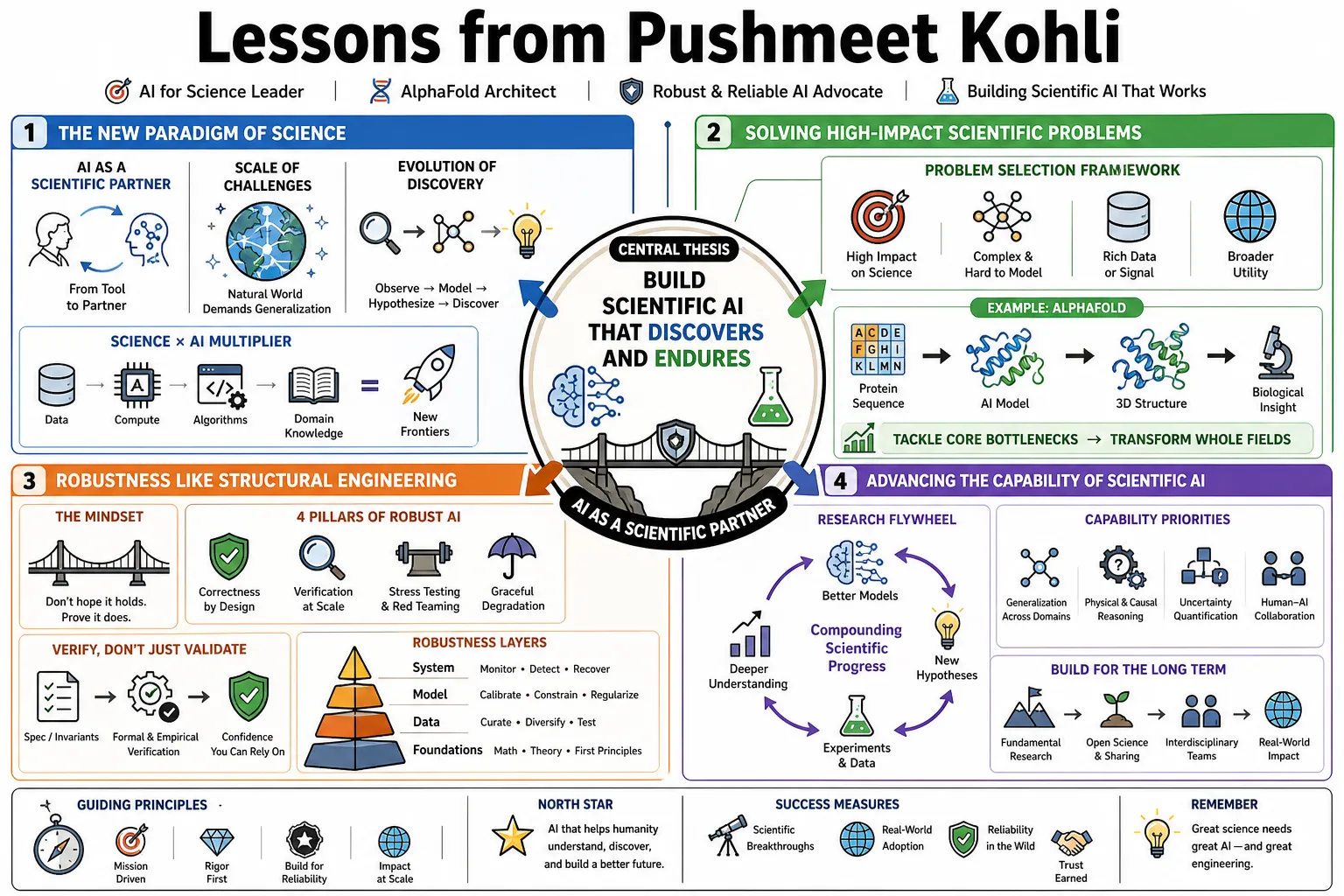
Part 1: The New Paradigm of Science
- On AI as a scientific partner: "We are moving from a regime where AI is just a tool to help scientists process data, to one where AI systems can act as agents that help formulate hypotheses and conduct research." — Source: Google DeepMind Podcast
- On the scale of scientific challenges: "Science is the ultimate frontier for artificial intelligence because the complexity of the natural world requires systems that can generalize far beyond human intuition." — Source: Sequoia Capital Interview
- On the evolution of discovery: "The traditional scientific method relies heavily on human observation and trial-and-error, but machine learning allows us to search vast combinatorial spaces directly." — Source: a16z Podcast
- On accelerating progress: "When you build an AI that can solve a fundamental scientific bottleneck, you don't just solve one problem—you unblock thousands of downstream researchers." — Source: Google AI Release Notes
- On the limits of human cognition: "Humans are incredibly good at recognizing patterns in three dimensions, but biological and physical data often live in thousands of dimensions where our intuition fails." — Source: 80,000 Hours
- On experimental design: "The next generation of AI in science will not just predict outcomes; it will actively propose the most informative experiments for a physical lab to run." — Source: Springer Nature
- On democratizing breakthroughs: "Tools like AlphaFold level the playing field, allowing a small lab with limited resources to conduct research that previously required millions of dollars in equipment." — Source: TIME 100 AI
- On simulation versus reality: "You can only get so far with synthetic data; eventually, an AI system has to prove its hypotheses against the messy, noisy reality of the physical world." — Source: World Science Festival
- On multidisciplinary teams: "Solving science with AI requires a tight loop between computer scientists who understand the algorithms and domain experts who understand the physics." — Source: Google DeepMind Research
- On long-term timelines: "Transformative scientific problems often take a decade or more to solve; you have to be willing to work on things that are not going to yield immediate reinforcement." — Source: Decoding Science
Part 2: Robust and Reliable AI
- On the structural engineering analogy: "Robustness in AI is not a side project. It is like structural engineering. You cannot build a bridge and then decide to figure out if it can hold weight later." — Source: 80,000 Hours
- On safety by design: "We have to move away from testing AI systems post-hoc and instead mathematically verify their properties during the training and architecture design phase." — Source: Alignment Forum
- On edge cases: "The real world is entirely composed of edge cases. If an AI system only works under the exact distribution of its training data, it is useless in reality." — Source: Microsoft Research Archives
- On verifiable models: "We need systems where we can formally prove that certain failure modes are impossible, rather than just empirically observing that they are rare." — Source: Google DeepMind Safety
- On specification gaming: "Models will often find the path of least resistance to optimize their objective function, which usually involves exploiting a flaw in how we specified the goal." — Source: 80,000 Hours
- On out-of-distribution failures: "A reliable system doesn't just need to be accurate; it needs to know when it doesn't know the answer and gracefully degrade its confidence." — Source: Sequoia Capital Interview
- On continuous testing: "Robustness is a moving target. As models become more capable, the methods we use to verify and test them must scale correspondingly." — Source: Google AI Blog
- On the limits of empirical testing: "You cannot rely on a static test set to prove an AI is safe. You have to actively search for the worst-case inputs." — Source: DeepMind Research
- On trust in automation: "If we want society to adopt AI in critical sectors like healthcare or aviation, mathematical guarantees of reliability are the only way to earn that trust." — Source: World Science Festival
- On system complexity: "The bigger the model, the harder it is to understand its failure modes. Interpretability has to scale alongside parameter counts." — Source: Alignment Forum
Part 3: The Architecture of Discovery
- On the four-condition framework: "We look for problems where the impact is massive, the current methods are hitting a wall, there is enough data to learn from, and we have a clear way to evaluate success." — Source: Google AI Release Notes
- On the 'harness' architecture: "Effective scientific AI often uses a harness: pairing a generative model that proposes solutions with a strict, domain-specific evaluator that checks them." — Source: Sequoia Capital Interview
- On objective functions: "If you can mathematically define what a good solution looks like, you can unleash reinforcement learning to find it. The hardest part is often writing the objective." — Source: Google DeepMind Podcast
- On integrating domain knowledge: "You don't want the network to learn the laws of physics from scratch. You want to bake those symmetries directly into the architecture." — Source: Springer Nature
- On evaluating progress: "In scientific AI, your ground truth is nature. You can't argue with experimental validation; either the protein folds that way or it doesn't." — Source: a16z Podcast
- On searching mathematical spaces: "Systems like AlphaTensor and FunSearch work because they map abstract mathematical reasoning into a search problem that algorithms excel at." — Source: DeepMind Technologies
- On breaking research bottlenecks: "We focus our AI efforts on the slowest steps in the scientific pipeline. If synthesizing a material takes months, that is where the algorithm belongs." — Source: TIME 100 AI
- On scaling laws in science: "More compute and more data will improve the models, but in scientific domains, algorithmic innovations that respect physical constraints yield the biggest jumps." — Source: Google AI Blog
- On generative models in biology: "We are moving from analytical models that simply read biological data to generative models that can write novel sequences." — Source: Pushkin Podcast
- On modularity: "The best AI systems for science are modular. You have one component generating ideas, another running simulations, and a third refining the output." — Source: Google DeepMind Research
Part 4: Red Teaming and Adversarial Testing
- On building adversaries: "You have to build automated adversaries whose sole purpose is to break your model. If you can't break it, you haven't tested it hard enough." — Source: 80,000 Hours
- On the arms race: "Adversarial robustness is an ongoing arms race between the attacker and the defender. The goal is to make the cost of attacking computationally prohibitive." — Source: Microsoft Research Archives
- On proactive security: "Do not wait for users to find the flaws in your model. Red teaming must be integrated into the daily training loop." — Source: DeepMind Safety
- On worst-case scenarios: "Average-case performance is misleading. An autonomous vehicle that drives perfectly 99% of the time but fails catastrophically 1% of the time is not deployable." — Source: Alignment Forum
- On automated red teaming: "Human red teamers are too slow. We need language models prompting other language models specifically to expose vulnerabilities." — Source: Google AI Blog
- On adversarial examples: "Small, imperceptible perturbations in input data can completely flip a model's prediction. Solving this requires fundamental changes to how models map feature spaces." — Source: 80,000 Hours
- On stress testing hypotheses: "When an AI proposes a new mathematical theorem, we use adversarial search to actively hunt for counterexamples before claiming success." — Source: Sequoia Capital Interview
- On finding blind spots: "Models tend to be highly confident even when they are entirely wrong. Adversarial testing forces the model to confront its own blind spots." — Source: DeepMind Research
- On security as a baseline: "Security in machine learning cannot be a premium feature. It has to be the default state of any system released to the public." — Source: World Science Festival
Part 5: From Perception to Reasoning
- On the limits of pattern matching: "Deep learning is incredible at perception—recognizing cats in images—but reasoning requires multi-step logic and the ability to backtrack." — Source: Google DeepMind Podcast
- On early computer vision: "Working with graph cuts taught me that defining the right energy function is more than half the battle in solving a complex perception problem." — Source: Microsoft Research Archives
- On the leap to mathematics: "Solving geometry or discovering matrix multiplication algorithms requires an AI to not just guess, but to assemble verifiable proofs." — Source: Sequoia Capital Interview
- On system 1 vs system 2 thinking: "Current language models mostly do fast, associative 'System 1' thinking. The frontier is getting them to pause, search, and perform deliberate 'System 2' planning." — Source: Google AI Release Notes
- On combinatorial optimization: "Many scientific problems are just massive combinatorial puzzles. If you can frame the science as a discrete optimization task, AI can usually solve it." — Source: a16z Podcast
- On visual intelligence: "My early work in computer vision focused on how to segment images optimally. Now, we are trying to segment the logic of mathematical equations." — Source: Microsoft Research Archives
- On learning algorithms: "We are not just training models to execute algorithms; we are training models to discover entirely new algorithms that human computer scientists missed." — Source: DeepMind Technologies
- On search spaces: "When the search space is larger than the number of atoms in the universe, brute force fails. You need a neural network to guide the search heuristic." — Source: Springer Nature
- On formal verification: "Reasoning in AI ultimately leads to formal verification. If the model can output a proof that a standard solver can check, we completely eliminate hallucinations." — Source: Alignment Forum
Part 6: Biology and Protein Folding
- On the AlphaFold milestone: "Protein folding was considered a grand challenge of biology for 50 years. Solving it demonstrated that AI could fundamentally alter the trajectory of a natural science." — Source: Pushkin Podcast
- On data availability in biology: "AlphaFold was only possible because generations of biologists painstakingly mapped protein structures and deposited them into public databases like the PDB." — Source: Google DeepMind Podcast
- On structural constraints: "A protein isn't just a sequence of letters; it is a physical object that has to obey spatial and energetic constraints. The AI architecture had to reflect that physical reality." — Source: Springer Nature
- On mapping the proteome: "We went from having structures for a fraction of human proteins to mapping nearly every known protein sequence on Earth in a matter of months." — Source: TIME 100 AI
- On drug discovery: "Understanding the structure is step one. The next step is using AI to design small molecules that bind to those structures to cure diseases." — Source: Sequoia Capital Interview
- On synthetic biology: "Once an AI understands the rules of how sequences fold, we can start generating novel proteins that do not exist in nature to break down plastics or capture carbon." — Source: a16z Podcast
- On AlphaMissense: "By adapting the AlphaFold architecture, we can predict which genetic mutations are likely to cause disease, accelerating the diagnosis of rare genetic disorders." — Source: DeepMind Technologies
- On cross-disciplinary impact: "Biologists are now using our predictions to solve crystal structures that they had been stuck on for years. The AI is a multiplier for human effort." — Source: Google AI Blog
- On the complexity of life: "Proteins do not act alone. The next frontier is predicting how complexes of proteins interact, move, and function within the dynamic environment of the cell." — Source: Pushkin Podcast
Part 7: Career Philosophy and Choosing Problems
- On picking hard problems: "If a problem is easy, the broader community will solve it. An industrial research lab should focus on the problems that require massive scale and long time horizons." — Source: 80,000 Hours
- On leaving Microsoft for DeepMind: "I wanted to be in an environment completely obsessed with solving intelligence and applying it to the hardest scientific problems." — Source: Google DeepMind Podcast
- On the value of fundamentals: "Trends in machine learning come and go, but a deep understanding of mathematics, optimization, and physics will always be relevant." — Source: Microsoft Research Archives
- On building teams: "The most effective teams are those where people are not afraid to ask basic questions across disciplines. The AI researcher must learn the biology, and the biologist must learn the AI." — Source: Decoding Science
- On failure: "In high-risk research, 90% of your ideas will fail. You have to build a culture where negative results are celebrated as necessary steps to finding the truth." — Source: Sequoia Capital Interview
- On focus: "There are a thousand interesting things to work on in AI right now. The hardest part of my job is saying no to 999 of them." — Source: TIME 100 AI
- On motivation: "What drives me is the asymmetry of impact. A single algorithm can theoretically improve the health and well-being of billions of people." — Source: 80,000 Hours
- On evaluating ideas: "An idea is only as good as the experiment you can design to test it. If you can't measure it, you can't optimize it." — Source: Google AI Release Notes
- On patience in research: "Breakthroughs like AlphaFold don't happen in a weekend. They require years of grinding through terrible baselines before the exponential curve kicks in." — Source: Springer Nature
Part 8: The Future of AI and Humanity
- On AI as infrastructure: "Eventually, AI will become like electricity. It will be an invisible infrastructure that powers everything from grid optimization to personalized medicine." — Source: World Science Festival
- On human-AI collaboration: "The goal is not to replace the scientist. The goal is to give the scientist a collaborator that can read every paper ever published and simulate a million experiments a second." — Source: Google DeepMind Podcast
- On existential risk: "We must take the risks of advanced AI seriously. That is exactly why we are investing so heavily in verifiable, robust, and aligned systems today." — Source: 80,000 Hours
- On open science: "Sharing the AlphaFold database freely with the world was a deliberate choice to maximize human benefit. The tools of discovery should be accessible." — Source: TIME 100 AI
- On materials science: "We are on the verge of an era where we can ask an AI to design a battery that is twice as efficient and doesn't use rare earth metals, and it will give us the recipe." — Source: a16z Podcast
- On mathematical frontiers: "When AI starts discovering fundamental mathematical truths, it changes our relationship with the universe. It shows that logic is universally accessible to computation." — Source: DeepMind Technologies
- On climate change: "AI for science is our best lever for tackling climate change. We need new materials for carbon capture and better models for climate prediction, and we need them yesterday." — Source: Sequoia Capital Interview
- On continuous learning: "The systems of the future will not be static weights frozen in time. They will constantly learn, experiment, and adapt as they interact with the world." — Source: Google AI Blog
- On the ultimate goal: "We are building these tools to understand the fabric of reality. Artificial intelligence is simply the most powerful lens humanity has ever created to look at the universe." — Source: Pushkin Podcast