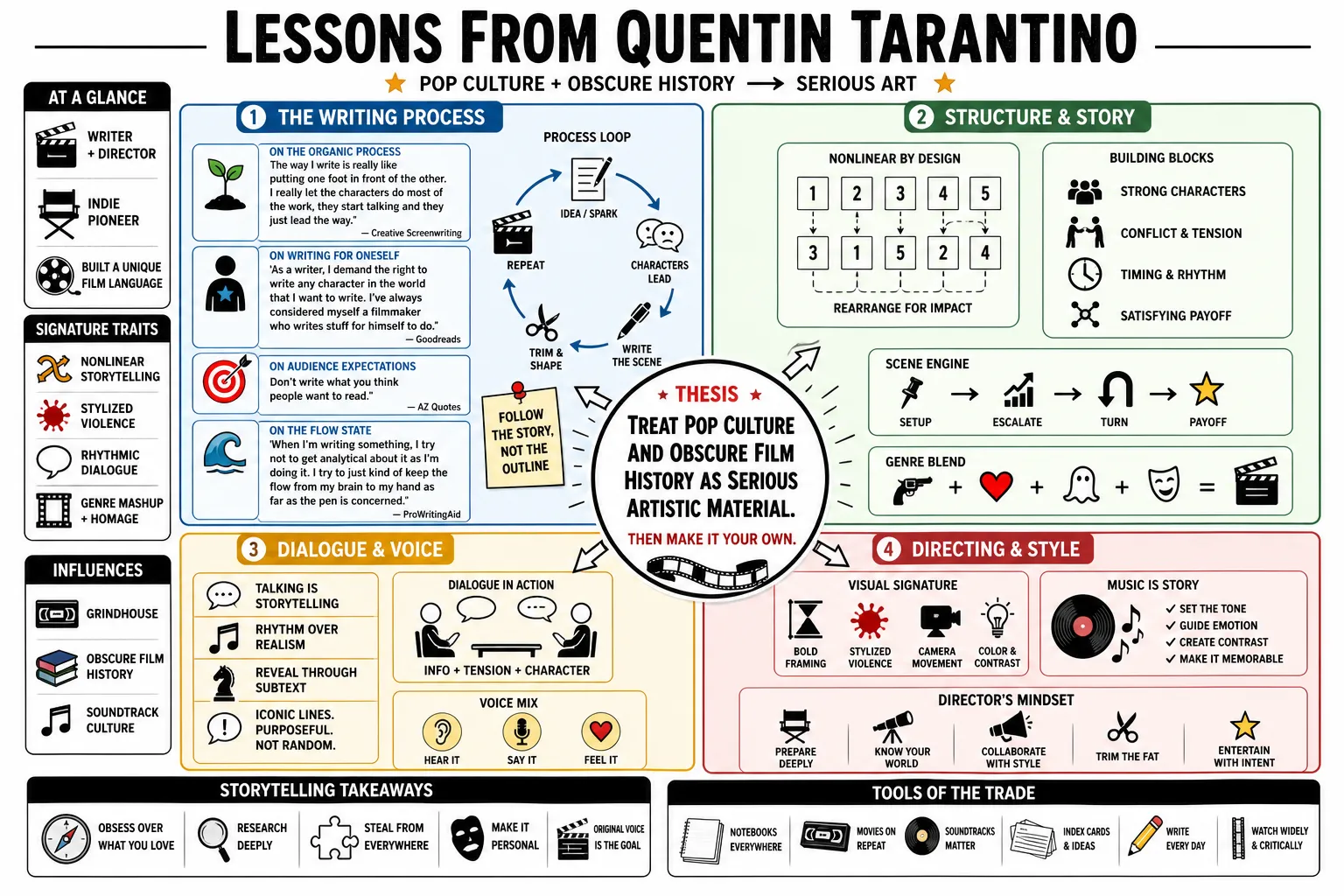
Lessons from Quentin Tarantino
Writer and director Quentin Tarantino built his career by treating pop culture and obscure film history as serious artistic material. He is known for popularizing nonlinear storytelling, stylized violence, and rhythmic dialogue in American independent cinema. This profile collects his practical perspectives on writing, directing, and the mechanics of storytelling.
Part 1: The Writing Process
- On the organic process: "The way I write is really like putting one foot in front of the other. I really let the characters do most of the work, they start talking and they just lead the way." — Source: Creative Screenwriting
- On writing for oneself: "As a writer, I demand the right to write any character in the world that I want to write. I've always considered myself a filmmaker who writes stuff for himself to do." — Source: Goodreads
- On audience expectations: "Don't write what you think people want to read." — Source: AZ Quotes
- On the flow state: "When I'm writing something, I try not to get analytical about it as I'm doing it. I try to just kind of keep the flow from my brain to my hand as far as the pen is concerned." — Source: ProWritingAid
- On the physical medium: He prefers writing with pen and paper because it facilitates a direct connection to the words and the characters as they speak. — Source: Medium
- On writing routines: He writes during the day, then floats around in his pool to reflect on the pages and plan the next day's work. — Source: Cal Newport
- On avoiding strategy: "I don't write dialogue in a strategic way. I didn't really go about crafting the scene, I just put them in the room together. They just started talking and I jotted it down." — Source: No Film School
- On conscious influences: In a SiriusXM discussion, Tarantino named Elmore Leonard, David Mamet, and Richard Pryor as the writers whose influence most shaped his dialogue. — Reference: Far Out report on Tarantino's SiriusXM dialogue influences
- On acting experience: Taking acting classes early in his career helped him intimately understand the realistic flow of conversation. — Source: No Film School
Part 2: Character Development and Dialogue
- On becoming the characters: "I'm a method writer. I am them while I'm writing them." — Source: Reddit
- On character consistency: "I really become the characters when I'm writing them. I'll become one or two of them more than others, I'm consistent that way." — Source: QuoteFancy
- On telling the truth: "I demand the right to be them, I demand the right to think them and I demand the right to tell the truth as I see they are." — Source: Goodreads
- On withholding judgment: "I don't judge my characters, and that's my job not to judge them. It's my job to treat them with respect and to just look at it from their point of view." — Source: AZ Quotes
- On narrative roadblocks: "Screenwriters will have a habit of putting road blocks up against some of those roads because basically they can't afford to have their characters go down there. I have never put that kind of imposition on my characters." — Source: AZ Quotes
- On taking credit: "I almost feel like a fraud for taking credit for writing dialogue, because it's the characters that are doing it." — Source: WordPress
- On following instincts: He maintains that wherever his characters decide to go in a scene, he will dutifully follow them. — Source: AZ Quotes
- On unseen preparation: He creates extensive backstories for his characters to ensure he knows exactly how they would react, even if those details never appear on screen. — Source: Golden Script
- On moral complexity: By actively avoiding judging his creations, he allows his villains and anti-heroes to remain authentic and charismatic to audiences. — Source: StudioBinder
- On internal voices: He views himself less as a strategic planner and more as a conduit for his characters' internal monologues. — Source: Creative Screenwriting
Part 3: The Filmmaking Philosophy
- On original creation: Tarantino describes directing from a fully imagined inner movie: before making a film, he says he watches it in his mind and works from that genuine vision. — Reference: StudioBinder compilation of Tarantino filmmaking interviews
- On personal taste: A central tenet of his philosophy is to unapologetically create the kind of films you would personally pay to watch. — Source: Open Culture
- On formal education: "I didn't go to film school, I went to films." — Source: QuoteFancy
- On the role of passion: "You don't have to know how to make a movie. If you truly love cinema with all your heart and with enough passion, you can't help but make a good movie." — Source: Reddit
- On vulnerability: Make your work personal enough that it actually feels embarrassing to share it with the world. — Source: No Film School
- On bypassing gatekeepers: You no longer need traditional permission or massive studio budgets to start making a movie. — Source: Filmmaking Stuff
- On the value of failure: He views the process of making terrible films early in one's career as the greatest possible film school. — Source: No Film School
- On continuous growth: Surround yourself with people who are more talented or faster than you in order to push your own standards higher. — Source: No Film School
- On perfection: "There are very few perfect movies. This is okay, since in the pursuit of cinematic art, perfection shouldn't be the goal. Nevertheless, when it's accomplished it's an achievement." — Source: Goodreads
- On time management: On a film set, time is a limited resource, and how you choose to use it ultimately defines who you are as a director. — Source: Reddit
Part 4: Directing and On-Set Dynamics
- On video village: Avoid staying in the separate monitor room; a director should be right by the camera so actors feel they are performing directly for you. — Source: Noam Kroll
- On emotional conduction: He views the director as the primary conductor of the audience’s emotions. — Source: CME Content Academy
- On clear vision: It is your job to have an uncompromising vision and ensure that the film communicates that vision effectively to both your crew and the viewer. — Source: No Film School
- On the trunk shot: He frequently uses a low-angle POV shot from inside a trunk to firmly establish power dynamics and make the subject appear powerless. — Source: Videomaker
- On wide shots: Well-staged, expansive wide shots are essential to immersing the audience deeply into the specific world of the film. — Source: StudioBinder
- On close-ups: Extreme close-ups serve to heighten narrative tension and forcefully direct the viewer's focus onto significant details. — Source: Videomaker
- On structural rhythm: He approaches script structure like a novelist, using chapters and time jumps to prioritize narrative rhythm over standard plot pacing. — Source: NYFA
- On character loyalty: Your only true responsibility as a director is to remain relentlessly true to your characters. — Source: No Film School
- On dialogue musicality: He treats dialogue as a musical element, focusing on its cadence and the way it reveals personality. — Source: No Film School
Part 5: Music and Sound Design
- On the foundation of a film: "Music is very, very important in my movies. In some ways the most important stage, whether it ends up being in the movie or not, is just when I come up with the idea itself." — Source: AZ Quotes
- On discovering the film's spirit: "One of the things I do when I am starting a movie is I go through my record collection and just start playing songs, trying to find the personality of the movie, find the spirit of the movie." — Source: Open Culture
- On soundtracks as mix tapes: "I've always thought my soundtracks do pretty good, because they're basically professional equivalents of a mix tape I'd make for you at home." — Source: QuoteFancy
- On cinematic alchemy: The act of arranging songs within a film utilizes what movies do better than any other art form, creating a viscerally emotional experience. — Source: Open Culture
- On setting expectations: Using Dick Dale's "Misirlou" for the opening credits of Pulp Fiction was a deliberate gauntlet thrown down, demanding the rest of the film match its intensity. — Source: Open Culture
- On permanent association: "If a song in a movie is used really well, as far as I'm concerned, it becomes associated with the film." — Source: Netribution
- On changing a song's meaning: A scene executed perfectly with a specific track ensures that the audience can never hear that song the same way again. — Source: Open Culture
- On dictating the pace: Music is never just background noise; it is an active narrative tool used to define the tone and pace the audience's experience. — Source: No Film School
- On shifting tones: Carefully selected soundtracks allow him to orchestrate sudden tonal shifts, moving viewers from humor to shock seamlessly. — Source: Scribd
Part 6: Violence and Cinema Aesthetics
- On violence as a color: "Violence in real life is terrible; violence in movies can be cool. It's just another colour to work with." — Source: QuoteFancy
- On aesthetic meaning: "When Fred Astaire dances, it doesn't mean anything. Violence is the same. It doesn't mean anything. It's a colour." — Source: Tony Watkins
- On entertainment: "Violence is a form of cinematic entertainment." — Reference: BBC Kill Bill interview with Quentin Tarantino
- On paving the way: "If I've made it a little easier for artists to work in violence, great!" — Source: AZ Quotes
- On creative ownership: "I don't need you to tell me how fucking violent my movie is, okay? I'm the one who made it, I know how violent it is." — Source: Reddit
- On separating reality from art: He maintains a strict distinction between real-world tragedy and movie violence, viewing the latter strictly as an artistic element. — Source: AZ Quotes
- On stylistic flexibility: Violence can be modulated for various effects, ranging from gritty realism to extreme stylistic flair or comedic impact. — Source: Medium
- On gender equality in violence: True equality in his cinematic universe means any character, regardless of gender, can be subjected to the same brutality in a given situation. — Source: Collider
- On catharsis: He uses violence as an emotional release valve for the audience's built-up tension rather than just for simple shock value. — Source: No Film School
Part 7: The Theatrical Experience and Industry
- On digital projection: "As far as I'm concerned, digital projection and DCPs is the death of cinema as I know it." — Reference: KQED report quoting Tarantino at Cannes on digital projection
- On the essence of film: At Cannes, Tarantino argued that when most films are no longer presented in 35 mm, digital projection becomes "television in public" rather than the cinema he knew. — Reference: KQED report quoting Tarantino at Cannes on digital projection
- On streaming: "What the f--- is a movie now? Something that plays in theaters for a token release for four f---in' weeks, and by the second week you can watch it on television?" — Source: World of Reel
- On diminishing returns: The rapid shift to streaming represents a model of diminishing returns that contradicts the entire reason he got into the business. — Source: World of Reel
- On the end of an era: He has characterized 2019 as the final year of movies before the traditional theatrical model was irrevocably altered. — Source: Reddit
- On the goal of cinema: "To one degree or another I've spent my entire life since both attending movies and making them, trying to re-create the experience of watching a brand-new Jim Brown Film." — Source: Goodreads
- On serialization: He contrasts standalone cinematic movies with modern serialized television, comparing the latter to rollercoaster rides where moments blur together. — Source: Reddit
- On 1980s cinema: He has criticized the sanitized nature of 80s cinema, which frequently demanded happy endings and forced moral redemption for its protagonists. — Source: WhatCulture
- On democratization: Despite his preference for 35mm film, he acknowledges that digital technology has allowed marginalized voices to bypass traditional gatekeepers. — Source: PremiumBeat
Part 8: Film Criticism and Passion for Cinema
- On being a critic: He believes that if he were not a filmmaker, he would be a film critic, as he feels uniquely qualified for the role. — Source: AZ Quotes
- On intellectual games: He observes that critics often treat his films like a game of chess, showing off their own knowledge of references rather than experiencing the movie. — Source: AZ Quotes
- On artistic deviations: Critics frequently dislike when directors deviate from their established style, though he views this tension as a positive aspect of film discourse. — Source: AZ Quotes
- On the decline of critique: He laments that the modern profession has shifted toward website aggregators rather than individual voices with distinct tastes. — Source: Reddit
- On internet influence: He suggests the internet has destroyed traditional film criticism, stripping individual writers of the power they once held. — Source: AZ Quotes
- On ignoring social critics: It is the writer's job to ignore social critics and prioritize the internal logic of the characters above external societal judgment. — Source: AZ Quotes
- On true film education: "If you're reading this cinema book, hopefully to learn a little something about cinema, and your head is swimming from all the names you don't recognize, congratulations, you're learning something." — Source: Goodreads
- On unlikable protagonists: He prefers characters who remain unapologetic throughout the narrative, contrasting them with the forced moral growth often demanded by critics. — Source: WhatCulture
- On artistic interpretation: Responding to backlash about historical depictions, he fiercely defends his right to interpret characters and situations through his own distinct stylistic lens. — Source: Collider
- On the ultimate measure: A filmmaker's true success is not found in critical reception, but in the ability to evoke a loud, visceral response from a packed theater. — Source: Open Culture