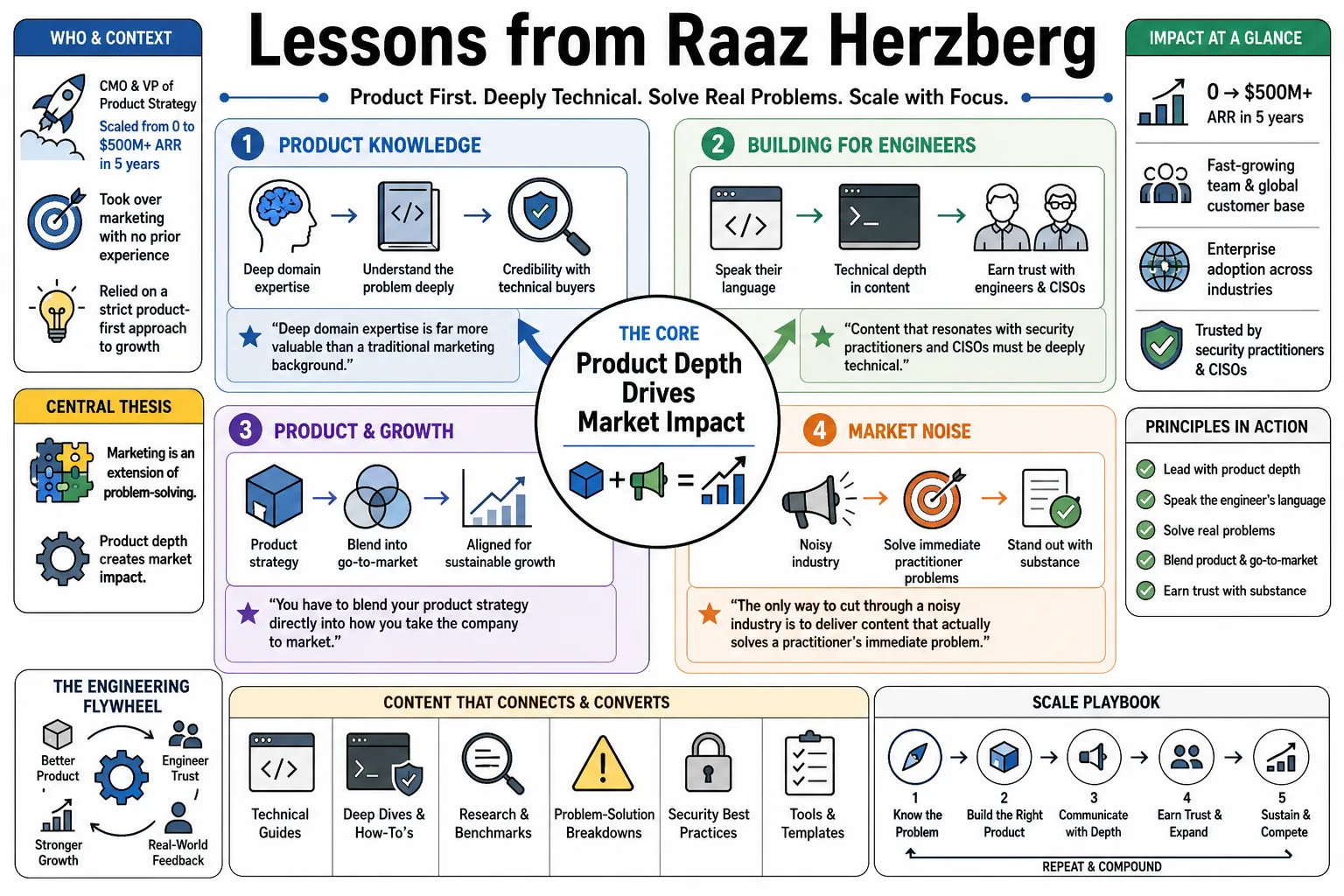
Lessons from Raaz Herzberg
Raaz Herzberg is the Chief Marketing Officer and VP of Product Strategy at Wiz, where she helped scale the company from zero to over $500 million in ARR in five years. She took over the marketing function with no prior experience in the field, relying instead on a strict product-first approach to growth. This post collects her advice on building technical products, handling rapid scale, and treating marketing as a straightforward extension of problem-solving.
Part 1: The Product-Centric Mindset
- On Product Knowledge: "Deep domain expertise is far more valuable than a traditional marketing background when trying to reach technical buyers." — Source: [SaaStr]
- On Building for Engineers: "Content that resonates with security practitioners and CISOs must be deeply technical because standard marketing fluff simply does not work." — Source: [Lenny's Podcast]
- On Product and Growth: "You have to blend your product strategy directly into how you take the company to market since they cannot be separate functions." — Source: [20VC]
- On Market Noise: "The only way to cut through a noisy industry is to deliver content that actually solves a practitioner's immediate problem." — Source: [SaaStr]
- On The Engineering Perspective: "Coming from an engineering background allows you to view market challenges as product problems waiting for a technical solution." — Source: [Lenny's Podcast]
- On Early Product Strategy: "In the beginning, your entire focus should be identifying the most acute pain point your ideal customer is actively trying to fix." — Source: [Wiz Blog]
- On Simplification: "Technical products often suffer from overcomplicated messaging. The goal is to make the complex easily approachable." — Source: [20VC]
- On Practitioner Trust: "Earning the trust of a CISO requires speaking their language natively, which is why technical product experience translates so well to marketing." — Source: [SaaStr]
- On Strategic Investment: "Security leaders invest heavily in tools that demonstrate immediate technical value rather than promises of future capability." — Source: [Wiz Blog]
Part 2: The Unconventional Marketing Transition
- On The Initial Request: "When asked to take over marketing, my initial reaction was, 'No. What are you talking about?'" — Source: [SaaStr]
- On Lack of Experience: "I did not know the first thing about marketing. When I took the role, I had never heard the term MQL." — Source: [SaaStr]
- On Traditional Playbooks: "Because I didn't know the traditional marketing playbook, I didn't feel constrained to follow it." — Source: [Lenny's Podcast]
- On Core Problems: "We simplified our early marketing strategy down to a single, glaring problem. Nobody had heard of Wiz." — Source: [SaaStr]
- On Learning Curves: "If you are willing to learn quickly, stepping into a function you know nothing about can be your biggest advantage." — Source: [20VC]
- On The Marketer Paradox: "Traditional marketers sometimes struggle in tech because they rely too heavily on inherited frameworks rather than understanding the specific product." — Source: [20VC]
- On Agency Dependence: "I had never worked with a PR agency before, which forced us to evaluate their actual utility from first principles." — Source: [SaaStr]
- On Avoiding Jargon: "Not knowing marketing terminology meant we communicated externally exactly how we communicated internally: like engineers." — Source: [Lenny's Podcast]
- On Rapid Adaptation: "You learn the mechanics of pipeline quickly when you treat pipeline generation like a software bug." — Source: [Index Ventures]
- On Founder Trust: "Transitioning roles successfully requires a CEO who is willing to bet on your capability to figure things out over your resume." — Source: [SaaStr]
Part 3: Hiring for Curiosity and Energy
- On The Excitement Test: "Unless you leave an interview very excited, thinking you wish this person was here right now, do not hire them." — Source: [SaaStr]
- On Patience in Recruiting: "If a candidate doesn't lift the energy in the room, pass. The right person will eventually come." — Source: [SaaStr]
- On The Defining Trait: "Only ten to fifteen percent of people have this trait of deep curiosity. You should try to hire exclusively from this group." — Source: [SaaStr]
- On Experience vs Mindset: "Hiring for curiosity and a growth mindset is significantly more valuable than hiring for years of specific experience." — Source: [20VC]
- On Adapting to Change: "In a fast-growing environment, the skills you hire for today will be obsolete tomorrow, making the ability to learn the only permanent requirement." — Source: [Lenny's Podcast]
- On Team Density: "A small team of highly curious people will consistently outperform a massive department of legacy thinkers." — Source: [Index Ventures]
- On Identifying Superstars: "Superstars are usually the ones asking the most fundamental, annoying questions about why things are done a certain way." — Source: [Lenny's Podcast]
- On Culture Fit: "Culture isn't about getting along. It is about sharing a common intensity and eagerness to solve hard problems." — Source: [SaaStr]
- On Interviewing: "During an interview, pay attention to whether the candidate is interviewing you back with genuinely insightful questions." — Source: [20VC]
Part 4: Navigating Hyper-Growth and Scaling
- On Speed of Execution: "Scaling from zero to $100M ARR in 18 months requires a willingness to break things and rapidly patch them." — Source: [Lenny's Podcast]
- On Resource Allocation: "Follow the heat. Wherever the organization is seeing unexpected traction, pour your resources there immediately." — Source: [20VC]
- On Focusing Efforts: "When you are growing quickly, the biggest risk is trying to do too many things passably well instead of one thing exceptionally well." — Source: [SaaStr]
- On Organizational Chaos: "Fast growth is inherently chaotic. Your job isn't to eliminate the chaos, but to direct it toward the customer." — Source: [Index Ventures]
- On Enterprise Sales: "Building a massive brand in enterprise requires sales and marketing to operate as a single unified organism." — Source: [20VC]
- On Scaling Pain Points: "Every time revenue triples, the company's internal processes break. You have to be comfortable rewriting the rules constantly." — Source: [Lenny's Podcast]
- On First Principles: "When standard operating procedures fail under the weight of scale, you have to revert to first principles thinking to find the fix." — Source: [SaaStr]
- On Momentum: "Momentum solves most internal problems. Keep the growth rate high, and people will tolerate the friction." — Source: [20VC]
- On Global Expansion: "Expanding into new regions like Canada or Australia forces you to localize your problem-solving, not just your product." — Source: [Wiz Blog]
- On Long-Term Vision: "Even while sprinting to hit quarterly targets, you have to plant seeds for the market realities that are two years away." — Source: [Lenny's Podcast]
Part 5: Rethinking Brand and Metrics
- On Granular Attribution: "We avoided complex vanity metrics in favor of solving the obvious pain point of increasing market awareness." — Source: [SaaStr]
- On Measuring Success: "When measuring brand success, prioritize high quarterly improvements over traditional, granular attribution models." — Source: [Index Ventures]
- On Industry Clichés: "We specifically avoided the traditional black and red color schemes and fear-based tactics that dominate cybersecurity marketing." — Source: [SaaStr]
- On Brand Voice: "Make the brand approachable. Security marketing can actually be fun without losing its technical credibility." — Source: [Lenny's Podcast]
- On Brand Awareness: "If your core problem is that nobody knows you exist, every single campaign should be optimized purely for visibility." — Source: [SaaStr]
- On Meaningful Metrics: "Focus on the indicators that show actual market penetration, not just the ones that make the marketing department look busy." — Source: [20VC]
- On Fear Marketing: "Selling through fear creates short-term spikes but damages long-term trust. Sell through clarity instead." — Source: [SaaStr]
- On Visual Identity: "A distinct visual identity in a crowded B2B space is a strategic moat, not just a design choice." — Source: [Index Ventures]
- On Word of Mouth: "The ultimate marketing metric is whether technical practitioners are actively recommending your tool to their peers in private Slack groups." — Source: [Lenny's Podcast]
Part 6: Customer Obsession and Market Fit
- On Early Hustle: "In the early days, our team conducted ten to fifteen customer calls daily to refine our product-market fit." — Source: [Index Ventures]
- On Direct Interaction: "There is absolutely no substitute for direct, constant interaction with the people actually using your software." — Source: [SaaStr]
- On Pivoting: "We realized early on that our initial idea wasn't working, and successfully pivoting required us to swallow our pride and listen to the users." — Source: [Lenny's Podcast]
- On Identifying Demand: "Customers will tell you exactly what to build if you ask them the right questions and actually pay attention to the answers." — Source: [20VC]
- On Validating Ideas: "Never assume you know the market's pain points better than the market does. Validate everything through constant dialogue." — Source: [Lenny's Podcast]
- On Economic Shifts: "Adapting to endure a shifting economic environment means understanding exactly where your customers plan to cut budgets and where they will still invest." — Source: [Wiz Blog]
- On Fast Iteration: "The speed at which you incorporate customer feedback into the product is the most accurate predictor of your eventual market share." — Source: [Index Ventures]
- On Listening: "Many companies talk to customers. Very few actually listen well enough to abandon their own preconceived roadmaps." — Source: [20VC]
- On User Empathy: "To build a tool a CISO loves, you have to intimately understand what is waking them up in the middle of the night." — Source: [SaaStr]
- On Building Trust: "When you fix a bug a customer reported within 24 hours, you earn a champion for life." — Source: [Lenny's Podcast]
Part 7: Artificial Intelligence as an Amplifier
- On Replacing Roles: "Every time someone left, broadly speaking, we replaced them with AI." — Source: [SaaStr]
- On Amplifying Talent: "Amazing people are just now 100 times more amazing and 100 times more effective. But I still need the amazing people." — Source: [SaaStr]
- On True AI Integration: "Showing up with a recipe you got on ChatGPT doesn't count as being AI native." — Source: [SaaStr]
- On AI in the Enterprise: "Custom AI tools will become the defining factor for enterprises, completely changing how they operate and grow." — Source: [20VC]
- On Small Teams: "AI allows small, high-performing teams to achieve massive impact without accumulating traditional corporate bloat." — Source: [Index Ventures]
- On Threat Readiness: "Security teams must develop a specific framework for AI threat readiness before deploying new models across the enterprise." — Source: [Wiz Blog]
- On Execution Speed: "With AI handling the baseline execution, your team's primary differentiator becomes taste and strategic judgment." — Source: [SaaStr]
- On Tool Adoption: "Do not adopt AI just to cut costs. Adopt it to remove the friction that slows your best people down." — Source: [Lenny's Podcast]
- On Future Growth: "The companies that win the next decade will be the ones who figure out how to weave AI into their daily workflows, not just their product pitches." — Source: [20VC]
Part 8: Leadership and Cross-Functional Alignment
- On Breaking Silos: "We moved field marketing directly under sales leadership to ensure that organizational alignment took precedence over traditional reporting charts." — Source: [SaaStr]
- On Vulnerability: "One of the most important leadership skills is the willingness to speak up and admit when you simply do not understand something." — Source: [Lenny's Podcast]
- On Removing Friction: "Leadership is mostly about finding the organizational friction that is slowing down your top performers and ruthlessly eliminating it." — Source: [20VC]
- On Goal Alignment: "Marketing and sales cannot have different definitions of success. If revenue isn't growing, both departments are failing." — Source: [Index Ventures]
- On Decision Making: "When you do not know what to do, follow the heat in the organization and let momentum guide the decision." — Source: [Lenny's Podcast]
- On Cross-Functional Empathy: "Because I came from product, I knew exactly what engineering needed from marketing, which naturally bridged the gap between the two sides." — Source: [SaaStr]
- On Ego in Leadership: "Fast growth requires leaders who care more about solving the customer's problem than defending their departmental territory." — Source: [20VC]
- On Managing Failures: "You have to be open about your biggest failures. Analyzing what went wrong is the only way the organization learns to avoid repeating the mistake." — Source: [Lenny's Podcast]
- On Organizational Design: "Never let an archaic org chart dictate how you serve the market. Reorganize as often as necessary to stay aligned with the customer." — Source: [SaaStr]