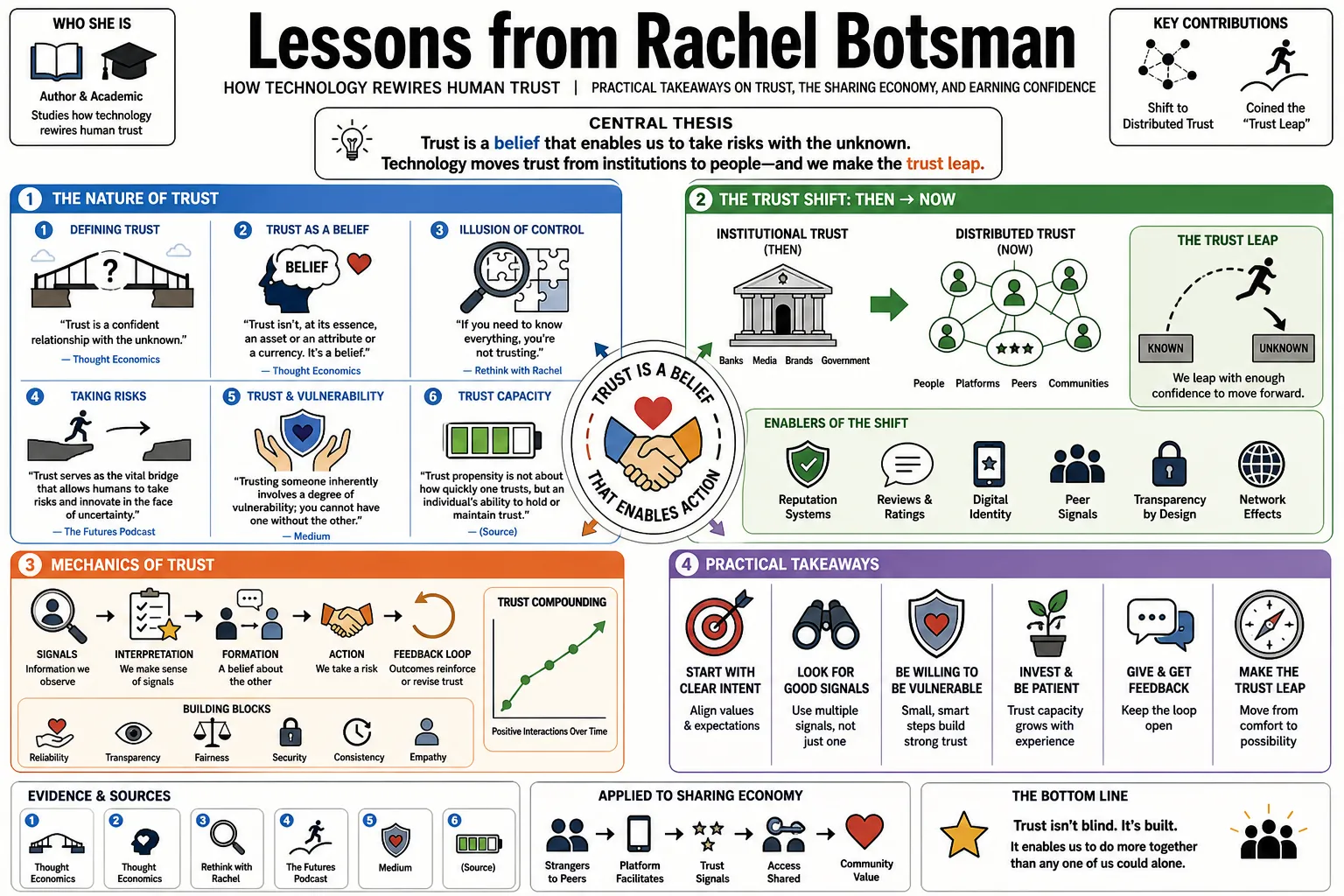
Lessons from Rachel Botsman
Author and academic Rachel Botsman studies how technology rewires human trust. She documented the shift from institutional to "distributed trust" and coined the concept of the "trust leap." This profile gathers her practical takeaways on the sharing economy, the mechanics of trust, and earning confidence as technology evolves.
Part 1: The Nature of Trust
- On Defining Trust: "Trust is a confident relationship with the unknown." — Source: Thought Economics
- On Trust as a Belief: "Trust isn't, at its essence, an asset or an attribute or a currency. It's a belief." — Source: Thought Economics
- On the Illusion of Control: "If you need to know everything, you're not trusting." — Source: Rethink with Rachel
- On Taking Risks: "Trust serves as the vital bridge that allows humans to take risks and innovate in the face of uncertainty." — Source: The Futures Podcast
- On Trust and Vulnerability: "Trusting someone inherently involves a degree of vulnerability; you cannot have one without the other." — Source: Medium
- On Trust Capacity: "Trust propensity is not about how quickly one trusts, but an individual's ability to hold or maintain trust within relationships." — Source: Rethink with Rachel
- On Continuous Assessment: "Trust is not a static state; it is a dynamic, continuous process of evaluation." — Source: CPA Australia
- On the Components of Trust: "Trustworthiness is determined by a combination of a person's character, such as empathy and integrity, and capability, meaning competence and reliability." — Source: Medium
- On the Transferability of Trust: "I don't think trust just disappears. It's kind of like energy, it just transfers." — Source: Strategies for Influence
- On Trust and Progress: "Trust is an essential, yet frequently overlooked, component of innovation and societal progress." — Source: The Futures Podcast
Part 2: The Trust Leap
- On Trust Leaps: "A trust leap is when we take a risk to do something new or to do it differently from the way that we've done something before." — Source: Strategies for Influence
- On Overcoming Fear: "Trust leaps carry us over the chasm of fear, that gap between us and the unknown." — Source: Goodreads
- On Asking for Change: "Anytime we ask someone to do something new or do something differently, we're asking them to make a trust leap." — Source: Nordic Business Forum
- On Achieving Breakthroughs: "Every breakthrough depends on what I call a trust leap: the decision to embrace a new way of working, creating, or connecting." — Source: Leading Authorities
- On the Success of Innovation: "Why do some innovations fail while others succeed? The difference is rarely the technology; it's whether people trust it enough to make the leap." — Source: London Speaker Bureau
- On Human Progress: "Without the willingness to take a trust leap, society would remain stagnant and unable to adopt necessary advancements." — Source: Medium
- On Confronting the Unknown: "The size of a trust leap depends entirely on how much unknown is involved in the new action or idea." — Source: Rethink with Rachel
- On Adopting New Technologies: "Getting people to use a new app or service is less about the user interface and more about guiding them through a trust leap." — Source: TED
- On Early Adopters: "Those who take trust leaps first are often the bridge that helps normalize the unknown for the rest of society." — Source: TED
Part 3: Collaborative Consumption
- On Shifting Away from Consumerism: "The system of consumerism may seem like an immovable fact of modern life. But it is not. We can reshape those forces to create a healthier, more sustainable system." — Source: Goodreads
- On the Definition of Collaborative Consumption: "Traditional sharing, bartering, lending, trading, renting, gifting, and swapping redefined through technology and peer communities." — Source: Strategies for Influence
- On the Danger of Hyper-Consumption: "The things you own end up owning you." — Source: Strategies for Influence
- On the Currency of Interactions: "Money is the currency of transactions. Trust is the currency of interactions." — Source: Medium
- On the Value of Reputation: "Reputation is becoming a currency that will be more powerful than our credit histories in the 21st Century." — Source: Five Minute Marketing
- On the New Economy: "The currency of the new economy is trust between strangers." — Source: John J Sills
- On the 21st Century Shift: "The 20th century was about hyper-consumption, but the 21st century will be defined by collaborative consumption." — Source: Fast Company
- On Sharing Access vs. Ownership: "Collaborative consumption shifts the focus from owning an asset to merely having access to it when needed." — Source: TED
- On Manipulative Market Forces: "The buy now, pay later culture and the law of life cycles have artificially fed our hyper-consumption habits." — Source: Strategies for Influence
Part 4: Distributed Trust
- On the Decline of Institutional Trust: Botsman argues that trust has not disappeared; it has shifted from institutional trust to distributed trust, changing where people place confidence and authority. — Reference: TIME interview on trust shifting from institutions to distributed networks
- On the Rise of Distributed Trust: "Trust is no longer flowing top-down; it is being distributed horizontally among peers and strangers." — Source: Innovatrics
- On Trusting Strangers: "Platforms like Airbnb succeed because they have effectively designed systems that allow us to trust complete strangers." — Source: TED
- On the Role of Networks: "In a distributed trust system, the network itself becomes the validator and the guarantor of safety." — Source: FUTURES Podcast
- On the Impact of Blockchain: "Blockchain technology is the ultimate expression of distributed trust, removing the need for a central authority to verify transactions." — Source: FUTURES Podcast
- On the Speed of Trust Transfer: "In distributed networks, trust can be established, scaled, and destroyed at unprecedented speeds." — Source: TED
- On Accountability in Networks: "Distributed trust requires reliable reputation systems to hold bad actors accountable without a central referee." — Source: TED
- On the Illusion of Institutional Safety: "The public's loss of faith in institutions often stems from repeated opacity and failures in accountability." — Source: Rethink with Rachel
- On the Architectural Shift: "We are moving from a trust architecture designed like a ladder to one that resembles a web." — Source: Rachel Botsman Official Site
Part 5: Technology and Trust
- On the Tension Between Efficiency and Trust: "Efficiency of technology is the enemy of trust." — Source: Center for Humane Technology
- On the Responsibility of Tech Leaders: "Tech leaders must consider the cultural and ethical implications of their products, not just their technical capabilities." — Source: Innovatrics
- On the Limits of Algorithms: "Algorithms can process vast amounts of data, but they cannot replicate the nuance of human intuition in assessing trustworthiness." — Source: Rethink with Rachel
- On AI and Human Interaction: Her AI framing is contextual: people may trust a system for input or information before trusting it with health, money, or other decisions, which keeps human judgment central. — Reference: TIME interview on contextual trust in AI
- On the Danger of Frictionless Tech: "When technology removes all friction, it also removes the necessary pause where we actively decide to give our trust." — Source: Center for Humane Technology
- On Repairing Digital Trust: "When tech platforms break user trust, restoring it requires fundamental shifts in behavior, not just software updates." — Source: Rethink with Rachel
- On Automation vs. Trust: "Automating a process does not automatically earn the user's trust in the outcome of that process." — Source: World Economic Forum
- On Transparency and Tech: Botsman warns that transparency is often mistaken for trust: showing every process can reduce the need for trust, but it does not by itself create confidence in the unknown. — Reference: TIME interview on transparency reducing the need for trust
- On Technology as a Facilitator: "Technology is merely the enabler; the underlying human willingness to connect is what makes the sharing economy function." — Source: TED
- On the Future of Digital Identity: "How we verify and protect digital identities will be the foundational layer of trust in the next era of the internet." — Source: FUTURES Podcast
Part 6: Trust in Leadership
- On Power Dynamics: "Top-down, power-over leadership structures inherently struggle to foster genuine trust compared to power-with approaches." — Source: Washington Speakers Bureau
- On the Role of Humility: "Humility is a secret accelerator for trust; admitting you do not know or were wrong demonstrates honesty." — Source: Nordic Business Forum
- On Leading Through Change: "Trust is actually the key component not just for companies but any organization that wants human beings to try new things." — Source: Medium
- On Breaking People for Progress: "Leaders must stop breaking people's trust and psychological safety in the name of aggressive progress and change." — Source: The Change Signal
- On Transparency in Leadership: For leaders and institutions, Botsman connects restored trust to behavior: people look for capability and character, not just more disclosure. — Reference: TIME interview on capability and character
- On Workplace Culture: "In hybrid workplaces, maintaining trust requires intentional effort to replace the casual, in-person interactions that naturally foster it." — Source: Culture First Podcast
- On the Impact of Scandals: "When public figures or organizations face scandals, it is usually their character, rather than their competence, that fundamentally breaks the public's trust." — Source: Trust Issues Podcast
- On Micro-Moments: "Leadership trust is not built through grand corporate gestures, but through the micro-moments of daily behavior." — Source: CPA Australia
- On Organizational Innovation: "Companies that lack internal trust will inevitably fail to innovate, as employees will be too afraid to take the necessary trust leaps." — Source: Medium
Part 7: Earning Trust
- On the Flaw of Building Trust: "Trust can't be built. It's up to others, friends, customers, employees, the public, your family, to decide whether or not to give it to you." — Source: Holly Ransom
- On Continuous Effort: "Rather than building trust, leaders have to think about continuously earning trust, and the only way to do that is through behaviour." — Source: CPA Australia
- On Personal Agency: "We all have the power to be trustworthy, but we're still dependent on others to give their trust." — Source: Relationship Experts Online
- On Marketing vs. Behavior: "Trust is earned through authentic interactions and consistent behavior, not through slick marketing campaigns or communications strategies." — Source: CPA Australia
- On Assessing Trustworthiness: "People constantly assess whether you are worthy of their trust based on small, often unconscious, observations of your reliability." — Source: Medium
- On the Gift of Trust: "We should reframe our mindset to view trust as a gift that must be continuously earned and respected, rather than a commodity to be acquired." — Source: Substack
- On Repairing Broken Trust: "When trust is lost, you cannot simply rebuild it; you must begin the difficult work of proving you have changed your behavior to earn it back." — Source: Rachel Botsman Official Site
- On the Role of Empathy: "Demonstrating genuine empathy for others' fears and uncertainties is a primary method for earning their trust." — Source: Medium
- On the Danger of Entitlement: "Organizations that act as though they are entitled to consumer trust are usually the fastest to lose it." — Source: Thought Economics
- On Trusting the Process: "Earning trust requires patience and a willingness to consistently show up, even when the immediate outcome is not guaranteed." — Source: Culture First Podcast
Part 8: The Future of Trust
- On Navigating Uncertainty: "Our ability to handle future societal challenges will depend directly on our collective capacity to navigate uncertainty with trust." — Source: Trust Issues Podcast
- On the Trust Crisis: She reframes the trust crisis as a placement problem: the key question is not whether people trust, but where they are placing their trust. — Reference: TIME interview on trust as redirection rather than disappearance
- On Smart Trust Decisions: "To navigate the modern world, we must learn to make smarter, more discerning decisions about who and what we choose to trust." — Source: Revisionist History
- On Challenging Assumptions: "We must constantly question our default assumptions about trust, particularly when interacting with new, unregulated digital platforms." — Source: TED
- On the Value of Friction: "In the future, we may need to intentionally design friction back into our systems to force users to pause and evaluate trustworthiness." — Source: Center for Humane Technology
- On the Evolution of Human Connection: Botsman is hopeful that AI will force a clearer discussion of human connection, because humanness may become a differentiator as technology mediates more work. — Reference: TIME interview on AI and human connection
- On Trusting the Wrong People: In the ReThinking conversation, Botsman and Adam Grant examine why people trust the wrong people and why trust judgments need context, not blanket confidence. — Reference: ReThinking transcript on contextual trust judgments
- On the Role of the Individual: "The future of trust relies on each individual taking responsibility for their own trustworthiness and their decisions to trust others." — Source: Relationship Experts Online
- On the Enduring Nature of Trust: "Despite technological upheaval, the fundamental human need to trust and be trusted remains the cornerstone of society." — Source: Thought Economics