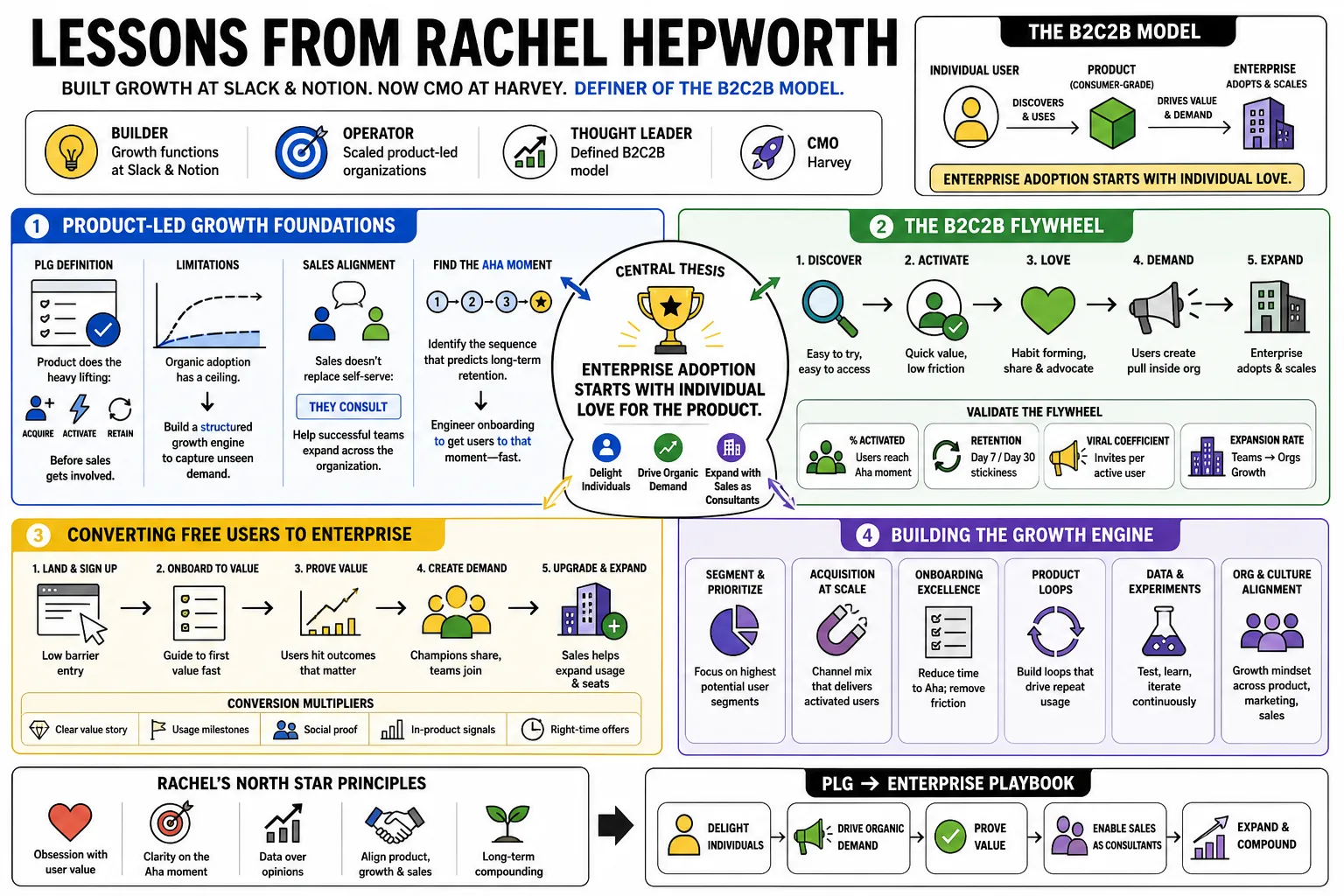
Lessons from Rachel Hepworth
Rachel Hepworth built the growth marketing functions at Slack and Notion before becoming CMO at Harvey. She defined the B2C2B model, where enterprise software adoption depends on consumer-grade design and individual user activation. This profile details her approach to scaling product-led growth and converting free users into enterprise accounts.
Part 1: Product-Led Growth
- On defining PLG: "Product-led growth means the product itself does the heavy lifting of acquiring, activating, and retaining customers before sales ever gets involved." — Source: First Round Review
- On the limitations of product-led growth: "You can only grow so far on organic adoption alone. Eventually, you have to build a structured growth engine to capture the demand you didn't even know existed." — Source: Decibel VC
- On sales and PLG alignment: "In a successful PLG model, sales doesn't replace self-serve; they act as a consultant to help successful teams expand their usage across the organization." — Source: Inside Intercom
- On finding the Aha moment: "You have to know exactly what sequence of actions correlates with long-term retention, and engineer your entire onboarding flow to get users there faster." — Source: SaaS Half Full
- On friction in onboarding: "Some friction is actually good. If you force a user to invite a teammate during onboarding, activation might drop slightly, but the overall network effect and retention will increase." — Source: First Round Review
- On enterprise expansion: "The easiest way to sell enterprise software is to find a company where a hundred people are already using your product on their personal credit cards." — Source: SaaStr
- On free plans: "A free tier is an acquisition cost. It replaces a portion of your paid advertising budget by letting people experience the value firsthand." — Source: First Round Review
- On product marketing in PLG: "Product marketing should not just explain what the product does, but help build loops within the product that encourage sharing and collaboration." — Source: Notion Blog
- On the ceiling of self-serve: "Self-serve revenue will eventually plateau. To maintain a high growth rate, marketing has to figure out how to pass high-intent signals to a sales team." — Source: Decibel VC
- On engineering as marketing: "Sometimes the best marketing investment is putting a growth engineer on the task of optimizing a referral loop inside the application." — Source: First Round Review
Part 2: The B2C2B Motion
- On consumer-grade expectations: "Workers today expect their business software to be as intuitive and beautifully designed as the apps they use in their personal lives." — Source: SaaS Half Full
- On bottom-up adoption: "You aren't selling to a procurement officer initially. You are selling to a frustrated employee who just wants a better way to organize their projects." — Source: Inside Intercom
- On brand design: "If your B2B brand looks like a traditional enterprise company, you lose the individual user. You have to look like a tool they actually want to spend time in." — Source: Future London Academy
- On personal use cases: "Encouraging personal use cases, like someone planning their wedding in your tool, is a strategic move to build deep habit and loyalty that eventually transfers to their workplace." — Source: First Round Review
- On avoiding corporate speak: "Speak to people like people. B2B marketing often relies on jargon, but the end user responds to clear, direct, and human language." — Source: SaaStr
- On multi-player mode: "The real magic happens when a single user realizes the product gets exponentially better the moment they invite a colleague." — Source: Notion Blog
- On shadow IT: "What IT calls shadow IT, growth marketers call product-market fit. The goal is to make the product so indispensable that IT has to formalize it." — Source: Inside Intercom
- On template galleries: "Templates reduce the time to value. They let a new user instantly apply the tool to their specific job function without staring at a blank screen." — Source: Decibel VC
- On horizontal products: "When your product can be used for almost anything, your marketing challenge is to show people exactly one thing they can use it for today." — Source: First Round Review
- On bridging to enterprise: "The transition from bottom-up usage to an enterprise contract requires translating the love of the end user into ROI metrics for the executive buyer." — Source: SaaS Half Full
Part 3: Instrumentation and Analytics
- On measuring what matters: "Don't measure everything just because you can. Find the three or four metrics that actually indicate a user is forming a habit." — Source: First Round Review
- On vanity metrics: "Raw signups can be dangerous if they are empty. If someone signs up and never takes a core action, you haven't acquired a user; you've just rented their email address temporarily." — Source: GetVero
- On team activation: "In a collaborative tool, a workspace isn't active until at least two people are communicating or working together within a specific timeframe." — Source: Decibel VC
- On the limits of attribution: "Not everything can be measured cleanly. If you demand perfect attribution for every channel, you will underinvest in brand and word-of-mouth." — Source: SaaS Half Full
- On qualitative data: "You cannot understand why users drop off just by looking at a dashboard. You have to read support tickets and talk to the people who abandoned the product." — Source: First Round Review
- On forecasting: "Build a model based on your historical conversion rates, but leave room for the unpredictable impact of product launches and market shifts." — Source: Inside Intercom
- On data infrastructure: "Invest in data engineering early. If your growth team cannot run queries or build dashboards independently, their speed of execution will grind to a halt." — Source: SaaStr
- On rapid experimentation: "A growth engine relies on velocity. If you can test three different onboarding sequences in a month instead of one, you will compound your learnings much faster." — Source: First Round Review
- On identifying churn risks: "The leading indicator of churn isn't a canceled subscription; it's a gradual decline in daily active usage among the core team members." — Source: Decibel VC
Part 4: Building Marketing Teams
- On hiring for growth: "Look for marketers who are highly analytical and comfortable living in spreadsheets, but who also possess a strong intuition for user experience." — Source: First Round Review
- On team structure: "Marketing cannot operate in a silo. Growth marketers must sit directly alongside product managers and engineers to actually affect the customer journey." — Source: SaaS Half Full
- On early hires: "Your first marketing hire should be a generalist who can write well and figure out distribution. Specialists come later when you have a predictable channel to scale." — Source: SaaStr
- On product marketing: "Product marketing is the translation layer between what the engineers build and what the market actually cares about." — Source: Inside Intercom
- On managing creatives: "Give your creative team tight constraints and clear business objectives, but never dictate exactly how a campaign should look." — Source: Future London Academy
- On cross-functional trust: "The relationship between the CMO and the Head of Product determines the success of a PLG company. If they are misaligned, the user experience will fracture." — Source: Decibel VC
- On scaling functions: "You have to re-evaluate your team structure every time the company doubles in size. The organizational chart that got you to ten million will break at fifty million." — Source: First Round Review
- On hiring specialists: "Only hire a dedicated specialist for a channel like paid search or SEO once you have proven that the channel actually works for your business model." — Source: SaaS Half Full
- On fostering ownership: "Give individuals on the marketing team responsibility for a specific metric, not just a list of tasks. Let them figure out how to move that number." — Source: First Round Review
Part 5: Community and Word-of-Mouth
- On organic growth: "Word-of-mouth is the most powerful acquisition channel, but it isn't magic. You can engineer it by building features that are inherently shareable." — Source: Decibel VC
- On user communities: "A healthy community cannot be tightly controlled by the brand. You have to provide the platform and step back so users can connect with each other authentically." — Source: Notion Blog
- On empowering champions: "Identify your most passionate users and give them early access, swag, and direct lines to your product team. They will become your best salespeople." — Source: First Round Review
- On user-generated content: "When users build and share their own templates or workflows, it provides infinitely more credibility than a piece of corporate content." — Source: SaaS Half Full
- On managing feedback: "Listen closely to your community, but remember that the loudest voices do not always represent the needs of your broader user base." — Source: Inside Intercom
- On regional communities: "Global expansion often happens organically through local community organizers. Support them with resources, but let them adapt the message to their culture." — Source: Future London Academy
- On the flywheel effect: "A strong community creates a flywheel: more users create more templates, which attract new users, who in turn join the community and create even more resources." — Source: SaaStr
- On brand affection: "You want users to feel an emotional attachment to the product. If they are proud of the work they do in your tool, they will naturally tell their peers." — Source: First Round Review
- On scaling support: "As community grows, rely on power users to answer basic questions in forums. This scales better than hiring a massive support team and builds a sense of belonging." — Source: Decibel VC
Part 6: Marketing Leadership and Strategy
- On the role of the CMO: "A modern CMO has to balance the analytical rigor of a revenue leader with the creative intuition of a brand builder." — Source: First Round Review
- On goal setting: "Set aggressive but mathematically sound targets. If the team does not understand the formula behind their quarterly goals, they will feel set up to fail." — Source: SaaStr
- On managing budgets: "Keep a portion of your marketing budget strictly for unproven experiments. If you only invest in optimized channels, you will eventually tap them out." — Source: Decibel VC
- On navigating hypergrowth: "In hypergrowth, your primary job is often just maintaining focus. It is easy to chase shiny objects when you have capital, but you must stick to your core engine." — Source: Inside Intercom
- On brand vs. performance: "Performance marketing harvests demand, but brand marketing creates it. If you underfund brand, your acquisition costs will inevitably rise over time." — Source: First Round Review
- On board meetings: "When presenting marketing to a board of directors, lead with revenue impact and customer acquisition costs before showing them the new advertising creative." — Source: SaaS Half Full
- On market positioning: "Positioning is not about what your product does; it is about who it is for and what problem it solves better than any other alternative." — Source: SaaStr
- On failing fast: "Create a culture where a failed marketing campaign is celebrated for the data it generated, as long as the failure was recognized and shut down quickly." — Source: Decibel VC
- On maintaining simplicity: "As a company grows, the messaging naturally tends to become complicated. The marketing leader's job is to constantly edit and simplify the narrative." — Source: First Round Review
Part 7: Customer Journey and Activation
- On the first five minutes: "The first five minutes of a user's experience will dictate their likelihood to retain. You have to deliver value before they lose patience." — Source: Inside Intercom
- On mapping the funnel: "Break down the user journey into micro-steps. If you only look at the gap between signup and purchase, you will miss the specific screen where most users abandon the process." — Source: First Round Review
- On email lifecycle: "Lifecycle emails should trigger based on user behavior, not a generic timeline. Sending an advanced tutorial to someone who hasn't logged in for a week is a waste." — Source: GetVero
- On simplifying choices: "When a user logs in for the first time, do not give them twenty options. Give them one clear, high-value action to complete." — Source: Decibel VC
- On reactivation: "It is often cheaper to win back a lapsed user than to acquire a new one. Trigger reactivation campaigns when you launch a major new feature." — Source: SaaS Half Full
- On educating the market: "Sometimes your biggest competitor is not another software company, but the way people have always worked. You have to educate them on a new paradigm." — Source: First Round Review
- On user psychology: "Understand the emotional state of the user. Are they stressed, rushed, or curious? Design your activation flow to match their state of mind." — Source: Future London Academy
- On identifying power users: "Power users naturally hack your product to do things it wasn't designed for. Watch them closely, because they are showing you your next product roadmap." — Source: SaaStr
- On in-app messaging: "In-app messages should be contextual and helpful, not intrusive. Only interrupt a user's workflow if the message helps them accomplish their immediate task faster." — Source: First Round Review
- On upgrading teams: "The trigger to ask a team to upgrade to a paid tier should occur exactly when they hit the limits of the free tier while trying to do something highly valuable." — Source: Decibel VC
Part 8: The Future of SaaS Marketing
- On artificial intelligence: "AI features must be integrated naturally into the user's existing workflow. If they have to leave their document to prompt an AI, the friction is too high." — Source: First Round Review
- On category creation: "Creating a new category requires immense marketing capital and patience. Often, it is smarter to redefine an existing category around your specific strengths." — Source: Inside Intercom
- On changing acquisition costs: "The era of cheap digital acquisition is over. B2B companies must invest heavily in organic brand and product-led loops to maintain efficient growth." — Source: SaaS Half Full
- On shifting team skillsets: "The marketers of the future will need to be part data scientist and part behavioral psychologist. The pure tacticians will be automated." — Source: SaaStr
- On the role of design: "Design is no longer a nice-to-have in B2B software; it is a primary competitive advantage. Users will abandon a functional tool if a more beautiful alternative exists." — Source: Future London Academy
- On adapting to scale: "The playbook you used to hit ten million in revenue will not get you to one hundred million. You must constantly unlearn your own past success." — Source: Decibel VC
- On global markets: "You cannot just translate your website and expect to win in Europe or Asia. You must understand the local nuances of how teams communicate and work." — Source: First Round Review
- On sales and marketing convergence: "The line between sales and marketing is blurring. Growth teams are now responsible for revenue, and sales teams are relying on product data to close deals." — Source: Inside Intercom
- On enduring brands: "The most successful software companies are not just utilities; they are movements. If you can align your product with a shift in how people want to work, your growth is limitless." — Source: First Round Review