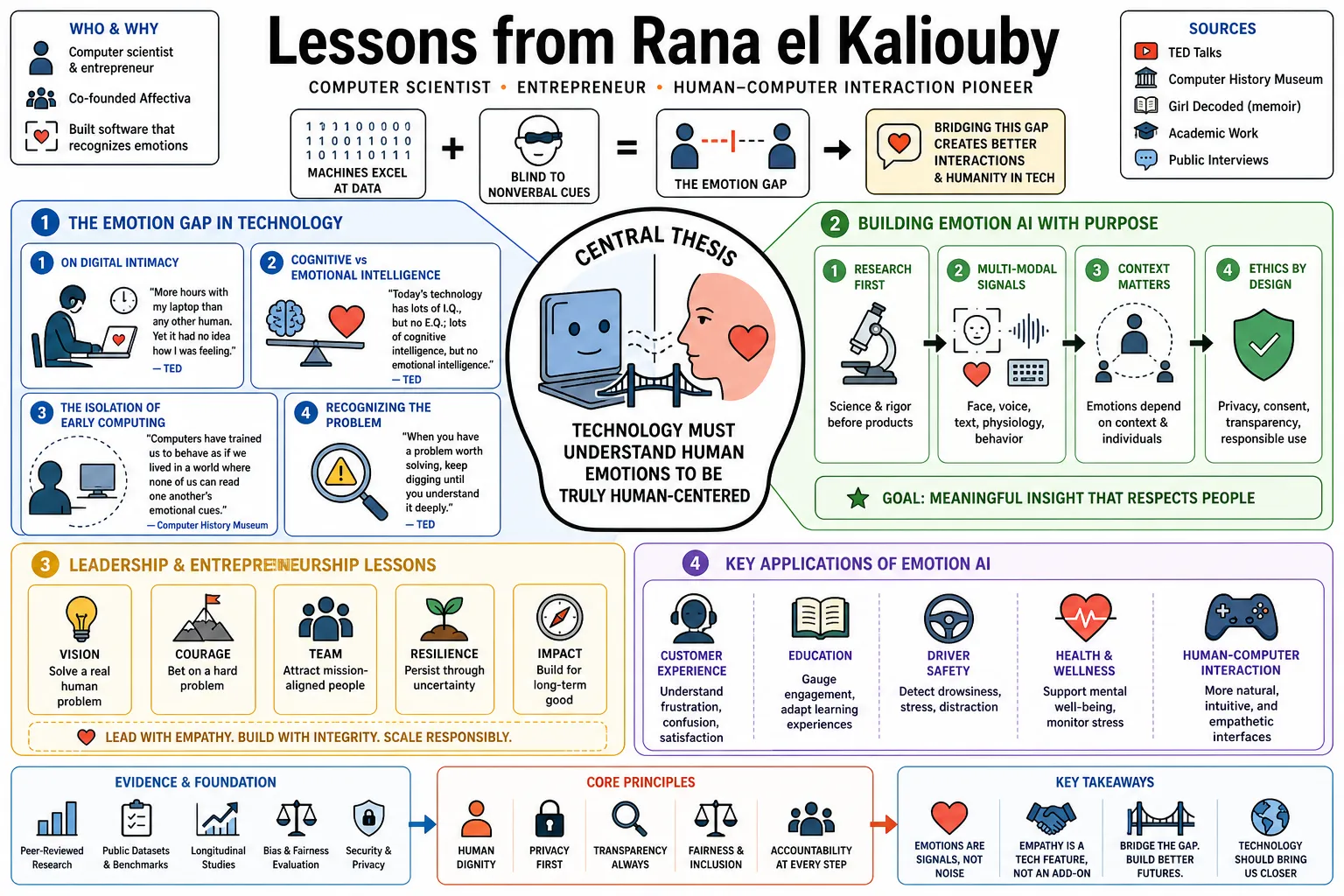
Lessons from Rana el Kaliouby
Computer scientist and entrepreneur Rana el Kaliouby co-founded Affectiva to build software that recognizes human emotions. She argued that while machines easily process data, their blindness to nonverbal cues creates a gap in how we interact with devices and each other. Drawing from her memoir Girl Decoded, academic work, and public interviews, this compilation covers her work in human-computer interaction and her practical approach to building ethical software and leading a company.
Part 1: The Emotion Gap in Technology
- On digital intimacy: "I realized I was spending more hours with my laptop than I did with any other human. Yet despite this intimacy, my laptop had absolutely no idea how I was feeling." — Source: TED
- On cognitive vs emotional intelligence: "Today's technology has lots of I.Q., but no E.Q.; lots of cognitive intelligence, but no emotional intelligence." — Source: TED
- On the isolation of early computing: "When it comes to the digital world, our computers have trained us to behave as if we lived in a world where none of us can read one another's emotional cues." — Source: Computer History Museum
- On recognizing the problem: "When you have a hearing problem, you put on a hearing aid. But there was no equivalent of a hearing aid for social and emotional communication." — Source: Medium
- On nonverbal communication: "Roughly 93 percent of human communication is nonverbal, yet we have built communication platforms that strip all of this away." — Source: Lex Fridman Podcast
- On our digital environments: "We've evolved to live in a world with complex social cues, but instead, we're living more and more of our lives in a world that's devoid of emotion." — Source: TED
- On missing context: Text-based communication leaves out the inflection of a voice and the hesitation in a face, forcing humans to act more like machines. — Source: Girl Decoded
- On the founding spark: The initial motivation for developing Emotion AI came from a profound sense of homesickness and the inadequacy of early video calls to bridge the distance to her family in Egypt. — Source: Girl Decoded
- On what devices lack: A device that knows your heart rate but ignores your frustration only possesses half the data needed to understand your current state. — Source: Girl Decoded
- On the goal of Emotion AI: "I am on a mission to bring emotions back into our digital experiences." — Source: TED
Part 2: Emotion AI and Human Connection
- On empathetic technology: "What if our technology could sense our emotions and react accordingly, just the way an emotionally intelligent friend would?" — Source: TED
- On quantifying feelings: "It blows me away that we can now quantify something as personal as our emotions and that we can do it at scale." — Source: TED
- On reclaiming humanity: "By humanizing technology, we have this golden opportunity to reimagine how we connect with machines, and therefore, how we connect with one another." — Source: Affectiva
- On automotive safety: Vehicles that can detect a driver's cognitive load and drowsiness can actively intervene to prevent accidents. — Source: Chris Colbert Interview
- On improving ourselves: "Emotionally-enabled technology can actually help each of us become more emotionally intelligent" by making us aware of our own behavioral patterns. — Source: Chris Colbert Interview
- On mental health applications: AI tools that recognize early markers of depression or anxiety through vocal biomarkers and facial expressions can prompt timely clinical interventions. — Source: Lex Fridman Podcast
- On education technology: Learning environments equipped with emotion recognition can adapt to a student's frustration or boredom in real time, changing the pace of instruction. — Source: Lex Fridman Podcast
- On human amplification: The purpose of this technology is to amplify human capabilities, not to replace the human element of interaction in healthcare or education. — Source: Fast Company
- On everyday interactions: A smart device shouldn't just know the weather forecast; it should recognize if you're too stressed to care about the weather right now. — Source: Masters of Scale
- On the fundamental mission: The ultimate goal is not a world of highly efficient machines, but a world where machines help make human interactions more compassionate. — Source: Girl Decoded
Part 3: The Ethics of Artificial Intelligence
- On the real threat: "The real problem is not the existential threat of AI. Instead, it is in the development of ethical AI systems." — Source: Goodreads
- On unintentional harm: "I am concerned that unfortunately and unintentionally we all may be building biases into these algorithms and then deploying them at scale." — Source: Chautauqua Institution
- On the diversity deficit: "If you just have middle-aged white guys developing models and looking at their accuracy, it's not going to be enough to overcome blind spots." — Source: Stern Strategy
- On neutrality: "Any technology in human history is neutral. It's how we decide to use it." — Source: Should This Exist
- On user agency: "We all have a responsibility because we get to vote with our wallet which AI tools we're using every day." — Source: Fast Company
- On data representation: To build systems that work for everyone, training data must explicitly account for diverse ages, ethnicities, and cultural expressions, including individuals wearing hijabs or facial coverings. — Source: Chautauqua Institution
- On the Terminator narrative: "It’s not that the robots are going to take over the universe. It is that we are just building bias into these systems with really dire consequences." — Source: Science Focus
- On questioning builders: Consumers must start asking if the companies building their digital tools are actively mitigating both data and algorithmic bias. — Source: Fast Company
- On ethical deployment: Consent and transparency are just as important in the deployment and user-facing phase as accurate code is in the backend development phase. — Source: Computer History Museum
Part 4: Building Affectiva and Entrepreneurship
- On commercializing research: Moving from an academic lab at MIT to a venture-backed startup required shifting focus from publishing papers to solving immediate, practical customer problems. — Source: Masters of Scale
- On the Smart Eye merger: "This is a unique opportunity to join forces and reach our goals faster and in a more efficient way." — Source: Underscore VC
- On shared values in business: In mergers, complementary technologies are necessary, but a shared vision for the future and aligned cultural values are what make the integration work. — Source: Business Wire
- On early skepticism: In the beginning, investors were confused by Emotion AI because the enterprise applications of reading facial expressions weren't immediately obvious to them. — Source: Girl Decoded
- On finding product-market fit: The team realized early on that advertising testing was the most viable beachhead market to generate revenue and fund their broader ambitions for the technology. — Source: Masters of Scale
- On creating categories: Affectiva didn't just build a software product; they had to define and evangelize the entirely new category of Emotion AI to the market. — Source: Affectiva
- On long-term focus: "Am I making a net contribution to society – not just right now, but for future generations?" — Source: Masters of Scale
- On navigating acquisition: Founders must look for partners who understand the core technology and want to build upon it, rather than just stripping the assets. — Source: Smart Eye
- On impact vs product: Being obsessed with the impact of your work is ultimately a more sustainable way to run a company than just being obsessed with the product features. — Source: Masters of Scale
Part 5: Leadership and Women in Tech
- On self-sabotage: "There are many moments in my life where I felt like I was my own biggest obstacle. Don't be your own biggest obstacle." — Source: Majo Molfino Interview
- On standing out: Embrace differences. In a homogenous industry, a unique perspective is the most critical asset a person can bring to a complex technical problem. — Source: The CEO Magazine
- On mentorship: Build a personal board of trustees—a network of supporters who will offer unvarnished counsel and actively open doors for you when you aren't in the room. — Source: YPO
- On self-advocacy: Women must find their voice and explicitly ask for what they deserve, from venture funding to leadership titles, rather than waiting to be recognized. — Source: Inc.
- On persistence: "You don't have to be a genius to be a scientist, but you do need to be persistent." — Source: Goodreads
- On female founders: The disparity in venture funding for female founders means women often have to work harder to prove their business models, which frequently results in more resilient companies. — Source: Behind Her Empire
- On male allies: True progress in the tech industry requires male leaders who are willing to sponsor women and actively challenge the status quo in the boardroom. — Source: YPO
- On imposter syndrome: Acknowledging that you feel out of place in a room is the first step to realizing that your different background is exactly why your perspective is needed there. — Source: Girl Decoded
- On setting boundaries: Leadership requires the discipline to maintain core values even when investors or clients pressure the company to pivot in ethically gray directions. — Source: Inc.
Part 6: Navigating Identity and Culture
- On cultural expectations: Growing up in the Middle East, she was taught to be a "nice Egyptian girl," which often meant suppressing ambition in favor of maintaining social harmony. — Source: Girl Decoded
- On smart disobedience: Sometimes you have to practice smart disobedience—breaking the rules respectfully to pursue a path that your community does not yet understand. — Source: Majo Molfino Interview
- On immigration: Moving to Cambridge for a Ph.D. was a shock to the system, isolating her from family but forcing her to rely entirely on her own drive and resourcefulness. — Source: Girl Decoded
- On finding a voice: It took years of deliberate effort to transition from a quiet academic researcher who deferred to others into a CEO who could confidently command a boardroom. — Source: Behind Her Empire
- On reconciling two worlds: She learned that she didn't have to choose between her cultural heritage and her identity as a western tech founder; she could integrate both. — Source: Girl Decoded
- On the hijab: Wearing the hijab in the tech world made her highly visible, a reality she learned to use as an opportunity to challenge assumptions about Muslim women in science. — Source: Girl Decoded
- On maternal guilt: Balancing the demands of a high-growth startup with raising children across continents requires accepting that you cannot be perfect at everything all the time. — Source: Behind Her Empire
- On redefining success: Success became less about adhering to the traditional timeline expected of women in her culture and more about the scale of the problems she could solve. — Source: Girl Decoded
- On owning your story: The act of writing her memoir was an exercise in reclaiming her narrative from the neat, sanitized version often presented in tech press profiles. — Source: Girl Decoded
Part 7: Human-Centric Systems and the Future of Work
- On the adoption of AI: "AI won't decide the future of work—unless you let it. Leaders must foster trust and keep humans at the center to unlock AI's full potential." — Source: Microsoft WorkLab
- On organizational readiness: The primary barrier to realizing the value of AI is rarely the capability of the technology itself, but the readiness of the people and the culture asked to use it. — Source: Microsoft WorkLab
- On social thriving: "Human-centric AI isn't just a safety guardrail; it's the key to thriving socially, economically, and emotionally." — Source: Fast Company
- On human-machine teaming: The most successful future organizations will figure out how to pair human empathy with machine efficiency, rather than treating them as interchangeable substitutes. — Source: Microsoft WorkLab
- On redesigning workflows: You cannot just drop an AI tool into an old process; managers have to fundamentally rethink the workflow to take advantage of the new capabilities. — Source: Microsoft WorkLab
- On trust as a prerequisite: Employees will not adopt AI systems if they do not trust how their data is used or whether the system accurately understands their working context. — Source: Roland Berger
- On continuous learning: The rapid integration of AI into the workplace means that emotional intelligence and adaptability will become more valuable to employers than static technical skills. — Source: Pioneers of AI Podcast
- On evaluating tech: We must judge the success of an AI deployment not purely by its computational efficiency, but by how much time and cognitive energy it gives back to the human worker. — Source: Fast Company
- On the goal of automation: The core promise of automation is that it should handle rote and repetitive tasks so humans can focus entirely on nuanced, creative, and interpersonal work. — Source: Pioneers of AI Podcast
Part 8: Advice for Innovators and Founders
- On starting up: Don't wait until you have all the answers to begin. The process of building a company is essentially the process of figuring out what you don't know yet. — Source: Masters of Scale
- On intellectual curiosity: A successful researcher remains deeply curious and motivated to find the truth even when the initial hypothesis fails entirely. — Source: Girl Decoded
- On pitching vision: When you are creating a new category, you have to sell investors on the long-term vision of how the world will change, not just the features of the current software. — Source: Affectiva
- On handling rejection: In the early days, she heard 'no' from investors constantly. Founders have to learn to extract the useful feedback from a rejection and ignore the rest. — Source: Behind Her Empire
- On ethical boundaries: Decide early on what industries or applications you will refuse to work with, because it is much harder to draw that line later when immediate revenue is on the table. — Source: Network Capital
- On the value of diverse teams: "The more diverse perspectives we have that can poke holes at the approach, the better we will all be." — Source: Stern Strategy
- On iterating in public: You have to put early versions of your technology into the real world. Controlled lab data will never accurately reflect the messiness of actual human behavior. — Source: Lex Fridman Podcast
- On staying grounded: Surround yourself with people who knew you before you were a CEO; they will keep your ego in check when things go well and offer support when they don't. — Source: Majo Molfino Interview
- On leaving academia: Transitioning out of MIT meant leaving a comfortable, prestigious track for chaos, but it was the only way to see if the technology could survive reality. — Source: Girl Decoded
- On the ultimate legacy: We should strive to build tools that actively remind us of our shared humanity, rather than systems designed to optimize human connection away. — Source: TED