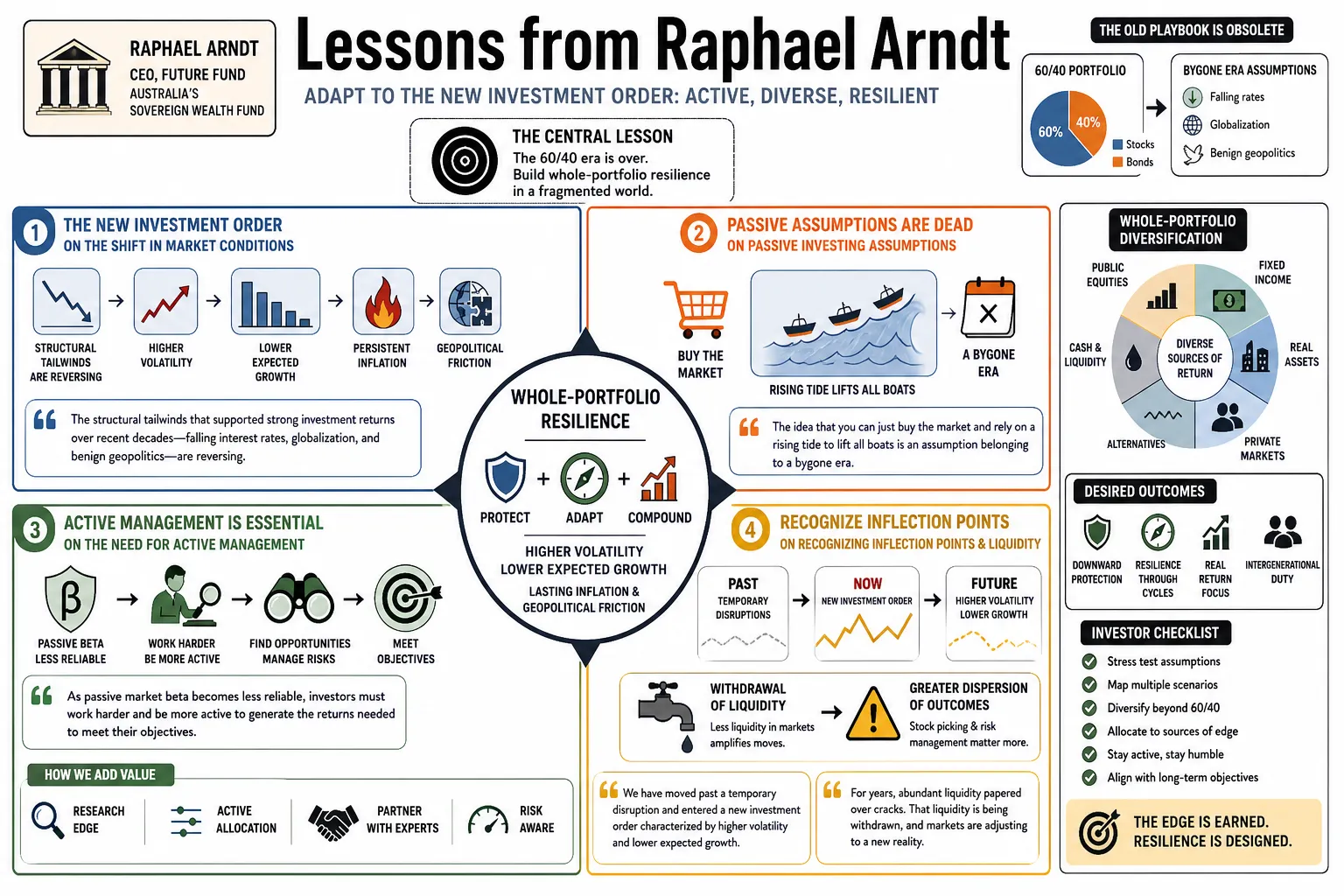
Lessons from Raphael Arndt
As CEO of Australia's sovereign wealth fund, the Future Fund, Raphael Arndt argues the standard 60/40 portfolio is dead in a fragmented economy. This profile gathers his case for how institutional investors must adapt to persistent inflation and geopolitical friction, choosing whole-portfolio resilience over simple market exposure.
Part 1: The New Investment Order
- On the shift in market conditions: "The structural tailwinds that supported strong investment returns over recent decades—falling interest rates, globalization, and benign geopolitics—are reversing." — Source: [Future Fund Position Paper]
- On passive investing assumptions: "The idea that you can just buy the market and rely on a rising tide to lift all boats is an assumption belonging to a bygone era." — Source: [Investment Magazine]
- On the need for active management: "As passive market beta becomes less reliable, investors must work harder and be more active to generate the returns needed to meet their objectives." — Source: [Australian Financial Review Alpha Live]
- On recognizing inflection points: "We have moved past a temporary disruption and entered a new investment order characterized by higher volatility and lower expected growth." — Source: [Future Fund Position Paper]
- On the withdrawal of liquidity: "For years, central banks provided a safety net of liquidity that subsidized risk; that net has been pulled away." — Source: [Capital Allocators Podcast]
- On regulatory friction: "Increased regulation, driven by populist politics and the demands of climate transition, is introducing friction into markets that were previously celebrated for their efficiency." — Source: [FCLTGlobal Going Long Podcast]
- On the illusion of safety: "Assets that were traditionally considered 'safe harbor' investments may no longer provide the capital protection investors expect during equity drawdowns." — Source: [Investment Magazine]
- On complex strategy execution: "Navigating this new order requires more sophisticated combinations of strategies, moving beyond simple asset class allocation." — Source: [Capital Allocators Podcast]
- On historical bias: "Investors who build their models solely on the data of the last forty years are preparing for a world that no longer exists." — Source: [Future Fund Position Paper]
- On adapting to lower growth: "In an environment of lower aggregate economic growth, generating alpha through skill becomes a mathematical necessity, not a luxury." — Source: [Australian Financial Review Alpha Live]
Part 2: The Death of 60/40 and Traditional Portfolios
- On the failure of 60/40: "The conventional 60/40 investment strategy, which relies on bonds to offset equity losses, is fundamentally broken in an environment where inflation drives both asset classes down simultaneously." — Source: [Future Fund Position Paper]
- On bond correlation: "When inflation is the primary macroeconomic risk, equities and bonds become positively correlated, destroying the diversification benefit of fixed income." — Source: [Capital Allocators Podcast]
- On rethinking defensive assets: "We have to completely rethink what constitutes a 'defensive' asset when traditional sovereign debt fails to protect capital." — Source: [Investment Magazine]
- On alternative diversifiers: "Investors must look beyond public markets—to private equity, infrastructure, and commodities like gold—to find true diversification." — Source: [Future Fund Position Paper]
- On the 'set and forget' model: "The era of the 'set and forget' portfolio is over; institutional investing now requires continuous, dynamic adjustment." — Source: [Capital Allocators Podcast]
- On real return generation: "When nominal bonds offer negative real yields in an inflationary environment, you have to find alternative sources of real return, even if they come with higher complexity." — Source: [Australian Financial Review Alpha Live]
- On illiquidity premiums: "There is still an illiquidity premium to be captured in private markets, but it requires much deeper operational expertise to extract than in previous decades." — Source: [FCLTGlobal Going Long Podcast]
- On the danger of benchmark hugging: "Clinging to traditional market-cap weighted benchmarks exposes investors to concentrated risks that have accumulated during the tech-led bull market." — Source: [Investment Magazine]
- On structural portfolio adjustments: "We haven't just tweaked our portfolio at the margins; we have made structural adjustments to reduce our reliance on simple equity beta." — Source: [Future Fund Position Paper]
- On initiating industry conversation: "Our paper on the death of traditional portfolio construction was meant to be a wake-up call to the industry that the old rules no longer apply." — Source: [Capital Allocators Podcast]
Part 3: Navigating the Permacrisis
- On the concept of permacrisis: "We are operating in a 'permacrisis'—a compounding series of shocks, from pandemics to wars, rather than isolated, discrete events." — Source: [Future Fund Senate Estimates]
- On compounding shocks: "The challenge of the current environment is that economic shocks are stacking on top of each other before the system has time to clear the previous one." — Source: [Investment Magazine]
- On abandoning mean reversion: "Investors waiting for a 'return to normal' or mean reversion are misunderstanding the structural permanence of these shifts." — Source: [Australian Financial Review Alpha Live]
- On dynamic asset allocation: "Navigating a permacrisis requires a highly dynamic approach to asset allocation; you cannot stick rigidly to long-term strategic targets when the ground is shifting." — Source: [FCLTGlobal Going Long Podcast]
- On the role of scenario planning: "We spend less time trying to forecast specific outcomes and more time running scenario analyses to understand how our portfolio behaves under extreme stress." — Source: [Capital Allocators Podcast]
- On institutional agility: "In a continuous crisis, institutional agility—the ability of your team to make decisions and execute them quickly—becomes your primary competitive advantage." — Source: [Future Fund Position Paper]
- On managing drawdowns: "The goal is not to avoid volatility entirely, but to manage drawdowns effectively so that the portfolio can compound capital over the long term." — Source: [Investment Magazine]
- On identifying underlying trends: "Amidst the noise of the permacrisis, the key is to isolate the underlying structural trends, like decarbonization and deglobalization, that will drive returns." — Source: [Australian Financial Review Alpha Live]
- On accepting uncertainty: "We have to accept that the cone of uncertainty around future economic outcomes is wider now than it has been at any point in my career." — Source: [Future Fund Senate Estimates]
Part 4: Resilience as a Strategic Imperative
- On defining resilience: "Resilience is not just defense; it is a strategic enabler that allows you to absorb shocks, adapt quickly, and take advantage of dislocations when others are forced to sell." — Source: [FCLTGlobal Going Long Podcast]
- On prioritizing resilience over alpha: "For much of the last decade, the industry obsessed over chasing alpha through complexity. Today, resilience must take precedence in portfolio design." — Source: [Future Fund Position Paper]
- On the cost of fragility: "Portfolios optimized for a specific economic environment are inherently fragile when that environment changes abruptly." — Source: [Capital Allocators Podcast]
- On structural robustness: "We aim to build structural robustness into the portfolio by identifying un-correlated return streams, rather than relying on historical correlation matrixes." — Source: [Investment Magazine]
- On investing in capabilities: "Resilience extends beyond the assets you hold; it encompasses investments in data, technology, and organizational culture." — Source: [FCLTGlobal Going Long Podcast]
- On liquidity management: "Maintaining appropriate liquidity is the ultimate form of resilience, giving you the optionality to pivot when the facts change." — Source: [Future Fund Position Paper]
- On stress testing assumptions: "True resilience requires constantly stress-testing your own investment assumptions and being willing to abandon deeply held beliefs when the evidence shifts." — Source: [Australian Financial Review Alpha Live]
- On avoiding forced errors: "A resilient portfolio prevents you from being a forced seller at the bottom of a market, which is where long-term returns are permanently destroyed." — Source: [Capital Allocators Podcast]
- On the mindset of survival: "You have to ensure you survive the short-term volatility in order to capture the long-term risk premiums." — Source: [Future Fund Senate Estimates]
- On organizational resilience: "A resilient culture is one where team members feel safe communicating bad news early, allowing the institution to react before a minor issue becomes a crisis." — Source: [FCLTGlobal Going Long Podcast]
Part 5: Geopolitics and the End of Benign Globalization
- On the return of geopolitics: "Geopolitical risk is no longer an afterthought or a tail risk; it is a primary driver of market outcomes and capital allocation." — Source: [Future Fund Position Paper]
- On the weaponization of trade: "The weaponization of trade and the shifting of supply chains for security rather than efficiency is a fundamentally inflationary trend." — Source: [Investment Magazine]
- On multipolarity: "We are transitioning from a unipolar world to a multipolar one, which inherently creates more friction, competition, and economic inefficiency." — Source: [Australian Financial Review Alpha Live]
- On deglobalization: "The era of seamless globalization that allowed for optimized, just-in-time supply chains has ended, replaced by a demand for 'just-in-case' resilience." — Source: [FCLTGlobal Going Long Podcast]
- On strategic competition: "Strategic competition between major powers means that capital flows are increasingly dictated by political alignment rather than pure economic return." — Source: [Capital Allocators Podcast]
- On populist politics: "The rise of domestic populism limits the ability of governments to enact optimal economic policies, creating a drag on global growth." — Source: [Future Fund Senate Estimates]
- On monitoring vs. predicting: "You cannot predict geopolitical events with precision, but you can monitor the fault lines and ensure your portfolio doesn't hold concentrated risk across those lines." — Source: [Investment Magazine]
- On sovereign risk: "Sovereign risk is no longer confined to emerging markets; developed markets are increasingly deploying policies that alter the rules for foreign capital." — Source: [Future Fund Position Paper]
- On the cost of fragmentation: "Economic fragmentation means higher baseline costs for businesses, which compresses margins and alters the equation for equity investors." — Source: [FCLTGlobal Going Long Podcast]
Part 6: The Re-emergence of Inflation and Stagflation Risks
- On structural inflation: "Inflation is not merely a cyclical spike caused by pandemic disruptions; it is being sustained by structural forces like demographics and deglobalization." — Source: [Future Fund Position Paper]
- On the risk of stagflation: "The most difficult environment for an allocator is stagflation—low growth coupled with high inflation—and that remains a material risk to the global economy." — Source: [Capital Allocators Podcast]
- On central bank constraints: "Central banks face a difficult trade-off; fighting inflation aggressively risks triggering severe recessions, limiting their ability to support markets as they have in the past." — Source: [Investment Magazine]
- On real asset protection: "In an inflationary regime, hard assets, infrastructure, and certain types of real estate become essential tools for preserving purchasing power." — Source: [Australian Financial Review Alpha Live]
- On pricing power: "When evaluating equities in an inflationary environment, a company's ability to pass on costs—its pricing power—becomes the most critical metric." — Source: [FCLTGlobal Going Long Podcast]
- On the role of commodities: "Commodities, including gold, have reasserted their role in the portfolio as necessary diversifiers when fiat currencies are under pressure." — Source: [Future Fund Position Paper]
- On wage pressures: "Shifting demographics and tighter labor markets are reversing decades of wage suppression, feeding into a higher baseline rate of inflation." — Source: [Future Fund Senate Estimates]
- On the cost of capital: "A structurally higher cost of capital forces a repricing of risk assets across the board, particularly those whose valuations depend on cash flows far in the future." — Source: [Capital Allocators Podcast]
- On shifting return expectations: "Institutional investors must realistically recalibrate their return expectations downward in a world where inflation eats away at nominal gains." — Source: [Investment Magazine]
Part 7: The Total Portfolio Approach and Culture
- On whole-portfolio thinking: "We employ a 'total portfolio approach,' meaning we don't look at asset sectors in isolation; we analyze how every investment interacts to serve the mandate." — Source: [FCLTGlobal Going Long Podcast]
- On breaking down silos: "You cannot manage a modern institutional fund with rigid asset class silos. The best risk-adjusted returns often fall in the spaces between traditional buckets." — Source: [Capital Allocators Podcast]
- On collaborative culture: "Our investment process relies on deep collaboration; if the equities team and the private markets team aren't talking, we are mispricing risk." — Source: [FCLTGlobal Going Long Podcast]
- On single-team mentality: "We evaluate the success of the organization as a single team based on total fund performance, not the outperformance of individual asset class desks." — Source: [Future Fund Position Paper]
- On top-down asset allocation: "Asset allocation cannot be a bottom-up aggregation of whatever the individual desks want to buy; it must be a deliberate, top-down expression of macroeconomic views." — Source: [Investment Magazine]
- On peer review: "Every major investment decision is subjected to rigorous peer review across the organization to ensure we are identifying unintended macro exposures." — Source: [Capital Allocators Podcast]
- On flexibility in mandates: "We give our investment teams the flexibility to seek the best relative value across the capital structure, rather than boxing them into strict equity or debt mandates." — Source: [Australian Financial Review Alpha Live]
- On alignment of incentives: "To achieve a total portfolio approach, your compensation and incentive structures must reward collaboration and whole-fund outcomes." — Source: [FCLTGlobal Going Long Podcast]
- On centralized risk management: "Risk management must sit at the center of the organization, providing a unified view of the portfolio's vulnerabilities." — Source: [Future Fund Senate Estimates]
Part 8: Climate Risks and the Path to Decarbonization
- On climate as a systemic risk: "Climate change is not just an ESG issue; it is a systemic financial risk that alters the fundamental pricing of assets across all sectors." — Source: [Future Fund Position Paper]
- On the cost of transition: "The global transition to a low-carbon economy will require massive capital expenditure, which inherently introduces inflationary pressures into the system." — Source: [Investment Magazine]
- On energy market friction: "As we shift energy systems, the friction between divesting from fossil fuels and scaling renewables is creating volatility in energy markets." — Source: [Australian Financial Review Alpha Live]
- On transition opportunities: "While decarbonization presents risks, it also offers one of the most significant investment opportunities of our generation, particularly in transition infrastructure." — Source: [FCLTGlobal Going Long Podcast]
- On stranded assets: "Investors must rigorously evaluate their portfolios for stranded asset risk, as regulatory changes and technological advancements accelerate the obsolescence of carbon-intensive business models." — Source: [Capital Allocators Podcast]
- On physical climate risks: "Beyond policy shifts, the physical impacts of climate change—such as extreme weather events—require a reassessment of the viability of physical assets in certain geographies." — Source: [Future Fund Position Paper]
- On engaging with carbon emitters: "We believe in engaging with carbon-intensive companies to drive transition strategies, rather than simply divesting and handing those assets to less transparent owners." — Source: [Investment Magazine]
- On regulatory divergence: "The differing pace of climate regulation across various jurisdictions creates a complex compliance and valuation environment for global investors." — Source: [FCLTGlobal Going Long Podcast]
- On long-term value creation: "Integrating climate risk into the investment process is essential for protecting capital and generating the long-term returns expected by our stakeholders." — Source: [Future Fund Senate Estimates]