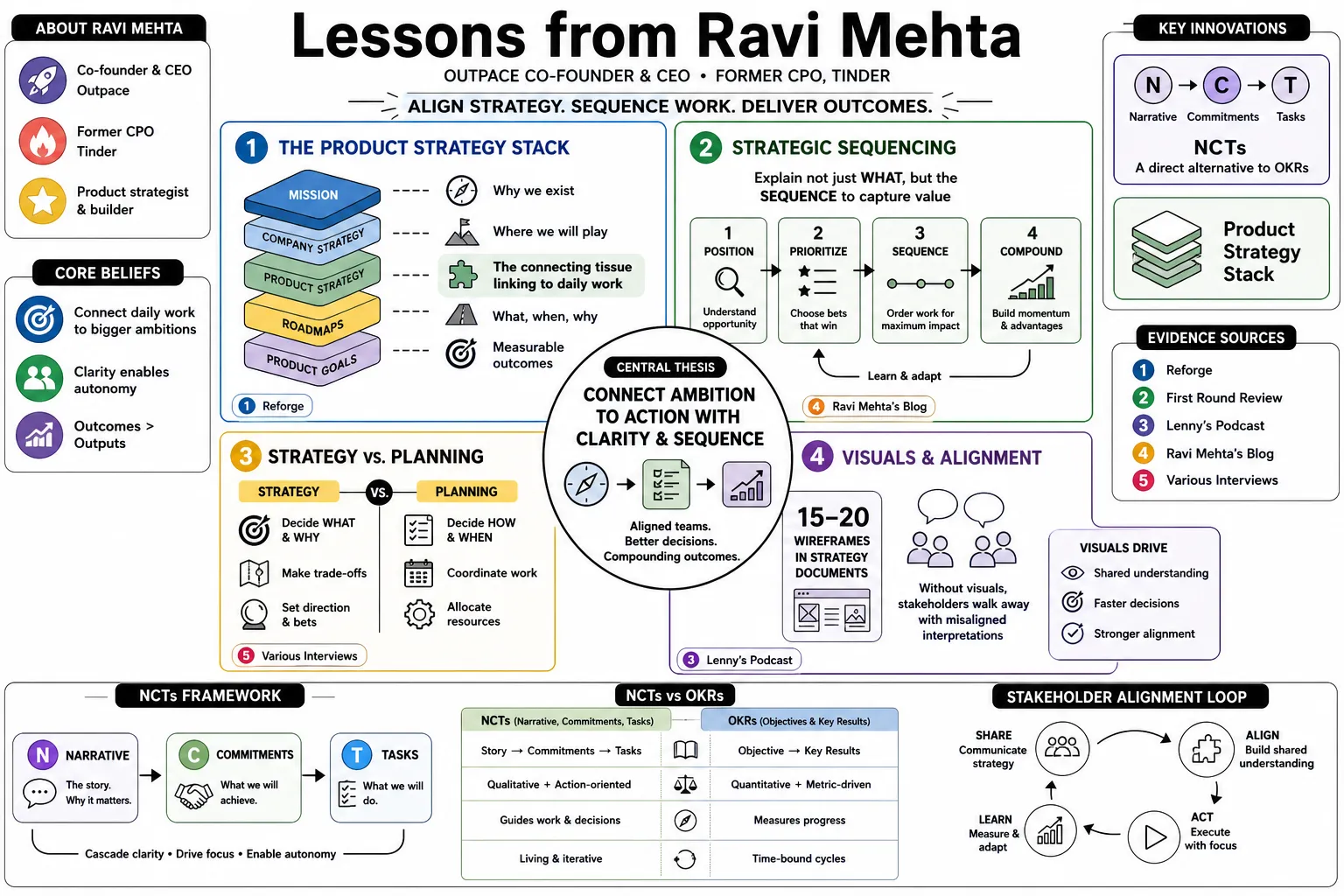
Lessons from Ravi Mehta
Ravi Mehta is the co-founder and CEO of Outpace and the former Chief Product Officer at Tinder. He developed the "Product Strategy Stack" and introduced NCTs (Narrative, Commitments, Tasks) as a direct alternative to OKRs. This profile details his specific frameworks for leading product teams, managing stakeholders, and building consumer technology.
Part 1: The Product Strategy Stack
- On the Purpose of Strategy: "Strategy is about alignment between the company's mission, company strategy, product strategy, roadmaps, and product goals." — Source: Reforge
- On the Missing Link: "Many companies have a mission and a roadmap, but lack the connecting tissue of product strategy to link daily work to broader ambitions." — Source: First Round Review
- On the Role of Visuals: "Include 15 to 20 wireframes in your product strategy documents. Without visuals, stakeholders often walk away with misaligned interpretations." — Source: Lenny's Podcast
- On Strategic Sequencing: "A good product strategy explains not just what you are building, but the sequence in which you will build it to capture value." — Source: Ravi Mehta's Blog
- On Strategy vs. Planning: "Strategy is deciding what game you are playing and how to win; planning is deciding who is doing what by when." — Source: The Growth Podcast
- On Avoiding Isolation: "Product strategy cannot exist in a vacuum. It must actively translate the company's high-level business goals into a tangible product direction." — Source: First Round Review
- On Continuous Refinement: "A strategy stack is not something you write once and put in a drawer. It should be a living framework that guides everyday decision-making." — Source: Reforge
- On Clarity Over Complexity: "The best strategies are easily understood by the entire team, not just the executives who wrote them." — Source: Ravi Mehta's Blog
- On the Strategy Gap: "When individual contributors don't understand the strategy, it's usually because the strategy stack is broken or missing a layer." — Source: First Round Review
Part 2: NCTs vs. OKRs
- On the Flaw of OKRs: "OKRs often fail because they lack context. Teams optimize for a metric without understanding the broader narrative behind it." — Source: Reforge
- On Defining NCTs: "NCTs stand for Narrative, Commitments, and Tasks. They provide a more balanced approach to goal setting than OKRs." — Source: First Round Review
- On the Narrative: "The narrative is a one- to two-sentence description of what the team wants to achieve in a quarter and why it matters." — Source: Sub Club Podcast
- On Commitments: "Commitments should be three to five objectively measurable goals that the team is held accountable to delivering by the end of the quarter." — Source: Reforge
- On Tasks: "Tasks are the specific, trackable activities the team will undertake to meet their commitments." — Source: First Round Review
- On Narrative vs. Metrics: "Narratives matter more than metrics in effective goal-setting, because narratives tell the team why they are doing the work." — Source: Sub Club Podcast
- On Adopting NCTs: "Transitioning to NCTs forces a team to articulate the story of their product, which immediately surfaces misalignments." — Source: Lenny's Newsletter
- On the Value of Tasks: "While OKRs discourage tracking tasks in favor of outcomes, NCTs acknowledge that executing specific tasks is often the clearest path to learning." — Source: Ravi Mehta's Blog
- On Psychological Safety: "Commitments in the NCT framework are meant to be achieved 100 percent, unlike the '70 percent is success' rule in OKRs, which creates clearer expectations." — Source: Reforge
- On Goal Decay: "Without a strong narrative, goals decay into checklists that don't actually move the business forward." — Source: First Round Review
Part 3: The Shape of a PM
- On the Impossibility of the Perfect PM: "No product manager can excel in all 12 competencies of the craft. The idea of the perfect PM is a myth." — Source: Ravi Mehta's Blog
- On the 12 Competencies: "Product management breaks down into four pillars: Product Execution, Customer Insight, Product Strategy, and Influencing People." — Source: Reforge
- On Knowing Your Shape: Mehta argues that most product managers excel at only a handful of competencies, so the practical work is to know your shape, build around your strengths, and pair with teammates who fill the gaps. — Reference: Ravi Mehta essay on PM shapes, strengths, and team fit
- On Team Composition: "Instead of trying to hire unicorns, build a team of PMs with complementary shapes so the team as a whole covers all competencies." — Source: First Round Review
- On Product Execution: "Execution is the foundation. If a PM cannot reliably ship high-quality products, their strategic skills won't matter." — Source: Ravi Mehta's Blog
- On Influencing People: "As you grow in your career, the job shifts from managing products to influencing people and managing stakeholders." — Source: Lenny's Podcast
- On Career Transitions: "Moving from a senior PM to a product leader requires fundamentally changing your shape from an executor to a strategist and influencer." — Source: Reforge
- On Self-Awareness: "A PM who understands their weaknesses is far more dangerous than one who thinks they are good at everything." — Source: The One Percent Project
- On Customer Insight: "Customer insight isn't just looking at data; it's understanding the underlying human behavior driving that data." — Source: Ravi Mehta's Blog
Part 4: Growth and Retention
- On the Limits of Data: "Data only tells you what is happening. It does not explain why it is happening." — Source: Ravi Mehta's Blog
- On Triangulating Insights: Mehta describes peak product managers as both analytical and empathetic: data can show behavior and trends, but customer conversations and research explain why users behave that way. — Reference: Ravi Mehta Product Competency Toolkit on data and voice of the customer
- On the Dashboard Trap: "Teams often become over-reliant on dashboards, which can obscure the actual human reasons for user behavior." — Source: Ravi Mehta's Blog
- On Early Engagement: "At Tinder, high engagement and retention were present early on, long before a clear monetization strategy was fully defined." — Source: Churn.fm
- On Growth vs. Innovation: "Companies should not mistake growth optimization for product innovation. Growth teams increase reach, but innovation prevents disruption." — Source: Ravi Mehta's Blog
- On Platform Fit: "Tinder grew quickly because it offered a significantly better fit for mobile capabilities, like swiping and location, than its competitors." — Source: Churn.fm
- On Sustainable Growth: "Growth that relies solely on performance marketing rather than organic retention is a leaky bucket." — Source: Reforge
- On Qualitative Research: Mehta warns that teams over-rely on accessible metrics as they scale, while peak PMs keep a close relationship with customers through conversations, support tickets, reviews, surveys, usability tests, and other research channels. — Reference: Ravi Mehta Product Competency Toolkit on customer conversations and user research
- On Feature Bloat: "Adding more features rarely solves a retention problem. Often, it just makes the core value proposition harder to find." — Source: Ravi Mehta's Blog
- On Activation: "The most critical moment for retention happens in the first few minutes of onboarding. If they don't get the value then, they won't come back." — Source: Sub Club Podcast
Part 5: Interviewing and Building Teams
- On the Ownership Test: "When interviewing PMs, listen for whether they use 'I' or 'we.' The word 'I' indicates strong personal ownership, while 'we' signals a collaborative mindset." — Source: Reddit Product Management AMA
- On the Classic Interview Question: "Asking what product you love and why allows the interviewer to probe how the candidate thinks about design, value, and development." — Source: Hustle Badger
- On Interview Preparation: "Top companies share their interview processes in advance because they want prepared candidates. Preparation allows for a deeper, more substantive conversation." — Source: Ravi Mehta's Blog
- On Hiring for Potential: "Don't just hire for the skills a candidate has today; hire for the trajectory of how fast they can learn." — Source: Lenny's Newsletter
- On Assessing Strategy in Interviews: "A good candidate can critique a product; a great candidate can explain the business constraints that led to those product decisions." — Source: Reforge
- On Team Culture: "The culture of a product team is defined by the worst behavior the leader is willing to tolerate." — Source: The One Percent Project
- On Evaluating Empathy: "You can teach a PM how to write a SQL query, but it is incredibly difficult to teach them how to have empathy for the user." — Source: Hustle Badger
- On Reference Checks: "Back-channel references are often more valuable than the interview itself for understanding how a PM handles adversity." — Source: Lenny's Podcast
- On the False Positive: "It is always better to pass on a good candidate than to hire a bad one. The organizational cost of a bad PM is massive." — Source: First Round Review
Part 6: Navigating AI in Product
- On the Purpose of AI: "AI is not a replacement for people; it is a way to amplify people and make them more effective." — Source: Refound
- On the Shifting Bar: "The bar for PMs has moved from simply learning about AI to actually executing and shipping products that utilize these technologies." — Source: Ravi Mehta's Substack
- On AI Strategy: "To succeed in AI, companies must move beyond simple adoption and build sustainable, AI-driven product advantages." — Source: Reforge
- On Business Model Impacts: "AI will not just change how products are built; it will fundamentally alter the business models that monetize those products." — Source: Atlassian Blog
- On Search and AI: In the Unsolicited Feedback AI-marketing discussion, Mehta and the panel treat AI-generated answers as a pressure on search-driven growth, with companies needing alternatives as organic clicks decline. — Reference: Unsolicited Feedback episode on AI, declining search clicks, and marketing strategy
- On Qualitative AI: Mehta says LLMs can interpret, code, label, cluster, and analyze qualitative data at scale, turning large bodies of customer feedback and survey text into more usable product insight. — Reference: Unsolicited Feedback episode on AI-assisted qualitative-data analysis
- On the AI Moat: "A wrapper around an LLM is not a moat. The moat comes from proprietary data and deep workflow integration." — Source: Reforge
- On Prototyping with AI: "PMs should be using AI tools to prototype faster, reducing the time from idea to initial user feedback." — Source: Ravi Mehta's Substack
- On Managing AI Expectations: "The challenge with AI products is managing user expectations. When a system is probabilistic, it will eventually make a mistake." — Source: Lenny's Podcast
Part 7: The Reality of the PM Role
- On the Mortar Analogy: "You are like the mortar in a brick wall. You fluidly fill the gaps between teams to ensure the entire organization is stronger." — Source: Ravi Mehta's Blog
- On Filling Gaps: "Product managers must operate in a connective capacity. If a team lacks a designer, the PM steps in. If they lack an analyst, the PM pulls the data." — Source: Ravi Mehta's Blog
- On Authority vs. Influence: "Product managers have all the responsibility but none of the authority. Your success depends entirely on your ability to influence others." — Source: Reforge
- On Dealing with Ambiguity: "The core job of a product manager is taking an ambiguous problem space and turning it into a structured plan of execution." — Source: The One Percent Project
- On Founder Mode: "There is a balance between micromanagement and high-level strategy. Founders must learn when to dive into the details and when to pull back." — Source: Ravi Mehta's Blog
- On Saying No: "Being a PM means saying no to 99 good ideas so you can focus the team on the one great idea that actually matters." — Source: First Round Review
- On Non-Linear Careers: Mehta frames PM development as a shape-building exercise: product managers move from execution into customer insight, strategy, and influence, while staying broad enough to work across the product system. — Reference: Ravi Mehta essay on PM shape and progression from PM to product leader
- On Cross-Functional Friction: "Friction between engineering, design, and product is healthy. If there is no friction, someone is not advocating hard enough for their discipline." — Source: Lenny's Podcast
- On Taking Blame: "A great product manager gives away all the credit when things go well and takes all the blame when things go poorly." — Source: Reforge
- On Isolation: "Product management can be a lonely job, because you sit in the middle of different functions without strictly belonging to any of them." — Source: Ravi Mehta's Blog
Part 8: Monetization, Value, and Execution
- On Value-Based Pricing: "If you have a product solving an important need, focus on the value of the entire system you provide, not just the price of the transaction." — Source: Sub Club Podcast
- On Tiered Pricing: "Tiered pricing, like we used at Tinder, allows a product to capture value from casual users while serving the needs of power users." — Source: RevenueCat
- On the Cost of Complexity: "Every new monetization feature you add increases the cognitive load on the user. Ensure the revenue justifies the complexity." — Source: Sub Club Podcast
- On Consumables: "Incorporating consumable purchases within a subscription app can dramatically increase the lifetime value of your most engaged cohorts." — Source: RevenueCat
- On Execution Speed: "Speed of execution is a feature. A good strategy executed today is better than a perfect strategy executed next quarter." — Source: First Round Review
- On Shipping to Learn: "You don't ship a product to prove you were right; you ship a product to learn where you were wrong." — Source: The Growth Podcast
- On Alignment Constraints: "Execution slows down when alignment is weak. If the team keeps pausing to ask why, your strategy stack is failing." — Source: Reforge
- On Feature Parity: "Chasing feature parity with a competitor is a losing game. You should be building features that differentiate your core value proposition." — Source: Ravi Mehta's Blog
- On the Ultimate Goal: "The ultimate measure of execution is not how much code you shipped, but how much user behavior you successfully changed." — Source: First Round Review