Lessons from Ray Kroc
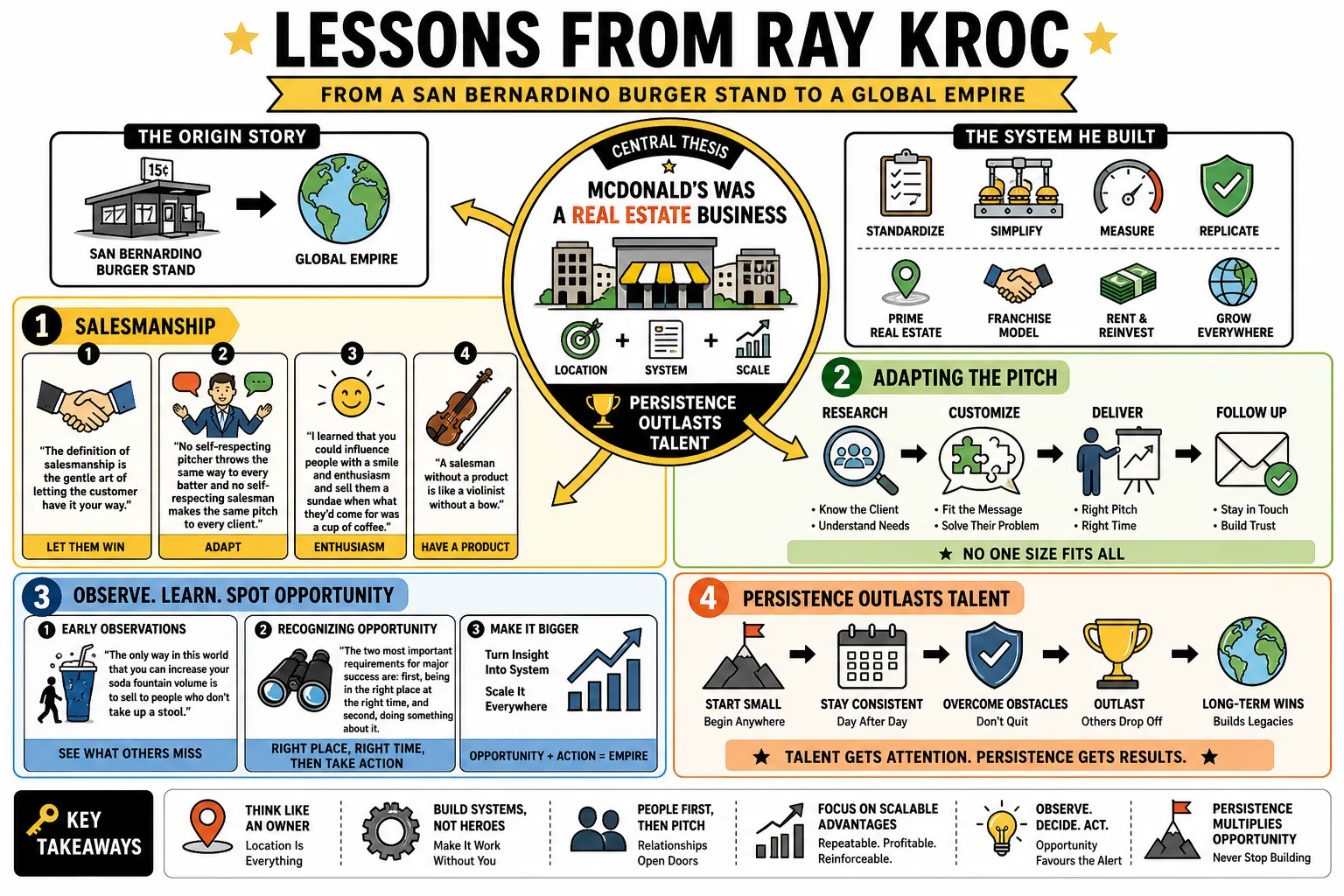
Ray Kroc turned a San Bernardino burger stand into a global empire by realizing McDonald’s was actually a real estate business. He built the system through a relentless obsession with uniformity and the stubborn belief that persistence outlasts talent every time.
Part 1: Sales and the Art of the Pitch
- On Salesmanship: "The definition of salesmanship is the gentle art of letting the customer have it your way." — Source:
- On Adapting the Pitch: "No self-respecting pitcher throws the same way to every batter and no self-respecting salesman makes the same pitch to every client." — Source:
- On Enthusiasm: "I learned that you could influence people with a smile and enthusiasm and sell them a sundae when what they'd come for was a cup of coffee." — Source:
- On Having a Product: "A salesman without a product is like a violinist without a bow." — Source:
- On Early Observations: "The only way in this world that you can increase your soda fountain volume is to sell to people who don't take up a stool." — Source:
- On Recognizing Opportunity: "The two most important requirements for major success are: first, being in the right place at the right time, and second, doing something about it." — Source:
- On Personal Appearance: Kroc insisted that salesmen and counter staff be clean-shaven and well-groomed to project a professional, trustworthy image. — Source:
- On the Salesman's Mindset: "I was a battle-scarred veteran of the business world, but I was still eager to learn." — Source:
- On Influencing Customers: Kroc believed in suggestive selling, where an employee's genuine energy could convince a customer to add an extra item to their order. — Source:
- On the Paper Cup Trade: His early years selling paper cups taught him that low-margin, high-volume items were the key to massive wealth. — Source:
Part 2: Persistence and the Long Game
- On the Power of Persistence: "Nothing in the world can take the place of persistence. Talent will not; nothing is more common than unsuccessful individuals with talent." — Source:
- On Genius: "Genius will not; unrewarded genius is almost a proverb." — Source:
- On Education: "Education will not; the world is full of educated derelicts. Persistence and determination alone are omnipotent." — Source:
- On the Overnight Success Myth: "I was an overnight success all right, but 30 years is a long, long night." — Source:
- On Sweat and Luck: "Luck is a dividend of sweat. The more you sweat, the luckier you get." — Source:
- On Starting Late: Kroc founded the McDonald’s Corporation at age 52, proving that professional prime can occur late in life. — Source:
- On Health and Resilience: Despite suffering from diabetes and arthritis, Kroc maintained a travel schedule that would exhaust younger men. — Source:
- On Achievement Against Odds: "Achievement must be made against the possibility of failure, against the risk of defeat." — Source:
- On the "Grind": Kroc viewed business as a continuous process of overcoming small, repetitive obstacles rather than one grand event. — Source:
- On Professional Longevity: He believed that a man should never stop working as long as he had something to contribute. — Source:
Part 3: Operational Perfection and QSC&V
- On Quality Control: "If I had a brick for every time I've repeated the phrase QSC and V (Quality, Service, Cleanliness, and Value), I'd be able to bridge the Atlantic Ocean." — Source:
- On the Perfect French Fry: "The French fry is my canvas." — Source:
- On Beauty in Detail: "It requires a certain kind of mind to see beauty in a hamburger bun." — Source:
- On Cleanliness: "If you've got time to lean, you've got time to clean." — Source:
- On Pampered Potatoes: Kroc developed an elaborate curing and air-blasting process for potatoes to ensure they had the perfect starch-to-moisture ratio. — Source:
- On Customer Priority: "Look after the customer and the business will take care of itself." — Source:
- On Standardizing the Experience: "Our aim was to insure repeat business based on the system’s reputation rather than on the quality of a single store or operator." — Source:
- On Kitchen Discipline: Kroc viewed the kitchen as a "theatre" where every movement must be choreographed for speed and sanitation. — Source:
- On Maintenance: He once spent an entire morning cleaning a restaurant's parking lot himself to demonstrate the standards he expected. — Source:
- On Product Consistency: Kroc’s obsession ensured that a Big Mac tasted exactly the same in any location globally. — Source:
Part 4: The Real Estate Pivot and Business Modeling
- On the Real Business of McDonald's: "You don't build an empire off a 1.4% cut of a 15-cent hamburger. You build it by owning the land on which that burger is cooked." — Source:
- On the Sonneborn Model: Under Harry Sonneborn's advice, Kroc created the Franchise Realty Corporation to buy and lease land back to operators. — Source:
- On Asset Leverage: By owning real estate, McDonald’s gained the collateral needed to borrow capital for rapid, national expansion. — Source:
- On Rent vs. Royalties: Kroc realized that fixed rent provided a stable floor of income while percentage rent allowed the company to share in the upside. — Source:
- On the "Ground" Leverage: Owning the land gave Kroc the ultimate control; a franchisee who failed standards could be evicted from the property. — Source:
- On Financing the Buyout: In 1961, Kroc used his real estate assets as leverage to secure the $2.7 million loan needed to buy out the McDonald brothers. — Source:
- On Scouting Locations: Kroc would fly over towns in a small plane to identify busy intersections and suburban growth patterns for new sites. — Source:
- On the Value of the Name: Kroc believed the name "McDonald's" was a uniquely promotable asset that captured the "public fancy." — Source:
- On Long-term Assets: He viewed land as a "hard asset" that would appreciate regardless of the volatility of food costs. — Source:
- On the Golden Arches: Kroc protected the visual identity of the buildings as much as the food, viewing the arches as a permanent marketing tool. — Source:
Part 5: Partnerships, Franchisees, and the Three-Legged Stool
- On the Three-Legged Stool: "The stool is only as strong as the three legs that support it. If any one of those legs is weak, the whole structure will collapse." — Source:
- On Collective Strength: "None of us is as good as all of us." — Source:
- On Supplier Integrity: "I want nothing from you but a good product. Don't wine me, don't dine me... If there are any cost breaks, pass them on to the operators." — Source:
- On Mutual Success: "The more I help others to succeed, the more I succeed." — Source:
- On Supplier Loyalty: Kroc preferred long-term partnerships over "squeezing" vendors, believing that suppliers should grow alongside the brand. — Source:
- On the Handshake Deal: "I've worked out many a satisfactory deal on the strength of a handshake." — Source:
- On Investing in Talent: "If we are going to go anywhere, we’ve got to have talent. And, I’m going to put my money in talent." — Source:
- On Empowering Managers: "I believe that if you hire a man to do a job, you ought to get out of the way and let him do it." — Source:
- On Avoiding Kickbacks: Kroc famously refused rebates from suppliers, a practice common in franchising at the time, to build trust with his operators. — Source:
Part 6: Growth, Risk, and the "Green and Growing" Mindset
- On Continuous Evolution: "As long as you're green, you're growing. As soon as you're ripe, you start to rot." — Source:
- On Business Risk: "If you're not a risk taker, you should get the hell out of business." — Source:
- On Innovation Timing: "Creativity is a highfalutin word for the work I have to do between now and Tuesday." — Source:
- On Global Ambition: "I don't believe in saturation. We're thinking and talking worldwide." — Source:
- On Being First: "To be successful, you must be daring, be first and be different." — Source:
- On Building in Bad Times: "When times are bad is when you want to build! Why wait for things to pick up so everything will cost more?" — Source:
- On Scaling Systems: Kroc’s goal was a system that could produce consistent results regardless of the specific individual behind the counter. — Source:
- On Show Business: "We don't just feed people, we entertain them. McDonald's is not in the restaurant business; it's in show business." — Source:
- On Practical Training: He founded Hamburger University in 1961 to turn the "art" of restaurant management into a rigorous science. — Source:
Part 7: Competition and Market Dominance
- On Ruthless Competition: "If any of my competitors were drowning, I'd stick a hose in their mouth and turn on the water." — Source:
- On the Positive Approach: "My way of fighting the competition is the positive approach. Stress your own strengths." — Source:
- On Efficiency as a Weapon: Kroc believed his speed of service was his greatest competitive advantage over sit-down diners. — Source:
- On Market Entry: "If you can't do it by offering a better fifteen-cent hamburger... then I would rather be broke tomorrow." — Source:
- On the Threat of Stagnation: Kroc viewed competitors not as peers to be respected, but as obstacles to be removed from the market. — Source:
- On Adversarial Tactics: He was known for opening McDonald's locations directly across the street from rivals to force them out of business. — Source:
- On Quality as Defense: He believed that as long as his QSC&V was superior, no competitor could survive the comparison. — Source:
- On Price wars: Kroc refused to cut prices if it meant compromising the quality of the raw ingredients. — Source:
- On the Burger Crown: "I don't care if the Pope himself comes to Cincinnati... We are not going to stink up our restaurants with any of your damned old fish!" — Source:
Part 8: Leadership, Philosophy, and Achievement
- On Happiness: "Happiness is not a tangible thing, it’s a byproduct of achievement." — Source:
- On Risk and Pride: "It is no achievement to walk a tightrope laid flat on the floor. Where there is no risk, there can be no pride in achievement." — Source:
- On Priorities: "I believe in God, family, and McDonald's. And in the office, that order is reversed." — Source:
- On Trade vs. Academic Degrees: "There are too many baccalaureates and too few butchers." — Source:
- On Managing Stress: "I refused to worry about more than one thing at a time... and I would not let useless fretting keep me from sleeping." — Source:
- On Individual Trust: "The organization cannot trust the individual; the individual must trust the organization." — Source:
- On Leading by Example: Kroc’s willingness to perform menial tasks like picking up trash set the standard for every employee in the system. — Source:
- On Leaving a Legacy: "If you work just for money, you'll never make it, but if you love what you're doing... success will be yours." — Source: