Lessons from Ray Ozzie
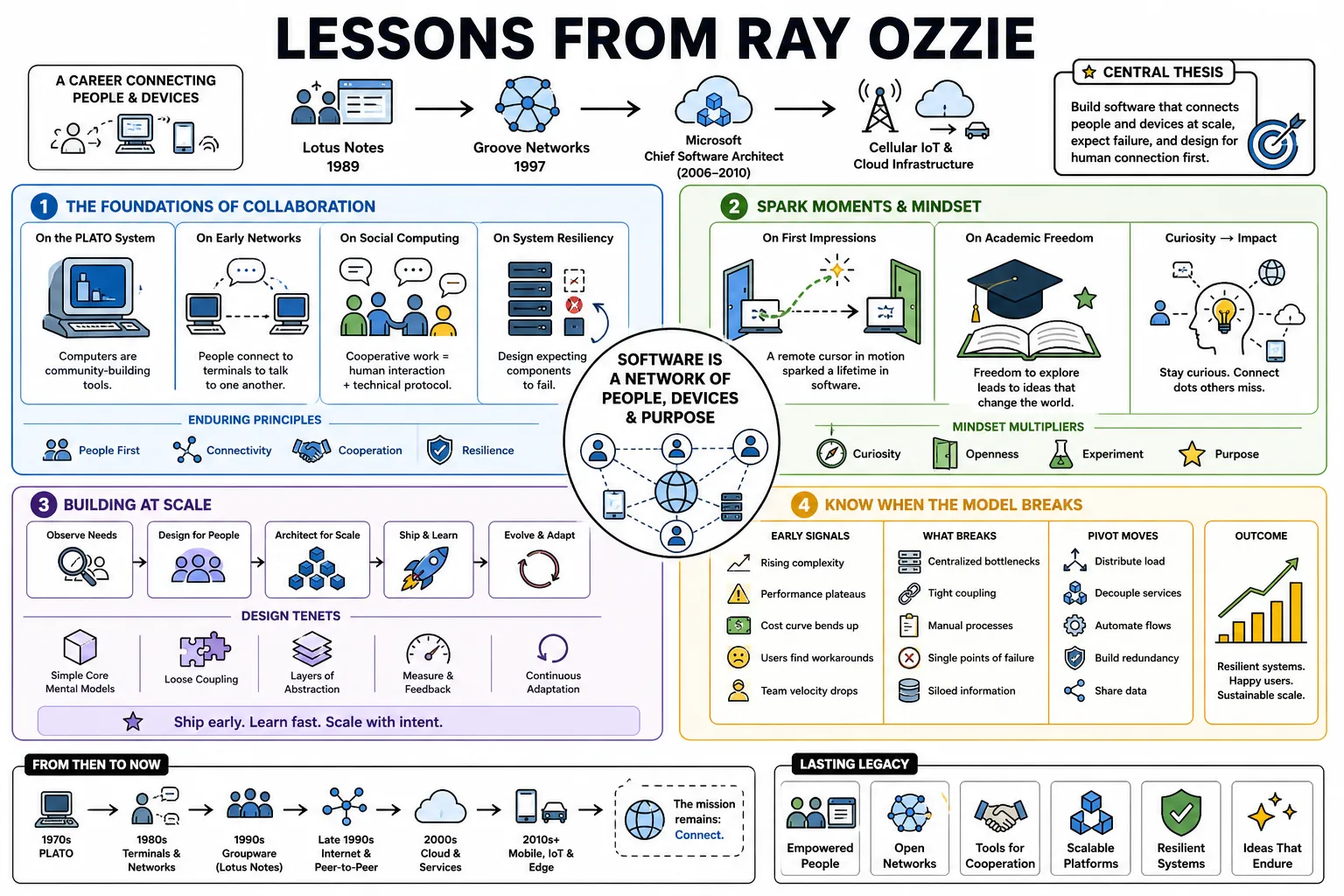
Ray Ozzie built Lotus Notes, founded Groove Networks, and succeeded Bill Gates as Microsoft's Chief Software Architect. He spent his career connecting people and devices across networks, from early peer-to-peer tools to cloud infrastructure and cellular IoT. This collection details how he builds software, manages scale, and spots when a technology model is about to break.
Part 1: The Foundations of Collaboration
- On the PLATO System: "Experiencing PLATO in the 1970s revealed that computers were fundamentally community-building tools, rather than merely calculators." — Source: [Computer History Museum]
- On Early Networks: "When you connect people through terminals, the first thing they want to do is talk to one another." — Source: [University of Illinois Archives]
- On Social Computing: "Building systems for cooperative work requires understanding human interaction as much as technical protocol." — Source: [CHM Oral History]
- On System Resiliency: "The best early multi-user systems survived because they were designed expecting components to fail." — Source: [Programmers at Work]
- On First Impressions: "Seeing a cursor move across a screen controlled by someone in another room was the spark for a lifetime of software development." — Source: [Computer History Museum]
- On Academic Freedom: "The unstructured exploration allowed in early university computer labs provided the blueprint for independent software ventures." — Source: [University of Illinois Archives]
- On User Interfaces: "A shared system must immediately communicate who else is present and what they are doing." — Source: [CHM Oral History]
- On Iteration: "The software development cycle is about continuously refining the bridge between a human need and hardware capabilities." — Source: [Programmers at Work]
- On Community Memory: "Shared digital spaces naturally evolve from transient chats into permanent repositories of collective knowledge." — Source: [Computer History Museum]
- On Early Funding: "Convincing investors to back communication software before widespread network adoption required selling a timeline they could not yet see." — Source: [NotesMail Archive]
Part 2: Designing Lotus Notes
- On Groupware: "The market initially struggled to define software that wasn't a spreadsheet or a word processor, forcing us to invent the category." — Source: [Network World]
- On Security: "Public-key encryption had to be built into the foundation of collaboration tools to make enterprise adoption possible." — Source: [Y Combinator Archives]
- On Bandwidth Constraints: "Designing for slow, intermittent network connections forces you to build highly efficient replication engines." — Source: [Taskade History]
- On Offline Work: "Users need the ability to disconnect, work deeply, and sync flawlessly when they return to the network." — Source: [CHM Oral History]
- On Enterprise Scaling: "A tool built for a five-person team will break in a five-thousand-person organization unless the underlying data structure anticipates the load." — Source: [Network World]
- On Feature Creep: "Every new feature added to a groupware product exponentially increases the testing matrix." — Source: [Programmers at Work]
- On Database Replication: "Conflict resolution in distributed databases is as much a social problem as a mathematical one." — Source: [EBSCO Information Services]
- On Platform Strategy: "Notes succeeded because it allowed non-programmers to build their own custom workflow applications on top of it." — Source: [Computer History Museum]
- On Funding: "Securing investment from Mitch Kapor meant trading total independence for the distribution channel needed to survive." — Source: [NotesMail Archive]
- On Product Positioning: "Sometimes you have to call a product a 'personal information manager' until the customer understands what it actually does." — Source: [WordPress Tech History]
Part 3: The Philosophy of Groove Networks
- On Peer-to-Peer: "Decentralized architecture allows small teams to collaborate securely without waiting for IT to provision a server." — Source: [Computer History Museum]
- On Friction: "Collaboration software and technology in general is all about reducing the cost of coordination between entities." — Source: [CNET]
- On Technology Layers: "Explaining peer-to-peer synchronization to enterprise customers is like peeling an onion; you have to reveal the complexity one layer at a time." — Source: [ZDNet]
- On Startup Culture: "What holds a team together is the shared belief that what you are doing is going to have a dramatic impact on the world." — Source: [AZQuotes]
- On Possibility: "I love software, because if you can imagine something, you can build it." — Source: [QuoteFancy]
- On Enterprise Firewalls: "Building software that successfully negotiates strict corporate firewalls requires treating the network as hostile by default." — Source: [ZDNet]
- On Ad Hoc Teams: "Modern work frequently involves cross-organizational teams that exist for a single project and then disband." — Source: [CNET]
- On Local Storage: "Users feel inherently more secure when they know their data lives on their local hard drive." — Source: [Computer History Museum]
- On Mobile Workforce: "The ability to carry an entire project workspace on a laptop transformed how consultants operated." — Source: [Network World]
- On Acquisition: "Merging a nimble startup into a massive corporation requires carefully protecting the core engineering culture." — Source: [Wikipedia Archives]
Part 4: Managing Software Complexity
- On Complexity: "Complexity kills. It sucks the life out of developers, it makes products difficult to plan, build and test." — Source: [DEV Community]
- On End Users: "Complexity introduces security challenges and causes end-user and administrator frustration." — Source: [Medium]
- On Technical Debt: "Every quick fix added to a codebase compounds the difficulty of shipping the next major release." — Source: [DEV Community]
- On Architecture: "Good architecture is invisible; poor architecture requires constant explanation and apology." — Source: [Business Insider]
- On Software Entropy: "Systems naturally degrade into tangled dependencies unless engineers actively fight for simplicity." — Source: [Digital Trends]
- On Testing: "A product that requires a thousand-page test plan is fundamentally broken at the design level." — Source: [DEV Community]
- On API Design: "Setting clear technical boundaries empowers external developers to innovate without breaking the core system." — Source: [GeekWire]
- On Refactoring: "Sometimes the most productive thing a team can do is delete code." — Source: [Medium]
- On Scale: "A system designed to handle a million users rarely scales to ten million without a complete rewrite." — Source: [DEV Community]
- On Security by Design: "Security cannot be bolted onto an application after it is written; it must dictate the initial architecture." — Source: [Digital Trends]
Part 5: The Internet Services Disruption
- On Industry Shifts: "The technology industry experiences a fundamental disruption roughly every five years." — Source: [Sriram Krishnan Archive]
- On Business Models: "Ad-supported, free internet services pose a direct existential threat to traditional packaged software economics." — Source: [CNET]
- On Subscriptions: "Moving from shrink-wrapped software to services allows for continuous revenue streams but requires flawless uptime." — Source: [CIO Magazine]
- On Cloud Economics: "Cloud computing acts as overdraft protection for your website, handling sudden traffic spikes automatically." — Source: [Dokumen Pub]
- On Agility: "A massive organization must learn to ship software in weeks rather than waiting for three-year product cycles." — Source: [Business Insider]
- On Seamless Experience: "Customers are increasingly drawn to web-based services simply because they just work without installation." — Source: [Code Magazine]
- On Software Plus Services: "The future requires blending the rich interface of a local client with the limitless storage of the cloud." — Source: [RedMonk]
- On Infrastructure Costs: "Centralizing data centers drastically reduces the marginal cost of delivering software to the next million users." — Source: [Dries Buytaert Blog]
- On Change Management: "Turning around a company with billions in legacy revenue requires a memo that functions as a wake-up call." — Source: [GitHub Awesome Memos]
Part 6: Leadership, Vision, and Strategy
- On Reality vs. Planning: "If your map does not match the actual terrain of the industry, it is the map that must change." — Source: [Fast Company]
- On Executive Focus: "Leaders must occasionally step away from daily operations to clearly paint a vision of the future." — Source: [GeekWire]
- On Constraints: "Imposing strict technical and organizational constraints forces teams to find creative solutions." — Source: [Knowledge at Wharton]
- On Coordination: "The primary job of an executive architect is aligning disparate product groups toward a single architectural truth." — Source: [CNET]
- On Innovation: "Large companies struggle to innovate because preserving the existing profit engine always takes priority over experimental projects." — Source: [Knowledge at Wharton]
- On Candor: "Speaking plainly about internal failures is the only way an engineering culture can self-correct." — Source: [Fast Company]
- On Hiring: "You want engineers who are driven by the user's problem, rather than solely by the elegance of the math." — Source: [GeekWire]
- On Weak Ties: "The strength of weak ties in social networks dictates how information and innovation spread within a company." — Source: [Joi Ito Blog]
- On Transitions: "Handing over technical leadership requires trusting the next generation to discard your obsolete assumptions." — Source: [Knowledge at Wharton]
Part 7: Post-PC Computing and "Dawn of a New Day"
- On the End of the Desktop: "The industry is moving toward a future where the PC is no longer the sole center of the computing experience." — Source: [Computerworld]
- On Appliances: "Users want appliance-like connected devices that are simple, instantly usable, and interchangeable." — Source: [InformationWeek]
- On Continuous Services: "The backend must act as a continuous service, quietly streaming, caching, and synchronizing content in the background." — Source: [Business Insider]
- On Files and Folders: "The concepts of files and folders are artifacts of a previous era; modern users simply want to find their data." — Source: [Modern Ghana]
- On Competition: "We must honestly acknowledge when rivals outpace us in mobile experiences and the fusion of hardware and software." — Source: [Sriram Krishnan Archive]
- On Device Interchangeability: "Losing a phone or tablet should be a minor inconvenience, rather than a catastrophic loss of data." — Source: [CIO Magazine]
- On Hardware Integration: "The most magical user experiences happen when the hardware, operating system, and cloud service are designed as a single entity." — Source: [Rich Hewlett Blog]
- On Agnostic Development: "Building services means assuming the user will access them from screens of every size and operating systems we do not control." — Source: [InformationWeek]
- On Legacy: "A company's survival depends on its willingness to cannibalize its most profitable franchise before a competitor does." — Source: [Computerworld]
Part 8: Safecast, Blues Wireless, and IoT
- On Civic Tech: "The Fukushima disaster proved that citizen networks can deploy sensors and gather vital data faster than slow-moving governments." — Source: [Safecast]
- On IoT Connectivity: "Adding cellular connectivity to a physical product should be as easy as adding a standard component to a circuit board." — Source: [Blues Wireless]
- On Data Plans: "The complexity of negotiating SIM cards and data plans is the biggest friction point preventing global IoT deployment." — Source: [Stacey on IoT]
- On Edge Computing: "Devices in the field need enough intelligence to know what data is worth sending over a constrained network." — Source: [SiliconANGLE]
- On Low Power: "When building remote sensors, battery life dictates the entire architecture of the hardware and the software payload." — Source: [Blues Newsroom]
- On Open Hardware: "Providing open-source hardware designs accelerates adoption and builds a community around a new standard." — Source: [GeekWire]
- On Physical Systems: "Connecting the physical world to the cloud is the natural continuation of connecting computers and people." — Source: [Axios]
- On The Final Mile: "We have solved cloud scaling; the next decade is about solving the extreme edge of the network." — Source: [Stacey on IoT]