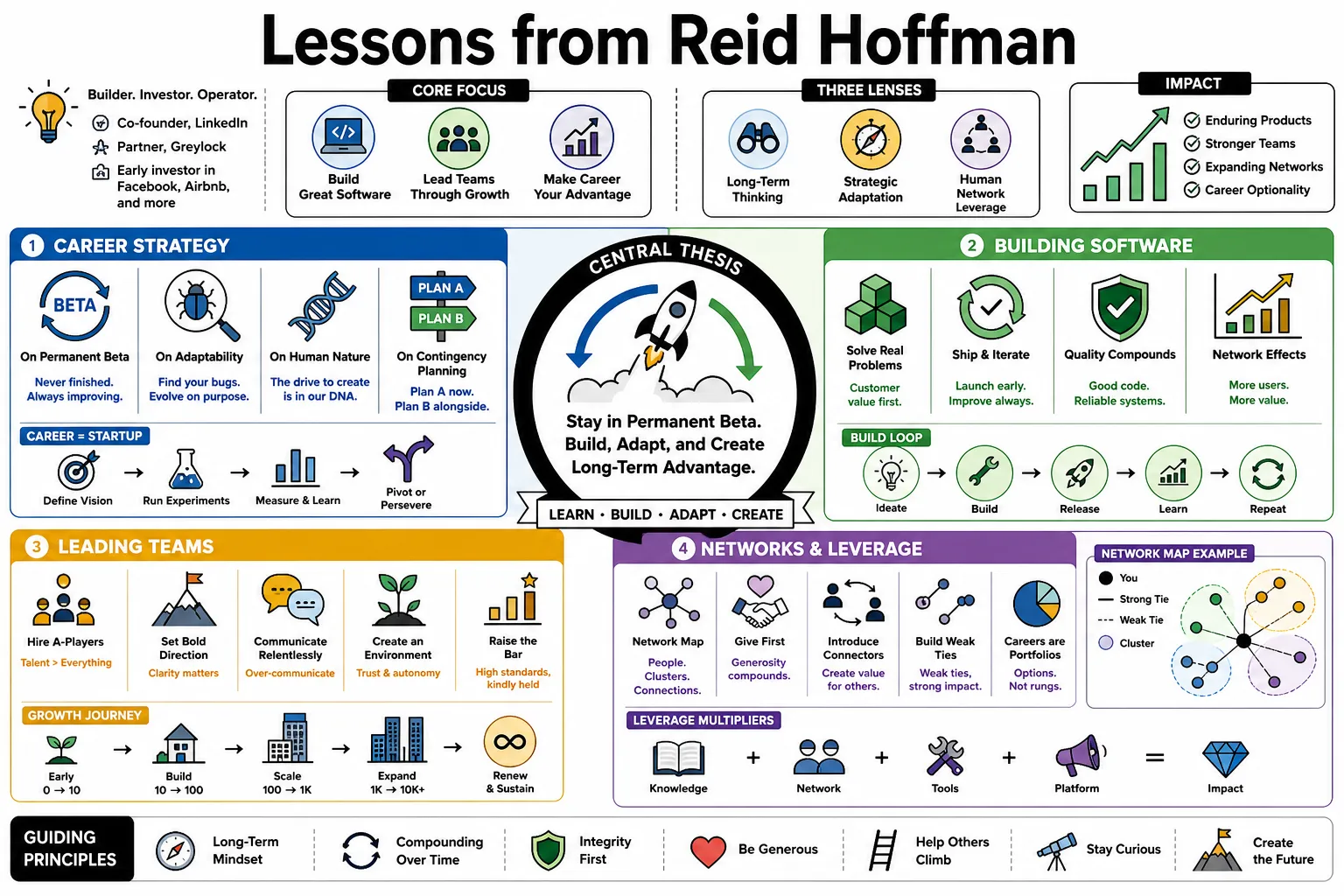
Lessons from Reid Hoffman
Reid Hoffman co-founded LinkedIn before joining Greylock Partners, where he became an early investor in companies like Facebook and Airbnb. This collection organizes his advice on building software and managing teams through periods of rapid growth. It also covers his well-known frameworks for mapping professional networks and treating a career like a startup.
Part 1: Career Strategy
- On permanent beta: "Finished ought to be an F-word for all of us. We are all works in progress. Each day presents an opportunity to learn more, do more, be more, grow more in our lives and careers." — Source: [The Startup of You]
- On adaptability: "Keeping your career in permanent beta forces you to acknowledge that you have bugs, that there's new development to do on yourself, that you will need to adapt and evolve." — Source: [The Startup of You]
- On human nature: "All humans are entrepreneurs not because they should start companies but because the will to create is encoded in human DNA, and creation is the essence of entrepreneurship." — Source: [The Startup of You]
- On contingency planning: "Plan A is the current implementation of your competitive advantage. Plan B runs in tandem, and if plan A is no longer working or a new better way is discovered, then a pivot to Plan B can be painless. Plan Z is the 'lifeboat' option." — Source: [The Startup of You]
- On identifying soft assets: "Often it's when you come in contact with challenges other people find hard but you find easy that you know you're in possession of a valuable soft asset." — Source: [Goodreads]
- On market ownership: "If you want to own the market, sell something others can't." — Source: [Reddit AMA]
- On the career journey: "There is no beginning, middle, or end to a career journey; no matter how old you are or at what stage, you will always be planning and adapting." — Source: [The Startup of You]
- On self-improvement: "The fastest way to change yourself is to hang out with people who are already the way you want to be." — Source: [Forbes]
- On continuous learning: "In a rapidly changing economy, individuals must manage their careers with the same mindset, agility, and strategies as a startup to avoid obsolescence." — Source: [The Startup of You]
- On assessing risk: "Risk isn't just about what you could lose by making a move; the greatest risk often lies in remaining stagnant while the industry evolves around you." — Source: [The Startup of You]
Part 2: Networks and Relationships
- On quality over quantity: "It's better to be the best connected than the most connected." — Source: [Glasp]
- On finding opportunity: "Opportunities do not float like clouds in the sky. They're attached to people. If you're looking for an opportunity, you're really looking for a person." — Source: [Glasp]
- On redefined networking: "One of the challenges in networking is everybody thinks it's making cold calls to strangers. Actually, it's the people who already have strong trust relationships with you, who know you're dedicated, smart, a team player, who can help you." — Source: [Glasp]
- On mutual benefit: "Your network is the people who want to help you, and you want to help them, and that's really powerful." — Source: [QuoteFancy]
- On building alliances: "Build a network of alliances to help you with intelligence, resources, and collective action." — Source: [Goodreads]
- On shared interests: "In a sentence, as you meet your friends and new people, shift from asking yourself the very natural question of 'What's in it for me?' and ask instead, 'What's in it for us?' All follows from that." — Source: [Goodreads]
- On network engagement: "If you are not receiving or making at least one introduction a month, you are probably not fully engaging your extended professional network." — Source: [Goodreads]
- On information flow: "The people you surround yourself with shape the information you receive; a diverse network acts as a crucial filtering mechanism for high-quality intelligence." — Source: [The Startup of You]
- On building trust: "A transformative, albeit risky, approach to building relationships involves providing value without explicit expectations of return, solely to improve the relationship and help others." — Source: [MikeCoach]
- On problem-solving networks: "What great founders do is seek the networks that will be essential to their problem and their task." — Source: [Medium]
Part 3: Entrepreneurship and Startups
- On launching products: "If you are not embarrassed by the first version of your product, you've launched too late." — Source: [Glasp]
- On taking the leap: "An entrepreneur is someone who jumps off a cliff and builds a plane on the way down." — Source: [Glasp]
- On ambition: "If you don't start out aiming for the big game, you almost never can get there." — Source: [Glasp]
- On the reality of founders: "The reality is: a founder is someone who deals with a ton of different headaches and no one is universally super-powered." — Source: [Medium]
- On multi-disciplinary skills: "In the field of technology startups, a multidisciplinary focus tends to be a higher predictor of entrepreneurial success than even a sole focus on a topic like computer science." — Source: [Glasp]
- On decision speed: "Observe, orient, decide, act. It's fighter pilot terminology... In Silicon Valley, the OODA loop of your decision-making is effectively what differentiates [the winners from the losers]." — Source: [Glasp]
- On professional instinct: "I think, as a rule of thumb, if you're a good entrepreneur you can assume that your instincts are right 95 percent of the time and your ideas might be right 25 percent of the time." — Source: [Goodreads]
- On distribution: "Having a great idea for a product is important, but having a great idea for product distribution is even more important." — Source: [AZQuotes]
- On failure: "You have to be willing to be wrong. You have to be willing to fail, because if you're not failing, you're not innovating enough." — Source: [Masters of Scale]
- On iteration: "Successful companies don't usually start with the perfect idea; they start with a decent hypothesis and evolve rapidly based on user interaction." — Source: [Masters of Scale]
Part 4: Blitzscaling and Growth
- On the core concept: "Blitzscaling is a strategy and set of techniques for driving and managing extremely rapid growth that prioritize speed over efficiency in an environment of uncertainty." — Source: [Blitzscaling]
- On speed versus efficiency: "Blitzscaling means that you're willing to sacrifice efficiency for speed, without waiting to achieve certainty on whether the sacrifice will pay off." — Source: [Strategy+Business]
- On letting fires burn: "When you have a fast-scaling company, the focus must be on moving forward. You won't always know which fire to stamp out first. And if you try to put out every fire at once, you'll only burn yourself out. That's why entrepreneurs have to learn to let fires burn—and sometimes even very large fires." — Source: [Goodreads]
- On accepting risk: "When you're moving at the speed of light, your decisions require commitment, even if your confidence is trailing somewhere behind you. Blitzscaling requires you to accept the risk in every decision you make." — Source: [Coda]
- On the plane analogy: "If classic startup growth is about slowing your rate of descent as you try to assemble your plane, blitzscaling is about assembling that plane faster, then strapping on and igniting a set of jet engines (and possibly their afterburners) while you're still building the wings." — Source: [Strategy+Business]
- On first-mover advantage: "The only time that it makes sense to blitzscale is when you have determined that speed into the market is the critical strategy to achieve massive outcomes." — Source: [Webutvikling]
- On relative motion: "Blitzscaling is always relative because of speed; it's relative motion." — Source: [Greylock]
- On expanding beyond tech: "The great thing about blitzscaling is this strategy doesn't just work for high-tech companies. It has already been used in markets the length and breadth of the economy." — Source: [Summaries.com]
- On scaling organizations: "Growth is not just about scaling the product or customer base, but rapidly re-architecting the organizational structure multiple times within a short period." — Source: [Masters of Scale]
Part 5: Investing and Venture Capital
- On picking winners: "In the venture capital industry, just picking winners is a losing strategy. The goal is [to create them]." — Source: [Glasp]
- On future investment: "A business that isn't investing in tomorrow's opportunities and technologies – well, that's a company already in the process of dying." — Source: [Glasp]
- On founder backgrounds: "There are two things that need to be explained away in order for me to invest in your startup: An MBA or a background in management consulting." — Source: [Glasp]
- On capital and growth: "Blitzscaling requires capital—whether from investors or from cash flow—to fund relatively inefficient growth." — Source: [Goodreads]
- On the role of VC: "While often criticized, venture capital remains one of the most effective structures for funding high-risk innovation, outperforming government mandates or family wealth which rely on politics and nepotism." — Source: [Pulse 2.0]
- On network intelligence for VCs: "A venture capitalist's primary edge is not their internal spreadsheet analysis, but their ability to tap a network of experts to rapidly evaluate a founding team and market." — Source: [Masters of Scale]
- On contrarian ideas: "The most lucrative investments often look like terrible ideas to the majority of people; if an idea looks obvious, the market is likely already saturated." — Source: [Masters of Scale]
- On scaling capital: "The venture model is designed for power laws; investors aren't looking for companies that will return 2x their money, but the rare few that will return 100x." — Source: [Masters of Scale]
- On evaluating founders: "The best founders possess a paradoxical combination of traits: they are passionately stubborn about their long-term vision but intensely flexible about the short-term tactics to get there." — Source: [Greylock]
Part 6: Artificial Intelligence
- On human augmentation: "AI should be viewed not as a replacement for human capability, but as a 'co-pilot' that amplifies human creativity and productivity." — Source: [Impromptu]
- On computational math: "Large language models are essentially a form of advanced computational math that can produce natural [language]." — Source: [Goodreads]
- On forming bonds: "Similar to how people form relationships with pets, humans are beginning to form incredibly close and important bonds with non-human intelligences." — Source: [EconTalk]
- On empathetic design: "The next generation of artificial intelligence must be designed to be explicitly supportive and empathetic and delightful to interact with." — Source: [On Being]
- On Generation AI: "Younger generations have the opportunity to define themselves as 'Generation AI'—individuals who possess a native, intuitive understanding of AI tools that older generations lack." — Source: [Y Combinator]
- On future labor models: "The integration of AI agents will allow individuals to move beyond traditional rigid work structures toward more creative, highly-leveraged entrepreneurial roles." — Source: [Every]
- On human agency: "Society is not powerless against technological change; we have the agency to steer artificial intelligence toward positive, inclusive outcomes." — Source: [Possible with Reid Hoffman]
- On the AI race: "The current competition in AI should not be viewed as a zero-sum cage match, but rather as a broad, fundamental technological shift offering vast opportunities for innovation." — Source: [Possible with Reid Hoffman]
- On ethical deployment: "Speed in AI development must be balanced with responsible scaling, but halting progress entirely cedes the future to those who may not share democratic values." — Source: [Impromptu]
Part 7: Leadership and Management
- On the solo game: "No matter how brilliant your mind or strategy, if you're playing a solo game, you'll always lose out to a team." — Source: [AZQuotes]
- On employee retention: "The fundamental paradox of the tour of duty: acknowledging that the employee might leave is actually the best way to build trust, and thus develop the kind of relationship that convinces great people to stay." — Source: [Goodreads]
- On corporate networks: "You need to make it clear that the company isn't supporting networks as an employee benefit, but rather as a mutually beneficial asset that helps the company as well." — Source: [Goodreads]
- On the employer-employee pact: "The modern workplace requires a new pact based on mutual benefit rather than lifetime employment; companies help employees increase their market value, and employees help companies become more valuable." — Source: [The Alliance]
- On the tour of duty: "Structuring employment as a 'tour of duty'—a specific mission with a defined timeline and mutual expectations—aligns company goals with individual career growth." — Source: [The Alliance]
- On honest conversations: "Leaders must be willing to have honest conversations with their teams about the fact that most employees will eventually work somewhere else, and plan the relationship accordingly." — Source: [The Alliance]
- On alumni networks: "A company's relationship with an employee shouldn't end when they leave; robust corporate alumni networks are powerful sources for new hires, intelligence, and business partnerships." — Source: [The Alliance]
- On corporate culture: "Culture isn't a set of values written on a wall; it's the actual behavior you reward and punish within the organization on a daily basis." — Source: [Masters of Scale]
- On scaling hiring: "When scaling rapidly, you often have to hire executives who are highly specialized for the exact stage the company is currently navigating, rather than generalists who are good at everything." — Source: [Masters of Scale]
Part 8: Society and the Future
- On the humanities in tech: "Studying philosophy provides a unique toolkit for founders, teaching them to rigorously analyze human nature, language, and the underlying logic of complex systems." — Source: [Masters of Scale]
- On civic responsibility: "As technology companies scale to touch billions of lives, founders must transition from being just product builders to being responsible stewards of global civic infrastructure." — Source: [Greylock]
- On technology's role: "Technology is fundamentally a mechanism for amplifying human intention; it takes what humans want to do and gives them the leverage to do it at scale." — Source: [Impromptu]
- On navigating uncertainty: "In a rapidly changing world, the most valuable skill is not predicting the exact future, but building the personal and organizational agility to survive and capitalize on whatever happens." — Source: [The Startup of You]
- On structural change: "Meaningful societal progress requires moving beyond individual philanthropy to address the structural and systemic bottlenecks that prevent broad-based prosperity." — Source: [Medium]
- On the power of the internet: "The internet’s true revolutionary power is not in processing data, but in its ability to connect individuals and build global communities around shared interests." — Source: [LinkedIn Pulse]
- On the long game: "Success requires a paradoxical focus: executing fiercely on the immediate tactics of today while never losing sight of the multi-decade vision of the future." — Source: [Masters of Scale]
- On intellectual honesty: "The best thinkers actively seek out people who will disagree with them, understanding that stress-testing ideas against intelligent opposition is the only way to refine them." — Source: [The Startup of You]
- On personal legacy: "A person's ultimate legacy is measured not by the companies they built or the wealth they accumulated, but by the network of people they elevated and empowered along the way." — Source: [Masters of Scale]