Lessons from René Lacerte
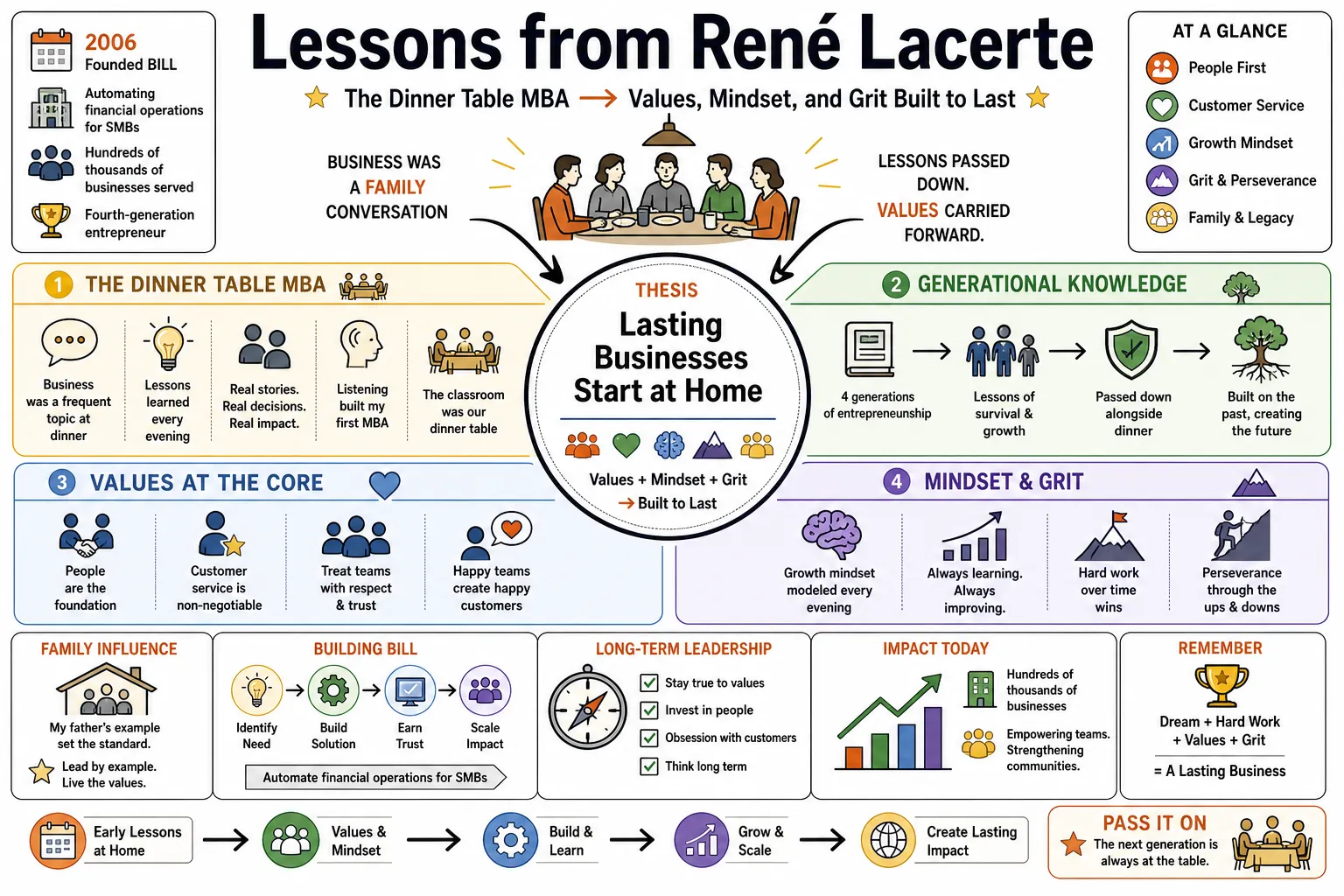
René Lacerte founded BILL in 2006 to automate financial operations for small and mid-sized businesses. A fourth-generation entrepreneur, he drew on his family's finance background to build a platform that now serves hundreds of thousands of companies. This collection gathers his advice on long-term leadership and the practical realities of building products and running a business.
Part 1: The Dinner Table MBA
- On Upbringing: "Business was a frequent topic of conversation growing up; it taught me that entrepreneurship is possible with a dream and hard work." — Source: [Thirty Minute Mentors]
- On Generational Knowledge: "Being a fourth-generation entrepreneur means the lessons of business survival and growth were passed down alongside dinner." — Source: [Forbes]
- On Core Values: "The nightly discussions at home ingrained in me the importance of people and customer service." — Source: [Thirty Minute Mentors]
- On Growth Mindset: "A growth mindset wasn't something I read in a book; it was modeled for me every evening at the dinner table." — Source: [Thirty Minute Mentors]
- On Grit: "You learn early on that building a successful, lasting business requires an immense amount of hard work and perseverance." — Source: [Fintech Leaders]
- On Family Influence: "My father’s dedication as a jazz pianist shaped my understanding of what it means to commit to excellence." — Source: [Fintech Leaders]
- On Early Exposure: "Listening to my parents and grandparents discuss their financial services businesses gave me an informal MBA before I even went to college." — Source: [Thirty Minute Mentors]
- On Practical Education: "The most valuable lessons weren't always academic; they were the practical realities of running a daily operation." — Source: [Thirty Minute Mentors]
- On Business as a Vocation: "Entrepreneurship was treated as a calling that demands dedication, rather than a simple job." — Source: [Forbes]
- On Enduring Lessons: "The principles of resilience I learned at home remain the foundation of how I operate today." — Source: [Fintech Leaders]
Part 2: The Fortune 5 Million
- On Market Focus: "Small and mid-sized businesses are the backbone of the U.S. economy, which I call the Fortune 5 Million." — Source: [Fintech Leaders]
- On Enterprise Inequality: "While large corporations have long enjoyed sophisticated automated tools, small businesses have historically been forced to rely on manual, friction-heavy processes." — Source: [BILL Blog]
- On Leveling the Field: "Our mission is to provide these smaller businesses with enterprise-grade financial capabilities." — Source: [BILL Blog]
- On SMB Resilience: "The businesses that make up the Fortune 5 Million show incredible adaptability and strength, even in wait-and-see economies." — Source: [SaaStr]
- On Economic Impact: "When you empower small companies with better tools, you are directly impacting the engine of job creation." — Source: [Fintech Leaders]
- On Underserved Markets: "For too long, software providers ignored the complex needs of smaller businesses, assuming they were too small to need specific financial infrastructure." — Source: [PYMNTS]
- On Operational Friction: "Removing the manual friction from back-office tasks gives business owners their time back to focus on growth." — Source: [BILL Blog]
- On Democratizing Technology: "AI and automation must be accessible to the corner store and the local agency, rather than reserved for large enterprises." — Source: [Digits]
- On Community Strength: "The success of the Fortune 5 Million translates into the success of local communities nationwide." — Source: [Fintech Leaders]
- On Building for the Masses: "Scaling to half a million customers means understanding that every smaller company has unique workflows that need a unified platform." — Source: [SaaStr]
Part 3: Owner Mode
- On Leadership Frameworks: "I prefer 'Owner Mode' over the traditional debate between founder mode and manager mode." — Source: [Digits]
- On Accountability: "Owner Mode means being accountable for the future today." — Source: [Digits]
- On Balancing Approaches: "An owner knows when to deploy the creativity of a founder and when to lean on the rigorous process of a manager." — Source: [Digits]
- On Long-term Thinking: "You have to make decisions that address immediate quarterly needs while ensuring the company thrives over a 10- to 20-year horizon." — Source: [Digits]
- On Empowering Others: "My job as a leader is to enable others to be the best versions of themselves." — Source: [Exco Leadership]
- On Authenticity: "Authenticity and humility must be the core values driving any organization in Owner Mode." — Source: [Exco Leadership]
- On Decision Making: "Think like an owner; if it were your money and your sole responsibility, how would you solve the problem?" — Source: [Digits]
- On Avoiding Complacency: "Lifelong learners are never satisfied with the status quo, which is a prerequisite for staying in Owner Mode." — Source: [Forbes]
- On Corporate Governance: "A contrarian view on governance is sometimes necessary; you need patient capital that aligns with an owner's timeline." — Source: [Fintech Leaders]
- On Sustained Passion: "To operate in Owner Mode for decades, you must maintain the same passion you had on day one." — Source: [Digits]
Part 4: Patience and Impatience
- On the Core Balance: "Success requires mastering the balance of patience and impatience." — Source: [Fintech Leaders]
- On Market Readiness: "You have to be patient enough to let markets, software, and customer relationships develop organically." — Source: [Fintech Leaders]
- On Knowing When to Push: "Impatience is necessary when you recognize an opportunity to accelerate progress and push aggressively." — Source: [Fintech Leaders]
- On Timing: "Understanding the right time to wait and the right time to execute is the hardest skill for an entrepreneur to learn." — Source: [SaaStr]
- On Product Development: "Building reliable financial software takes time; you cannot rush the foundation, but you must iterate rapidly on the features." — Source: [McKinsey]
- On Managing Stakeholders: "Investors often demand speed, but an entrepreneur must buffer the team to ensure quality isn't sacrificed for artificial deadlines." — Source: [SaaStr]
- On Enduring the Grind: "Patience means surviving the years when no one understands what you are building." — Source: [Mixergy]
- On Seizing Momentum: "When the market finally catches up to your vision, that is the moment for absolute impatience." — Source: [Fintech Leaders]
- On Strategic Patience: "We waited years for the right conditions to shift from subscription models to payments-based revenue." — Source: [SaaStr]
Part 5: Building to Last
- On Company Lifespan: "I am a strong proponent of building companies for the long term rather than building them to flip." — Source: [Fintech Leaders]
- On Foundational Choices: "The decisions you make in year one will echo in year fifteen; build the architecture to support decades of growth." — Source: [Fintech Leaders]
- On Patient Capital: "Aligning with investors who understand patient capital is necessary for companies intending to go the distance." — Source: [Fintech Leaders]
- On Sustainable Growth: "Growth at all costs often leads to a fragile foundation; disciplined growth builds endurance." — Source: [SaaStr]
- On Mission Persistence: "Leading this company since 2006 has shown me that a durable mission can outlast any economic cycle." — Source: [BILL Blog]
- On Prioritizing Survival: "The primary directive of a founder who wants to build to last is ensuring the company survives its most vulnerable early years." — Source: [Mixergy]
- On Acquisition Strategy: "When we acquired Divvy, it wasn't a short-term play; it was a long-term integration to complete our financial offerings." — Source: [SaaStr]
- On Legacy: "You want to create an institution that continues to solve problems long after the initial founding team has moved on." — Source: [Fintech Leaders]
- On Structural Integrity: "A company built to last requires a culture rooted in trust and a shared vision for the future." — Source: [Exco Leadership]
Part 6: Artificial Intelligence and Automation
- On Pragmatic AI: "Small business owners don't want more AI; they want less work." — Source: [Digits]
- On AI as a Tool: "We view artificial intelligence as a tool to augment human capability instead of a replacement for human effort." — Source: [Digits]
- On Becoming AI-Native: "Transitioning into an AI-native company means embedding intelligence into the workflows where users already spend their time." — Source: [Payments Dive]
- On Reducing Drudgery: "The ultimate promise of automation in finance is eliminating the soul-crushing data entry that holds businesses back." — Source: [McKinsey]
- On Seamless Integration: "The best AI features are the ones the customer doesn't even realize are AI, where they just know the product works better." — Source: [Digits]
- On Trust in Automation: "In B2B payments, trust is paramount; automation must be accurate, secure, and completely reliable before it is adopted." — Source: [McKinsey]
- On Shifting Focus: "When automation handles the mundane, finance teams can shift their focus to strategic analysis and growth." — Source: [BILL Blog]
- On Technological Hype: "Look past the hype cycle of new technologies and focus entirely on whether it solves a real pain point for the user." — Source: [Digits]
- On Constant Evolution: "You must be willing to disrupt your own product with AI before a competitor does it for you." — Source: [Forbes]
Part 7: Customer Centricity and Empathy
- On Discovering Needs: "Product-market fit requires leading customers to solutions they didn't even know they needed." — Source: [Forbes]
- On Empathy: "Deep empathy for the struggles of a business owner is the most important trait a product manager can possess." — Source: [Thirty Minute Mentors]
- On Listening: "You cannot build a platform for half a million customers without obsessively listening to their feedback." — Source: [SaaStr]
- On Solving Pain: "We didn't start with a desire to build software; we started with a desire to eliminate the pain of paying bills." — Source: [PYMNTS]
- On Disrupting Yourself: "Entrepreneurs must innovate continuously until they can disrupt their own successful models for the benefit of the customer." — Source: [Forbes]
- On Customer Success: "If the software doesn't demonstrably save the customer time and money, it has failed its primary objective." — Source: [BILL Blog]
- On User Experience: "Enterprise-grade capability shouldn't mean enterprise-level complexity; the user experience must remain intuitive." — Source: [McKinsey]
- On Being a Partner: "We view ourselves as a financial partner invested in the survival and growth of our clients, rather than a mere vendor." — Source: [Fintech Leaders]
- On Adapting to Markets: "In a wait-and-see economy, your product must provide absolute clarity and control to anxious business owners." — Source: [SaaStr]
Part 8: Grit and the Entrepreneurial Journey
- On Initial Struggle: "When I started PayCycle, I learned quickly that the path from an idea to a sustainable business is paved with rejection." — Source: [Mixergy]
- On Self-Belief: "You need a certain level of irrational optimism to believe you can change how millions of businesses operate." — Source: [Mixergy]
- On Early Hustle: "Sometimes you have to start with the 'money in your back pocket' approach and prove the concept before anyone else will believe in it." — Source: [Mixergy]
- On Enduring Hardships: "Grit involves maintaining emotional stability when everything seems to be going wrong, beyond simply working long hours." — Source: [Fintech Leaders]
- On the Role of Luck: "Hard work puts you in a position to be lucky, but resilience keeps you in the game long enough for luck to find you." — Source: [Thirty Minute Mentors]
- On Moving Forward: "Every failure is data. The faster you process that data without taking it personally, the faster you succeed." — Source: [Thirty Minute Mentors]
- On Lifelong Learning: "The day you stop wanting to learn is the day your business begins its decline." — Source: [Forbes]
- On Building Teams: "Resilience is a team sport; you must surround yourself with people who can share the emotional load of building a company." — Source: [Exco Leadership]
- On The Ultimate Goal: "The entrepreneurial journey is difficult, but the reward of seeing a small business thrive because of your tool makes it entirely worthwhile." — Source: [BILL Blog]