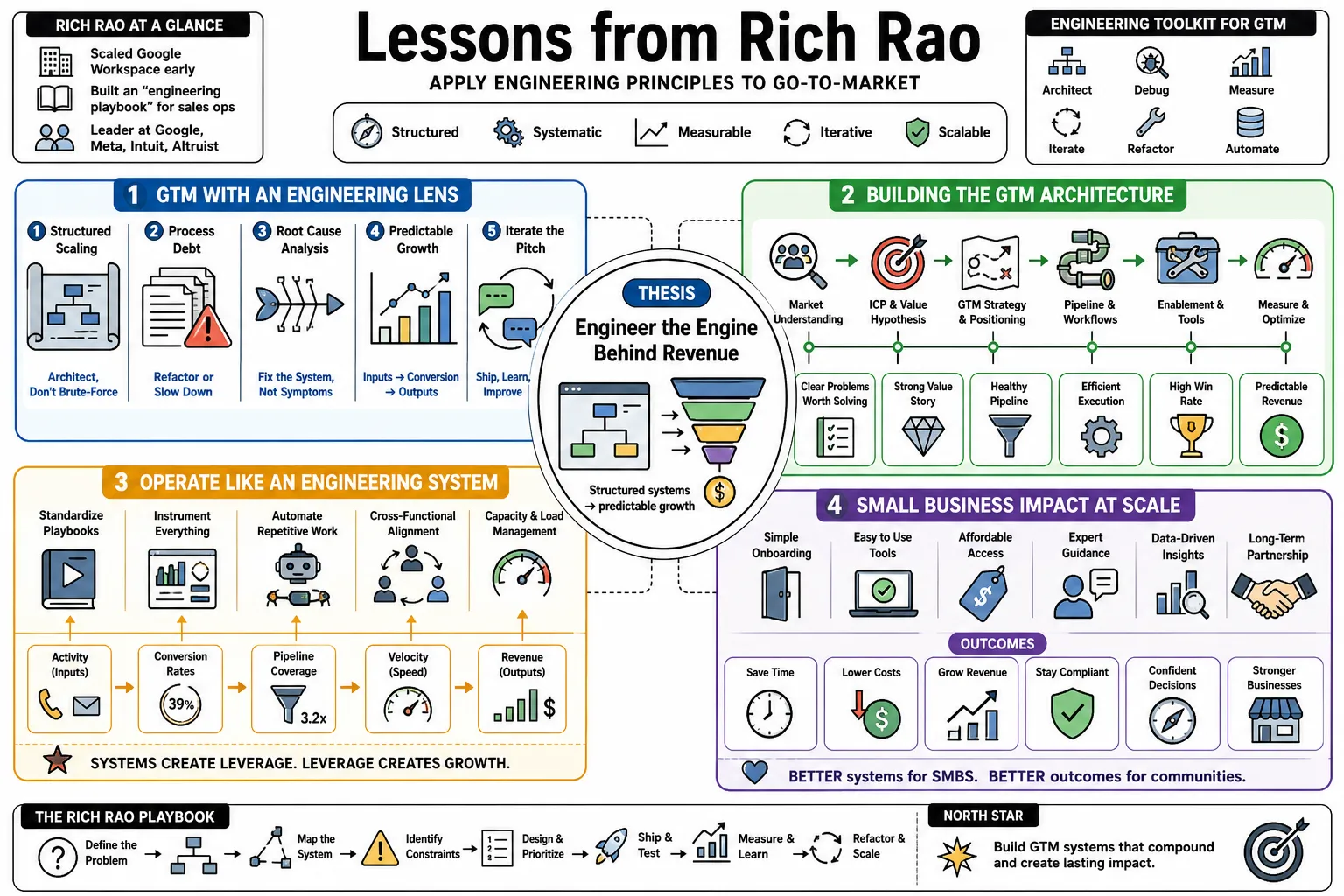
Lessons from Rich Rao
Rich Rao applies engineering principles to go-to-market strategy across his leadership roles at Google, Meta, Intuit, and Altruist. He is best known for scaling Google's early Workspace suite and building an "engineering playbook" for sales operations. This profile collects his frameworks for revenue growth, product roadmaps, and small business support.
Part 1: GTM with an Engineering Lens
- On structured scaling: "Go-to-market strategy shouldn't rely on brute-force selling; it requires the same architectural rigor as building software." — Source: [First Round Review]
- On process debt: "Sales operations can accumulate technical debt exactly like code. If you avoid refactoring your GTM processes, you slow down execution across the board." — Source: [First Round Review]
- On root cause analysis: "When sales dip, don't default to pushing the team to make more calls. Look for the system failure in your pipeline architecture." — Source: [First Round Review]
- On predictable growth: "Engineering approaches remove the mysticism from sales. It becomes a matter of inputs, conversion rates, and predictable outputs." — Source: [In Depth Podcast]
- On iterating the pitch: "Treat your core sales narrative like a product feature. Ship it, gather feedback, and ship a revision." — Source: [First Round Review]
- On data-driven decision making: "Sales intuition is valuable but scales poorly. You need systems that capture data so the entire organization learns from a single rep's win." — Source: [First Round Review]
- On continuous integration in sales: "Training shouldn't be a quarterly event. We integrated learning directly into the daily workflow of the sales floor." — Source: [In Depth Podcast]
- On debugging GTM: "If a channel stops working, treat it like a software bug. Isolate the variables until you find what broke." — Source: [First Round Review]
- On cross-functional language: "Engineers and sales teams often speak different languages. Translating GTM goals into engineering terms aligns the entire company." — Source: [First Round Review]
- On automation: "Automate the repetitive parts of the sales cycle so humans can spend time on the complex negotiations that require empathy." — Source: [First Round Review]
Part 2: Scaling Sales and Operations
- On early Google sales: "We were building the airplane while flying it with Google Workspace. Scaling meant defining playbooks for products that were still changing daily." — Source: [First Round Review]
- On hiring for scale: "You need different sales leaders at $1 million than you do at $100 million. The early team figures out the playbook; the next team operationalizes it." — Source: [In Depth Podcast]
- On global expansion: "What works in North America rarely translates directly to other markets without localization in both product and sales approach." — Source: [First Round Review]
- On specialization: "As teams grow, generalist reps become a bottleneck. You have to segment by industry, company size, and product line." — Source: [First Round Review]
- On compensation: "Incentives drive behavior. If you want a team to sell the new product instead of the easy legacy product, the commission structure has to reflect that reality." — Source: [First Round Review]
- On sales ops: "Sales operations is the central nervous system of a scaling organization. Underinvesting here means flying blind." — Source: [First Round Review]
- On managing growth: "Rapid growth masks operational inefficiencies. You only see the cracks in your sales process when the market slows down." — Source: [In Depth Podcast]
- On feedback loops: "The fastest way to improve a product is to shorten the distance between the frontline sales rep and the product manager." — Source: [First Round Review]
- On forecasting: "Accurate forecasting isn't about predicting the future; it's about understanding the present state of every deal in your pipeline." — Source: [First Round Review]
- On capacity planning: "You can't hire 50 reps in December and expect them to hit quota in January. Ramping takes time, and capacity models must account for it." — Source: [First Round Review]
Part 3: Small Business Strategy
- On SMB resilience: "Small businesses are often the most adaptable segment of the economy because the owners are making decisions on the front lines every day." — Source: [Entrepreneur Magazine]
- On digital adoption: "For many small businesses, the shift to digital wasn't a strategy; it was a survival mechanism that eventually became a growth engine." — Source: [Entrepreneur Magazine]
- On advertising for SMBs: "Meta's goal for small businesses was to make enterprise-level targeting accessible to a local bakery with a $50 ad budget." — Source: [First Round Review]
- On cash flow: "Revenue is vanity, but cash flow is reality. Most small businesses fail because of bad timing on their receivables, rather than a bad idea." — Source: [Entrepreneur Magazine]
- On hiring locally: "Small businesses compete for talent differently than tech giants. They win on flexibility, community connection, and direct impact." — Source: [Entrepreneur Magazine]
- On competing with giants: "You can't outspend large corporations, but you can out-care them. Customer intimacy is a small business's strongest moat." — Source: [Entrepreneur Magazine]
- On technology stacks: "SMBs want fewer problems, rather than more software. The tools that win are the ones that integrate seamlessly into their messy realities." — Source: [Entrepreneur Magazine]
- On community building: "Local businesses grow by embedding themselves in their communities, both offline and online." — Source: [Entrepreneur Magazine]
- On resource constraints: "Having limited capital forces prioritization. It makes you verify demand before you build supply." — Source: [Entrepreneur Magazine]
- On adapting to change: "The pandemic proved that small businesses could rewrite their entire operational models over a weekend if the situation demanded it." — Source: [Entrepreneur Magazine]
Part 4: Product Pricing and Packaging
- On free trials: "We learned early on with Workspace that free trials often attract users with zero intent to buy, clogging the pipeline and skewing product feedback." — Source: [First Round Review]
- On the friction of paying: "Asking a customer for a credit card early forces the issue of value. If they refuse to pay a small amount now, they won't pay a large amount later." — Source: [First Round Review]
- On pricing tiers: "Good pricing architecture pushes customers into the tier where they receive the most value, rather than where the company simply makes the most margin." — Source: [In Depth Podcast]
- On perceived value: "Price signals quality. Underpricing an enterprise tool can actually increase sales friction because buyers assume it lacks capability." — Source: [First Round Review]
- On discounting: "Heavy discounting trains your sales team to sell on price over value, which erodes your brand over time." — Source: [First Round Review]
- On packaging features: "Don't lock your core value proposition behind a paywall. Charge for scale, security, and administrative control." — Source: [First Round Review]
- On testing prices: "Pricing isn't a static number you set at launch. It's a variable you should test in the market constantly." — Source: [In Depth Podcast]
- On annual contracts: "Annual upfront payments change the cash flow dynamics of a startup entirely, providing the capital to fund customer acquisition." — Source: [First Round Review]
- On usage-based pricing: "When revenue scales directly with customer usage, your support and success teams effectively become revenue generators." — Source: [First Round Review]
Part 5: Navigating Economic Shifts
- On inflation: "During inflationary periods, small businesses can't simply absorb costs; they have to rethink their pricing structures and supplier relationships." — Source: [Entrepreneur Magazine]
- On cost cutting: "When the market tightens, cut the experiments that aren't working quickly, but protect the core engines of growth." — Source: [Entrepreneur Magazine]
- On operational efficiency: "A downturn is an opportunity to fix the leaky buckets in your GTM motion that you ignored when capital was cheap." — Source: [First Round Review]
- On customer retention: "In a recession, retaining a customer is exponentially cheaper than acquiring a new one. Shift resources from acquisition to success." — Source: [First Round Review]
- On vendor consolidation: "When budgets shrink, companies look to consolidate vendors. Your product needs to solve multiple problems to avoid being cut." — Source: [In Depth Podcast]
- On transparent communication: "If you have to raise prices due to supply chain costs, tell your customers exactly why. They respect transparency over hidden fees." — Source: [Entrepreneur Magazine]
- On cash reserves: "Operating with a wider margin of safety isn't inefficient; it ensures you survive to see the next bull market." — Source: [Entrepreneur Magazine]
- On shifting GTM strategies: "A macro shift requires a micro adjustment in your sales pitch. You have to speak to the pain your customer is feeling right now." — Source: [First Round Review]
- On finding opportunity: "The companies that emerge strongest from economic downturns are the ones that continued to invest in product while competitors pulled back." — Source: [Entrepreneur Magazine]
Part 6: Customer Value and Innovation
- On entering fintech: "Joining Altruist was about connecting a massive market opportunity with a platform that fundamentally improves the advisor-client relationship." — Source: [Altruist Blog]
- On the RIA market: "Registered Investment Advisors need technology that gets out of the way so they can focus on behavioral coaching and financial planning." — Source: [Altruist Blog]
- On customer-centric design: "Innovation doesn't always mean adding features. Often, it means removing steps from a workflow." — Source: [Altruist Blog]
- On scaling support: "As you scale, customer support must transition from a reactive cost center to a proactive driver of product improvements." — Source: [Altruist Blog]
- On building trust: "In financial services, trust is your product. The technology simply facilitates the delivery of that trust at scale." — Source: [Altruist Blog]
- On onboarding: "The first 30 days of a customer's experience dictate the next three years of their lifecycle." — Source: [First Round Review]
- On solving the right problem: "Customers will ask for a faster horse. Your job is to understand why they want to go faster, then build the engine." — Source: [Altruist Blog]
- On ecosystem integration: "No product lives in a vacuum. Your value increases based on how well you play with the other tools your customer relies on." — Source: [First Round Review]
- On long-term value: "We optimize for customer lifetime value over initial contract value. That forces us to ensure the product actually works for them after the sale." — Source: [Altruist Blog]
Part 7: Building Roadmaps and Architecture
- On defining the roadmap: "A GTM roadmap should look like a product roadmap. It needs specific milestones, clear owners, and strict dependencies." — Source: [First Round Review]
- On prioritization: "Saying no to good ideas is the only way you maintain the capacity to execute on the great ones." — Source: [In Depth Podcast]
- On architectural integrity: "If you build your sales processes on a weak foundation of bad CRM data, the entire structure will eventually collapse." — Source: [First Round Review]
- On cross-functional alignment: "The roadmap fails if marketing is building demand for a product feature that engineering has delayed by two quarters." — Source: [First Round Review]
- On measuring progress: "Don't measure progress by activity; measure it by outcomes. A thousand calls mean nothing if the conversion rate is zero." — Source: [First Round Review]
- On course correction: "You need instrumentation in your go-to-market motion so you know you're off track before you miss the quarter." — Source: [First Round Review]
- On legacy systems: "You eventually reach a point where patching the old system takes more energy than building a new one from scratch." — Source: [First Round Review]
- On sequencing: "Doing the right things in the wrong order will still lead to failure. Sequencing the rollout of new territories and products dictates success." — Source: [In Depth Podcast]
- On documentation: "If the process isn't documented, it doesn't exist. Tribal knowledge prevents an organization from scaling." — Source: [First Round Review]
Part 8: Leadership and Mentorship
- On building teams: "You hire for trajectory over past experience. Look for the slope of their career growth rather than the static y-intercept." — Source: [First Round Review]
- On setting expectations: "Clarity is the greatest gift a leader can give a team. Ambiguity breeds anxiety and wasted effort." — Source: [In Depth Podcast]
- On delegation: "If you are the bottleneck for every decision, you aren't leading; you are micromanaging. Push decision-making down to the edge." — Source: [First Round Review]
- On failure: "Create an environment where people can fail safely. If no one is failing, you aren't pushing the boundaries hard enough." — Source: [First Round Review]
- On career development: "A manager's job is to eventually work themselves out of a position by training their replacements." — Source: [First Round Review]
- On culture: "Culture is defined by the behaviors you reward and the behaviors you tolerate." — Source: [In Depth Podcast]
- On cross-team empathy: "The best sales leaders I know spend time shadowing engineering, and the best engineers sit in on sales calls." — Source: [First Round Review]
- On making hard calls: "Prolonging a difficult personnel decision doesn't help the team, and it certainly doesn't help the individual who is struggling." — Source: [In Depth Podcast]
- On retaining talent: "People don't leave companies; they leave bad managers. The best retention strategy is developing excellent leaders at the middle-management layer." — Source: [First Round Review]