Lessons from Richard Garriott
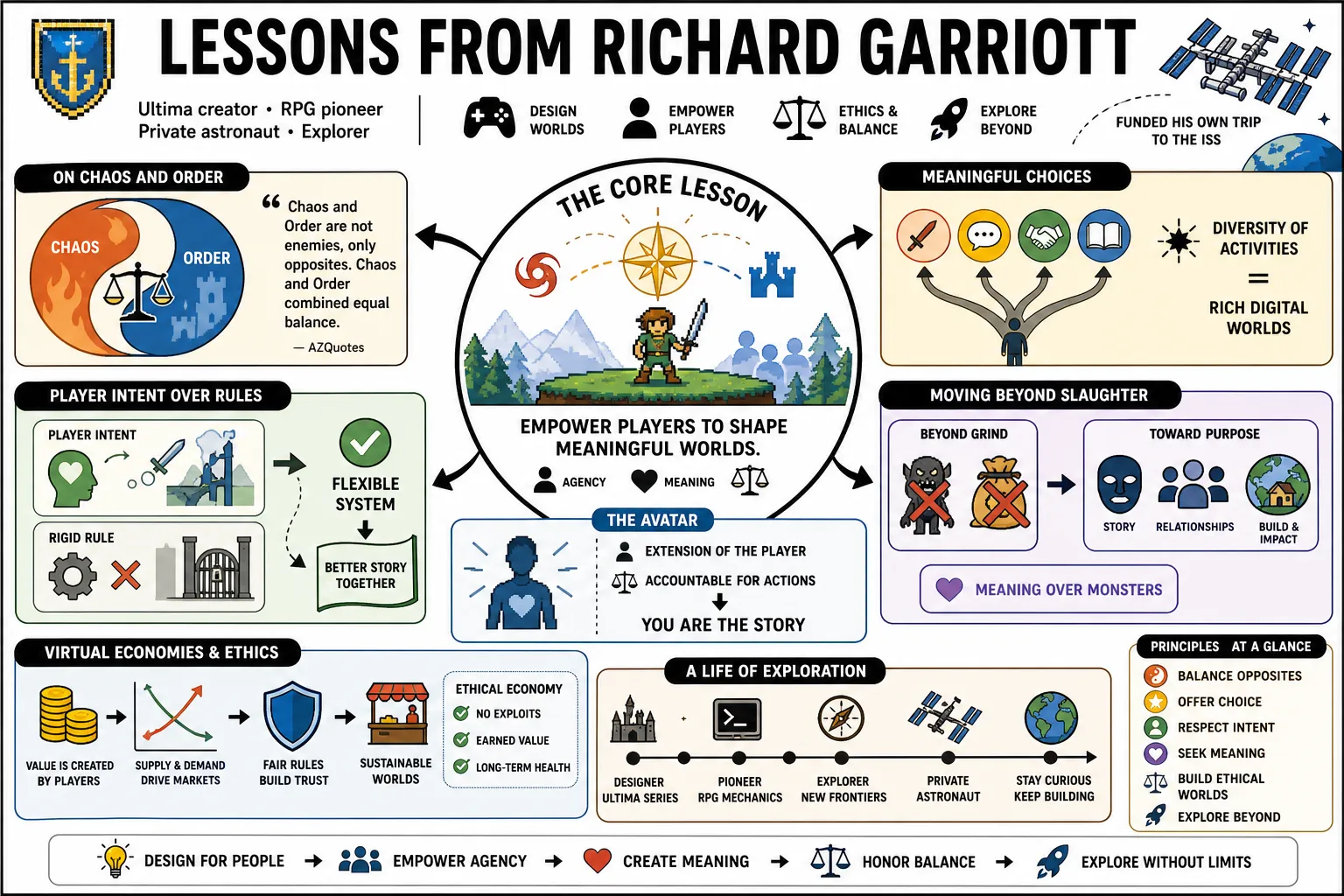
Richard Garriott designed the Ultima series and established the core mechanics and ethical systems of modern role-playing games. He later funded his own trip to the International Space Station as a private astronaut. This collection covers his approach to player agency, the psychology of virtual economies, and the realities of space travel.
Part 1: Game Design & Player Agency
- On Chaos and Order: "Chaos and Order are not enemies, only opposites. Chaos and Order combined equal balance." — Source: AZQuotes
- On Meaningful Choices: To compel a player, the game must offer enough unique ways to accomplish a task. Diversity of activities is what makes a digital world rich. — Source: AZQuotes
- On the Concept of the Avatar: Coining the term "Avatar" for a game was about making the character on screen an extension of the player themselves, holding them accountable for their actions. — Source: Ghost.io
- On Player Intent over Rules: If an action seems logical to the player and contributes to a better story, the game mechanics should flex to allow it. — Source: Ghost.io
- On Moving Beyond Slaughter: He sought to move games past the slog of fighting monsters and collecting treasure, pushing the medium toward something that evaluates behavior. — Source: Lightspeed Magazine
- On Game Evolution: The stories we tell in games should grow alongside the audience and move away from simple kingdom-saving tropes toward contemporary social relevance. — Source: Game Developer
- On Early Innovation: Helping to kick off role-playing games on computers and refining the earliest ideas remains a foundational aspect of his career. — Source: Ghost.io
- On Listening to Players: Systems built in isolation often fail, meaning modern developers must incorporate community feedback to avoid catastrophically constructed features. — Source: Ultima Codex
- On Internal Consistency: Magic and science in a game should function as internally consistent pseudo-science complete with linguistics and logic. — Source: Reddit
Part 2: The Virtue System & Morality
- On Literature as Inspiration: The poet Khalil Gibran provided a lens to look at virtues and vices in a succinct way, directly inspiring the ethical systems of his games. — Source: Lightspeed Magazine
- On Ethical Dilemmas: Morality in games is not about finding the correct answer, but navigating situations where the right choice is complex and demanding. — Source: Kotaku
- On Technology and Ethics: "Technology without ethics is pointless," a principle he applied heavily when shifting his design focus away from mere technological graphics. — Source: The Culture of Tech
- On Virtuous Gameplay: The goal of embedding virtues was to espouse positive behavior and judge the player based on the morality of their playstyle. — Source: Lightspeed Magazine
- On Designing the Virtues: Constructing the Virtue system required deep intellectual effort and research into philosophy to ensure it held up as a cohesive ethical framework. — Source: Lightspeed Magazine
- On Personal Accountability: By judging the player's actions against principles like truth, love, and courage, the game transforms into a tool for moral self-improvement. — Source: David Barr Kirtley
- On Shifting Antagonists: The most significant innovation in role-playing was realizing the ultimate challenge was not a single enemy, but the player's own moral compass. — Source: Kotaku
- On the Responsibility of the Creator: As a designer, incorporating ethical dilemmas forces players to engage with the concept of doing the right thing rather than indulging in combat. — Source: The Culture of Tech
- On Social Relevance: The embedding of ethical storylines allowed his games to speak directly to contemporary social issues and elevate the medium. — Source: Game Developer
Part 3: Ultima Online & Social Experiments
- On Legitimizing Evil Roles: "When we first launched Ultima Online, we set out to create a world that supported the evil player as a legitimate role." — Source: The Digital Antiquarian
- On Rising to the Challenge: Players complaining about antisocial behavior in a multiplayer game should instead use the tools at their disposal to shape the digital society into what they want it to be. — Source: The Digital Antiquarian
- On the MMO as a Social Experiment: Watching players interact in an open world is a grand statement about human nature that reveals how real social dynamics manifest digitally. — Source: The Digital Antiquarian
- On Emergent Gameplay: While ingenious strategies for player-killing or stealing were challenging, they proved that giving players total freedom leads to unpredictable behavior. — Source: LLTS
- On the Lord British Assassination: Players will always test the boundaries of a system and find ways to assassinate the creator during a beta test. — Source: Morgan Ramsay
- On Player Voice: Even when players are unhappy with a game, their choice to protest from within the game world itself proves the strength of their immersion. — Source: The Digital Antiquarian
- On Shifting Morality: Unlike single-player games that enforce virtue mechanically, multiplayer environments shift the burden of morality entirely onto the society of players. — Source: Reddit
- On New Player Experiences: The chaotic freedom of a purely player-driven society creates a harsh environment for newcomers that highlights the tension between liberty and safety. — Source: The Digital Antiquarian
- On Designing for Interaction: The focus of a multiplayer game should be the complex friction generated when thousands of human minds collide in a shared space. — Source: Scribd
- On the Reality of Digital Actions: The greed, cooperation, and malice seen in early multiplayer worlds demonstrated that digital actions carry real psychological weight. — Source: TV Tropes
Part 4: World-Building & Origin Systems
- On Creating Worlds: The corporate motto "We create worlds" was a mandate to prioritize rich universes over mere gameplay mechanics. — Source: Blogspot
- On Immersion: Crafting detailed game manuals, complex histories, and deep lore was essential to making a fictional universe feel like a tangible place. — Source: Ultima Codex
- On NPC Agency: Giving non-player characters their own schedules and daily lives was crucial to making Britannia feel like a living, breathing world. — Source: Ghost.io
- On Shared Adventures: A special part of his games was making himself and his team active participants in the world to show players that everyone is on the adventure together. — Source: Ultima Codex
- On Blending Reality and Lore: Real-life friends, employees, and members of his social circles were routinely immortalized as companions within his digital worlds. — Source: Hardcore Gaming 101
- On Narrative Independence: When faced with corporate friction, he used his game's narrative to subtly critique the forces threatening creative freedom by casting the antagonist as the "Destroyer of Worlds." — Source: Y Combinator
- On Creative Freedom: The golden era of PC gaming was defined by trusting designers with the autonomy to build expansive, story-driven experiences without strict corporate oversight. — Source: Reddit
- On World Continuity: "I'm creating a world which is not incompatible with what has come before," ensuring that long-running series maintain a cohesive, enduring history. — Source: Ultima Codex
- On Depth Over Mechanics: A truly memorable game relies less on the sheer mechanics of play and more on the depth of the world the player inhabits. — Source: Ultima Codex
- On The Final Polish: The evolution across game trilogies is a continuous process of technical, mechanical, and narrative refinement. — Source: Medium
Part 5: Britannia Manor & Experiential Living
- On Homes as Adventures: He viewed his properties as extensions of his game design and aimed to turn his house into an adventure through secret passages and hidden rooms. — Source: Ultima Codex
- On Immersive Entertainment: The legendary haunted houses at Britannia Manor were designed not as passive walk-throughs, but as full-contact, live-action puzzle experiences. — Source: Game Developer
- On Collecting Inspiration: "I collect and I look at these demonstration toys... and other electromechanical items to inspire the work I do. As a collector, these are personally important to me." — Source: PR Web
- On Embracing the Persona: While some viewed the Lord British title as adolescent, he fully embraced it as a commitment to living a life that feels like an epic quest. — Source: Josh Wieder
- On Tangible Fantasy: VICE described Britannia Manor as an elaborate house combining several kinds of teenage fantasy, a reminder that Garriott often turns imaginative worlds into physical, explorable spaces. — Reference: VICE profile of Britannia Manor
- On Meticulous Planning: Whether building a digital game or a real-world haunted house, the experience demands the same level of rigorous design and financial commitment. — Source: Wikipedia
- On the Drive to Create: The physical manifestation of Britannia Manor stems from the exact same creative drive that motivated him to program virtual worlds. — Source: Ultima Codex
- On Living History: Housing authentic space artifacts, vampire hunting kits, and automaton collections turns a residence into an active museum of human curiosity. — Source: Wikipedia
- On Experiential Architecture: A home can be an interactive environment, complete with a rotating observatory and dungeon, which blurs the line between domestic life and theatrical gameplay. — Source: Allen Varney
Part 6: The Drive for Exploration
- On the Cradle of Humanity: "The Earth is the cradle of humanity, but one cannot live in the cradle forever." — Source: The Moth
- On Dual Pursuits: The concepts of exploring and creating are not separate hobbies, but a central philosophical duality that feeds into every aspect of his work. — Source: Old Game Hermit
- On Real-World Inspiration: Expeditions to the Amazon, Antarctica, and the Titanic wreckage directly informed the depth and realism of his virtual ecosystems. — Source: Forbes
- On Refusing Limits: Told as a teenager he could not be a NASA astronaut due to his eyesight, he found alternative, commercial paths to achieve his lifelong goal. — Source: Astronomy Now
- On Life as a Game: He has often remarked that his real-world adventures feel like playing through one of his own carefully constructed role-playing campaigns. — Source: Vice
- On Extreme Exploration: Garriott's exploration record spans both poles, outer space, and the Mariana Trench, showing that his idea of exploration is physical, costly, and deliberately extreme. — Reference: Curiosity Weekly / Apple Podcasts episode on Garriott and the Explorers Club
- On Pushing Boundaries: The drive to explore hidden worlds is about constantly seeking new frontiers that challenge our understanding of what is possible. — Source: The Space Review
- On the Necessity of Risk: Groundbreaking experiences demand an acceptance of extreme risk for the sake of discovery. — Source: Eurogamer
- On Continuous Curiosity: The journey from a bedroom programmer to an astronaut is fueled by a relentless refusal to stop asking what comes next. — Source: WikiQuote
Part 7: Space Travel & The Overview Effect
- On the Reality of Spacecraft: Both the Soyuz capsule and deep-sea submersibles share a harsh reality of having no extra space at all, emphasizing function over comfort. — Source: Forbes
- On the Overview Effect: Viewing Earth from orbit triggers a profound cognitive shift that highlights the fragility and interconnectedness of our entire planet. — Source: Reddit
- On Orbital Perspective: Traversing entire continents in minutes and watching sunrises every 45 minutes provides an intimately humbling view of human existence. — Source: Reddit
- On Family Legacy: Growing up as the son of a NASA astronaut made the concept of space travel feel like a natural, practical human endeavor rather than science fiction. — Source: Smithsonian Magazine
- On Commercial Spaceflight: Expanding human presence in space relies on private individuals and commercial entities stepping up to fund and normalize the industry. — Source: Vice
- On Art in Microgravity: Space is a new frontier for human expression, necessitating the creation and promotion of art in orbit. — Source: The Space Review
- On Overcoming Physical Tolls: The journey to space involves intense microgravity health challenges, requiring rigorous training and a willingness to endure extreme physical stress. — Source: Reddit
- On Multi-Planetary Futures: Garriott sees private individuals and commercial space companies as part of the expansion of humanity beyond government-led spaceflight and into the wider solar system. — Reference: VICE interview on Garriott, private spaceflight, and Mars
- On the Practicality of Space: Despite the romanticism of the stars, living in space is a mechanical, demanding lifestyle heavily reliant on life-support systems. — Source: Forbes
- On Father-Son History: Becoming the first American father-son astronaut duo represents a passing of the torch from government exploration to the private sector. — Source: Discovery
Part 8: Legacy & The Future
- On Forty Years in Gaming: "It's been a great ride! I was fortunate to get in at the very beginning, but obviously it took lots of hard work to try and stay near the top." — Source: Ghost.io
- On the Ultimate RPG: When asked if his modern projects aim to fulfill his earliest design manifestos, he confirmed that building the ultimate role-playing game remains the constant intention. — Source: Ultima Codex
- On Industry Growth: "Twenty-eight years ago, I created my first game on an Apple II... Today the games business has grown to a multi-billion dollar industry and we are just at the tip of the iceberg." — Source: WikiQuote
- On Owning Lunar Property: Garriott bought the Soviet Lunokhod 2 rover at auction; after NASA imagery located it on the Moon, he described himself as the private owner of an object on a celestial body. — Reference: NPR report on Garriott and Lunokhod 2
- On Continual Evolution: The interactive entertainment industry is still taking its first steps, meaning the potential for future mediums is vastly larger than what currently exists. — Source: WikiQuote
- On the intersection of Tech and Wonder: His life's work serves as a chronicle of wonder, proving that the merging of technology and imagination can push human boundaries. — Source: Eric Jorgenson
- On Inspiring the Next Generation: The ultimate goal of exploring hidden worlds is to ensure that future generations will have entirely new planets on which to create and play. — Source: Forbes
- On the Value of Hard Work: Being an early arrival is only part of the equation, as maintaining relevance in a rapidly changing industry requires decades of relentless effort. — Source: Ghost.io
- On an Adventurous Life: He built a legacy by proving that one does not need to choose between being a creator of digital worlds and an explorer of the physical one. — Source: Vice