Richard Harris is a sales trainer, leadership coach, and co-founder of Surf and Sales who focuses on the human dynamics of selling and the mental health of revenue professionals. Known for creating the N.E.A.T. Selling framework, he trains reps to move beyond rigid scripts by earning the right to ask difficult questions. This profile collects his core principles on discovery, negotiation, and building trust in high-pressure environments.
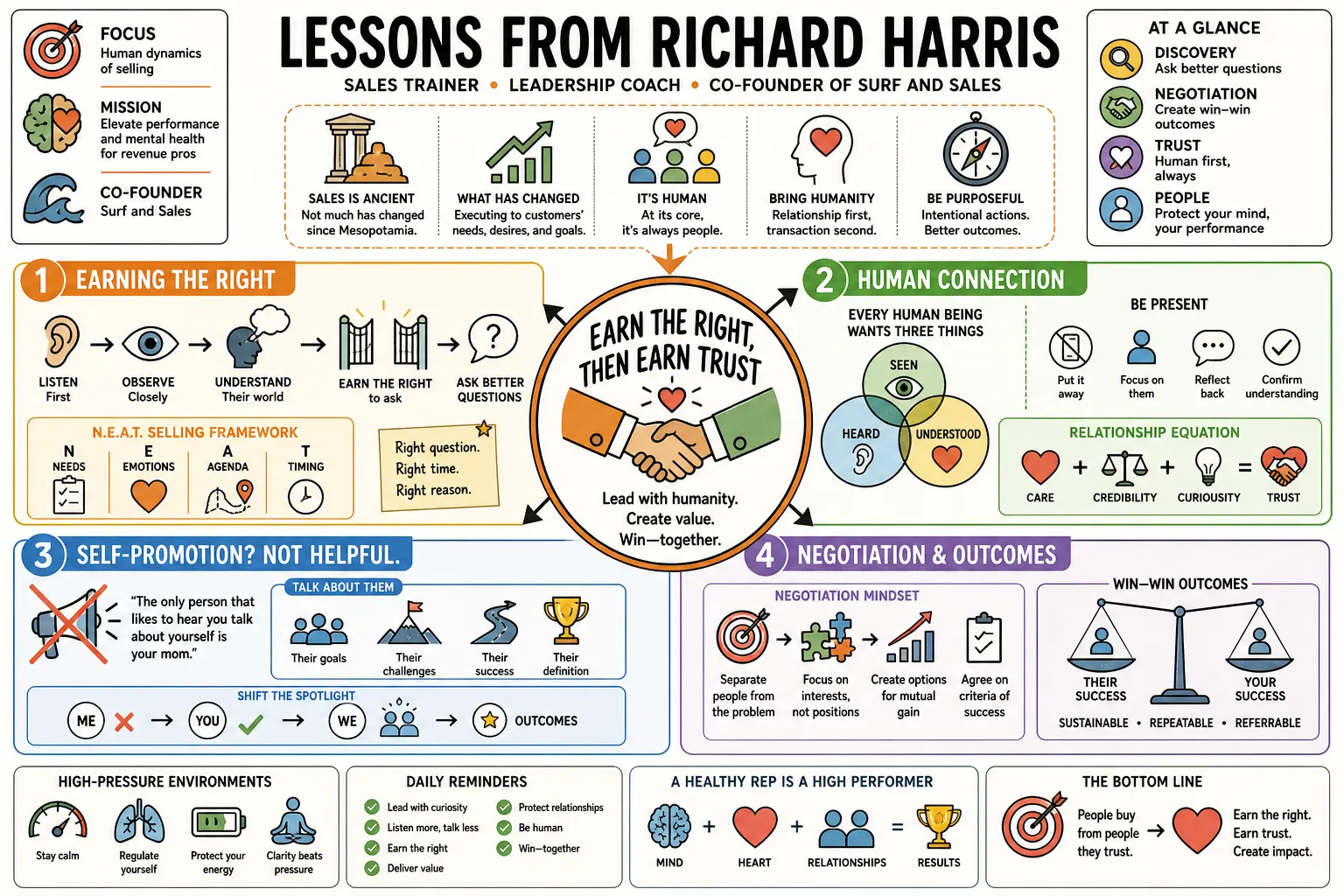
Part 1: The Core Philosophy: Human Connection and "Earning the Right"
- On Earning the Right: "We teach salespeople and founders how to earn the right to ask questions, which questions to ask, and when to ask them." — Source: [Substack]
- On Human Connection: "Every human being wants three things: They want to be seen, heard, and understood." — Source: [Salesforce]
- On the History of Sales: "Not much has changed in sales since Mesopotamia. The ability to execute in a meaningful way in relation to your customers' needs, desires, and goals has." — Source: [In The Funnel]
- On Self-Promotion: "The only person that likes to hear you talk about yourself is your mom." — Source: [Substack]
- On the Nature of the Relationship: "If you think business isn't personal, think again. There is a certain level of humanity that must be upheld in these relationships." — Source: [Founder Reports]
- On Building Trust: "Discover how to have your clients 'fall in trust' with you so that you can earn the right to ask the right questions at the right time." — Source: [In The Funnel]
- On Collaboration: "Stop selling. Start collaborating." — Source: [Transistor.fm]
- On Likability vs. Trust: "People don't buy from people they like; they buy from people they trust. It doesn't mean that likability doesn't matter, it's a subset of trust." — Source: [7th Level HQ]
- On Value Delivery: "You have to earn the right to ask questions, and you earn that right by providing value first." — Source: [YouTube]
- On Bringing Humanity Back: "It’s time to bring humanity back into sales again." — Source: [Founder Reports]
Part 2: The Seller's Journey vs. The Buyer's Journey
- On the Buyer's Journey Fallacy: "There is no such thing as a buyer's journey. It's all about the buyer's experience through a seller's journey." — Source: [The Harris Consulting Group]
- On Fluid Conversations: "Sales conversations can't be rigid." — Source: [Transistor.fm]
- On Navigating Sales: "Understand the nonlinear nature of the sales process and the importance of having a clear map and compass to guide your journey." — Source: [In The Funnel]
- On the Compass Metaphor: "Like a compass needle, it will swing back and forth based on the direction of the conversation." — Source: [The Harris Consulting Group]
- On Starting Points: "It's a compass cause I want people to know you can kind of start wherever you need to go." — Source: [Transistor.fm]
- On the Title of His Book: "I titled the book 'The Seller's Journey' because I don't believe there's a buyer's journey... There's a buyer's experience through the seller's journey." — Source: [YouTube]
- On Shifting Paradigms: The traditional "buyer's journey" is often a myth; modern sales execution requires restoring the human element instead of relying on automated funnels. — Source: [Heinz Marketing]
- On Responsibility: Sellers are responsible for shaping the buyer's experience by acting as a guide rather than an order-taker. — Source: [Salesforce]
- On the Map and Compass: Orienting yourself in the modern sales landscape requires moving from discovery to closing using a flexible methodology rather than a static map. — Source: [In The Funnel]
Part 3: The N.E.A.T. Selling Framework
- On Modern Alternatives: N.E.A.T. was developed as a modern alternative to legacy qualification frameworks like BANT, which often feel like an interrogation to the buyer. — Source: [Weflow]
- On Need (N): "We want needs to reflect on the real pains of your buyers... below the surface." — Source: [Transistor.fm]
- On Economic Impact (E): "Economic impact is the only thing that can drive urgency." — Source: [Weflow]
- On Quantifying Cost: "No one believes the R [Return], they only believe the I [Investment]." You must quantify the cost of doing nothing. — Source: [YouTube]
- On Access to Authority (A): "‘A’ no longer stands for authority. It stands for Access to Authority." — Source: [GTM Weekly]
- On Reaching the Top: "Can the people you are speaking with actually get you an 'Audience with the Pope?'" — Source: [Weflow]
- On the Buying Committee: It’s not about finding one "decision-maker" but mapping the entire buying committee and understanding how they influence the deal. — Source: [Weflow]
- On Timeline (T): "If there is no compelling event, it will be very hard to qualify timeline." — Source: [The Harris Consulting Group]
- On Compelling Events: A deal only closes if there is a specific, compelling event driving the timeline forward. — Source: [YouTube]
- On Pipeline Reality: "Stop 'smoking hopium' and close more deals with N.E.A.T. Selling!" — Source: [Founder Reports]
Part 4: Discovery, Pain, and Asking Better Questions
- On Discovery Mindset: "Discovery is not a stage; it’s a mindset." — Source: [Transistor.fm]
- On Pain vs. Product: "Talk about the pain you solve, not what you do. Nobody cares what you do; they care what pains you solve." — Source: [Buzzsprout]
- On Buying in Pain: "We have to paint the picture of that pain. People buy in the pain. When it hurts we want to fix it." — Source: [GTM Weekly]
- On Digging Deeper: "Just ask 'why' one more time." — Source: [Founder Reports]
- On the Skeptic: "Who on your team is most skeptical about this solution, and what are they skeptical about?" — Source: [YouTube]
- On Emotional Pricing: "How does that feel? ... Money is emotional... All pricing has a feeling." — Source: [Salesforce]
- On Opening the Call: "The first 7–8 seconds of your first call are so critical—they are the difference between opening the door... or another lead dropping out of your pipeline." — Source: [The Harris Consulting Group]
- On Avoiding Filler: Stop saying "Does that make sense?" Instead, ask: "How does this compare to what you are currently doing?" — Source: [7th Level HQ]
- On Good Questions: "Any time you can ask a question that causes the prospect to say, ‘That’s a really good question,’ you know you are on the right track." — Source: [7th Level HQ]
Part 5: Negotiation and The Respect Contract
- On the Start of Negotiation: "Negotiation begins the moment you open your mouth." — Source: [The Harris Consulting Group]
- On Solo Negotiation: "If you drop your price without a counter from the buyer, you've just negotiated solo. Not a good look." — Source: [The Harris Consulting Group]
- On True Control: "Control doesn't mean domination. It means clarity. It means guiding the process with confidence, questions, and calm." — Source: [Founder Reports]
- On the Respect Contract: "A verbal agreement between two parties that sets the stage and lays the ground rules of engagement—not just for the first meeting but for every subsequent interaction." — Source: [ConnectAndSell]
- On Setting Tone: "Respect contracts are the foundation of effective communication in sales, setting the tone for productive conversations." — Source: [YouTube]
- On the Goal of the Contract: "The goal is to go from strangers to acquaintances to trusted business allies." — Source: [Transistor.fm]
- On Give to Get: "If you're discounting or making concessions in a negotiation, you're in a position to ask for something... it's always give to get." — Source: [YouTube]
- On "Must-Win" Deals: "Never walk away from a deal is a recipe for disaster." — Source: [Raise Your AQ]
- On Reframing Budget: Never use the words "Budget" or "Price" early on. Instead, refer to them as "Commercial Terms" to elevate the conversation to a business level. — Source: [7th Level HQ]
Part 6: Sales Leadership, Pipeline, and Coaching
- On Methodology Failure: "Methodologies fail because of coaching gaps, not framework flaws." — Source: [Medium]
- On Meetings vs. Reviews: "Pipeline reviews and sales meetings are not the same thing." — Source: [The Harris Consulting Group]
- On Forecasting Failures: "Sales forecasting fails not because sales reps are bad at predicting outcomes, but because leaders lack visibility into real sales behavior." — Source: [Salesforce]
- On the Need for Structure: "Without structure, reps don't know what their next actions should be. That fuzziness in your pipeline data will create inaccuracies in your forecast." — Source: [Salesforce]
- On the Lever of Productivity: "Sales coaching is the most important lever to drive sales productivity." — Source: [Medium]
- On Hiring Traits: "I’m looking more for a willingness to learn, and probably more so, a willingness to be quiet." — Source: [Founder Reports]
- On Leading by Example: "You can earn far more respect as a leader by sharing your knowledge and hitting your sales goals than if you merely hit your sales goals." — Source: [Substack]
- On Helping Newbies: "Dedicating time to help newbie reps on the inside sales team actually makes you better at closing your own deals." — Source: [Substack]
- On Knowing It All: Leaders don't need to "know it all" to be effective; admitting what you don't know can build more trust with a team than pretending to have the answers. — Source: [Founder Reports]
Part 7: Mental Health, Empathy, and the Reality of Sales
- On Impostor Syndrome: "My biggest challenge has always been impostor syndrome. As someone who speaks openly about mental health and depression, impostor syndrome is a big part of it." — Source: [Founder Reports]
- On Overcoming Blocks: "If I can overcome this mental block, then there is nothing I cannot accomplish." — Source: [Founder Reports]
- On Shared Struggles: "Let's talk about impostor syndrome. We all get it. I get it all the time... You've got where you are because of the work you've done." — Source: [GTM Now]
- On Deserving Success: "Those struggling with impostor syndrome are usually the ones who deserve to be where they are." — Source: [GTM Now]
- On Making It a Superpower: "Through lots of therapy and yes, medication, I have learned to make this [impostor syndrome] my superpower." — Source: [Founder Reports]
- On Getting in Your Own Head: "You can get into your own head. You can confuse yourself, you can mentally tear yourself down. And yes, it can lead to anxiety and depression." — Source: [Founder Reports]
- On Fear in Sales: "The fear you bring into a sales call will often be the very reason you lose the deal." — Source: [Founder Reports]
- On Rejection: "Sales is always personal. Don't pretend rejection doesn't sting; acknowledge it and learn from it." — Source: [Salesforce]
- On Empathy vs. Sympathy: "You can't be empathetic if you don't understand their perspective; otherwise, it's just fake sympathy." — Source: [YouTube]
- On Resilience: "The failure is what drives success." — Source: [YouTube]
Part 8: Surf and Sales: Building Community and Unselfish Help
- On the Mission of Surf and Sales: "Everyone is looking for help in sales, yet so few are willing to give it unselfishly." — Source: [YouTube]
- On Stripping Away Ego: The Surf and Sales events combine intensive sales coaching with surfing, aiming to strip away the "corporate ego" and focus on raw, tactical improvement. — Source: [YouTube]
- On Humility: "It's ok to be humble and be proud of what you have done at the same time." — Source: [Founder Reports]
- On Practice: "There is a difference between sounding scripted and having a script... Go run your lungs, say it out loud, and see what it sounds like. Practice. Practice. Practice." — Source: [Transistor.fm]
- On Success Factors: "Success in sales is the result of discipline, dedication, and a clear value proposition." — Source: [Medium]
- On the Road to Success: "The road to success is paved over the potholes of risk-taking, mini-wins, and an open mind." — Source: [Salesforce]
- On Innovation: "Innovation is hard. Innovation at scale is really, really hard." — Source: [In The Funnel]
- On Validation Through Action: Those feeling like "impostors" should look at their track record of results as objective evidence that they have "earned the right" to be in the room. — Source: [Founder Reports]
- On Self-Care as Professionalism: Being "kind and friendly to yourself" and prioritizing mental health is essential for long-term success in high-pressure sales environments. — Source: [Founder Reports]