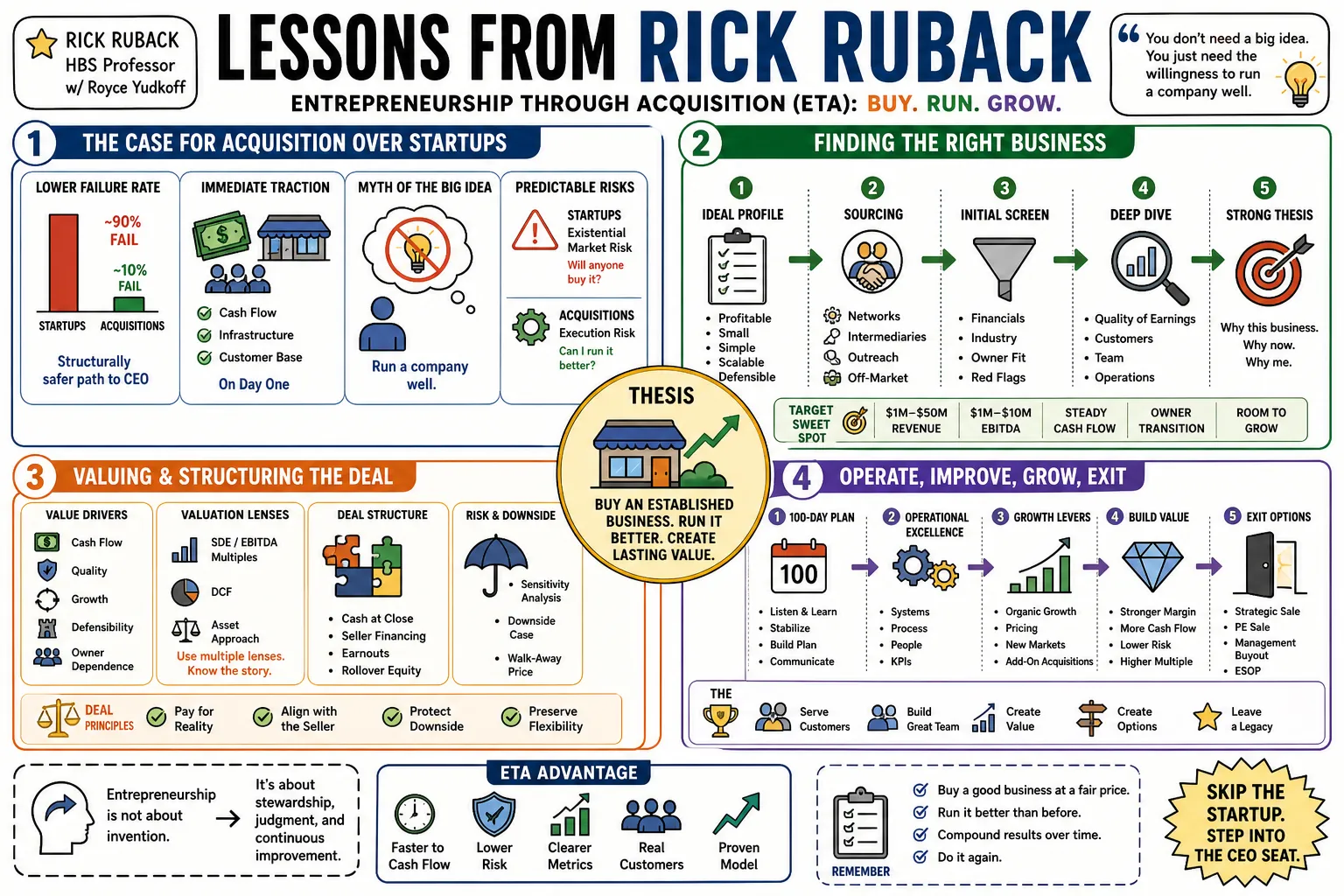
Lessons from Rick Ruback
Harvard Business School professor Richard "Rick" Ruback, alongside Royce Yudkoff, formalized the mechanics of entrepreneurship through acquisition (ETA). He teaches professionals how to skip the startup phase by buying and running established, profitable small businesses. This collection outlines his methods for sourcing, valuing, and operating these companies.
Part 1: The Case for Acquisition over Startups
- On the startup failure rate: "A large percentage of traditional startups fail to deliver positive returns, making the acquisition of an established business a structurally safer path to the CEO seat." — Source: [HBR Guide to Buying a Small Business]
- On immediate traction: "When you buy an existing business, you immediately acquire cash flow, infrastructure, and an established customer base on day one." — Source: [HBR Guide to Buying a Small Business]
- On the myth of the big idea: "You don't need a novel invention, a technological breakthrough, or a big idea to be an entrepreneur. You just need the willingness to run a company well." — Source: [Think Big, Buy Small]
- On predictable risks: "Startups carry existential market risk, meaning you don't know if anyone will buy the product. Acquisitions carry execution risk, meaning you only have to manage the company effectively. The latter is far easier to control." — Source: [Harvard Business School]
- On the third career path: "There is a third path between climbing the corporate hierarchy and risking your capital on a startup venture: buying and running a small firm." — Source: [HBR Guide to Buying a Small Business]
- On career control: "Acquisition allows you to bypass decades of climbing the corporate ladder and step directly into a leadership position where you control your own destiny." — Source: [Axial]
- On capital efficiency: "Buying an existing cash-flowing asset allows you to use debt to finance the purchase, which amplifies your personal equity return far beyond typical early-stage investing." — Source: [HBR Guide to Buying a Small Business]
- On demographic tailwinds: "There is a massive, unprecedented opportunity today because a generation of baby boomer owners is reaching retirement age and needs a succession plan." — Source: [Acquiring Minds]
- On the value of dullness: "Boring businesses are often the best investments. They operate outside the hyper-competitive spotlight of trendy startup sectors." — Source: [Think Big, Buy Small]
- On long-term survival: "A business that has already survived for ten or twenty years has proven its resilience and demonstrated that it provides a durable service to its local market." — Source: [Harvard Business School]
Part 2: Defining the "Enduringly Profitable" Business
- On recurring revenue: "The defining characteristic of an enduringly profitable business is a loyal customer base that repeatedly pays for the company's products or services." — Source: [HBR Guide to Buying a Small Business]
- On slow growth: "High growth drains cash and attracts fierce competition. Slow, steady growth is safer, more predictable, and can be purchased at a much more reasonable price point." — Source: [Think Big, Buy Small]
- On buying a business vs a job: "Ensure you are buying a company where the value stems from the business model and systems, not simply buying a job where you must do all the technical work yourself." — Source: [HBR Guide to Buying a Small Business]
- On customer concentration: "Avoid businesses where a single customer makes up a large percentage of revenue. If they leave, your cash flow to service debt vanishes." — Source: [Harvard Business School]
- On necessary services: "Look for companies that provide essential, unglamorous services, things people and other businesses absolutely need to function day-to-day." — Source: [Think Big, Buy Small]
- On recession resistance: "Enduringly profitable companies maintain stable cash flows even during economic downturns because their offerings are not discretionary." — Source: [HBR Guide to Buying a Small Business]
- On capital expenditure: "Be wary of businesses that require constant, massive equipment upgrades to maintain their current revenue levels." — Source: [Harvard Business School]
- On gross margins: "Healthy gross margins indicate pricing power and provide the financial cushion needed to absorb unexpected operational shocks." — Source: [Acquiring Minds]
- On technological risk: "Avoid industries where rapid technological shifts could render the company's core product obsolete overnight." — Source: [Think Big, Buy Small]
- On local monopolies: "Many small businesses benefit from geographic isolation or niche specialization, operating as profitable local monopolies." — Source: [HBR Guide to Buying a Small Business]
Part 3: The Search and Sourcing Process
- On setting parameters: "Before you begin looking at deals, define clear geographic, financial, and industry parameters to filter out the noise." — Source: [HBR Guide to Buying a Small Business]
- On personal alignment: "Match the business to your skills. If you are allergic to fur, do not buy a pet shop. Do not acquire a business you will not enjoy running." — Source: [Think Big, Buy Small]
- On proprietary search: "The best deals rarely come from public broker listings; they come from directly contacting owners who have not yet put their businesses on the market." — Source: [Harvard Business School]
- On search endurance: "Finding a good business to buy is a numbers game that requires relentless outreach and the emotional stamina to handle constant rejection." — Source: [HBR Guide to Buying a Small Business]
- On the role of brokers: "Brokers are useful for learning the market and finding initial deal flow, but you must recognize they represent the seller's interests, not yours." — Source: [Axial]
- On kissing frogs: "You will have to look at dozens, sometimes hundreds, of flawed businesses before you find one that meets the criteria for enduring profitability." — Source: [Acquiring Minds]
- On industry focus: "While general management skills are highly transferable, searching within a few specific industries makes you a smarter, faster evaluator of deals." — Source: [Think Big, Buy Small]
- On geographic flexibility: "Searchers who are willing to relocate anywhere in the country significantly increase their odds of finding a high-quality acquisition." — Source: [Harvard Business School]
- On time management: "Treat the search process as a full-time job. A part-time effort rarely yields a successful acquisition in a competitive market." — Source: [HBR Guide to Buying a Small Business]
Part 4: Assessing Fit and Evaluating the Seller
- On the two-sided interview: "The acquisition process is akin to a job interview where both the buyer and the seller must determine if there is a strong professional and cultural fit." — Source: [Harvard Business School]
- On seller motivation: "Always ask why the owner is selling. Retirement or health issues are standard; vague answers about moving on to new opportunities require deep skepticism." — Source: [HBR Guide to Buying a Small Business]
- On building trust: "Sellers care deeply about their legacy and their employees. You must convince them that you will be a responsible steward of their life's work." — Source: [Think Big, Buy Small]
- On owner dependency: "Assess how deeply the owner is embedded in daily operations. If the business cannot run without them for a week, transitioning ownership will be exceptionally difficult." — Source: [Acquiring Minds]
- On key relationships: "Determine if critical customer or supplier relationships belong to the business itself or strictly to the retiring owner's personal network." — Source: [HBR Guide to Buying a Small Business]
- On hidden culture: "Spend time observing the shop floor. The way employees interact when the boss is not looking tells you more about the culture than the owner's pitch." — Source: [Think Big, Buy Small]
- On communication styles: "If the seller is consistently evasive, disorganized, or slow to provide basic information, it is a massive red flag for how the transition will go." — Source: [Harvard Business School]
- On seller financing: "A seller who refuses to finance a portion of the deal is signaling a lack of confidence in the business's ability to survive after they leave." — Source: [HBR Guide to Buying a Small Business]
- On the seller's ego: "Many owners struggle emotionally with stepping away. You have to navigate their ego carefully during negotiations." — Source: [Axial]
Part 5: Navigating Due Diligence
- On verifying reality: "Due diligence is not a formality; it is the critical process of verifying that the business you are buying actually exists in the way it was presented." — Source: [HBR Guide to Buying a Small Business]
- On horrifying mistakes: "Failing to physically verify assets is a horrifying mistake. Buyers sometimes take inventory at face value, only to find out after closing that it is expired, broken, or simply not there." — Source: [Think Big, Buy Small]
- On quality of earnings: "Always hire a professional accountant to perform a Quality of Earnings review. Small business financial statements are notoriously messy and often commingle personal expenses." — Source: [Harvard Business School]
- On customer retention: "During diligence, analyze customer churn rates closely. A business losing 20 percent of its customers annually is a leaky bucket that requires exhausting sales efforts." — Source: [Acquiring Minds]
- On employee interviews: "With the seller's permission, speak to key managers during the late stages of diligence. You need to know if the top talent plans to quit the day the business changes hands." — Source: [Think Big, Buy Small]
- On legal liabilities: "Thoroughly review all contracts, leases, and pending litigation. A bad long-term lease or a hidden lawsuit can bankrupt an otherwise healthy company." — Source: [HBR Guide to Buying a Small Business]
- On working capital: "Define exactly how much working capital will be left in the business at closing. Buyers often underestimate the cash needed to fund operations in the first few months." — Source: [Harvard Business School]
- On operational complexity: "Map out the core operational processes. If the business relies on undocumented, complex procedures that exist only in the seller's head, the risk of failure spikes." — Source: [Think Big, Buy Small]
- On knowing when to walk: "Do not fall in love with a deal. If diligence uncovers unfixable problems, you must be willing to walk away, even after spending significant time and money." — Source: [HBR Guide to Buying a Small Business]
Part 6: Valuation, Deal Structuring, and Finance
- On rational multiples: "Unlike venture capital, small businesses trade at rational, cash-flow-based multiples, often three to five times earnings, allowing for reasonable debt service and equity returns." — Source: [Acquiring Minds]
- On valuing cash flow: "Focus on the cash flow available to a new owner, adjusting for the current owner's personal expenses and a market-rate salary for the CEO." — Source: [HBR Guide to Buying a Small Business]
- On the debt advantage: "Using debt correctly allows you to buy a significantly larger, more stable business than you could with cash alone, while debt paydown actively builds your equity." — Source: [Think Big, Buy Small]
- On SBA loans: "The Small Business Administration 7(a) loan program is a structural advantage for acquisition entrepreneurs, providing long-term debt with relatively low equity requirements." — Source: [Harvard Business School]
- On margin of safety: "Structure the deal so that the business can comfortably cover its debt obligations even if revenues dip by 10 to 15 percent in your first year." — Source: [HBR Guide to Buying a Small Business]
- On seller notes: "Including a seller note aligns incentives. If the seller holds a portion of the debt, they are motivated to ensure a smooth transition and your ongoing success." — Source: [Think Big, Buy Small]
- On outside investors: "Raising equity from investors reduces your personal financial risk, but it dilutes your ownership and introduces board-level oversight." — Source: [Harvard Business School]
- On earn-outs: "Use earn-outs cautiously. While they bridge valuation gaps, they often lead to post-closing disputes over how the business was managed and how profits were calculated." — Source: [HBR Guide to Buying a Small Business]
- On overpaying: "Overpaying for a great business is a survivable mistake; overpaying for a mediocre business with high debt will destroy your capital." — Source: [Acquiring Minds]
Part 7: Transitioning to the CEO Role
- On the first 100 days: "When you take over, your primary job is to do no harm. Focus on learning the business, observing the culture, and building trust, not making immediate radical changes." — Source: [HBR Guide to Buying a Small Business]
- On imposter syndrome: "It is natural to feel overwhelmed on day one. Acknowledge what you do not know and lean on the existing employees who understand the daily operations." — Source: [Think Big, Buy Small]
- On transparent communication: "Employees will be anxious about a new owner. Communicate clearly, frequently, and honestly about your intentions to protect their jobs and grow the company." — Source: [Harvard Business School]
- On the seller transition period: "Keep the seller around for a defined transition period to handle introductions and transfer knowledge, but ensure there is a hard stop so you can establish your own authority." — Source: [HBR Guide to Buying a Small Business]
- On quick wins: "Identify small, low-risk improvements, like upgrading outdated software or fixing a broken piece of equipment, to demonstrate your value to the team early on." — Source: [Think Big, Buy Small]
- On respecting history: "Do not insult the way things were done before you arrived. The previous methods built the profitable company you just purchased." — Source: [Harvard Business School]
- On financial controls: "Implement rigorous financial reporting and cash management controls immediately. You must know exactly where the cash is going every single week." — Source: [HBR Guide to Buying a Small Business]
- On decisive action: "While patience is necessary early on, if a toxic employee undermines the culture or the transition, you must act quickly to remove them." — Source: [Axial]
- On shifting from operator to leader: "Your long-term goal is to transition from doing the daily technical work to managing the people and systems that do the work." — Source: [Think Big, Buy Small]
Part 8: Career Path and Life as an Acquisition Entrepreneur
- On the reality of the work: "Running a small business is demanding and unglamorous. It involves fixing broken toilets, covering shifts, and managing interpersonal conflicts." — Source: [HBR Guide to Buying a Small Business]
- On partnering vs. hiring: "Many searchers want a partner to share the emotional load. But if you just need specific skills, it is far more efficient to hire an employee than to give away half of the equity." — Source: [Think Big, Buy Small]
- On wealth creation: "ETA offers one of the most reliable paths to personal wealth, driven by the combination of debt paydown, organic growth, and eventual exit multiples." — Source: [Harvard Business School]
- On isolation: "Being a small business CEO can be incredibly lonely. Build a peer network of other business owners you can call when you face difficult decisions." — Source: [Acquiring Minds]
- On community impact: "Owning a local business allows you to have a profound, immediate impact on your community by providing stable jobs and vital services." — Source: [HBR Guide to Buying a Small Business]
- On the self-funded vs. traditional model: "The traditional search fund model provides a salary and guaranteed capital, but self-funded searchers retain significantly more equity and control over the types of businesses they buy." — Source: [Think Big, Buy Small]
- On the value of an MBA: "While an MBA provides excellent financial and strategic frameworks, the grit required to close a deal and run a blue-collar business cannot be taught in a classroom." — Source: [Harvard Business School]
- On long-term compounding: "If you hold an enduringly profitable business for decades, the compounding effects of cash flow and debt reduction will generate staggering returns." — Source: [HBR Guide to Buying a Small Business]
- On risk tolerance: "ETA is not risk-free. You are often personally guaranteeing loans, so you must be comfortable with the asymmetric risk of losing your equity to gain a CEO role." — Source: [Think Big, Buy Small]
- On the ultimate reward: "The true reward of entrepreneurship through acquisition is the autonomy of building a company on your own terms." — Source: [Axial]