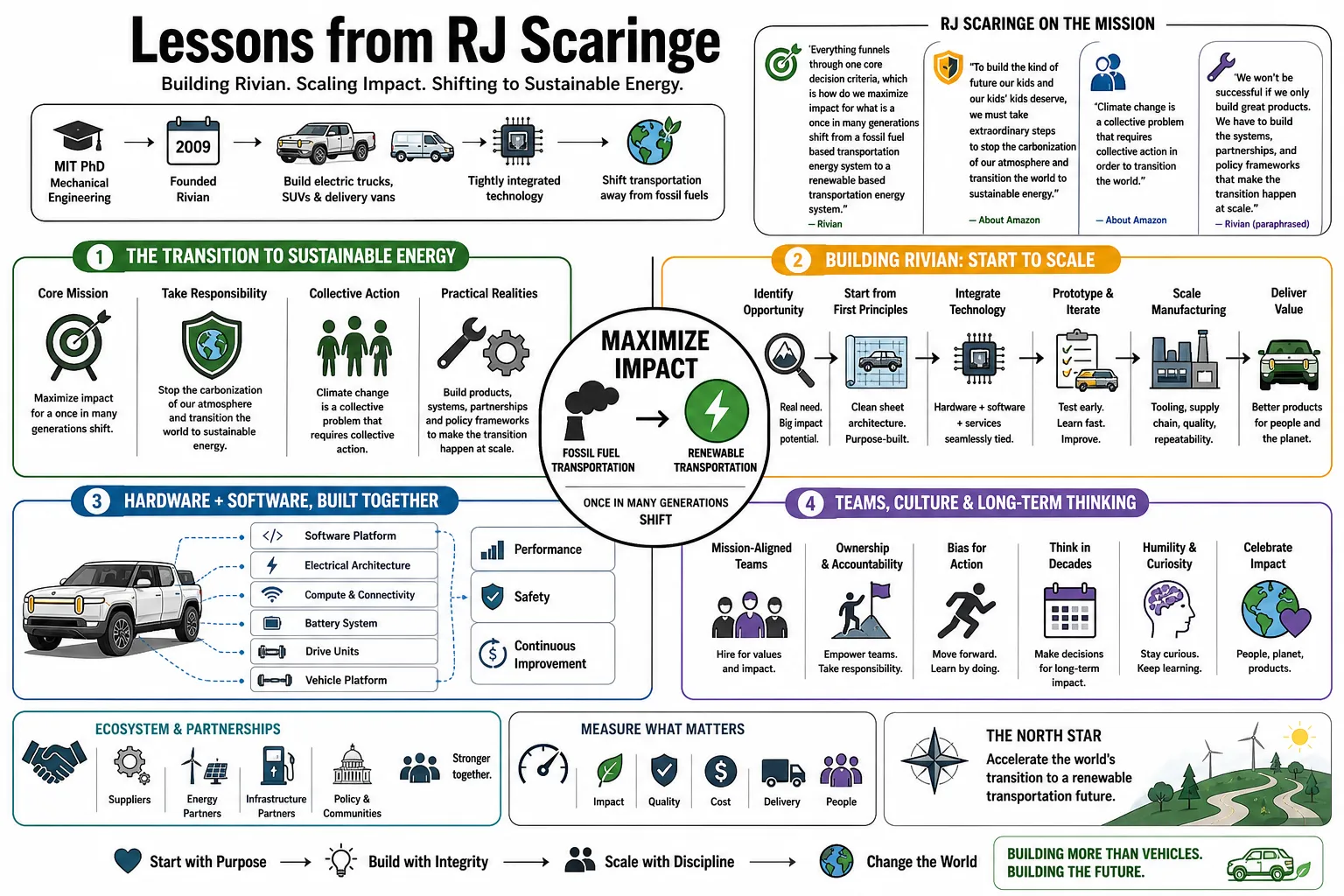
Lessons from RJ Scaringe
RJ Scaringe started the electric automaker Rivian in 2009 after finishing a PhD in mechanical engineering at MIT. Building a car company from scratch meant figuring out how to manufacture trucks, SUVs, and delivery vans with tightly integrated technology. This profile covers his practical approach to scaling hardware and managing the teams required to shift transportation away from fossil fuels.
Part 1: The Transition to Sustainable Energy
- On the core mission: "Everything funnels through one core decision criteria, which is how do we maximize impact for what is a once in many generations shift from a fossil fuel based transportation energy system to a renewable based transportation energy system." — Reference: Rich Roll interview with RJ Scaringe
- On taking responsibility: "To build the kind of future our kids and our kids' kids deserve, we must take extraordinary steps to stop the carbonization of our atmosphere and transition the world to sustainable energy." — Reference: About Amazon feature on Rivian delivery vans
- On collective action: "Climate change is a collective problem that requires collective action in order to transition the world." — Reference: About Amazon feature on Rivian delivery vans
- On practical realities: "We won't be successful if we only do one of these two things: If we only focus on the future, but don't solve the present, or we only solve the present, but don't focus on the future." — Reference: Rich Roll interview with RJ Scaringe
- On there being no easy fix: Scaringe frames decarbonizing transportation as a long systems challenge, not something solved by one simple switch. — Reference: Rich Roll episode on Rivian's decarbonization mission
- On sustainable operations: "Creating a sustainable planet requires that we also build a sustainable business." — Reference: Rich Roll interview with RJ Scaringe
- On framing the transition: Rivian's mission is to make sustainable transportation feel adventurous and desirable rather than like a compromise. — Reference: Rich Roll episode on sustainable transportation
- On climate optimism: "We must maintain extreme optimism when confronting climate change as an existential threat, taking proactive steps rather than succumbing to despair." — Reference: Rich Roll interview with RJ Scaringe
- On systemic sustainability: "True sustainability extends beyond the vehicle to the manufacturing processes, renewable charging networks, and battery recyclability." — Reference: Rich Roll interview with RJ Scaringe
- On long-term priorities: "Moving away from internal combustion engines is an urgent choice for society, and reversing that trend is very bad for future generations." — Reference: Rich Roll interview with RJ Scaringe
Part 2: Engineering and Vertical Integration
- On in-house electronics: "We made the decision to vertically integrate our network architecture and associated electronics, full vehicle software stack, and our propulsion platform, as we believe this creates a long-term competitive advantage in terms of both cost and product performance." — Reference: Stratechery interview with RJ Scaringe
- On securing credibility: "Earning a Ph.D. in mechanical engineering from MIT was partly a strategic choice to gain the credibility needed to secure investment for a new car company." — Reference: Stratechery interview with RJ Scaringe
- On controlling the stack: "Vertically integrating software, drive units, and electronics carries high upfront financial risk but is necessary for better performance and long-term cost reduction." — Reference: Stratechery interview with RJ Scaringe
- On centralized architecture: "Legacy automakers use a scattered chip approach, whereas a centralized software architecture allows a company to manage the vehicle's brain efficiently." — Reference: Stratechery interview with RJ Scaringe
- On component design: "Rivian designs and produces its own critical components in-house, from silicon and sensors to motors and gearboxes." — Reference: Stratechery interview with RJ Scaringe
- On engineering at heart: "Despite my role as CEO, I view my primary function and operational lens as being an engineer first." — Reference: Stratechery interview with RJ Scaringe
- On advanced automation: "Integrating advanced robotics on the factory floor is necessary to address labor shortages and streamline complex vehicle assembly tasks." — Reference: Stratechery interview with RJ Scaringe
- On iterative development: "A software-defined vehicle architecture allows an automaker to iterate more effectively than hardware-bound legacy competitors." — Reference: Stratechery interview with RJ Scaringe
- On multi-program facilities: "Modern automotive manufacturing requires building multi-program capabilities within single assembly plants to scale efficiently." — Reference: Stratechery interview with RJ Scaringe
- On hardware and software parity: Scaringe says Rivian built its electronics and software stack in-house because vehicle hardware and software now have to be designed together. — Reference: The Verge Decoder interview on Rivian's platform
Part 3: Building and Scaling Rivian
- On building while flying: Scaringe's Stratechery interview traces how Rivian moved from a blank-sheet car-company dream into the production realities of a scaled manufacturer. — Reference: Stratechery interview on founding and building Rivian
- On handling volume: Scaringe's leadership frame combines extreme optimism with robust realism when facing chaos, supply-chain pressure, and scale. — Reference: Rich Roll episode on leadership and supply-chain survival
- On adapting systems: "The process using the systems that we set up when it was ten people don't work when it's 50 and certainly don't work when it's 100." — Reference: Stratechery interview with RJ Scaringe
- On the necessity of the team: "The most important element of building a company is the team, which requires driving specific actions in how you recruit, promote, and provide feedback." — Reference: Stratechery interview with RJ Scaringe
- On navigating complexity: Scaringe describes Rivian as a hard hardware, software, production, autonomy, and partnership problem all at once. — Reference: Stratechery interview on production challenges
- On staying flexible: Scaringe kept the long-term goal of starting a car company while adapting the path through engineering, MIT, fundraising, and production. — Reference: Stratechery interview on Rivian's long path
- On comfort with the unfinished: Rivian's story shows Scaringe operating through long periods where the product, factory, and company were still incomplete. — Reference: Stratechery interview on building a car company
- On questioning assumptions: Scaringe uses the R2/R3 roadmap and VW partnership to rethink what Rivian should own internally versus share through a joint venture. — Reference: The Verge Decoder interview on the Volkswagen joint venture
- On starting: "Aspiring entrepreneurs should simply start; the process is harder and more complex than anticipated, but going for it is the only way forward." — Reference: Stratechery interview with RJ Scaringe
- On ignoring self-doubt: Scaringe started Rivian immediately after his PhD because he believed earned credibility could help overcome the capital demands of building cars. — Reference: Stratechery interview on Scaringe's founding path
Part 4: Product Design and Customer Experience
- On design confidence: "Vehicles should move away from aggressive, menacing aesthetics toward a design language that is confident and approachable." — Reference: The Verge Decoder interview with RJ Scaringe
- On customer choice: "We are choosing a certain design language. There are a ton of great EVs out there today if you don't like ours." — Reference: The Verge Decoder interview with RJ Scaringe
- On interior minimalism: "A screen-centric interior is a deliberate choice, as halfway measures that mix touchscreens with too many physical buttons create a confusing user experience." — Reference: The Verge Decoder interview with RJ Scaringe
- On the product ethos: "The goal is to build an inviting user experience that feels powerful without seeming overly precious." — Reference: The Verge Decoder interview with RJ Scaringe
- On adventure: "Inspiring people to explore and enjoy the natural world is a core function of the product, fostering a deeper connection to nature." — Reference: The Verge Decoder interview with RJ Scaringe
- On avoiding politics: "Our vehicles are about performance, adventure, and innovation—not politics." — Reference: The Verge Decoder interview with RJ Scaringe
- On product pride: "We are really excited to be producing R2 for our customers. The vehicle is incredible — it's the result of all the hard work and dedication of the Rivian team." — Reference: The Verge Decoder interview with RJ Scaringe
- On market positioning: "We want people looking to say it's the best car I can buy in that price range, and by virtue of that, it'll draw new customers." — Reference: The Verge Decoder interview with RJ Scaringe
- On expanding the base: "Bringing an adventure ethos to a broader, mainstream audience requires distinct platforms that maintain the brand's unique identity at different price points." — Reference: The Verge Decoder interview with RJ Scaringe
Part 5: Leadership and Company Culture
- On long-term legacy: "Rivian is a manifestation of a ton of teamwork. I want to make a place that 50 years later will inspire kids to dream big." — Reference: Rich Roll interview with RJ Scaringe
- On onboarding: "The company considers the planet a primary stakeholder in its success, a principle introduced to every employee during onboarding." — Reference: Rich Roll interview with RJ Scaringe
- On continuous learning: "There is not a day that goes by that something new doesn't happen, meaning leadership requires an open, curious mindset." — Reference: Rich Roll interview with RJ Scaringe
- On collective success: "A healthy culture views accomplishments as collective team efforts rather than individual successes or acts of braggadocio." — Reference: Rich Roll interview with RJ Scaringe
- On connection at scale: "Maintaining a direct connection with the workforce requires dedicated forums, like monthly culture-focused meetings, rather than just product updates." — Reference: Rich Roll interview with RJ Scaringe
- On extreme optimism: "Turning an impossible dream into reality requires a relentless optimism that helps leaders push through the intense pressures of entrepreneurship." — Reference: Rich Roll interview with RJ Scaringe
- On empathetic leadership: "Leadership in hardware manufacturing must prioritize empathy and people-first practices, acknowledging family and personal commitments." — Reference: Rich Roll interview with RJ Scaringe
- On resilience: Scaringe's operating posture centers on calm amid chaos and keeping the mission intact through supply-chain and production shocks. — Reference: Rich Roll episode on calm amid chaos
- On the long arc: "True impact is a long-term endeavor; it requires patience, persistence, and generating durable value over decades." — Reference: Rich Roll interview with RJ Scaringe
Part 6: Navigating the Market and Competition
- On the adoption barrier: Scaringe argues EV adoption needs compelling products across the political and consumer spectrum, not just one dominant template. — Reference: The Verge Decoder interview on EV demand
- On not copying Tesla: "We were starting in a similar logic space to say, 'build a sports car,' I realized somebody’s done that already, and they’ve done it well." — Reference: The Verge Decoder interview with RJ Scaringe
- On the fork in the road: "Legacy automakers face a fork in the road; choosing short-term internal combustion profits over EV investment will leave them woefully behind by the decade's end." — Reference: The Verge Decoder interview with RJ Scaringe
- On market variety: Scaringe says too many automakers copied the Tesla Model Y, leaving room for distinctive EVs like Rivian's R2, R3, and R3X. — Reference: The Verge Decoder interview on moving beyond Tesla
- On strategic partnerships: "Forming alliances with large legacy players allows a startup to scale its software and electrical architecture across millions of vehicles." — Reference: The Verge Decoder interview with RJ Scaringe
- On competitive advantage: "Controlling the full stack of a vehicle's technology is the only durable moat in the modern automotive landscape." — Reference: The Verge Decoder interview with RJ Scaringe
- On shifting economics: "The challenge for the industry isn't just building new mobility technologies, but scaling them economically so they can reach mass adoption." — Reference: The Verge Decoder interview with RJ Scaringe
- On the legacy dilemma: Rivian's clean-sheet electronics platform contrasts with traditional automakers' supplier-heavy vehicle architectures. — Reference: The Verge Decoder interview on traditional vehicle complexity
- On global supply chains: "Navigating the complexities of global supply chains requires building redundancy and vertically integrating wherever possible to avoid bottlenecks." — Reference: The Verge Decoder interview with RJ Scaringe
Part 7: Autonomy and Software Strategy
- On the autonomy timeline: "True autonomy is a long-term play that requires gathering massive amounts of data from a fleet of software-defined vehicles on the road." — Reference: Stratechery interview with RJ Scaringe
- On custom silicon: "Developing custom autonomy chips in-house is necessary to achieve the processing power and efficiency required for future driving systems." — Reference: Stratechery interview with RJ Scaringe
- On the vehicle's brain: "The vehicle of the future operates less like a mechanical machine and more like a rolling computer network that requires constant management." — Reference: Stratechery interview with RJ Scaringe
- On software iteration: Rivian's consolidated electronics architecture makes over-the-air updates and software improvements far easier than coordinating many suppliers. — Reference: The Verge Decoder interview on OTA updates
- On zonal architecture: Scaringe explains Rivian's zonal architecture as a handful of computers controlling physical zones rather than dozens of feature-specific ECUs. — Reference: The Verge Decoder interview on zonal architecture
- On AI in manufacturing: "Industrial AI and humanoid robotics will eventually be required to collaborate with human workers to build vehicles efficiently." — Reference: Stratechery interview with RJ Scaringe
- On software as a product: "Software is not a support feature; it is a primary product pillar that defines the user experience as much as the suspension or the seats." — Reference: Stratechery interview with RJ Scaringe
- On sensor integration: Rivian's autonomy work is built around integrated chips, sensors, and software rather than treating sensing as an aftermarket add-on. — Reference: Stratechery interview on Rivian autonomy
- On the data advantage: "A vertically integrated company can capture granular data from the battery cell up to the user interface, accelerating the pace of machine learning." — Reference: Stratechery interview with RJ Scaringe
Part 8: Early Days and Founding Vision
- On stealth mode: "Spending nearly a decade in stealth mode was necessary to develop the technology, secure the supply chain, and buy a factory before making public promises." — Reference: Rich Roll interview with RJ Scaringe
- On the initial pivot: "Realizing the world didn't need another fast, efficient sports car forced a total pivot toward building vehicles that enabled outdoor utility and adventure." — Reference: Rich Roll interview with RJ Scaringe
- On early credibility: "As a young founder, securing capital required over-preparing on the engineering details to prove the vision wasn't just a fantasy." — Reference: Rich Roll interview with RJ Scaringe
- On buying the factory: "Acquiring the Mitsubishi plant in Normal, Illinois, was a pivotal leap of faith that transformed the company from a design concept into a true manufacturer." — Reference: Rich Roll interview with RJ Scaringe
- On the impossible dream: "Transitioning from a bedroom tinkerer to an automotive CEO required sustaining belief when industry veterans insisted starting a new car company was impossible." — Reference: Rich Roll interview with RJ Scaringe
- On defining the brand: "The brand was explicitly designed to sit at the intersection of environmental stewardship and capable, outdoor utility." — Reference: Rich Roll interview with RJ Scaringe
- On avoiding distraction: "During the early years, it was critical to focus exclusively on the core vehicle architecture rather than chasing tangential mobility trends." — Reference: Rich Roll interview with RJ Scaringe
- On patience: Scaringe's path from childhood car-company ambition through engineering school, MIT, and production underscores the patience required for complex hardware. — Reference: Stratechery interview on Rivian's long gestation
- On the ultimate goal: "The founding drive was to prove that a business could achieve massive scale and financial success while actively working to heal the planet." — Reference: Rich Roll interview with RJ Scaringe