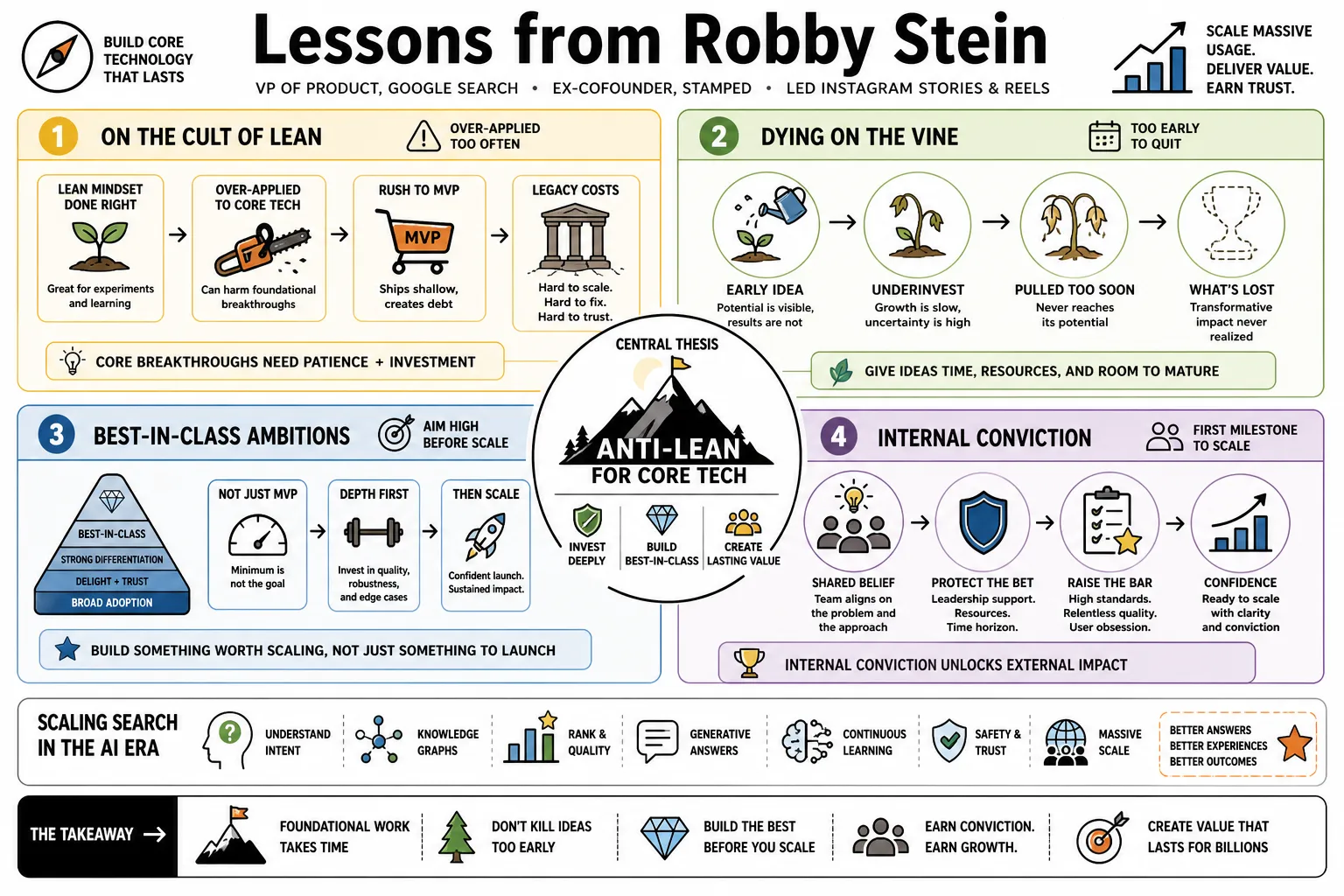
Lessons from Robby Stein
Robby Stein is the VP of Product for Google Search, following stints co-founding Stamped and leading Instagram Stories and Reels. He advocates an "anti-lean" approach to core technology, prioritizing deep investment and strict quality standards over rushing out minimum viable products. This profile examines how he scales large user bases and incorporates artificial intelligence into search behaviors.
Part 1: Product Philosophy and The Anti-Lean Approach
- On the Cult of Lean: "The tech industry often over-applies the lean, scrappy mindset to foundational technological breakthroughs, which require patience and significant upfront investment." — Source: Business Insider
- On Dying on the Vine: "Many transformative ideas fail because teams underinvest and abandon them too early before they have a chance to mature." — Source: Business Insider
- On Best-in-Class Ambitions: "When building complex foundational products, you have to aim for a best-in-class version before pushing for broad adoption, rather than shipping a minimum viable product." — Source: Lenny's Podcast
- On Internal Conviction: "The first major milestone for scaling a new product is internal conviction, that moment when the team fundamentally realizes they have built something special." — Source: Lenny's Podcast
- On External Validation: "Scaling should only happen after external validation proves that real users are returning repeatedly because the product solves a genuine problem." — Source: Lenny's Podcast
- On Patience in Engineering: "True technological breakthroughs demand the patience to invest heavily in foundational models rather than rushing a flawed experience to market." — Source: Business Insider
- On Building the Right Team: "Executing a complex product vision requires assembling a team that is willing to endure the long, unglamorous phase of foundational building." — Source: Lenny's Podcast
- On Strategic Commitment: "A relentless commitment to a core idea is necessary to weather the periods of doubt that naturally occur during long development cycles." — Source: Business Insider
- On Defining Success Early: "Before writing code for a massive bet, leadership must clearly define what a successful baseline looks like to avoid moving the goalposts." — Source: Lenny's Podcast
- On Avoiding Premature Optimization: "Focusing on minor iterations too early can distract a team from solving the hard, structural problems that actually unlock product-market fit." — Source: Business Insider
Part 2: Scaling Billion-User Products
- On Adopting New Formats: "Bringing Stories to Instagram was about lowering the barrier to sharing by creating a space where the pressure of permanence was removed." — Source: TechCrunch
- On the Strategy of Close Friends: "Giving users granular control over their audience was essential for fostering authentic sharing on a platform that had grown massive and public." — Source: TechCrunch
- On Product Integration: "Integrating a massive new format like Reels requires careful consideration of the core feed experience to ensure it feels additive rather than disruptive." — Source: Lenny's Podcast
- On Navigating Competition: "When introducing established market formats, the focus must be on executing them with higher quality and deeper integration into the user's existing social graph." — Source: TechCrunch
- On Designing for Scale: "A feature designed for a billion users must rely on immediately intuitive interactions that transcend language and cultural barriers." — Source: Disrupt Berlin
- On Visual Communication: "The evolution of social media has consistently moved toward richer, more ephemeral visual formats because they lower the cognitive load of sharing." — Source: TechCrunch
- On the Pressure of Perfection: "Products that demand perfection from their users will eventually see decreased engagement; tools must provide low-stakes environments to thrive." — Source: Lenny's Podcast
- On Incremental Adoption: "When rolling out massive changes to a core app, guiding users incrementally helps prevent the alienation of your most loyal base." — Source: Disrupt Berlin
- On Feature Parity: "Reaching feature parity is only the starting line; the real challenge is adapting the format to fit the unique ethos of your existing platform." — Source: Lenny's Podcast
- On Retaining Simplicity: "As an application scales its utility, the hardest and most important job is fighting the natural entropy toward interface complexity." — Source: TechCrunch
Part 3: The AI Evolution of Search
- On Search as Expansionary: "Generative AI is not replacing traditional search; it is an expansionary force that unlocks entirely new capabilities for users." — Source: Search Engine Land
- On the Core Utility of Search: "The foundational need to quickly look up facts, navigate to websites, and find specific answers remains as necessary today as it was a decade ago." — Source: Search Engine Land
- On Multi-Turn Queries: "AI allows search to evolve from a one-and-done retrieval system into a conversational engine that can handle complex, multi-turn reasoning." — Source: Google Blog
- On the Execution Layer: "We are moving toward an execution layer where search acts as an assistant that can research, plan, and ultimately act on behalf of the user." — Source: Search Engine Land
- On Balancing Modes: "The challenge of modern search design is seamlessly blending traditional results with generative summaries without overwhelming the interface." — Source: Google Blog
- On the Definition of a Query: Stein says Google is seeing people move beyond keyword-style searching into natural-language prompts, including long, hard questions and even five-sentence queries that can trigger AI Mode or AI Overviews. — Reference: Lenny's Podcast interview on natural-language AI Mode queries
- On Synthesis over Retrieval: "The greatest value unlock of AI in search is the ability to synthesize information across dozens of sources instantly, rather than forcing the user to do the manual synthesis." — Source: Google Blog
- On Adapting to Intent: "A modern search engine must dynamically adapt its interface based on whether the user's intent is exploratory, transactional, or informational." — Source: Lenny's Podcast
- On the Role of the Assistant: Stein frames AI Mode as a back-and-forth search experience: users can ask follow-up questions, go deeper from AI Overviews or Lens, and use Google's web, shopping, maps, finance, and other live context to answer harder information needs. — Reference: Lenny's Podcast interview on AI Mode follow-up search conversations
- On Expanding Access: "Making complex AI capabilities accessible through the familiar search interface democratizes advanced computing for the average user." — Source: Google Blog
Part 4: Cultivating Quality and Trust in AI
- On Foundational Quality: "AI search cannot abandon the lessons of traditional search; it must be built upon the same 25 years of strict quality signals." — Source: Search Engine Journal
- On Establishing Trust: "Trust in generative AI is earned by maintaining stringent standards for relevance, credibility, and helpfulness, identical to classic ranking systems." — Source: Search Engine Journal
- On Managing Hallucinations: "Systems for evaluating information quality must be deeply encoded into the AI models themselves to ensure a reliable and consistent experience." — Source: Search Engine Journal
- On the Value of Authority: "No matter how good generative summaries become, surfacing authoritative sources and linking to the broader web remains essential to the ecosystem." — Source: Search Engine Land
- On Guardrails: "We must be intentionally cautious when implementing AI features, prioritizing factual accuracy over pure generative flexibility." — Source: Search Engine Journal
- On Measuring Success: "The true metric of success for an AI overview extends beyond pure engagement to include the verifiable accuracy and utility of the information provided." — Source: Lenny's Podcast
- On Information Density: "A high-quality product must balance providing a dense amount of synthesized information with clear citations that allow users to verify claims." — Source: Search Engine Land
- On Algorithm Responsibility: "When a platform operates at billions of queries per day, the responsibility to prevent misinformation requires multi-layered, strict evaluation pipelines." — Source: Search Engine Journal
- On User Feedback: "Direct user feedback mechanisms within AI outputs are necessary for tuning the models and correcting emergent behavioral errors at scale." — Source: Google Blog
Part 5: Relentless Improvement and Iteration
- On the Relentless Mantra: "Achieving a product that serves billions of people requires a fundamental commitment to relentless improvement at every stage of development." — Source: Lenny's Podcast
- On Iterative Depth: "Relentless improvement means continuously refining a feature until it achieves the exact scale and utility necessary to become an everyday habit." — Source: Lenny's Podcast
- On Sweating the Details: "The difference between a good product and a ubiquitous one often comes down to obsessing over micro-interactions and latency." — Source: Lenny's Podcast
- On Ignoring Plateaus: "When a metric plateaus, it is a signal to dig deeper into user friction, avoiding the assumption that the product has reached its natural ceiling." — Source: Disrupt Berlin
- On Post-Launch Momentum: "Shipping v1 is merely the prologue; the actual work of product management begins by ruthlessly editing based on how real people use the tool." — Source: Lenny's Podcast
- On Qualitative Insights: "Data will tell you what is happening at scale, but you need qualitative user research to understand the reasoning behind the behavior." — Source: Lenny's Podcast
- On Sustaining Energy: "Maintaining relentless improvement requires insulating your team from burnout by celebrating incremental wins along the massive journey." — Source: Lenny's Podcast
- On Feature Refinement: "Sometimes the most impactful update is entirely removing a secondary feature that dilutes the core value proposition." — Source: TechCrunch
- On Adapting to Scale: "The systems and processes that got a product to ten million users will inevitably break when aiming for a billion; you must iteratively upgrade the organization as well." — Source: Lenny's Podcast
Part 6: Startups, Acquisitions, and Strategy
- On the Founder Transition: "Moving from a startup CEO at Stamped to a leader within Yahoo required shifting from pure survival mode to navigating massive organizational structures." — Source: Forbes
- On Recommendation Systems: "With Stamped, the insight was that a trusted recommendation from a friend is fundamentally more powerful than an anonymous aggregate review." — Source: TechCrunch
- On the Value of Curation: "In an era of infinite content, platforms like Artifact demonstrated that AI-driven curation is the key to maintaining a high signal-to-noise ratio." — Source: The Org
- On Strategic Acquisitions: "When a startup is acquired, success depends entirely on how well the founding team's vision can be integrated into the parent company's existing ecosystem." — Source: Forbes
- On Early Product Vision: "Stamped succeeded in creating a beautiful, opinionated interface because we restricted the input to binary choices—you either stamp it, or you don't." — Source: TechCrunch
- On Building for Niche vs. Mainstream: "A startup can afford to build for a highly engaged niche, but an acquisition often requires immediately broadening that appeal to a mainstream audience." — Source: Forbes
- On Resource Allocation: "Inside a tech giant, the constraint is rarely capital; it is the focused attention and prioritization of elite engineering talent." — Source: Lenny's Podcast
- On the Evolution of News: "Artifact aimed to solve the modern news consumption problem by using machine learning to surface high-quality journalism tailored to specific interests." — Source: The Org
- On Lessons from Failure: "While specific apps may sunset, the underlying mechanics and user behaviors learned are always recycled into the next massive product." — Source: TechCrunch
Part 7: Crafting User Experiences
- On Intentional Caution: "We must be intentionally cautious with features like extreme personalization to ensure we preserve a consistent, simple product experience." — Source: Search Engine Land
- On Lowering Barriers: "The best interfaces remove cognitive friction, making the transition from intent to action feel nearly invisible." — Source: Disrupt Berlin
- On Default Behaviors: "Because the vast majority of users never change their settings, designing the right default experience is the most important decision a product manager makes." — Source: Lenny's Podcast
- On Interface Consistency: "A consistent UI across different surfaces builds subconscious trust, allowing users to navigate new features using existing mental models." — Source: Google Blog
- On Aesthetic Utility: "A beautiful interface goes beyond aesthetics; visual polish actively increases a user's tolerance for learning new mechanics." — Source: TechCrunch
- On Designing for the Edge Case: "While you build for the mainstream, you must ensure that edge cases fail gracefully without breaking the core utility." — Source: Lenny's Podcast
- On User Agency: Stein emphasizes that AI search should feel coherent with the core product: people should be able to ask in the familiar Google surface, go deeper only when useful, and give feedback while the product learns from real use. — Reference: Lenny's Podcast interview on integrating AI Mode without disrupting user expectations
- On Mobile-First Thinking: "Designing for mobile means embracing constraints and forcing yourself to prioritize the most essential actions on a limited screen." — Source: TechCrunch
- On Haptic and Audio Feedback: "Subtle sensory feedback reinforces digital actions, making virtual interactions feel physically grounded and satisfying." — Source: Disrupt Berlin
Part 8: The Future of Human-Computer Interaction
- On the Agentic Web: On Limitless, Stein describes search moving from answers toward action: for a restaurant search, an agent can check Resy, OpenTable, and the web, then return restaurants with available reservation times. — Reference: Limitless Podcast transcript on agents, reservations, and doing things for users
- On Moving Beyond Text: "As models become multimodal, the primary interface will shift from typing text to interacting via voice, camera, and ambient context." — Source: Google Blog
- On Anticipatory Design: "The next leap in product design is moving from responsive systems to anticipatory systems that solve problems before the user explicitly asks." — Source: Lenny's Podcast
- On Preserving Human Connection: "Even as AI handles complex utility, platforms must preserve dedicated spaces for authentic, unoptimized human connection." — Source: TechCrunch
- On the Velocity of Innovation: Stein says the current AI moment has created urgency because the next wave of products will shape user habits for years, and Google needs to deliver a better AI-powered Search quickly. — Reference: Lenny's Podcast interview on Google's AI product urgency
- On Information Ecosystems: "A healthy future requires ensuring that as AI summarizes content, the original creators and publishers continue to receive value and traffic." — Source: Search Engine Land
- On Continuous Learning: "Products of the future will not be static applications; they will be continuous learning loops that hyper-personalize to the individual over time." — Source: Google Blog
- On Ethical Scaling: "When deploying AI to billions, ethical considerations regarding bias and representation must be prioritized at the engineering layer." — Source: Search Engine Journal
- On the Ultimate Goal: Stein defines AI Mode less as a general chatbot and more as a way to make information effortless: planning trips, shopping, researching questions, getting context, and still linking back to authoritative sources for verification. — Reference: Lenny's Podcast interview on AI Mode as effortless information access