Dr. Cialdini's research has identified seven key principles that guide human behavior, often in an automatic, subconscious way. [1] Understanding these "weapons of influence" can help individuals become more effective persuaders and, conversely, more resistant to manipulation. [2][3]
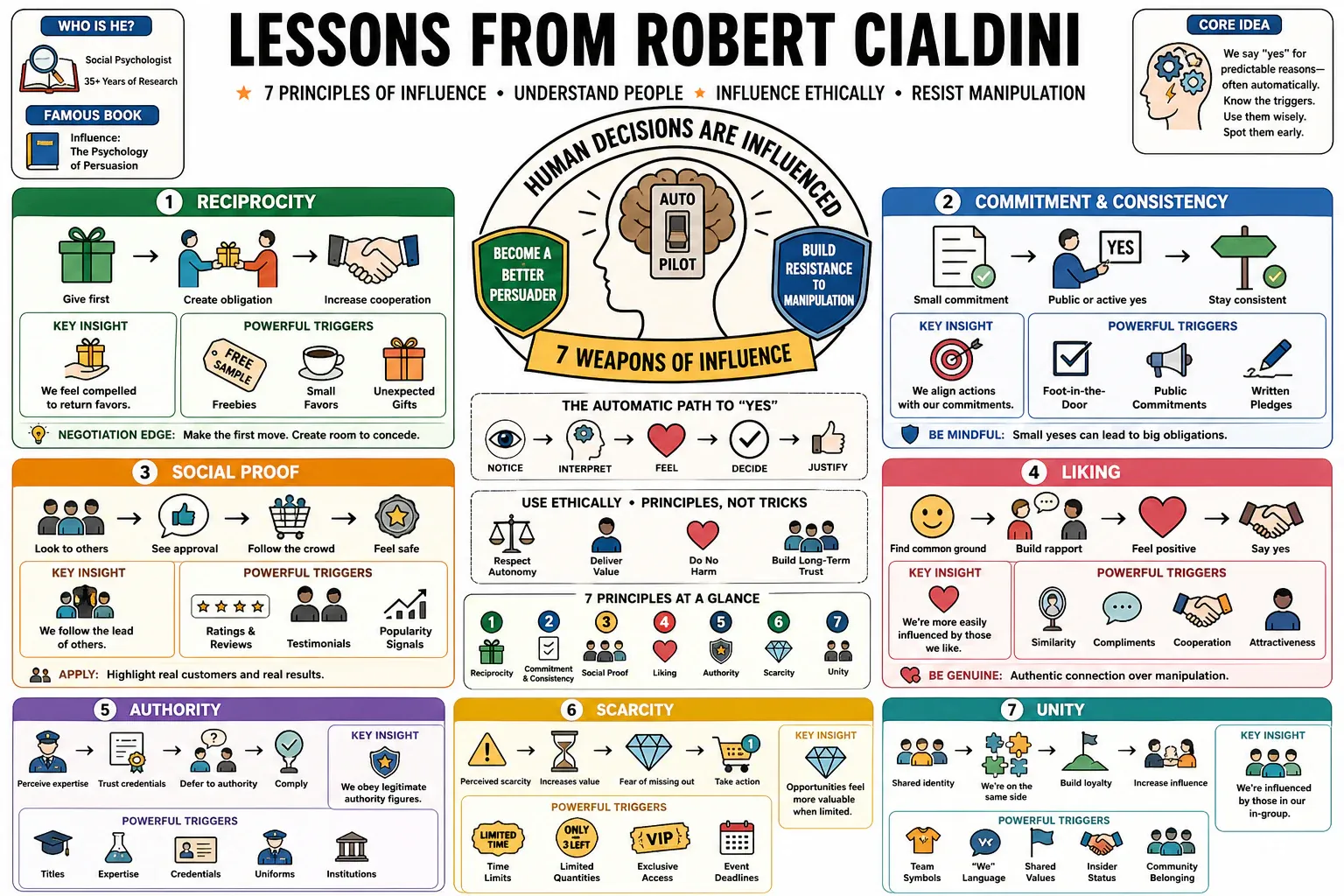
1. Reciprocity
The principle of reciprocity is based on the social norm that people feel obligated to give back to others what they have received first. [4] This can be in the form of a gift, a favor, or a service.
Quotes and Learnings:
- "The rule says that we should try to repay, in kind, what another person has provided us." [5]
- Learning: If you want to foster a collaborative environment, be the first to offer help or a concession. People are more likely to cooperate with those who have done something for them. [1][6]
- "The obligation to receive reduces our ability to choose whom we wish to be indebted to and puts that power in the hands of others." [7]
- Learning: Even an unwanted favor can create a sense of obligation. This is why free samples and small gifts can be so effective in marketing and sales. [8]
- "The truly gifted negotiator, then, is one whose initial position is exaggerated enough to allow for a series of concessions that will yield a desirable final offer from the opponent, yet is not so outlandish as to be seen as illegitimate from the start." [9][10]
- Learning: The "rejection-then-retreat" technique involves making a larger request that is likely to be turned down, followed by a smaller, more reasonable request. The second request is often accepted because it is seen as a concession.
2. Commitment and Consistency
People have a deep-seated desire to be consistent with what they have already said or done. [4] Once we make a commitment, we are more likely to follow through with actions that align with it. [8]
Quotes and Learnings:
- "Once we have made a choice or taken a stand, we will encounter personal and interpersonal pressures to behave consistently with that commitment." [11]
- Learning: To encourage a certain behavior, get a small, initial commitment. This could be as simple as asking someone to write down a goal or publicly state their support for an idea. [12][13]
- "Psychologists have long understood the power of the consistency principle to direct human action." [5]
- Learning: Public commitments are particularly powerful. When someone's stance is made public, they are more likely to stick to it to maintain a consistent image. [13]
- "Our best evidence of what people truly feel and believe comes less from their words than from their deeds." [7]
- Learning: Written commitments can be especially effective. The act of writing something down solidifies the commitment in the person's mind.
3. Social Proof
When people are uncertain about a course of action, they look to the actions and behaviors of others to determine their own. [14] This is the "safety in numbers" principle. [4]
Quotes and Learnings:
- "Since 95 percent of the people are imitators and only 5 percent initiators, people are persuaded more by the actions of others than by any proof we can offer." [5][9]
- Learning: Testimonials, case studies, and showing the popularity of a product or idea are powerful forms of social proof. [12]
- "We view a behavior as more correct in a given situation to the degree that we see others performing it." [13]
- "First, we seem to assume that if a lot of people are doing the same thing, they must know something we don't." [5][9]
- Learning: Social proof is most influential when the "others" are similar to the individual being persuaded. [3]
- "Without question, when people are uncertain, they are more likely to use others' actions to decide how they themselves should act." [5]
4. Liking
People are more easily persuaded by those they know and like. [8] This principle highlights the importance of rapport and relationships in the art of influence.
Quotes and Learnings:
- "We like people who are similar to us. This fact seems to hold true whether the similarity is in the area of opinions, personality traits, background, or life-style." [5]
- Learning: To increase likability, find common ground and offer genuine compliments. [15]
- "Research has shown that we automatically assign to good-looking individuals such favorable traits as talent, kindness, honesty, and intelligence." [9]
- Learning: Physical attractiveness can create a "halo effect," where positive qualities are automatically attributed to someone. [8]
- "There is a natural human tendency to dislike a person who brings us unpleasant information, even when that person did not cause the bad news. The simple association with it is enough to stimulate our dislike." [9][10]
- Learning: Cooperation towards a common goal is a powerful way to build liking and a sense of camaraderie. [15]
- "I can live for two months," confessed Mark Twain, "on a good compliment." [5]
5. Authority
Individuals are more likely to comply with requests made by figures of authority. [2] This can be conveyed through titles, uniforms, or expertise.
Quotes and Learnings:
- "People will tend to obey authority figures, even if they are asked to perform objectionable acts." [8]
- Learning: To establish authority, it's important to signal your expertise and credibility before attempting to influence. This can be done by mentioning your experience, credentials, or knowledge in a particular area. [6]
- Learning: Having a third party introduce you and your expertise can be a powerful way to establish authority without appearing boastful.
- Learning: The appearance of authority, such as a uniform or a well-tailored suit, can be enough to trigger a compliance response. [13]
- "Be as precise as possible about your need for aid." [5][9]
6. Scarcity
The less available something is, the more desirable it becomes. [2] The fear of missing out can be a powerful motivator.
Quotes and Learnings:
- "The way to love anything is to realize that it might be lost." [9][10]
- "The idea of potential loss plays a large role in human decision making. In fact, people seem to be more motivated by the thought of losing something than by the thought of gaining something of equal value." [7][9]
- Learning: Highlighting limited-time offers, exclusive information, or a dwindling supply can increase the perceived value of an item or opportunity. [8][15]
- "When our freedom to have something is limited, the item becomes less available, and we experience an increased desire for it." [9]
- "The joy is not in experiencing a scarce commodity but in possessing it." [7]
- "Freedoms once granted will not be relinquished without a fight." [9][10]
7. Unity
This is the newest principle, which Cialdini introduced in his book "Pre-Suasion." It refers to a shared identity. The more we perceive someone as being "of us," the more likely we are to be influenced by them.
Quotes and Learnings:
- Learning: The Unity principle is about shared identities. When we feel a sense of "we" with someone, their ability to influence us increases. [1]
- Learning: Emphasizing a common background, shared values, or being part of the same team or family can activate the Unity principle. [15]
- Learning: Asking for advice rather than opinions can create a sense of partnership and shared purpose.
- Learning: Using language that highlights a shared identity (e.g., "we" instead of "you and I") can be a subtle yet powerful way to build unity. [15]
General Learnings and Quotes on Persuasion
- "A well-known principle of human behavior says that when we ask someone to do us a favor we will be more successful if we provide a reason. People simply like to have reasons for what they do." [7][9]
- "Pre-suasion is the practice of getting people sympathetic to your message before they experience it." [7]
- "What we present first changes the way people experience what we present to them next." [5]
- "There is no expedient to which a man will not resort to avoid the real labor of thinking." [3][9]
- Learning: Understanding these principles is not just about becoming a more effective persuader, but also about defending yourself against unethical influence attempts. [2]
- "Embarrassment is a villain to be crushed." [9][10]
- "Often we don't realize that our attitude toward something has been influenced by the number of times we have been exposed to it in the past." [9][10]
- "persons who go through a great deal of trouble or pain to attain something tend to value it more highly than persons who attain the same thing with a minimum of effort." [9][10]
- Learning: The most effective persuasion is ethical persuasion, which involves being honest and transparent. [4]
- "Optimal persuasion is achieved thru optimal pre-suasion; positioning people to agree with a message before knowing what's in it." [16]
Sources:
- Influence at Work: https://www.influenceatwork.com/7-principles-of-persuasion/ [1]
- Binary Moon: https://www.binarymoon.co.uk/reading/influence/ [2]
- OCEG: https://www.oceg.org/projectriskleader/robert-cialdini-s-principles-of-persuasion/ [15]
- PeopleShift: https://people-shift.com/articles/cialdinis-6-principles-of-persuasion/ [14]
- Conceptually: https://conceptually.org/concepts/6-principles-of-influence/ [8]
- Goodreads (Author Quotes): https://www.goodreads.com/author/quotes/160932.Robert_B_Cialdini [9]
- QuoteFancy: https://quotefancy.com/robert-b-cialdini-quotes [5]
- A-Z Quotes: https://www.azquotes.com/author/31819-Robert_Cialdini [7]
- Times Now: https://www.timesnownews.com/lifestyle/books/features/10-lessons-to-learn-from-the-book-influence-the-psychology-of-persuasion-by-robert-cialdini-article-109943745 [4]
- Wayback Machine Archive: https://web.archive.org/web/20240909015600/antoniomartina-cialdini-lessons [12]
- Online Business School: https://esoftskills.com/lessons-from-robert-cialdini/ [6]
- Farnam Street: https://fs.blog/intellectual-giants/robert-cialdini/ [3]
- Internet Archive: https://archive.org/details/influencepsychol0000cial [11]
- Goodreads (Influence Quotes): https://www.goodreads.com/work/quotes/29303-influence-how-and-why-people-agree-to-things [10]
- Toby Sinclair: https://www.tobysinclair.com/post/book-summary-influence-robert-cialdini [13]
- Clarity: https://www.consultclarity.org/post/robert-cialdini-quotes [16]
Learn more:
- Dr. Robert Cialdini's Seven Principles of Persuasion | IAW - Influence at Work
- Key Lessons from Influence by Robert B. Cialdini - Binary Moon
- Who Is Robert Cialdini? Meet the Master of Influence and Persuasion - Farnam Street
- 10 Lessons to Learn From the Book 'Influence: The Psychology of Persuasion' by Robert Cialdini | Features - Times Now
- Top 70 Robert B. Cialdini Quotes (2025 Update) - QuoteFancy
- Harnessing Influence: Lessons from Robert Cialdini - Online Business School
- TOP 19 QUOTES BY ROBERT CIALDINI | A-Z Quotes
- Cialdini's 6 Principles of Influence - Definition and examples - Conceptually
- Quotes by Robert B. Cialdini (Author of Influence) - Goodreads
- Influence Quotes by Robert B. Cialdini - Goodreads
- Influence: The Psychology of Persuasion (Text Edition) - Internet Archive
- 6 Lessons From “Influence: The Psychology of Persuasion” By Robert B. Cialdini
- Book Summary: Influence by Robert Cialdini | The Big Ideas and Best Quotes - Toby Sinclair
- Cialdini's 6 Principles of Persuasion: A Simple Summary - PeopleShift
- Robert Cialdini's Principles of Persuasion - OCEG
- 400 Best Robert Cialdini Quotes: Author of Influence (2023) - Clarity