Lessons from Robert Goddard
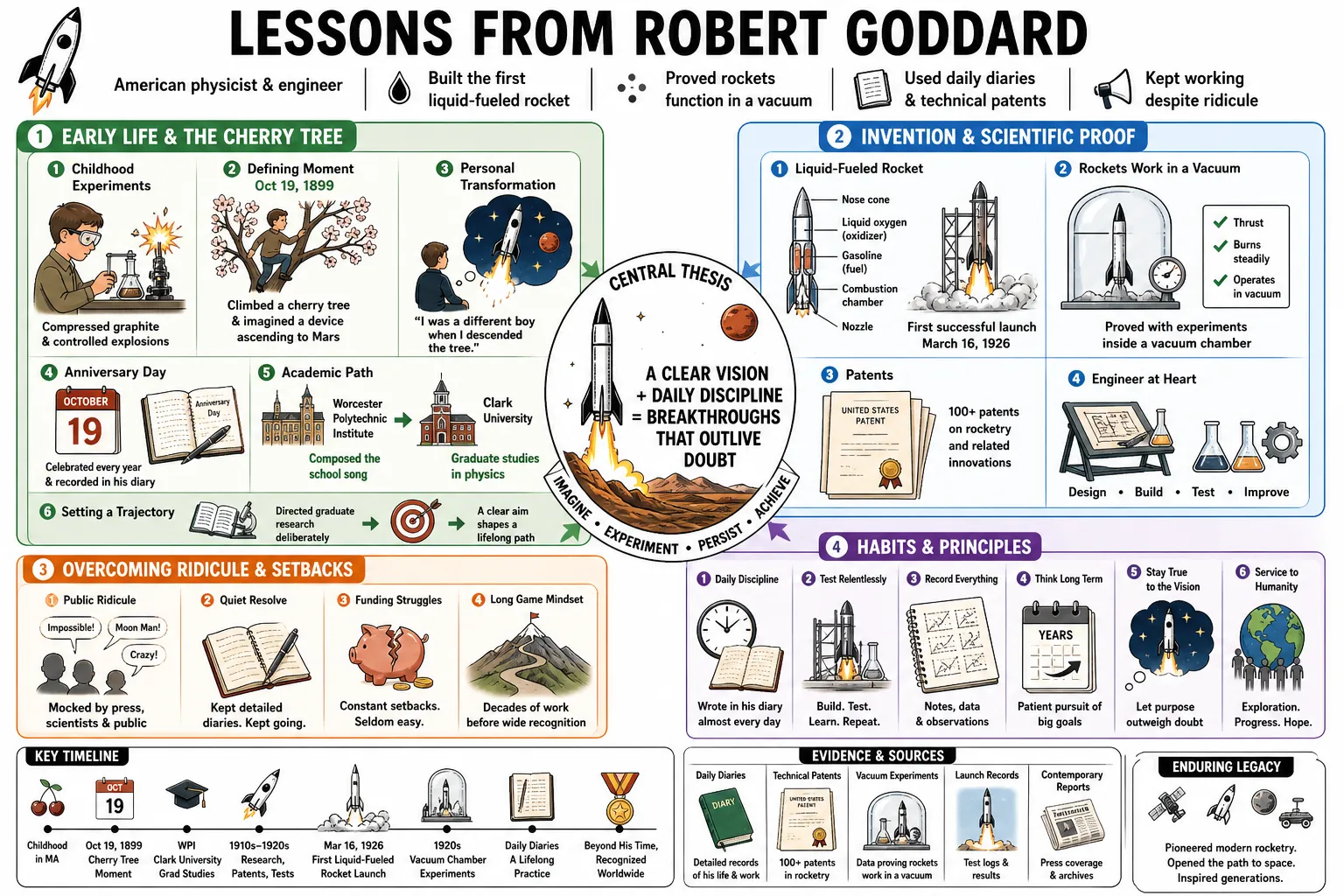
American physicist and engineer Robert H. Goddard built the first liquid-fueled rocket and proved that rockets function in a vacuum. Using his daily diaries and technical patents, this profile examines how he kept working despite intense public ridicule.
Part 1: Early Life and the Cherry Tree
- On childhood experiments: "As a boy in Massachusetts, he tried to manufacture diamonds using compressed graphite and controlled explosions." — Source: [Auburn Town Website]
- On his defining moment: "On October 19, 1899, he climbed a cherry tree to prune its branches and imagined a device ascending to Mars from the meadow below." — Source: [Clark University]
- On personal transformation: "I was a different boy when I descended the tree from when I ascended, for existence at last seemed very purposive." — Source: [Universe Today]
- On keeping the memory alive: "He celebrated October 19 every year for the rest of his life, recording it in his diary as 'Anniversary Day.'" — Source: [Chris Winter]
- On academic pursuits: "He attended Worcester Polytechnic Institute, where he composed the school song, before moving to Clark University for graduate studies in physics." — Source: [Worcester Polytechnic Institute]
- On setting a trajectory: "He directed his graduate research deliberately toward understanding propulsion and physical forces that could operate beyond the atmosphere." — Source: [Charles Lindbergh Site]
- On early physics: "Before focusing entirely on spaceflight, he developed an electronic oscillator circuit that predated the widespread use of the Audion vacuum tube." — Source: [Chris Winter]
- On solid propellants: "By 1915, he had successfully improved the efficiency of standard solid-fueled rockets before realizing their limitations for space travel." — Source: [Wikipedia]
- On military applications: "In 1918, he developed a solid-fuel projectile launched from a tube, which later served as the direct prototype for the World War II bazooka." — Source: [Chris Winter]
Part 2: The Philosophy of the Impossible
- On shifting boundaries: "It is difficult to say what is impossible, for the dream of yesterday is the hope of today and the reality of tomorrow." — Source: [AZ Quotes]
- On aiming high: "There can be no thought of finishing, for 'aiming at the stars,' both literally and figuratively, is a problem to occupy generations." — Source: [Aviation Quotations]
- On endless pursuit: "He believed that no matter how much progress a researcher makes, there is always the thrill of just beginning." — Source: [Today In Science]
- On resilience: "Just remember—when you think all is lost, the future remains." — Source: [Insight of the Day]
- On achieving a vision: "Every vision is a joke until the first man accomplishes it; once realized, it becomes commonplace." — Source: [Today In Science]
- On the value of effort: "Success is not handed to you, it is earned through hard work and determination." — Source: [Bookey]
- On ignoring skeptics: "He viewed public doubt not as a reason to stop, but as a standard societal reaction to any idea that disrupts established norms." — Source: [Goodreads]
- On incrementalism: "He approached the seemingly impossible task of space travel by breaking it down into small, mathematically solvable problems." — Source: [Clark University]
- On the nature of research: "He recognized that aiming for the stars meant accepting a lifetime of unfinished work that others would have to complete." — Source: [Aviation Quotations]
- On maintaining hope: "He relied on his internal vision of the future to sustain himself when funding and public support evaporated." — Source: [Universe Today]
Part 3: A Method of Reaching Extreme Altitudes
- On his seminal publication: "In 1919, he published a 79-page treatise detailing the mathematical proofs that rockets could function in a vacuum." — Source: [Smithsonian Institution]
- On escaping gravity: "He calculated the exact minimum initial mass required for a rocket to not only reach extreme altitudes but to fully escape Earth's gravitational pull." — Source: [NASA]
- On experimental proof: "To validate his math, he tested nitrocellulose powder inside an enclosed combustion chamber fitted with a de Laval nozzle." — Source: [Reaction Research Society]
- On vacuum mechanics: "He conducted tests in both ambient air and artificially induced vacuum conditions to prove an atmosphere was not necessary for thrust." — Source: [Clark University]
- On multi-stage efficiency: "The paper laid the theoretical groundwork for using multiple stages to shed dead weight during ascent." — Source: [Wikipedia]
- On the lunar proposal: "At the end of the report, he included a theoretical calculation for sending a rocket to the Moon and detonating flash powder to signal its arrival." — Source: [NASA]
- On rigorous methodology: "The publication was notable for moving rocketry out of the realm of science fiction and into strict, empirical physics." — Source: [Clark University]
- On institutional backing: "The work was funded and published by the Smithsonian Institution, giving it significant early legitimacy." — Source: [Smithsonian Magazine]
- On international reach: "Despite being mocked domestically, the paper was quietly studied by other rocket researchers in Europe, including Hermann Oberth." — Source: [History of Information]
Part 4: Facing the Critics
- On public misunderstanding: "The media fixated almost entirely on his theoretical moon rocket proposal, ignoring the rigorous atmospheric physics in the rest of the paper." — Source: [Clark University]
- On harsh media criticism: "A 1920 New York Times editorial mocked him, claiming he lacked the basic high school physics knowledge to understand that a rocket needed air to push against." — Source: [College of Wooster]
- On intellectual isolation: "The ridicule deeply affected him, causing him to become highly guarded and reluctant to share his findings with the press." — Source: [Clark University]
- On defending the science: "In a 1921 Scientific American piece, he wrote a direct refutation of popular fallacies regarding propulsion in a vacuum." — Source: [Clark University]
- On the moon man label: "He resented being caricatured by reporters as an eccentric dreamer rather than a serious, methodical physicist." — Source: [Smithsonian Magazine]
- On working in secret: "To avoid further public scrutiny, he began conducting his most important liquid-fuel tests with only a small, trusted team of assistants." — Source: [Space.com]
- On local complaints: "His early test launches in Massachusetts often prompted neighbors to call the authorities, forcing him to seek more isolated proving grounds." — Source: [Wikipedia]
- On maintaining dignity: "He rarely engaged in public arguments with his critics, preferring to let his diaries and his eventual flight data speak for themselves." — Source: [National Geographic]
- On the cost of mockery: "The negative press made it exceedingly difficult for him to secure necessary funding from traditional academic and government sources." — Source: [NASA]
Part 5: The First Liquid-Fueled Rocket
- On the Auburn launch: "On March 16, 1926, he successfully launched the world's first liquid-fueled rocket from a cabbage patch in Auburn, Massachusetts." — Source: [Worcester Polytechnic Institute]
- On the flight metrics: "It rose 41 feet and went 184 feet in 2.5 seconds, after the lower half of the nozzle burned off." — Source: [Aviation Quotations]
- On equipment failure: "The flight ended not because it ran out of fuel, but because the hardware could not withstand the extreme heat generated during ascent." — Source: [Aviation Quotations]
- On the quiet liftoff: "It looked almost magical as it rose, without any appreciably greater noise or flame." — Source: [Clark University]
- On the rocket's demeanor: "He imagined the machine saying, 'I've been here long enough; I think I'll be going somewhere else, if you don't mind.'" — Source: [Clark University]
- On his wife's observation: "Esther Goddard, who photographed the event, noted that the rocket looked like a fairy or an aesthetic dancer as it left the launch frame." — Source: [Clark University]
- On the fuel mixture: "The historic rocket was powered by a precisely calibrated mixture of liquid oxygen and gasoline." — Source: [NASA]
- On the design layout: "The 1926 rocket featured a unique design with the engine placed at the top and the fuel tanks suspended below, which he believed would aid stability." — Source: [Smithsonian Magazine]
- On historical parallels: "The brief flight in Auburn is frequently compared in significance to the Wright brothers' first short flight at Kitty Hawk." — Source: [Space.com]
- On securing the site: "He was only able to use the Auburn site through the permission of a family friend, Asa Ward, who owned the farm." — Source: [Auburn Town Website]
Part 6: The Crucible of Roswell
- On relocating for scale: "Seeking clear weather and open space away from complaining neighbors, he moved his operations to Roswell, New Mexico, in 1930." — Source: [Roswell Government]
- On the L-Series tests: "Between 1936 and 1938, he conducted 30 static and flight tests of his L-Series rockets in the desert." — Source: [Clark University]
- On reaching new heights: "Seventeen of his Roswell flights exceeded altitudes of 1,000 feet, demonstrating the viability of larger rocket frames." — Source: [National Space Society]
- On supersonic speeds: "Some of his New Mexico test vehicles were the first rockets to successfully break the sound barrier during flight." — Source: [Roswell Government]
- On publishing again: "In 1936, he released his second major work, 'Liquid Propellant Rocket Development,' detailing the engineering advances made in Roswell." — Source: [Clark University]
- On atmospheric conditions: "The thin, dry air of the high desert allowed his team to track the rockets visually and recover them more easily than in New England." — Source: [National Space Society]
- On financial lifelines: "His desert research was largely sustained by private grants from the Guggenheim Foundation, secured with the help of Charles Lindbergh." — Source: [Charles Lindbergh Site]
- On building a facility: "He constructed a complete testing infrastructure in Roswell, including launch towers, static test stands, and a machine shop." — Source: [Roswell Museum]
- On strict documentation: "Every test in Roswell was meticulously recorded on film and in technical logs, capturing both the explosive failures and the breakthroughs." — Source: [Smithsonian Magazine]
- On military indifference: "During his time in Roswell, he repeatedly offered his technology to the U.S. military, but they showed little interest until World War II began." — Source: [U.S. Air Force]
Part 7: Foundational Inventions
- On a prolific output: "Over his lifetime, he generated ideas that resulted in 214 specific patents related to aerospace technology." — Source: [Wikipedia]
- On the first core patents: "In 1914, he was awarded two foundational patents for the liquid-fueled engine and the multi-stage step rocket concept." — Source: [NASA]
- On solving stabilization: "He invented a method to stabilize flight paths by connecting an internal gyroscope to movable steering vanes in the exhaust stream." — Source: [Chris Winter]
- On fuel delivery: "He developed high-speed centrifugal pumps to force volatile liquid propellants into the combustion chamber under immense pressure." — Source: [U.S. Air Force]
- On managing heat: "To prevent engines from melting, he created a regenerative cooling system that circulated cold fuel around the chamber before combustion." — Source: [Chris Winter]
- On tank pressurization: "He patented methods for using inert nitrogen gas to keep fuel tanks pressurized as they emptied during flight." — Source: [Clark University]
- On air-breathing propulsion: "His 1934 patent for a resonance chamber motor influenced the later development of pulsejet technologies." — Source: [Chris Winter]
- On posthumous processing: "The majority of his 214 patents were finalized and filed after his death by his wife, Esther, using his detailed laboratory notes." — Source: [New Mexico Space Museum]
- On comprehensive design: "His patents covered virtually every functional subsystem required to build a modern orbital launch vehicle." — Source: [Chris Winter]
Part 8: Posthumous Vindication
- On the V-2 connection: "Captured German scientists after WWII admitted they had closely studied Goddard's patents to develop the V-2 ballistic missile." — Source: [U.S. Air Force]
- On settling the IP: "In 1960, the U.S. government finally recognized his contributions by paying his estate $1 million for the rights to his rocket patents." — Source: [Invention & Technology]
- On the Times' apology: "On July 17, 1969, as Apollo 11 headed to the Moon, the New York Times printed a formal retraction of their 1920 editorial that had mocked him." — Source: [College of Wooster]
- On correcting the record: "The newspaper admitted that further investigation and experimentation had confirmed that a rocket functions in a vacuum, stating they regretted the error." — Source: [Sibyl Publishing]
- On institutional honor: "NASA named the Goddard Space Flight Center in Maryland in his honor, cementing his legacy in the agency's infrastructure." — Source: [NASA]
- On the historical archive: "The Papers of Robert H. Goddard, published in 1970, preserved his diaries and technical reports for future generations of engineers." — Source: [Clark University]
- On the ultimate validation: "His childhood vision in the cherry tree was fully realized when machines relying on his exact principles began traversing the vacuum of space." — Source: [Universe Today]
- On his enduring title: "He is now universally recognized by the scientific community as the uncontested father of modern rocketry." — Source: [Britannica]
- On outlasting the critics: "The ridicule of his contemporaries faded, while the mechanical realities he proved in the desert became the foundation of human spaceflight." — Source: [New Mexico Space Museum]