Lessons from Robin Dunbar
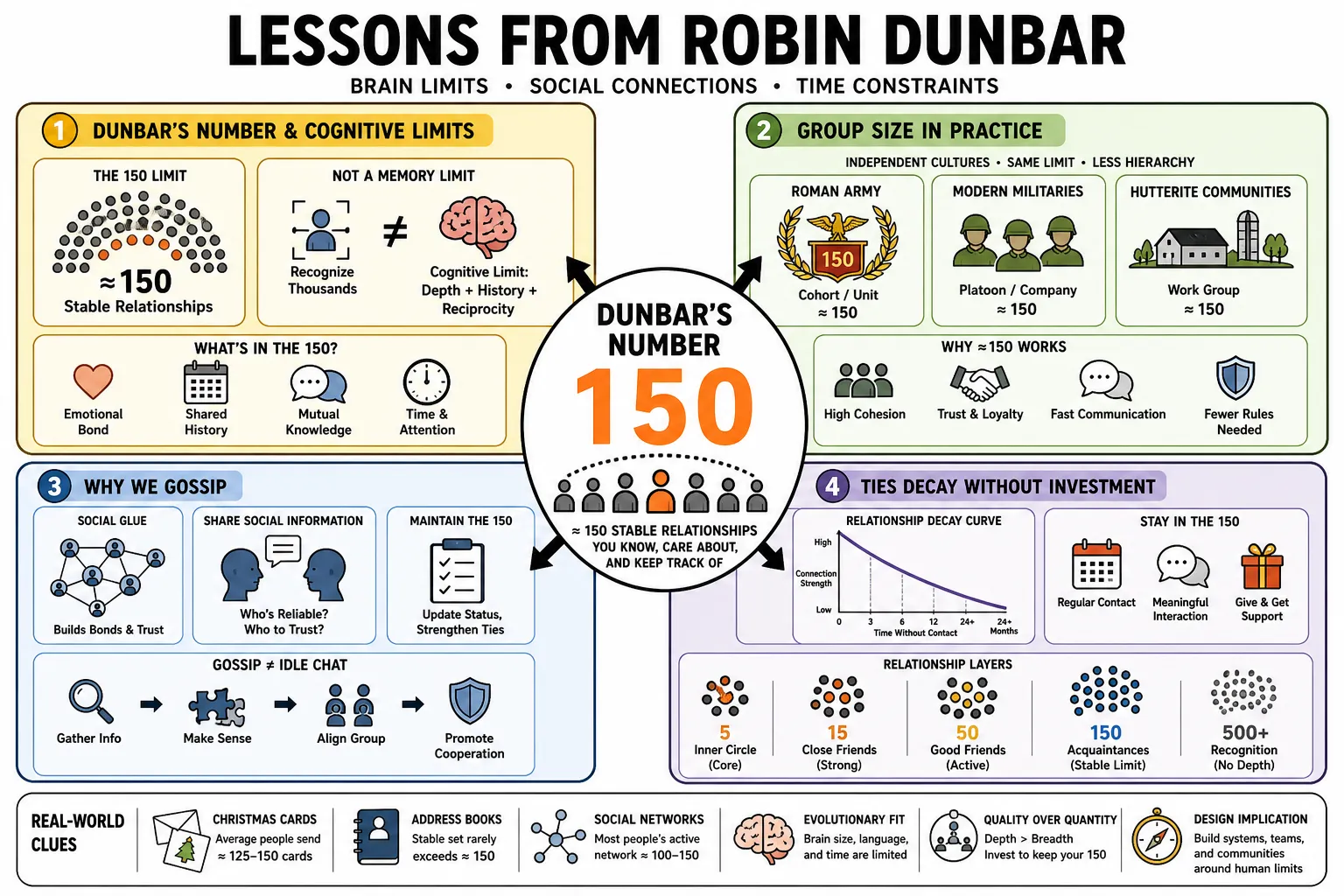
Evolutionary anthropologist and psychologist Robin Dunbar is best known for "Dunbar's Number," the finding that human cognition caps our social circles at roughly 150 stable relationships. His work explores how brain size, language, and time constraints dictate our social lives. This profile covers his research on the biological limits of human connection, from why we gossip to how friendships decay.
Part 1: Dunbar's Number and Cognitive Limits
- On the 150 Limit: "The human neocortex is biologically constrained to manage around 150 stable social relationships where you know who each person is and how they relate to everyone else." — Source: Goodreads: How Many Friends Does One Person Need? by Robin Dunbar.
- On Memory vs. Relationship: "It is a mistake to view this as a memory limit; you can recognize thousands of faces. The limit is the cognitive capacity to maintain the emotional depth and historical context required for a reciprocal connection." — Source: Goodreads: Friends by Robin Dunbar.
- On Military Organization: "The Roman army, modern militaries, and even Hutterite communities instinctively cap their basic operational groups at around 150 people to maintain cohesion without heavy formal hierarchy." — Source: Goodreads: How Many Friends Does One Person Need? by Robin Dunbar.
- On Christmas Cards: "If you examine the average number of people a family traditionally sends Christmas cards to, the number hovers right around 150, reflecting the natural boundaries of an active social network." — Source: The Guardian: My Bright Idea: Robin Dunbar.
- On Hunter-Gatherer Societies: "Across diverse hunter-gatherer societies spanning different continents and historical periods, clan sizes consistently average around 150 individuals." — Source: Goodreads: Friends: Understanding the Power of Our Most Important Relationships by Robin Dunbar.
- On Company Size: "Once a business exceeds 150 employees, informal management by mutual acquaintance fails, and formal hierarchies and rules become necessary to maintain order." — Source: YouTube: TEDx Talk by Robin Dunbar.
- On Time Budgets: "We only have a finite amount of social time. Expanding your network beyond 150 inevitably means thinning out the time and emotional capital available for each relationship." — Source: Goodreads: Friends by Robin Dunbar.
- On Brain Size: "The mathematical correlation between neocortex volume and group size in primates predicts the human group size of 150 with startling accuracy." — Source: Goodreads: Grooming, Gossip, and the Evolution of Language by Robin Dunbar.
- On Network Decay: "If you do not interact with someone within your 150 group regularly, they naturally drift outward into less meaningful layers of acquaintanceship." — Source: Goodreads: Friends by Robin Dunbar.
- On Emotional Boundaries: "The 150 threshold marks the boundary between people you would join uninvited for a drink at a bar and people you would only awkwardly nod to." — Source: BBC Radio 4: The Life Scientific: Robin Dunbar.
Part 2: The Social Brain Hypothesis
- On Evolutionary Pressures: "Human intelligence did not evolve primarily to solve ecological problems like hunting or finding food, but rather to navigate the shifting politics of large social groups." — Source: Goodreads: Friends: Understanding the Power of Our Most Important Relationships by Robin Dunbar.
- On Primate Brains: "Primates possess unusually large brains for their body size because they are forced to live in intensely complex, constantly renegotiated social hierarchies." — Source: Goodreads: Grooming, Gossip, and the Evolution of Language by Robin Dunbar.
- On Social Calculations: "Keeping track of who is friends with whom, who owes whom a favor, and who might betray you requires massive, continuous computational power." — Source: Goodreads: How Many Friends Does One Person Need? by Robin Dunbar.
- On Theory of Mind: "A larger neocortex enables advanced 'theory of mind,' allowing individuals to understand others' intentions and engage in tactical deception or strategic alliances." — Source: Goodreads: Friends: Understanding the Power of Our Most Important Relationships by Robin Dunbar.
- On Biological Costs: "The brain consumes a fifth of the body's energy. Evolution would only support such a costly organ if the social benefits directly improved survival and reproduction rates." — Source: Goodreads: Grooming, Gossip, and the Evolution of Language by Robin Dunbar.
- On Mating Strategies: "Species that form lifelong monogamous pair bonds often possess relatively larger brains than promiscuous species, as managing a lifelong cooperative relationship demands significant cognitive coordination." — Source: Goodreads: The Science of Love and Betrayal by Robin Dunbar.
- On Visual vs. Social Processing: "In some primates, brain size increased simply to process visual data in low light. In humans, the frontal lobes expanded specifically for complex social reasoning." — Source: Goodreads: Friends: Understanding the Power of Our Most Important Relationships by Robin Dunbar.
- On Freeloaders: "A key function of the enlarged social brain is identifying and punishing free-riders—individuals who extract resources from the group without contributing." — Source: Goodreads: How Many Friends Does One Person Need? by Robin Dunbar.
- On Survival: "Survival in early human bands depended entirely on the ability to form and maintain stable political alliances, not on individual physical strength." — Source: The Guardian: My Bright Idea: Robin Dunbar.
Part 3: Gossip as Social Grooming
- On Physical Grooming: "In primate societies, picking dirt from each other's fur triggers endorphins and builds alliances, but the practice maxes out its effectiveness at a group size of about 50." — Source: Goodreads: Grooming, Gossip, and the Evolution of Language by Robin Dunbar.
- On the Origin of Language: "Language evolved as a highly efficient form of vocal grooming. It allowed early humans to trigger social bonding mechanisms in multiple people simultaneously." — Source: YouTube: TEDx Talk by Robin Dunbar.
- On Group Efficiency: "You can only physically groom one peer at a time, but you can talk to three people at once, exponentially increasing the size of the network you can maintain." — Source: Goodreads: Grooming, Gossip, and the Evolution of Language by Robin Dunbar.
- On Conversational Content: "Studies of natural human conversation in cafes and public spaces reveal that roughly two-thirds of our speaking time is devoted to discussing who is doing what with whom." — Source: Goodreads: How Many Friends Does One Person Need? by Robin Dunbar.
- On Policing Behavior: "Gossip acts as an efficient mechanism for policing bad behavior. It allows a group to share information about untrustworthy individuals without risking direct physical confrontation." — Source: Goodreads: Grooming, Gossip, and the Evolution of Language by Robin Dunbar.
- On Trust: "Sharing a piece of socially sensitive information with someone is a definitive act of trust that binds two individuals closer together." — Source: Goodreads: Friends by Robin Dunbar.
- On the Need for Touch: "While language replaced physical grooming as our primary bonding mechanism, it lacks the immediate endorphin hit of physical touch, which is why we still hug our closest friends." — Source: BBC Radio 4: The Life Scientific: Robin Dunbar.
- On Storytelling: "The leap from casual gossip to structured storytelling allowed humans to impart complex social rules, morality, and clan history across generations." — Source: Goodreads: Friends: Understanding the Power of Our Most Important Relationships by Robin Dunbar.
Part 4: The Layers of Friendship
- On Social Scaling: "Our relationships scale outward in predictable multiples of three: we typically have 5 intimate friends, 15 good friends, 50 regular friends, and 150 meaningful contacts." — Source: Goodreads: Friends by Robin Dunbar.
- On the Inner Circle: "Your 'support clique' of about five people represents your closest confidants. These are the ones who will drop everything to help you in a dire emergency." — Source: Goodreads: How Many Friends Does One Person Need? by Robin Dunbar.
- On Social Energy: "The inner circle of five people is incredibly expensive to maintain, consuming approximately 40 percent of our total available social time and emotional energy." — Source: Goodreads: Friends by Robin Dunbar.
- On the Cost of Romance: "When you enter a new romantic relationship, it takes up so much time and cognitive space that you typically lose two close friends from your inner circle of five." — Source: Goodreads: The Science of Love and Betrayal by Robin Dunbar.
- On the Sympathy Group: "The layer of 15 people consists of close friends whose unexpected death would cause you profound emotional devastation." — Source: Goodreads: Friends by Robin Dunbar.
- On Female Friendships: "Women's friendships are generally maintained through intense, face-to-face conversation and emotional disclosure, making them highly resilient over time and distance." — Source: Goodreads: Friends by Robin Dunbar.
- On Male Friendships: "Men's friendships tend to be side-by-side, maintained through shared activities and physical tasks rather than deep emotional talks." — Source: The Guardian: My Bright Idea: Robin Dunbar.
- On Distance: "Because male friendships rely heavily on physical proximity and shared activities, they often decay much faster than female friendships when someone moves away." — Source: Goodreads: Friends by Robin Dunbar.
- On Family vs. Friends: "Kinship provides a biological safety net. You don't have to see a cousin for a year to remain cousins, but a friendship requires constant active maintenance to survive." — Source: Goodreads: How Many Friends Does One Person Need? by Robin Dunbar.
- On Reciprocity: "Friendships are essentially reciprocal obligations. If the effort becomes consistently one-sided, the relationship will eventually degrade into an acquaintanceship." — Source: Goodreads: Friends by Robin Dunbar.
Part 5: Romance, Monogamy, and Pair Bonding
- On Romantic Love: "Romantic love is an extreme neurological state that focuses an enormous amount of your cognitive and temporal resources on a single individual at the expense of the wider group." — Source: Goodreads: The Science of Love and Betrayal by Robin Dunbar.
- On Monogamy's Purpose: "Serial monogamy became our dominant evolutionary strategy to ensure the massive parental investment required to rear large-brained, highly vulnerable human infants." — Source: Goodreads: Friends: Understanding the Power of Our Most Important Relationships by Robin Dunbar.
- On Mate Selection: "The criteria we use to select mates are highly calibrated algorithms designed to evaluate fertility, health, and a willingness to invest resources." — Source: Goodreads: The Science of Love and Betrayal by Robin Dunbar.
- On the Seven-Year Itch: "Evolutionary biology suggests initial romantic passion is designed to last just long enough to rear a child through its most vulnerable early years—roughly four to seven years." — Source: Goodreads: The Science of Love and Betrayal by Robin Dunbar.
- On Kissing: "Kissing functions as a subconscious mechanism for assessing the immune system compatibility and genetic health of a potential partner through taste and smell." — Source: Goodreads: The Science of Love and Betrayal by Robin Dunbar.
- On Domestic Conflict: "Because pair bonds require immense compromise, they are inherently fraught with conflict over the distribution of domestic labor and social attention." — Source: Goodreads: The Science of Love and Betrayal by Robin Dunbar.
- On In-Laws: "Human pair bonds are unique among primates because they create complex networks of in-laws, effectively doubling an individual's social network and safety net." — Source: Goodreads: Friends: Understanding the Power of Our Most Important Relationships by Robin Dunbar.
- On Betrayal: "The profound emotional devastation of romantic betrayal stems from the abrupt destruction of a deep evolutionary alliance built on resource sharing and trust." — Source: Goodreads: The Science of Love and Betrayal by Robin Dunbar.
- On Long-Term Marriage: "For a pair bond to outlast the initial biochemical rush of romance, it must evolve into a dynamic that resembles the deep, reciprocal bonding of your closest platonic friendships." — Source: Goodreads: Friends by Robin Dunbar.
Part 6: Laughter, Singing, and Endorphins
- On Synchronized Movement: "Activities like dancing and marching in unison trigger a massive release of endorphins, rapidly fostering a strong sense of group identity and mutual trust." — Source: Goodreads: Friends by Robin Dunbar.
- On Laughter as Grooming: "Laughter is highly contagious and bridges the gap between physical grooming and language by creating a shared physiological bonding experience across a group." — Source: YouTube: TEDx Talk by Robin Dunbar.
- On Humor's Function: "Humor requires significant cognitive processing to understand subtext. Shared laughter acts as a profound indicator that two people view the world through the same lens." — Source: Goodreads: How Many Friends Does One Person Need? by Robin Dunbar.
- On Choral Singing: "Singing together releases oxytocin and endorphins, creating a sense of belonging among strangers faster than conversation alone can achieve." — Source: Goodreads: Friends by Robin Dunbar.
- On the Pain Threshold: "Endorphins are the body's natural painkillers. Experimental studies show that after group singing or laughing, a person's physical pain threshold significantly increases." — Source: BBC Radio 4: The Life Scientific: Robin Dunbar.
- On Communal Eating: "Eating together and the consumption of alcohol are ancient social mechanisms that intentionally lower inhibitions to trigger the brain's bonding chemistry." — Source: The Guardian: My Bright Idea: Robin Dunbar.
- On Religious Physicality: "The physical exertion, chanting, and synchronization found in most rituals evolved as highly efficient ways to bond large groups of people exceeding the 150 limit." — Source: Goodreads: Friends: Understanding the Power of Our Most Important Relationships by Robin Dunbar.
- On Language Limitations: "Words alone are often not enough to bind a large group together; we require the visceral, physical chemistry of shared activities to feel truly connected." — Source: Goodreads: Grooming, Gossip, and the Evolution of Language by Robin Dunbar.
- On Warmth and Connection: "The psychological feeling of social connection is deeply linked to the physical sensation of warmth, driven entirely by the brain's opiate system." — Source: Goodreads: Friends by Robin Dunbar.
Part 7: Religion, Ritual, and Group Cohesion
- On the Emergence of Religion: "As human groups grew larger, casual gossip was no longer enough to prevent freeloading. Religion emerged as an overarching mechanism to enforce social contracts." — Source: Goodreads: How Many Friends Does One Person Need? by Robin Dunbar.
- On Moralizing Gods: "The concept of an all-seeing, moralizing deity provided an evolutionary advantage by ensuring people behaved cooperatively even when nobody else was watching." — Source: Goodreads: Friends: Understanding the Power of Our Most Important Relationships by Robin Dunbar.
- On Shared Belief: "Believing in the same invisible concepts or creation myths acts as a psychological badge, allowing individuals to quickly identify trustworthy members of their own tribe." — Source: The Guardian: My Bright Idea: Robin Dunbar.
- On Costly Rituals: "Costly rituals, such as fasting or physical trials, serve to weed out free-riders. Only those truly committed to the group's survival will endure the pain." — Source: Goodreads: Friends: Understanding the Power of Our Most Important Relationships by Robin Dunbar.
- On Trance States: "Trance states and ecstatic religious experiences are potent triggers for the endorphin system, creating an overwhelming sense of unity and shared purpose." — Source: Goodreads: Friends by Robin Dunbar.
- On Doctrinal Religion: "Text-based world religions only emerged when human settlements grew into massive cities, necessitating a standardized moral code to govern thousands of strangers." — Source: Goodreads: How Many Friends Does One Person Need? by Robin Dunbar.
- On Schisms: "Religious groups, like any social network, naturally fracture and split when their congregations grow significantly beyond the 150-person threshold." — Source: Goodreads: How Many Friends Does One Person Need? by Robin Dunbar.
- On Secular Substitutes: "In secular societies, nationalism, political affiliations, and extreme sports fandom tap into the exact same evolutionary hardware that originally drove religious bonding." — Source: Goodreads: Friends: Understanding the Power of Our Most Important Relationships by Robin Dunbar.
- On Human Imagination: "The capacity to imagine and collectively believe in entities that do not physically exist is the defining cognitive leap that allowed human societies to scale globally." — Source: Goodreads: Grooming, Gossip, and the Evolution of Language by Robin Dunbar.
Part 8: Technology, Social Media, and Connection
- On Facebook Friends: "Despite having thousands of connections on social media, users' core behavioral networks—the people they actually interact with—still strictly adhere to the 150 limit." — Source: YouTube: TEDx Talk by Robin Dunbar.
- On Digital Maintenance: "Social media is excellent for slowing down the decay rate of relationships, allowing you to keep tabs on acquaintances who would otherwise disappear from your life." — Source: Goodreads: Friends by Robin Dunbar.
- On the Limits of Text: "Text-based communication lacks the micro-cues, tone of voice, and body language required to maintain the deepest layers of friendship." — Source: Goodreads: Friends by Robin Dunbar.
- On Physical Presence: "A text message cannot trigger the endorphin and oxytocin release that a physical hug, a pat on the back, or a shared meal provides." — Source: BBC Radio 4: The Life Scientific: Robin Dunbar.
- On Video Calls: "Video calls are exhausting because our brains work overtime to process a two-dimensional simulation, constantly searching for subtle social cues that are missing or delayed." — Source: Goodreads: Friends by Robin Dunbar.
- On Superficial Networks: "Amassing a massive online following does not equate to social capital; these ties are weak and rarely translate into real-world emotional or material support." — Source: YouTube: TEDx Talk by Robin Dunbar.
- On the Illusion of Intimacy: "Seeing someone's daily life updates online creates a false sense of closeness, making us feel bonded to people we no longer actually know." — Source: YouTube: TEDx Talk by Robin Dunbar.
- On the Digital Village: "The internet has not fundamentally changed human social psychology; it has merely provided a new environment in which our ancient, Pleistocene brains must operate." — Source: Goodreads: How Many Friends Does One Person Need? by Robin Dunbar.
- On Online Echo Chambers: "Digital networks artificially group together like-minded individuals, stripping away the mitigating influence of the casual acquaintances we would normally encounter in a physical community." — Source: Goodreads: Friends by Robin Dunbar.
- On the Future of Connection: "No matter how advanced technology becomes, human well-being will always fundamentally rely on investing time in a small core of face-to-face relationships." — Source: The Guardian: My Bright Idea: Robin Dunbar.