Lessons from Romain Lapeyre
As co-founder and former CEO of Gorgias, Romain Lapeyre built a customer support platform specifically for e-commerce merchants. He turned customer service from a traditional cost center into a measurable revenue driver by connecting helpdesks directly to platforms like Shopify. This profile details his approach to scaling a SaaS business through product development and data-driven growth.
Part 1: Customer-Centric Product Development
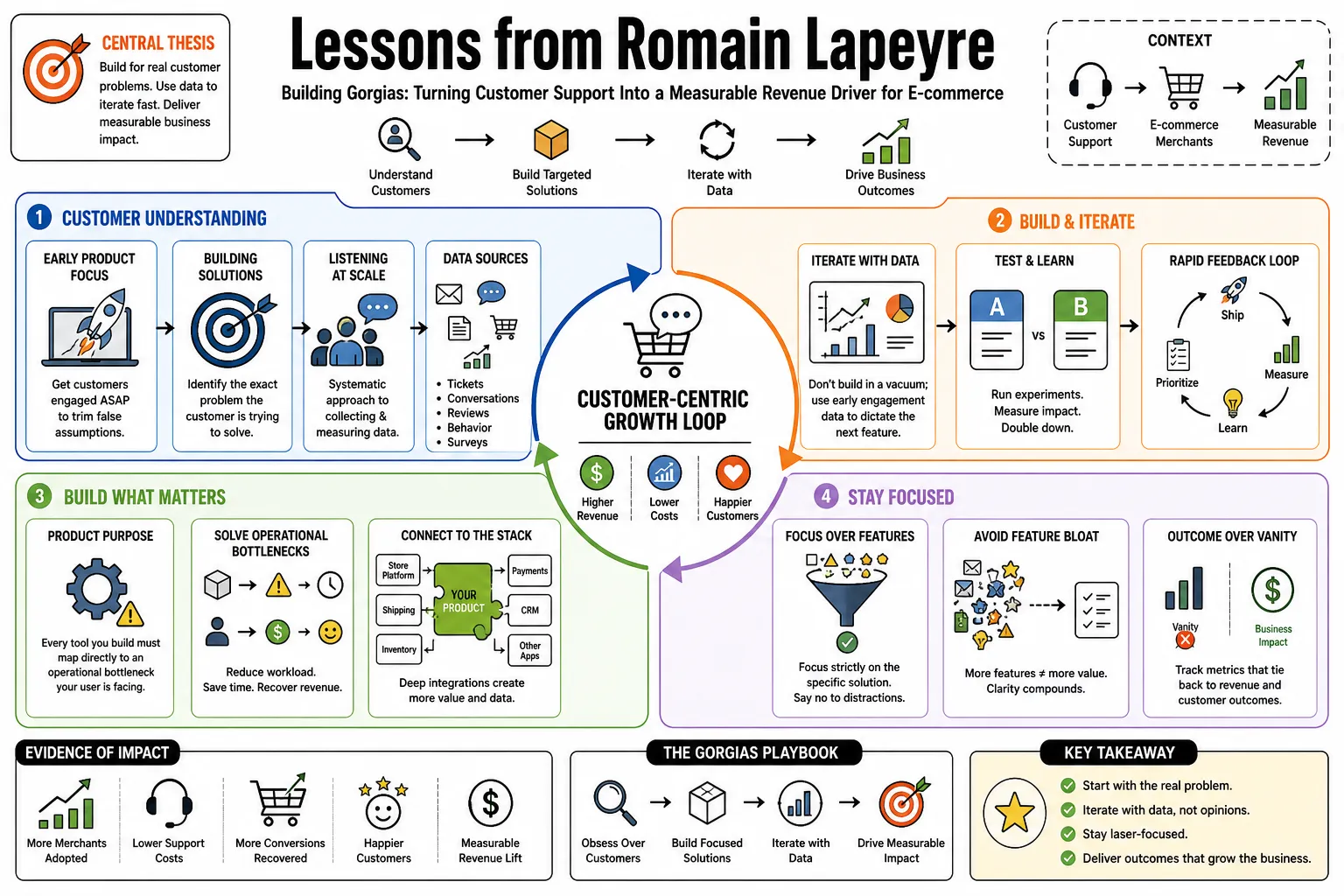
- On Early Product Focus: "Get your customers engaged with your product as soon as possible to trim false assumptions." — Source: Entrepreneur
- On Building Solutions: "Identify the exact problem the customer is trying to solve instead of guessing what they want." — Source: How We Solve
- On Listening at Scale: "A systematic approach to collecting and measuring customer data is the foundation of product development." — Source: How We Solve
- On Iteration: "Don't build in a vacuum; use early engagement data to dictate the next feature." — Source: Medium
- On Product Purpose: "Every tool you build must map directly to an operational bottleneck your user is facing." — Source: SaaStr
- On Feature Bloat: "Focus strictly on the specific solutions requested by your most active users." — Source: Medium
- On User Feedback: "Feedback is only useful if you have a method to categorize and quantify it against your roadmap." — Source: Medium
- On The 3-Step Process: "Collect data, isolate the specific problem, and build only the required solution." — Source: How We Solve
- On Market Alignment: "Your product must be purpose-built for the specific workflow of your target market." — Source: Startup Hacks
- On Pivoting: "Be willing to scrap assumptions the moment customer engagement data tells a different story." — Source: Entrepreneur
Part 2: Data-Driven Sales and Outbound Strategy
- On Growth Mechanics: "In order to build a growth machine for your business, you need to analyze your inputs and outputs." — Source: ChartMogul
- On Market Mapping: "Build a clear map of your Total Addressable Market before deploying your go-to-market efforts." — Source: SlideShare
- On Sales Laboratories: "Treat your sales team like a laboratory where every campaign is an experiment with measurable outcomes." — Source: Outbound Kitchen
- On Standard Advice: "Contradict standard SaaS advice if your internal data indicates a better path." — Source: Outbound Kitchen
- On Human vs. Automated Sales: "We shifted away from pure self-serve when our data proved human-led demos had significantly higher win rates." — Source: Outbound Kitchen
- On Early Outbound: "We acquired thousands of customers efficiently through an automated outbound engine before relying on traditional SDRs." — Source: Outbound Kitchen
- On Data as Revenue: "Auditing your data must be treated with the exact same rigor and importance as auditing your revenue." — Source: SlideShare
- On Campaign Tracking: "Understand precisely which inputs, like trade shows or emails, drive specific ARR outputs." — Source: ChartMogul
- On Predictable Acquisition: "Customer acquisition should never rely on emotion; it must be a math equation." — Source: SaaStr
- On Target Refinement: "Use your outbound data to continuously tighten your definition of an ideal customer profile." — Source: Medium
Part 3: Customer Support as a Profit Center
- On Support Dynamics: "Every support team wants speed without losing empathy." — Source: Brixo
- On Cost vs. Profit: "Turn customer support from a traditional cost center into a profit center that actively drives revenue." — Source: SaaStr
- On Agent Efficiency: "Agents should spend their time on complex inquiries that build relationships, not repetitive tasks." — Source: Future Commerce
- On Conversational Commerce: "The helpdesk is a sales channel where timely answers convert hesitant browsers into buyers." — Source: Gorgias
- On Personalization: "Connect customer history to support tickets so agents can personalize every interaction instantly." — Source: Gorgias
- On Response Times: "In e-commerce, the speed of your support response directly correlates with your conversion rate." — Source: Gorgias Connect
- On Empathy at Scale: "Automation shouldn't replace empathy; it should handle the logistics so humans can be empathetic." — Source: Medium
- On Proactive Support: "Don't wait for a customer to complain; use data to anticipate issues and reach out first." — Source: SaaStr
- On Support Metrics: "Measure your support team not just by ticket volume, but by the revenue they influence." — Source: Gorgias
- On Brand Loyalty: "A resolved support ticket is one of the most effective ways to create a repeat customer." — Source: Future Commerce
Part 4: Leveraging the Shopify Ecosystem
- On Platform Specialization: "Being purpose-built for the Shopify ecosystem allowed us to solve specific merchant pain points." — Source: SaaStr
- On Deep Integration: "A helpdesk must live where the order data lives to be truly effective for merchants." — Source: Medium
- On Ecosystem Growth: "Grow alongside your platform partner by consistently adding value to their core merchant base." — Source: Gorgias
- On Strategic Partnerships: "Partnerships with platforms like Shopify are essential for driving long-term revenue and reach." — Source: Gorgias
- On Investor Value: "Working with specialized investors like Shopify Ventures provides actionable advice and necessary industry connections." — Source: Shopify Ventures
- On App Store Dynamics: "Success in an app ecosystem requires maintaining high merchant ratings through relentless product quality." — Source: Medium
- On Merchant Needs: "E-commerce brands require tools that reduce their operational complexity without requiring technical setups." — Source: How We Solve
- On Competitive Moats: "Deep, bidirectional platform integration creates a workflow lock-in that is hard for horizontal competitors to break." — Source: SaaStr
- On SMB Strategy: "Focusing on SMB e-commerce means building intuitive products that deliver immediate ROI on day one." — Source: SaaStr
Part 5: Startup Growth and Scaling
- On Scaling to $10M ARR: "Transitioning from early traction to $10M ARR requires moving from founder-led sales to repeatable systems." — Source: Alven
- On Global Ambition: "Moving headquarters to the United States was a necessary step to pursue truly global growth." — Source: Analytics Insight
- On Raising Capital: "Align with investors who understand the specific mechanics of your market, not just those writing checks." — Source: Business Wire
- On Resource Allocation: "In the early days, every dollar spent must be trackable back to a specific customer acquisition metric." — Source: ChartMogul
- On Evolving the Stack: "Your SaaS stack must evolve continuously as you scale to avoid operational bottlenecks." — Source: Medium
- On Y Combinator Lessons: "The incubator environment forces you to strip away distractions and focus solely on what users are doing." — Source: StackSync
- On Managing Growth: "Hyper-growth breaks your internal processes every six months; you must constantly rebuild the engine while it runs." — Source: Alven
- On Early Hustle: "We started with a simple Chrome extension for email templates before expanding into a full helpdesk." — Source: Eesel
- On Founder Evolution: "A CEO must transition from building the product to building the machine that builds the product." — Source: Startup Hacks
Part 6: Artificial Intelligence in Commerce
- On The Agentic Shift: "The future of commerce relies on an agentic shift where AI handles complex customer interactions autonomously." — Source: Gorgias Connect
- On AI Utility: "AI in customer service is not a gimmick; it is an operational necessity to handle volume spikes during peak seasons." — Source: Gorgias Connect
- On Automation Limits: "Automate the predictable inquiries so human agents can focus entirely on high-stakes customer retention." — Source: Gorgias
- On Training Models: "Effective AI support requires models trained specifically on e-commerce transaction data, not general knowledge." — Source: Gorgias
- On AI as a Co-pilot: "Give agents AI tools that draft responses and surface data, acting as a co-pilot rather than a replacement." — Source: Gorgias Connect
- On Conversational Interfaces: "Customers expect immediate, conversational answers; AI bridges the gap between static FAQs and live agents." — Source: Gorgias Connect
- On Data Moats: "The companies that will win the AI transition are those that have proprietary, domain-specific ticket data." — Source: Business Wire
- On Resolution Rates: "Measure AI success by the automated resolution rate, ensuring the customer never has to escalate to a human." — Source: Gorgias
- On Customer Expectations: "AI must deliver answers with the same accuracy and tone as your best human agent." — Source: Gorgias
Part 7: Team Building and Leadership
- On Hiring Mindset: "Hire individuals who are obsessed with the mechanics of the problem, not just the prestige of the role." — Source: Audencia
- On Sales Talent: "A great early-stage sales hire acts more like a product researcher than a traditional closer." — Source: Outbound Kitchen
- On Remote Work: "Building a global company requires establishing asynchronous communication habits from day one." — Source: Medium
- On Company Culture: "Culture is defined by the specific behaviors you reward, particularly how you handle customer data." — Source: SaaStr
- On Internal Transparency: "Share the inputs and outputs of the growth machine with the entire company so everyone understands the math." — Source: ChartMogul
- On Founder Transition: "Stepping into a Chairman role allows a founder to focus on long-term vision while enabling operators to run the day-to-day." — Source: The SaaS News
- On Engineering Focus: "Engineers must have direct visibility into customer support tickets to truly understand the impact of bugs." — Source: Medium
- On Employee Autonomy: "Give your team the data they need and the autonomy to run their own experiments." — Source: Outbound Kitchen
- On Learning Agility: "The most important trait in early employees is the ability to discard old assumptions when the data changes." — Source: Audencia
Part 8: The SaaS Ecosystem
- On Vertical SaaS: "Vertical software succeeds because it removes the configuration burden from the end user." — Source: SaaStr
- On SaaS Economics: "Understand the economics of your specific segment; SMB SaaS requires fundamentally different acquisition costs than enterprise." — Source: SaaStr
- On App Store Ecosystems: "Building within an ecosystem like Shopify is the fastest way to validate market demand." — Source: Medium
- On B2B Marketing: "In B2B, content marketing must provide actionable operational playbooks, not just thought leadership." — Source: Medium
- On Angel Investing: "As an investor, I look for founders who apply rigorous data modeling to their earliest go-to-market motions." — Source: Tracxn
- On Software Integration: "Modern SaaS tools must talk to each other seamlessly; siloed data is a death sentence for merchants." — Source: Medium
- On Churn Prevention: "Churn is prevented in the onboarding phase by ensuring the user achieves their first measurable win immediately." — Source: SaaStr
- On Market Cycles: "Regardless of the fundraising environment, capital always flows toward companies with predictable, math-driven acquisition engines." — Source: Business Wire
- On The Future of SaaS: "The next generation of SaaS will be defined by platforms that execute tasks autonomously rather than just tracking them." — Source: Gorgias Connect