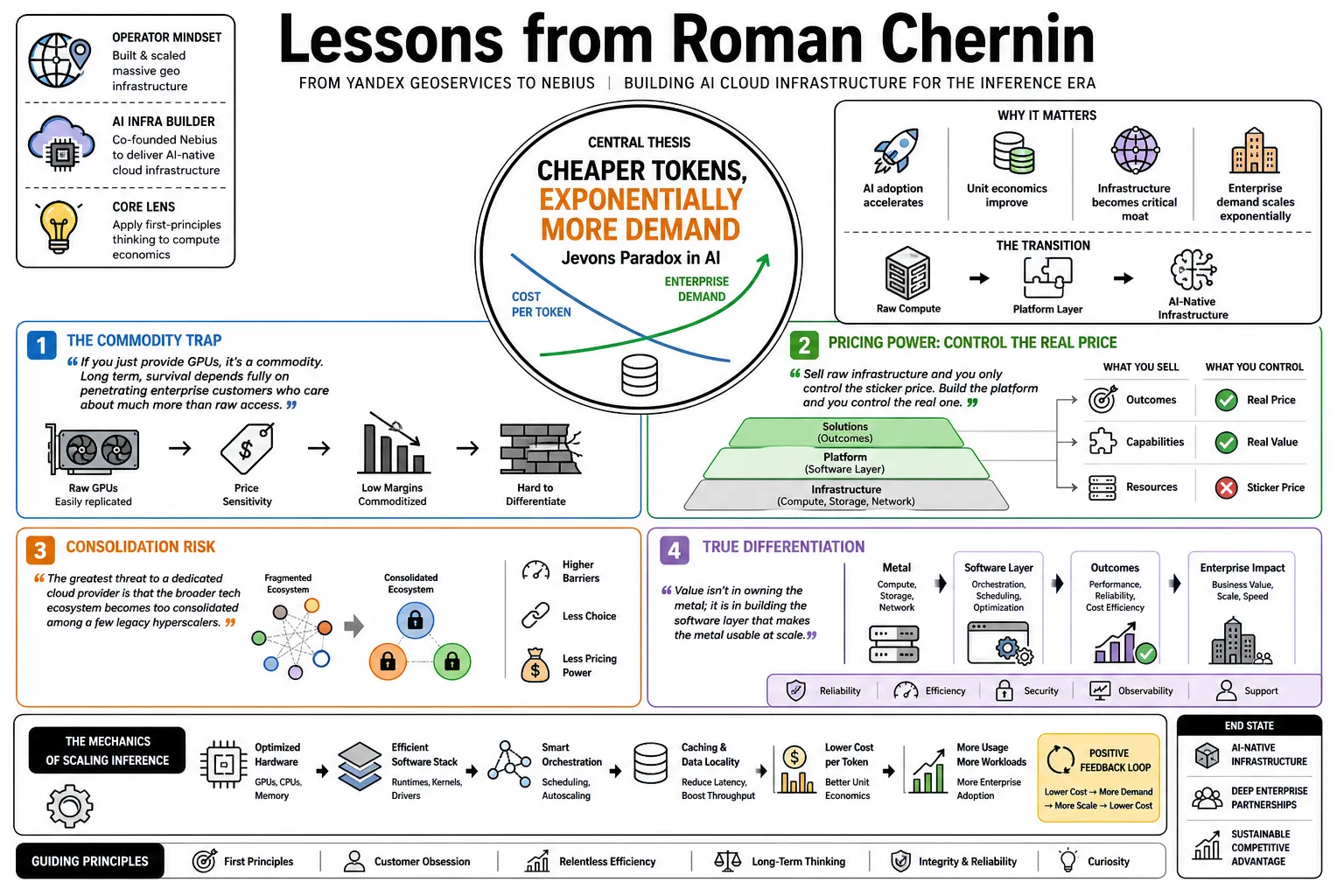
Roman Chernin managed massive logistical networks as CEO of Yandex Geoservices before co-founding Nebius to build AI-focused cloud infrastructure. He is known for applying the Jevons Paradox to compute economics, arguing that cheaper tokens will cause enterprise demand to exponentially increase rather than contract. This profile catalogs his arguments regarding hardware commoditization, the shift toward open-source models, and the mechanics of scaling inference.
Part 1: The AI Infrastructure Landscape & Commoditization
- On industry consolidation: "The greatest threat to a dedicated cloud provider is that the broader tech ecosystem becomes too consolidated among a few legacy hyperscalers." — 20VC with Harry Stebbings: Nebius Co-Founder on AI Infrastructure Bubbles]
- On true differentiation: "Value isn't in owning the metal; it is in building the software layer that makes the metal usable at scale." — The Hidden Advantage Of Integrated AI Infrastructure | Forbes Technology Council]
- On the infrastructure lifecycle: "We are currently in the heavy-lift phase of building datacenters, but the margin will eventually migrate to the orchestration layers sitting directly above the hardware." — The Hidden Advantage Of Integrated AI Infrastructure | Forbes Technology Council]
- On building competitive moats: "You cannot build a durable moat on hardware allocation alone. The moat is the developer experience and the efficiency of your managed services." — 20VC with Harry Stebbings: Nebius Co-Founder on AI Infrastructure Bubbles]
- On the bare metal illusion: "Customers ask for bare metal because they think it gives them control, but they quickly realize the hidden engineering costs of managing it themselves." — 20VC with Harry Stebbings: Nebius Co-Founder on AI Infrastructure Bubbles]
- On specialized clouds: "A purpose-built AI cloud doesn't just strip out legacy overhead; it rearchitects the network specifically for synchronous training workloads." — The Hidden Advantage Of Integrated AI Infrastructure | Forbes Technology Council]
- On market positioning: "We do not want to compete on who has the most capital to buy chips. We want to compete on who extracts the most useful work per chip." — 20VC with Harry Stebbings: Nebius Co-Founder on AI Infrastructure Bubbles]
Part 2: The Jevons Paradox & Compute Demand
- On compute elasticity: "The AI industry mistakenly assumes cheaper compute means lower spending. Instead, as the unit cost of intelligence falls, we apply it to thousands of previously uneconomic tasks." — 20VC with Harry Stebbings: Nebius Co-Founder on AI Infrastructure Bubbles]
- On budget reallocation: "When engineering teams can solve complex problems under budget, they do not return the savings to the finance department. They spend it to run more models." — 20VC with Harry Stebbings: Nebius Co-Founder on AI Infrastructure Bubbles]
- On agentic consumption: "Agents don't query a model once. They loop, reflect, and query fifty times to complete a task. That is where the actual compute demand is hiding." — 20VC with Harry Stebbings: Nebius Co-Founder on AI Infrastructure Bubbles]
- On long-term scaling: "We are planning our data center capacity not based on current query volumes, but on the assumption that background AI tasks will outnumber human queries by orders of magnitude." — 20VC with Harry Stebbings: Nebius Co-Founder on AI Infrastructure Bubbles]
Part 3: Scaling Open-Source AI
- On the switch strategy: "Startups should prototype with closed-source frontier models for speed, but scale using open-source models to manage their unit economics." — 20VC with Harry Stebbings: Nebius Co-Founder on AI Infrastructure Bubbles]
- On model optimization: "Running an open-source model out of the box is expensive. The margin is created through distillation, speculative decoding, and aggressive caching." — How AI Inference Can Unlock The Next Generation Of SaaS | Forbes Technology Council]
- On the token factory: "We view our inference platform as a token factory. The goal is to manufacture tokens as cheaply and quickly as the laws of physics allow." — 20VC with Harry Stebbings: Nebius Co-Founder on AI Infrastructure Bubbles]
- On enterprise control: "Enterprises eventually realize they cannot send their most sensitive, proprietary data via API to a third-party model. Open-source deployed on managed infrastructure is the only answer." — 20VC with Harry Stebbings: Nebius Co-Founder on AI Infrastructure Bubbles]
- On fine-tuning vs. prompting: "Prompt engineering gets you a demo. Fine-tuning a smaller, open-source model on your specific domain gets you a profitable product." — How AI Inference Can Unlock The Next Generation Of SaaS | Forbes Technology Council]
- On the open-source gap: "The performance gap between proprietary and open-source models is closing faster than the cost gap. That math heavily favors open source." — 20VC with Harry Stebbings: Nebius Co-Founder on AI Infrastructure Bubbles]
- On hardware utilization: "Optimizing an open-source model to run at 70% hardware utilization instead of 30% effectively halves your infrastructure bill." — How AI Inference Can Unlock The Next Generation Of SaaS | Forbes Technology Council]
Part 4: The Economics of Cloud & Value Chain
- On hyperscaler margins: "Legacy hyperscalers have built their margins on database storage and egress fees. AI workloads break that economic model because they are compute-heavy and data-light." — 20VC with Harry Stebbings: Nebius Co-Founder on AI Infrastructure Bubbles]
- On infrastructure layers: "The stack has four layers: bare metal, managed cloud, managed inference, and agentic orchestration. The higher you go, the stickier the customer." — 20VC with Harry Stebbings: Nebius Co-Founder on AI Infrastructure Bubbles]
- On power constraints: "Compute is no longer constrained by silicon availability; it is constrained by the ability to secure megawatts of stable power." — Scaling Europe: Building Europe's $25B AI Infrastructure Giant with Roman Chernin]
- On cooling technology: "Transitioning from air cooling to direct-to-chip liquid cooling is not just an operational upgrade. It fundamentally changes the density and economics of the data center." — The Hidden Advantage Of Integrated AI Infrastructure | Forbes Technology Council]
- On customer retention: "You retain customers in the AI cloud space by making their workloads run 10% faster every quarter without them having to change a line of code." — 20VC with Harry Stebbings: Nebius Co-Founder on AI Infrastructure Bubbles]
Part 5: Lessons from Yandex & Geoservices
- On logistical scaling: "Managing a fleet of thousands of vehicles taught us that the hardest problems are never purely software; they are where software meets physical reality." — Venture with Grace: Roman Chernin on AI Cloud Infra & Scaling Global Platforms]
- On data feedback loops: "The mapping business works because every driver using the app improves the map for the next driver. AI infrastructure requires the same compounding data advantages." — Venture with Grace: Roman Chernin on AI Cloud Infra & Scaling Global Platforms]
- On organizational transitions: "Moving from a search platform to a physical logistics business required entirely different metrics. We had to stop measuring clicks and start measuring physical utilization." — Venture with Grace: Roman Chernin on AI Cloud Infra & Scaling Global Platforms]
- On predicting demand: "In transport, you have to position cars before the demand spikes. In AI infrastructure, you have to provision clusters months before the models finish training." — Venture with Grace: Roman Chernin on AI Cloud Infra & Scaling Global Platforms]
Part 6: The AI Bubble & Enterprise Adoption
- On the bubble narrative: "We are not in an AI bubble; we are in the earliest stages of an infrastructure build-out. The true bubble is the expectation of overnight enterprise transformation." — 20VC with Harry Stebbings: Nebius Co-Founder on AI Infrastructure Bubbles]
- On proven use cases: "Roughly one AI use case works flawlessly at scale so far—coding. And even that only truly started working a few months ago." — 20VC with Harry Stebbings: Nebius Co-Founder on AI Infrastructure Bubbles]
- On enterprise timelines: "Enterprises are currently using AI for a tiny fraction of their potential volume. The integration cycle takes years, not weeks." — 20VC with Harry Stebbings: Nebius Co-Founder on AI Infrastructure Bubbles]
- On consumer vs. B2B: "Consumer AI applications get the headlines, but the actual compute consumption will be driven by silent, background B2B data processing." — How AI Inference Can Unlock The Next Generation Of SaaS | Forbes Technology Council]
- On long-term adoption: "The internet took a decade to reorganize retail. AI will take a similar amount of time to reorganize the modern knowledge worker's daily routine." — 20VC with Harry Stebbings: Nebius Co-Founder on AI Infrastructure Bubbles]
Part 7: Managing Inference & Performance
- On inference growth: "Training large models requires massive capital, but the true ongoing operational expense for the industry will be the daily cost of inference." — How AI Inference Can Unlock The Next Generation Of SaaS | Forbes Technology Council]
- On batching requests: "You achieve economic efficiency in inference by aggressively batching requests, but this fundamentally trades off against single-user latency." — How AI Inference Can Unlock The Next Generation Of SaaS | Forbes Technology Council]
- On memory bandwidth: "For large language models, compute isn't the bottleneck during inference; moving weights from memory to the processor is what slows everything down." — The Hidden Advantage Of Integrated AI Infrastructure | Forbes Technology Council]
- On continuous deployment: "Model weights are not static code. Deploying a new, heavily quantized model into production requires zero-downtime orchestration." — How AI Inference Can Unlock The Next Generation Of SaaS | Forbes Technology Council]
- On edge vs. cloud: "Certain inference tasks will move to edge devices for privacy reasons, but the heavy lifting of agentic reasoning will remain in centralized data centers." — 20VC with Harry Stebbings: Nebius Co-Founder on AI Infrastructure Bubbles]
- On standardizing metrics: "The industry needs a standard benchmark for tokens-per-second per dollar. Right now, marketing claims make it impossible for buyers to compare true costs." — How AI Inference Can Unlock The Next Generation Of SaaS | Forbes Technology Council]
Part 8: The Future of Global Tech Platforms
- On geographical distribution: "The concentration of compute in a few regions creates geopolitical risks. The future of infrastructure requires distributed, sovereign data centers." — Scaling Europe: Building Europe's $25B AI Infrastructure Giant with Roman Chernin]
- On energy grids: "The tech platforms of the next decade will essentially function as energy arbitrage businesses, locating data centers wherever power is stranded and cheap." — Scaling Europe: Building Europe's $25B AI Infrastructure Giant with Roman Chernin]
- On developer abstraction: "Our goal is that developers never have to think about CUDA kernels or memory allocation. They should only think about the logical flow of their application." — The Hidden Advantage Of Integrated AI Infrastructure | Forbes Technology Council]
- On the talent market: "The constraint on the AI industry is no longer silicon; it is the severe shortage of engineers who actually understand low-level hardware optimization." — 20VC with Harry Stebbings: Nebius Co-Founder on AI Infrastructure Bubbles]
- On startup survival: "To survive as an AI infrastructure startup, you have to identify the one layer of the stack the hyperscalers are currently ignoring, and dominate it." — 20VC with Harry Stebbings: Nebius Co-Founder on AI Infrastructure Bubbles]
- On the end goal: "We are not building this to support chatbots. We are building this infrastructure to support continuous, autonomous software systems that operate entire companies." — 20VC with Harry Stebbings: Nebius Co-Founder on AI Infrastructure Bubbles]